
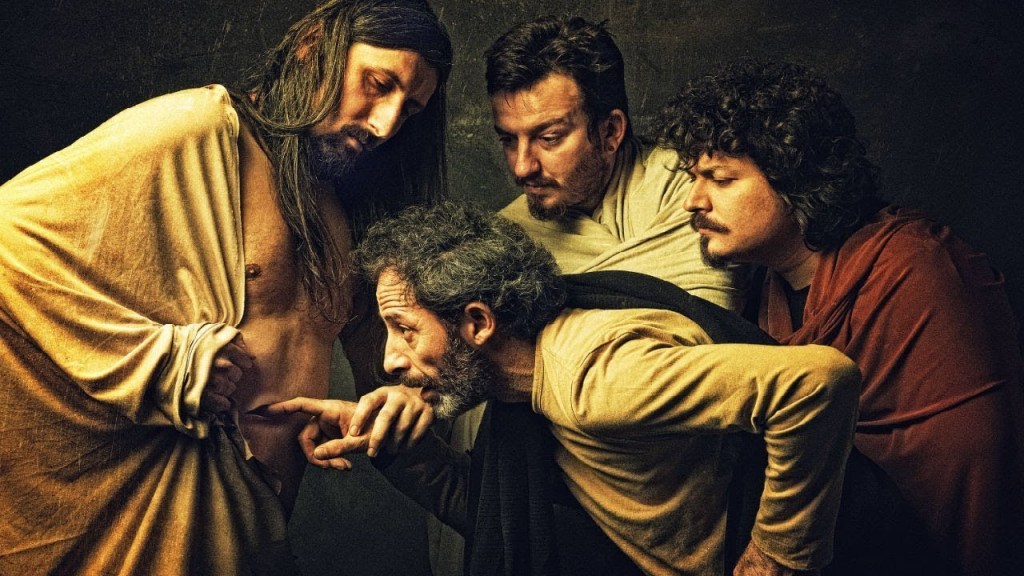
When it was evening on that day, the first day of the week, and the doors of the house where the disciples had met were locked for fear of the Jews, Jesus came and stood among them and said, ‘Peace be with you.’ After he said this, he showed them his hands and his side. Then the disciples rejoiced when they saw the Lord. Jesus said to them again, ‘Peace be with you. As the Father has sent me, so I send you.’ When he had said this, he breathed on them and said to them, ‘Receive the Holy Spirit. If you forgive the sins of any, they are forgiven them; if you retain the sins of any, they are retained.’ But Thomas (who was called the Twin), one of the twelve, was not with them when Jesus came. So the other disciples told him, ‘We have seen the Lord.’ But he said to them, ‘Unless I see the mark of the nails in his hands, and put my finger in the mark of the nails and my hand in his side, I will not believe.’ A week later his disciples were again in the house, and Thomas was with them. Although the doors were shut, Jesus came and stood among them and said, ‘Peace be with you.’ Then he said to Thomas, ‘Put your finger here and see my hands. Reach out your hand and put it in my side. Do not doubt but believe.’ Thomas answered him, ‘My Lord and my God!’ Jesus said to him, ‘Have you believed because you have seen me? Blessed are those who have not seen and yet have come to believe.’ Now Jesus did many other signs in the presence of his disciples, which are not written in this book. But these are written so that you may come to believe that Jesus is the Messiah, the Son of God, and that through believing you may have life in his name.
The Gospel of John, chapter 20 starting at verse 19
This reading is the one from which the name Doubting Thomas originates.
I always feel sorry for Thomas. He was an extremely faithful disciple. Indeed, in an earlier passage from John, when Lazarus has died and the other disciples do not want to go with Jesus back to Judea, it is Thomas who persuades them; and even says “Let us also go, that we may die with him”.
Again, when Jesus explains He is going to prepare a place in His Father’s house for His followers, it is Thomas who had the foresight to ask “Lord, we don’t know where you are going so how can we know the way?” This gained us that vital answer from Jesus that He is the way, the truth and the life; revealing that Jesus is the only path to God, moving the focus from a physical location to a spiritual relationship.
In that locked room where all the disciples except Thomas were gathered, Jesus appeared to them. He stood among them and said, “Peace be with you.” After saying this, Jesus showed His disciples His hands and His side.
Then the disciples rejoiced when they saw the Lord.
Let’s be clear on this, the disciples had already had the testimony of the empty tomb with the folded grave clothes from Peter and John. They had had the testimony of the women and from Mary who had seen the risen Christ. Yet Jesus still joined them in the room although all the doors were locked and showed them His wounds before they recognised Him.
Thomas, on the other hand, by not being with the other disciples had missed out on seeing the proof of the resurrection that the others had been shown freely by Jesus without having to ask for it.
Thomas, like the others had been, was in mourning for Jesus.
When we look at it this way, it does seem a little unfair that Thomas should be dubbed for all time The Doubter when he merely asked to experience the same as the others had already received.
Thomas is a wonderful gift to us … and we are, and should be, so thankful for the gift of Thomas.
He demonstrates true love, loyalty and faithfulness in going back to Judea with Jesus, even if it meant death, and persuading the other disciples to do likewise.
He demonstrated wisdom and courage in asking Jesus how we find our way to His Father’s house; which gifts us the teaching and understanding that Jesus is the way and we must follow His example and become like Him.
It is because of Thomas that we can be reassured that it is okay to have doubts.
Doubt can, after all, serve to bring us to deeper faith and understanding. It can be an invitation to ask sincere questions which can lead to a stronger relationship with God. Doubt is questioning that seeks answers. Honest questions are part of the spiritual journey for many. “Thinking is believing and believing is thinking” is a crucial part of our faith.
Thomas, by declaring “my Lord and my God” when Christ reappeared and showed Thomas His wounds, was the first person to explicitly acknowledge Jesus’s divinity.
Thomas was an enthusiastic apostle full of great fervor, an extremely human figure, close to each of us, symbolizing the doubts that can lead to greater awareness and the uncertainty that nurtures faith.
When the disciples scattered after Pentecost to bring the news of new life in Christ to all, Thomas went east, first to the Persians and then to India. From there he eventually reached the Malabar coast (present -day Kerala).
Thomas was completely filled with the Light of the Resurrection. In this light, full of the deepest faith and belief, Thomas was martyred in Chennai, India, in 72AD.
In a kind of paradox, Thomas’s death turned his statement from the events of Lazarus’s death and resurrection into a prophecy, for Thomas did indeed die to go with Christ.
 Just because