Grace and Prayer

Exodus 32:1-14, Philippians 4:1-9, Matthew 22:1-14

What do we do when there are delays and we don’t know what is going on? Do we remain calm, immersed in prayer and preparation? Or, do we panic?

In our Exodus reading, we pick up the journey of the Israelites at a point where Moses is on the mountain conversing with God. However, at this point he has been gone for forty days, the Israelites do not know what is going on or why he has not yet returned and they are, most certainly, panicking.

To them it has been a very very long time since Moses was last with them; but God’s time is not as our time and to Moses it seemed a relatively short time when compared to the out working of God’s plan for Israel. A delay ordained by God.

How we deal with, or handle, God’s ordained delays – times allocated for waiting and preparation – like Lent or Advent – is a good measure of our spiritual maturity. We should make good use of these times to deepen our perseverance in following God, to pray and study God’s Word, to ready ourselves for whatever will come next.

However, if we allow such delays to be used for drifting into sin, or lapsing into resignation to fate, then we are reacting poorly to those times – like the people of Israel did here. This episode of sin described in this passage started at the impulse of popular opinion. An example of where the will of the people is not always the will of God.

Not knowing what was happening with Moses, the people allowed their uncertainty to take over and turned to idolatry and sin instead of trusting God.

Aaron is just as guilty as the rest of the people. He asked them for their gold and they were generous in what they gave.

In general, people tend to be more generous in what they give to idols but we should be being more generous with what we give to God.

Aaron melted the gold, moulded it and fashioned it carefully with an engraving tool. This work was not led by the Holy Spirit but instead was inspired by sin and yet Aaron took the time to plan it out and carefully detail what he made.

Instead of refusing to go along with what he knew to be wrong, Aaron went along with the people and with popular opinion instead of standing firm for what is right.

Aaron and the people then put their energy, time, sleep, money in service to this idol. People usually find a way to rise early/give to things that are really important to them; but what should be really important to them (and us) is the Lord God.

God told Moses what the people were doing and was a tad upset. God offers to destroy all the people and still keep His promises by rebuilding the nation from Moses. He tells Moses to let Him alone so He could do this.

This implies that if Moses did nothing this plan would go ahead but Moses refused to do nothing. Just as when we see wrongs we should refuse to do nothing. Moses pleaded with the Lord in a short prayer. Prayer does not have to be long – it is the strength of the prayer that matters, not how long it is.

Moses was full of compassion for the people but also concerned with the honour of God. Just as what we do should bring honour to God.

Moses prayed: ‘Lord these people belong to you not me. We didn’t deserve to be freed from Egypt but you saved us by grace, continue to deal with us in your grace. If you kill the people the Egyptians will say you are a cruel God who only saved the Israelites to kill them – don’t let anybody say that about you. Lord you keep your promises and are always faithful, don’t break your promises.’

Now, the wording translation in our reading is “so the Lord changed His mind.”

This is a good place to pause and point out that Moses wrote in anthropomorphic or “man-centred” language. He described the actions of God as they appeared to him.

Moses’s prayer did not change God, but it did change the standing of the people in God’s sight – the people were now in a place of mercy, where previously they were in a place of judgement.

God did not destroy Israel and He knew He would not destroy Israel. He deliberately put Moses into this crucial place of intercession so that Moses’s heart could become like God’s heart for the people, a heart of love and compassion.

Moses prayed just as God wanted him to – as if heaven and earth, salvation and destruction depended upon his prayer.

This is how God wants us to pray.

He also wants us to live a life of prayer, which brings us to Paul’s letter to the Philippians.

The segment that forms our reading this morning starts with Paul addressing a disagreement between Euodia and Syntyche. Paul urges them to settle their differences or agree to differ and to remember their common ground in the Lord. He also advises the rest of the church to help them resolve this matter instead of taking sides and causing a rift.

Paul then moves on: “Rejoice in the Lord. Again, I will say rejoice!”

Joy in the Lord is a cure for all discord.

Let your gentleness be known to all men. The Lord is at hand. Have patience, forbearance, magnanimity, moderation to all men, not just to whom we please.

Live with the awareness that Jesus will return, that He will settle all wrongs and we can trust Him to make things right in our falling apart world.

Live a life of prayer.

Everything is the subject of prayer – there are no areas of our lives that are of no concern to God. Both prayer and supplication are required. Prayer means all our communications with God whereas supplication is directly asking God to do something.

Many of our prayers go unanswered because we do not ask God for anything. God invites us to make our requests known to Him. He wants us to ask with thanksgiving.

Pray about everything. Ask God our requests. Be thankful for anything we receive.

Paul goes on to say that the peace of God will guard our hearts and minds for us. God’s peace is a gift and is beyond our power of thinking. Peace with God is the relationship we enter into with God through the finished work of Jesus Christ.

Finally, Paul tells us to meditate on what is:

  • true
  • noble
  • just
  • pure
  • lovely
  • of good report
  • virtue
  • praiseworthy

This is a way to bring our thoughts and minds back to the obedience of Christ. Follow Jesus’s example and set that example.

Can we say of our lives “Follow me as I follow Jesus”?

If we do not follow Jesus we are rejecting Him. In the reading from Matthew’s gospel, Jesus tells the parable of the Wedding Feast to explain to the religious leaders and listening crowds the dangers of rejecting Him.

Those who had been invited were not willing to come to the Royal Wedding. It seems strange that all those invited refused and this illustrates that there is no logical reason for God’s good gifts to be refused.

The king made the invitation as attractive as possible. He really wanted these people to come and he sent more messengers to them, yet they still refused. Not only did they refuse but they laughed and killed the messengers. The king proclaimed judgement, sending an army to destroy these murderers. A prophesy of what would happen to Jerusalem where the religious leaders strongly, and repeatedly. rejected Jesus.

The king sent his servants to go out and invite everyone they came across. Everyone was to be invited.

This is both like God’s grace and like His invitation to both the Jews and the Gentiles.

Those invited and those who came to the wedding feast were undeserving of the invitation, much less the wedding feast itself.

We are undeserving of God’s grace, yet He freely and indiscriminately gives it to us.

The king came to see the guests just as we will all come before God in judgement. And there was a man there without a wedding garment. He was noticeably different from the other guests.

This man came only because he was invited but came only in appearance. The wedding banquet was to honour the king’s son but this man did not intend honour or respect. He came to eat the good things on offer but in his heart there was no love for the king (God) or his well-beloved son (Jesus).

This man has made too free with holy things and actively insulted the king. The result: this man suffered a terrible fate.

Those indifferent to the gospel and those antagonistic against the gospel and those unchanged by the gospel suffer the same fate – none of these will enjoy the king’s feast.

For many are called but few are chosen.

In this context , this statement of Jesus touches on the great working together of the choices of man and the choosing of God.

Why did they not come to the wedding feast? Because they refused the invitation. Why did they not come to the wedding feast? Because they were called but not chosen.

Do you accept the invitation? Will you be one of the chosen? Do you accept or reject Jesus? Will you come and follow Him if He but calls your name?
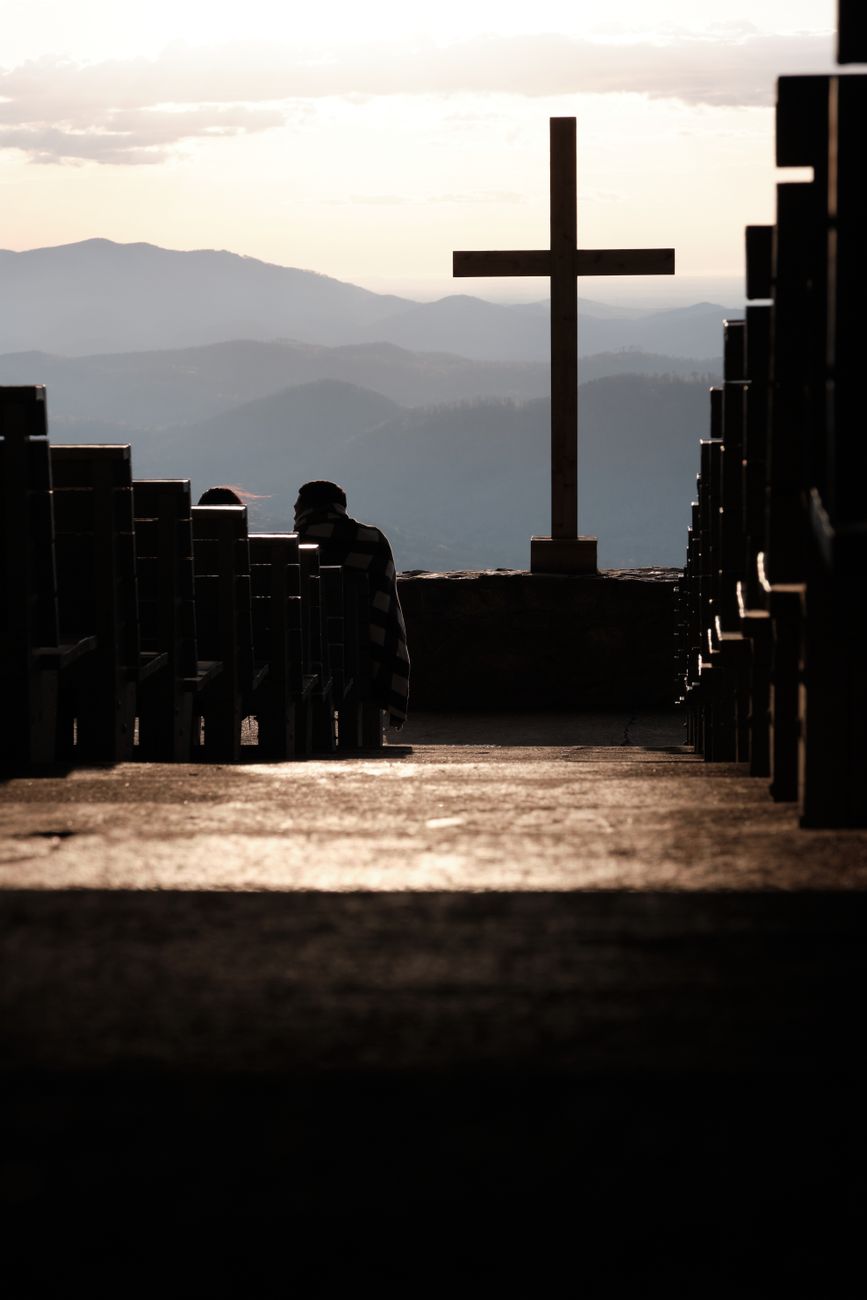

Grace and Prayer (Photo by Garrison Gao on Pexels.com)

Water, Humility and Authority

Exodus 17:1-7, Psalm 78, Philippians 2:1-13, Matthew 21:23-32

There is a saying that you cannot get blood out of a stone. Maybe not but, as described in our reading from Exodus, you can get water out of a rock!

The people of Israel had a teeny tiny problem – they had no water to drink! When we have a problem or a tricky situation, it can be much easier to blame somebody else for the problem than it is to just carefully and spiritually think through the problem. And this is the case with most situations throughout the history of humanity. For example, if the children or the husband do something less than endearing or particularly silly and I ask them “Why did you do that?” the response I will get is “It’s <insert appropriate name here e.g. Joe’s> fault – if they behaved properly then I wouldn’t have”. Likewise, if they want something, say a drink, instead of thinking through the problem and asking for or making a drink they will say “it’s your fault, you didn’t make me one” or “you didn’t tell me to make one”. Or instead of finishing their homework they do something else and then run out of time. Yep, you’ve guessed it, their response is “It’s your fault for not putting enough time on the phone”.

It was the same with the Israelites. They are thirsty. They have no water. Instead of thinking this through, something like, “We are in a desert, deserts don’t have much water, we need to ask God to meet this need”, the Israelites jumped straight to; “It’s Moses’s fault! We must complain to and about Moses.”

Whilst the lack of water was not the fault of Moses, as leader of Israel he had to set the example to follow. He has to lead them to the answer and show them that the right way to deal with the situation is to give it to the Lord in prayer.

Moses knew the right response was to ask God. The people of Israel had been taught this over and over again. And in a similar way to us when we are asked the same thing over and over again by someone who still can’t get it right, eliciting the response from us of “And what are we going to do with you?”; Moses says to the Lord “What am I going to do with these people?”

God gave Moses specific instructions, including to take with him some of the Elders of Israel to be witnesses. God was going to prove to Israel yet again that He was, is and ever shall be with His people.

And so Moses struck the rock God had chosen with his staff and God made water spring forth to quench the people’s thirst. Moses named that place Massah and Meribah because of the complaints and doubts of the Israelite people.

This event and these places are mentioned several times in the Bible, an example of such is in John 7: 37-39: “If anyone thirsts, let him come to me and drink. He who believes in me, as the scripture has said, out of his heart will flow rivers of living water.” This living water Jesus spoke of is the Holy Spirit; it is no less a miracle for God to bring the love and power of the Holy Spirit out of our hearts than it is to bring water out of a rock. Our hearts can be just as hard!

Today’s Psalm (78) extols the marvellous things God does citing the way He looked after the Israelites during their exodus from Egypt; leading them as cloud and fire, dividing the Red Sea, providing food for them to eat and splitting the rock to produce water for them to drink.

Paul, in his letter to the Philippians is giving a reminder to not do anything that is motivated out of selfish ambition or conceit, but instead in humility to regard others as better than ourselves. Putting the interests of others above our own. He is reminding us to have the mindset of Christ who, though He is God, became man, served, humbled Himself and was obedient to the point of death on the cross. All earth and heaven declares Jesus Christ is Lord; His name is above all names. We too must be obedient to God. It is God who is at work in us, enabling us to God’s will and to work to His own good pleasure.

We should not do things to boast of our own self-importance, rather we should view others as more important than ourselves, putting God and others first and in higher esteem that we place ourselves. Jesus’s example is the example we should be following.

Paul calls for love, humility and unity amongst believers. Everything we do should be out of love for God and our neighbours to glorify God and to serve Him with everything we have.

There is great consolation in Christ. There is great comfort in the love, fellowship of the Spirit, affection and mercy from God. Each of these are given to us directly from Jesus and from Jesus through His people. They are real and solid gifts for Christians to truly experience. Just like God was with His people in the desert, caring for, loving and providing for the Israelites, He is with us and doing the same for His people today, tomorrow and always.

Our reading from Matthew, like the Israelites complaining to and confronting Moses, details the Chief Priests confronting Jesus over His authority.

Jesus went back into the temple to teach. To put this passage into context, this is the day after Jesus had turned all the money-changers and merchants out of the temple. Whilst Jesus was mid-teaching, the Chief Priests challenged the authority Jesus had to do what He does.

Jesus answers their question by questioning their ability to judge, Jesus asks them where the authority of John the Baptist came from; knowing that the ability to judge John the Baptist and his ministry was a measure of their ability to judge Jesus. If the Chief Priests answer Jesus’s question and answer it correctly then they would have an answer to their own question as well.

The Chief Priests weighed up the potential outcomes of each answer. Their interest was in the opinions of the crowd and in trying to catch Jesus out. They couldn’t say, therefore, that the authority came from God because they were hypocrites and feared being asked why they did not believe. Likewise, they could not say from man because that would be going against the crowd who viewed John as a prophet from God. They resorted to “We don’t know” and as such they did not earn a response from Jesus in answer to their question.

Instead Jesus tells a parable about a man with two sons. He asks one of the sons to go and work in the vineyard and this son refuses. However, after thinking about it, this son then goes and does what his father asked him to do. Let’s call this son Xavier, who does precisely this. When we ask him to do something he will immediately reply “no” but a couple of minutes later, once he has thought about it and had time to process and understand the request, off he trots and does what he was asked to do.

The father goes and asks the other son to go and work in the vineyard and this son says “yes” but then does not do what he was asked. Let’s call this one Freddie, who agrees to do the task and when asked claims he has indeed done what was asked but who actually has not even started it. Jesus asks which son did his father’s will or bidding and the answer is Xavier (or the first son).

Many, including the Chief Priests in this passage, fall into the group of the second son. They admit God’s truth and the Word of God. They intend to get around to it ‘at some point’. They talk about doing the Father’s work and keep up appearances but their hearts are not right with God and they think words and promises are enough. The second son said he would go but didn’t, these people say they repent but have not. They speak of believing but don’t, they think about seeking the Lord and submitting to Him but they never get around to it. They are lying to the Holy Spirit despite knowing better.

What matters is living for God rather than saying the right words. The Chief Priests talked the talk but they didn’t walk the walk. Their lack of repentance meant that the truly repentant sinners would enter the kingdom of heaven before them. These proud Chief Priests should have been much more repentant having seen notorious sinners repent but they were not.

So let us move forward this week by walking the walk of Jesus, with the reassurances that God is with us, protecting us, guiding us and that we can bring to him all our hopes, fears and needs – for which He will provide.

Water from rock. (Photo by Marta Wave on Pexels.com)

Jesus Anointed by a Sinful Woman

When one of the Pharisees invited Jesus to have dinner with him, he went to the Pharisee’s house and reclined at the table. A woman in that town who lived a sinful life learned that Jesus was eating at the Pharisee’s house, so she came there with an alabaster jar of perfume. As she stood behind him at his feet weeping, she began to wet his feet with her tears. Then she wiped them with her hair, kissed them and poured perfume on them. When the Pharisee who had invited him saw this, he said to himself, “If this man were a prophet, he would know who is touching him and what kind of woman she is—that she is a sinner.” Jesus answered him, “Simon, I have something to tell you.” “Tell me, teacher,” he said. “Two people owed money to a certain moneylender. One owed him five hundred denarii, and the other fifty. Neither of them had the money to pay him back, so he forgave the debts of both. Now which of them will love him more?” Simon replied, “I suppose the one who had the bigger debt forgiven.” “You have judged correctly,” Jesus said. Then he turned toward the woman and said to Simon, “Do you see this woman? I came into your house. You did not give me any water for my feet, but she wet my feet with her tears and wiped them with her hair. You did not give me a kiss, but this woman, from the time I entered, has not stopped kissing my feet. You did not put oil on my head, but she has poured perfume on my feet. Therefore, I tell you, her many sins have been forgiven—as her great love has shown. But whoever has been forgiven little loves little.” Then Jesus said to her, “Your sins are forgiven.” The other guests began to say among themselves, “Who is this who even forgives sins?” Jesus said to the woman, “Your faith has saved you; go in peace.”

Luke 7:36-50

Let’s imagine we have been invited to lunch in a hot sandy country. It’s a place where when we arrive somewhere we would normally be given water to wash our feet and we would be given a special welcome. Now let’s imagine that we have arrived at our host’s house for lunch and we are shown straight to a seat. No welcome at all and no refreshing water for our hot dusty feet.

As a guest in a place where these customs were both important and a sign of respect this would probably make us feel rejected and neglected. Yet this is how Jesus was treated at Pharisee Simon’s house.

Now let’s imagine that there is someone who is well-known for being naughty and they are trying not to be noticed as they come over to you and start washing your feet for you and welcome you with great love. A bit like the woman in our reading did for Jesus.

The respectable host forgot the bare basics of hospitality but the naughty person gave, out of love, what was required and much more.

Simon sees what is going on and wonders why Jesus allowed it. Jesus points out that those that have less that needs forgiving show less love than those with more needing to be forgiven.

The woman’s love and faith was shown in her service to Jesus and shows that she had already been forgiven and changed by God’s Grace. Jesus reassured her that she was forgiven, that she was saved, and that she could now go in peace.

Sometimes we need reassurance that we are loved and forgiven and it can be hard to accept forgiveness for ourselves. It’s okay! God loves and forgives us already. Now we need to accept that great love and forgiveness, love God, love our neighbours and forgive ourselves and each other.

Who Would I Be?
A Poem on Luke 7:36-50 by Mark Ballenger
“But he who is forgiven little, loves little….”

If you came to my house, who would I be?
Would I love you like that sinful woman, or despise you like a Pharisee?

Would I fall at your feet and wet them with tears,
Or would I stand at a distance, judging in fear?

I hope I’d be like her, serving and loving you for all that you’ve done,
Knowing you are not just another teacher, you are God’s one and only Son.

But I do fear, at times, you would have to come and sit me down,
I fear you would have to tell me a parable to show you alone deserve the crown.

And I trust it would work, your loving words spoken so true,
I know your sweet compassion would surely draw me to you.

For you have humbled and taught me, like her, with this simple riddle,
That surely I should love you much, for my sin which you forgave was not very little.

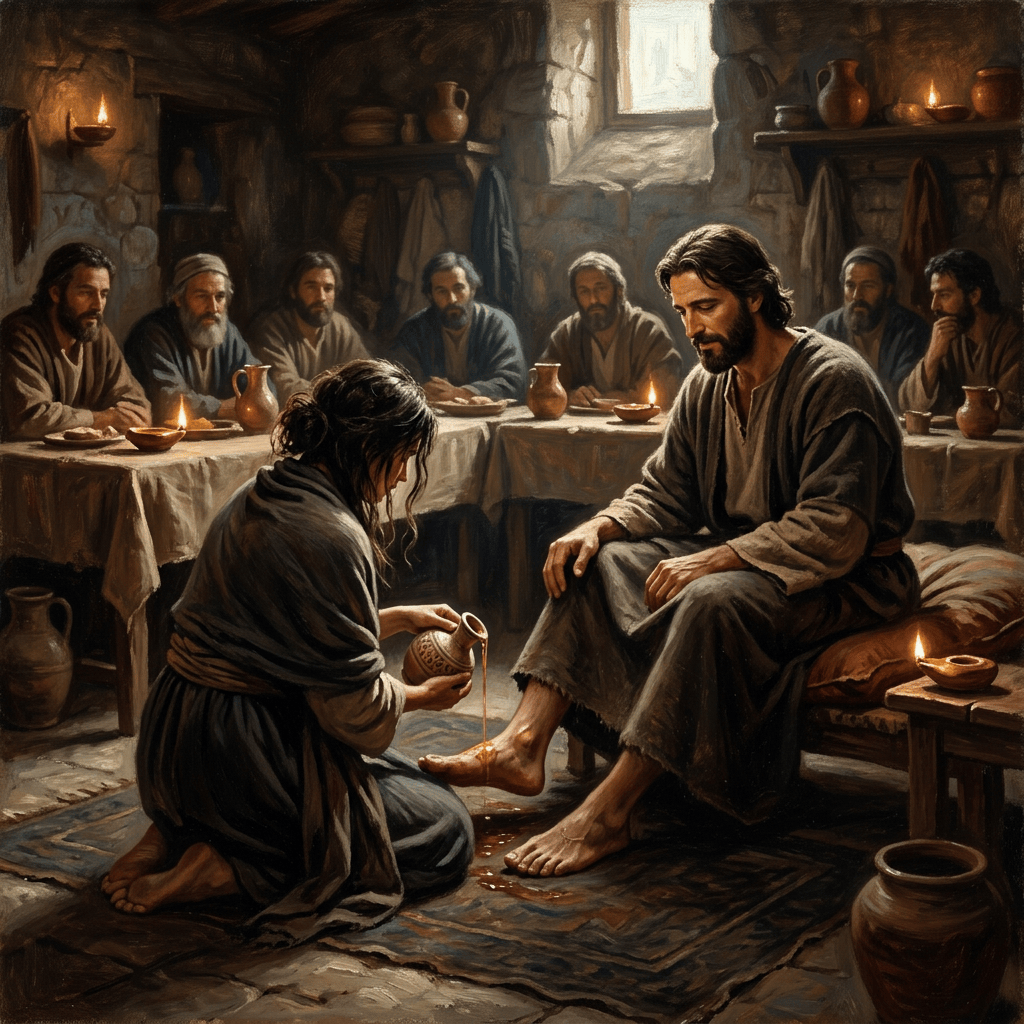
A woman washes Jesus’ feet with oil while seated guests watch.
A woman kneels to wash Jesus’ feet as others watch in a warmly lit ancient room.

Forgiveness

Exodus 14:19ff, Psalm 114, Romans 14:1-12, Matthew 18:21-35

In our readings we have the Israelites crossing the Red Sea safely whilst the Egyptians perish leading to the Israelites respecting and being in awe of God. All, like in our Psalm, in the presence of God. Paul in Romans highlights that we are the Lord’s and should do all things in honour of the Lord; giving Him thanks. And Matthew with the key word that binds all this together – forgiveness.

Exodus is a book about migration. It means a mass departure of a large group of people (in this case the Israelites) from a place (Egypt) all at the same time. At this point in the Exodus of Israel the Israelites were camped at the edge of the Red Sea. The Angel of God and the Cloud Pillar, sent by God to lead them, moved behind the Israelites whilst they were waiting to cross the Red Sea becoming a barrier between them and the Egyptian Army. God was with and protecting His people.

Just like He was with and protected His people then, God is with and protects His people now. Even when we feel overwhelmed in a struggle of some kind God is with and protecting us.

There was a time delay before the parting of the Red Sea. During this time when the Angel and Cloud were between the Egyptians and the Israelites both were protected. The Cloud was a source of light to the Israelites symbolising God’s glory and salvation; but a source of darkness to the Egyptians symbolising God’s judgement.

Like He so often does for us, God was giving the Egyptians another chance. During this time before their sentence was carried out the Egyptians were being given time. Time to repent form the heart, time to turn around, time to let the Israelites go, time to go home. Had they done this their sentence would have been lifted, they would have been forgiven, they would have been spared.

The waters of the Red Sea parted and the Israelites walked across the dry land in the middle to the other side. The Egyptians tried to follow the Israelites across the sea bed and God fought on the side of the Israelites until they were all safely across. The Egyptians started to flee back the way they had come but God commanded Moses to hold his staff over the sea and the waters returned.

God doesn’t need people in order to perform miracles but He often gets them to take part. God used this opportunity to vindicate Moses, who had been accused by the Israelites, before our reading starts, of having the lowest of motivations and an evil heart. God is showing the Israelites that Moses is their chosen leader.

Seeing the Egyptians dead on the seashore proved to the Israelites that God keeps His promises, that their deliverance from Egypt was real and that their oppressors were dead.

God delivered Israel in a miraculous way, demonstrating His faithfulness to Israel and to all His people.

The deliverance of Passover and the miracle of the Red Sea go hand in hand. Without the victory at the Red Sea the redemption at Passover would have been lost; and they would never have made to the Red Sea without the redemption at Passover. Likewise, the redemption of the cross would be lost without the miracle of the resurrection. Israel walked through potential death to new life in the presence of God. When we accept God’s unconditional forgiveness and when we forgive others we also have new life, a fresh start, in the presence of God.

Our reading from Paul’s letter to the Romans teaches us that we should accept all in faith, the new to faith, the mature in faith, and all those in-between, without condition i.e. we should not make spiritual maturity a condition or requirement for fellowship.

Paul reminds us it is not our place to pass judgement on any fellow Christian. They should stand or fall before their own Master – God.

There is a lot of useless, harmful division amongst some Christians over silly, unimportant and bigoted things. Paul does not say we must erase our differences but to rise above them as Christian brothers and sisters.

Or as Bishop Rose says: Instead of being a melting pot and all melding into one unidentifiable gloop we should be a fruit salad. Each a different bit of fruit all rubbing together in the fruit salad making it more interesting and flavoursome.

From beginning to end our lives are connected to others. No one is an island. From beginning to end our lives are to be dedicated to God and so whatever we do we must honour the Lord. We will stand before the Judgement Seat of Christ; which is concerned with a Christian’s rewards and position in the Kingdom. Don’t judge your brother or sister in Christ for we will all be judged by Christ.

Every knee shall bow! All will have to appear before God in humility and give an account of ourselves before Him. We should forgive our brothers and sisters and let God deal with them as He will surely deal with us all.

Again, our instruction is to forgive, which brings us to our excerpt from Matthew.

Peter asked how many times we are to forgive, suggesting seven times. To us that doesn’t seem very many but the accepted limit taught by many rabbis of the time was three; and so Peter probably felt seven was more than generous.

Jesus’s answer alludes to and is in contrast with Lamech’s in Genesis 4:24, in which Lamech says “If someone who kills Cain is punished seven times, then the one who kills me will be punished seventy-seven times.” Lamech is talking unlimited vindictiveness.

In giving the answer of seventy-seven, Jesus is saying we are to forgive the repentant an unlimited number of times. But even more than that we should also forgive the unrepentant unlimitlessly.

Jesus follows His answer with the story about the servant who did not forgive.

This servant owed a huge debt which he would never be able to repay. He begged for more time – even though it would be fruitless. His master took pity on him in compassion and mercy and forgave him the debt,

However, upon his return home this servant found someone who owed him a debt in an amount which was a tiny fraction of the amount he had just been forgiven. With unsparing severity he demanded repayment. The one owing this smaller amount used the same plea yet instead of being met with the same compassion and forgiveness he was thrown into the debtor’s prison.

When the master of the servant who had received mercy heard what had happened he was understandably angry that this man who had been forgiven so much had then been so unforgiving. The servant ends up in prison to be tortured.

Giving genuine forgiveness from the heart is required of all who have been forgiven. God forgives us all unconditionally and in comparison our sins against each other are but a tiny percentage of our sins against God. Therefore we have no justification for not forgiving.

We incur greater wrath from God by refusing to forgive than we do for the rest of our sins.

We must forgive from the heart, unconditionally and not determined by whether those who sin against us are repentant.

It’s worth saying again; since we have been forgiven so much we have no right to withhold forgiveness.

Jesus’s parable shows we must be more forgiving not less forgiving. If we forgive in words only and not in our hearts we are still condemned.

Granting forgiveness is evidence of having truly been forgiven. Whereas being unforgiving shows that the heart of the unforgiver has not allowed in the love of Jesus.

The unforgiving servant in the parable was delivered to the torturers. Not forgiving others is a form of torturing ourselves and can do us great harm.Those who will not forgive cannot expect forgiveness.

Forgiveness goes hand in hand with love. If we really want to love and be loved we must learn how to forgive and how to accept forgiveness. There is no love without forgiveness and no forgiveness without love. Forgiveness is the final form of love and cannot be separated from love.

When you forgive, you love, and when you love God’s light shines upon you.

So, if we really want to live, we must learn to forgive.

We can pray: I love you. I’m sorry. Please forgive me. Thank you.

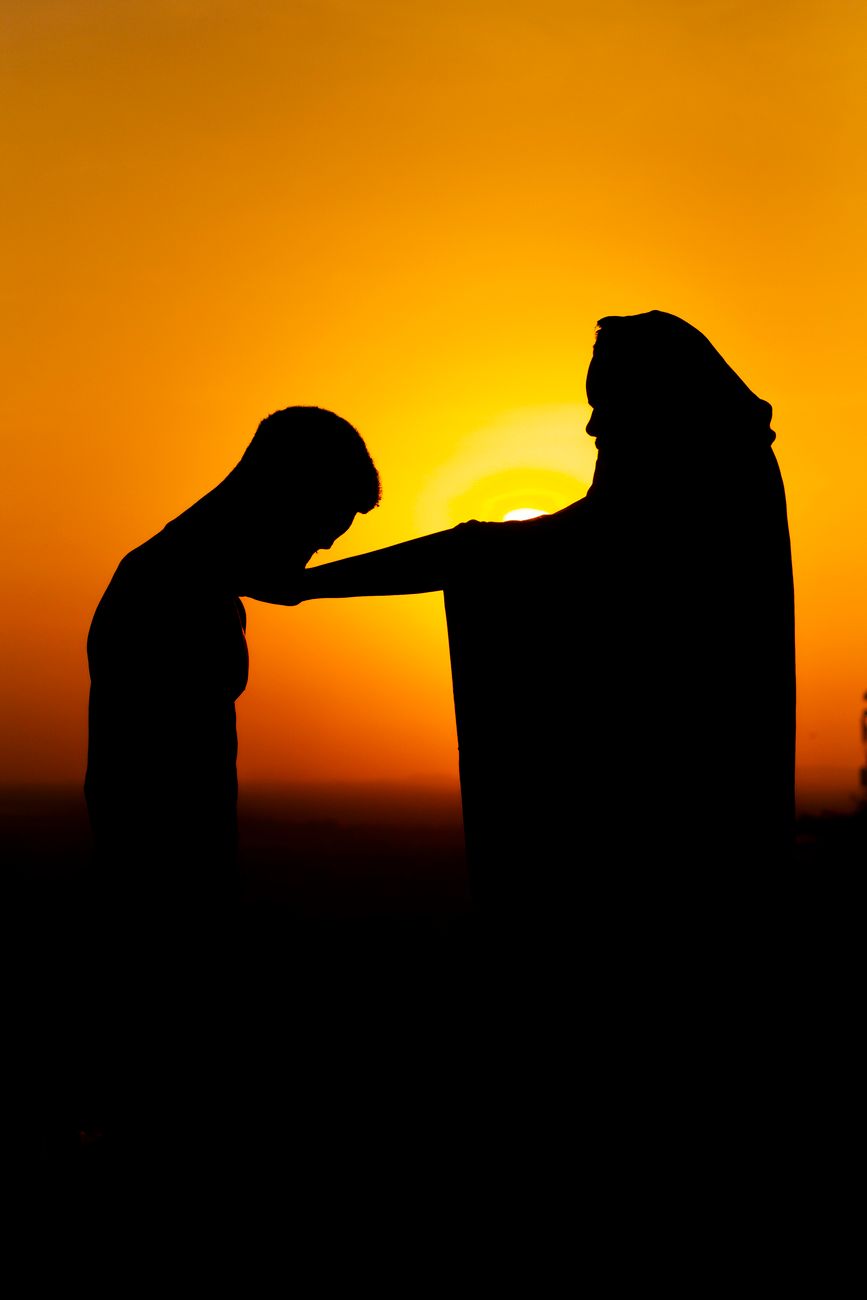
Forgiveness. One forgiving another. (Photo by Clement Eastwood on Pexels.com)

An Orchestra Of Believers

If another member of the church sins against you, go and point out the fault when the two of you are alone. If the member listens to you, you have regained that one. But if you are not listened to, take one or two others along with you, so that every word may be confirmed by the evidence of two or three witnesses. If the member refuses to listen to them, tell it to the church; and if the offender refuses to listen even to the church, let such a one be to you as a Gentile and a tax-collector. 

Truly I tell you, whatever you bind on earth will be bound in heaven, and whatever you loose on earth will be loosed in heaven. Again, truly I tell you, if two of you agree on earth about anything you ask, it will be done for you by my Father in heaven. For where two or three are gathered in my name, I am there among them.’

Matthew 18:15-20

How many of us have siblings? And how many of us have never had any disagreements or conflicts with our siblings? Let’s face it, if we are honest we all have. Jesus is advising on how to deal with such situations within our extended family of believers.

Now Jesus’s teaching and the Bible tell us that we should bear with one another, be tolerant and long suffering towards each other. The teaching Jesus is giving here is for situations where it needs to be addressed for resolution.

We could say that Jesus gives us two options when your brother or sister sins against you. You can go to them directly and deal with it; or you can drop the matter under Christian tolerance, forgiveness and bearing with one another. All other options which involve holding onto bitterness, retaliation, and gossiping to others about the problem are not allowed.

Jesus did not say that your brother or sister must agree with you or immediately repent before you. They just need to hear you. There needs to be a preparedness to listen to the point of view of each party and the acceptance that we and our brothers and sisters may have different views.                                                                                                                                                                                                                                                           

It is possible that an arbitrator from our brethren may be required to help resolve the issue by hearing both sides of the matter. The view of the arbitrator having heard both sides may be different to what each had thought. The important thing is that the outcome must be the restoration of the relationship, which is more important than proving who is right. Whilst it can be considered unwise to interfere in a quarrel, sometimes an independent person who is prepared to listen to both sides is what is needed for restoration and Jesus makes it clear that we must be willing to assist in settling a difference.

This process needs to be done humbly and according to the Word, which  is quite binding in the eyes of God. In the ancient Greek, agree is literally “to symphonize.” Jesus wants us to complement each other like a great orchestra. “It is a metaphor taken from a number of musical instruments set to the same key, and playing the same tune: here, it means a perfect agreement of the hearts, desires, wishes, and voices, of two or more persons praying to God.” 

Jesus is just as much present in the little congregation as in the great mass meeting…He is not the slave of numbers. It is meeting in Jesus’s  name that is most essential.

Gathering together in His name means that we are known by Him and by His name. It means that He is our point of gathering; we gather around Jesus. Gathering together in His name means gathering according to the character and nature of Jesus and gathering in a manner that Jesus would endorse.

Orchestra (Photo by Arian Fernandez on Pexels.com)

Who Am I?

Now when Jesus came into the district of Caesarea Philippi, he asked his disciples, “Who do people say that the Son of Man is?” And they said, “Some say John the Baptist but others Elijah and still others Jeremiah or one of the prophets.” He said to them, “But who do you say that I am?” Simon Peter answered, “You are the Messiah, the Son of the living God.” And Jesus answered him, “Blessed are you, Simon son of Jonah! For flesh and blood has not revealed this to you but my Father in heaven. And I tell you, you are Peter, and on this rock I will build my church, and the gates of Hades will not prevail against it. I will give you the keys of the kingdom of heaven, and whatever you bind on earth will be bound in heaven, and whatever you loose on earth will be loosed in heaven.” Then he sternly ordered the disciples not to tell anyone that he was the Messiah.

Matthew 16:13-20

Jesus took His disciples to Caesarea Philippi, about 25 miles north east of the Sea of Galilee, where the population was mainly non-Jewish; giving Jesus respite from the crowds and peace to teach His disciples.

In what is considered to be an introduction to a more important follow up question, Jesus asks the disciples who the people say He is.

Caesarea Philippi was associated with idols and temples to other gods, including a temple of white marble to worship Caesar. It is against this backdrop, amongst Gentiles worshipping multiple different things, that Jesus asked the disciples this question.

Some say the disciples took a guess at what the people thought. Some say they reported back gossip and hearsay and some say that the disciples genuinely knew what the crowds were thinking and saying. Either way the answers given were those of national reformers who stood up to corrupt rulers of their day. The Jews wanted a military Messiah who would lead them to victory against the Romans. Consequently, the general tendency of the people was to underestimate who Jesus was, giving Him some respect and honour but not to the extent due to Him and the people cannot decide who He is.

Having heard the answer to His introductory question, Jesus asked the main one: “Who do you think that I am?” Who did the disciples themselves think Jesus is? What did they believe about Him?

This is the question asked of all of us and all who hear about Jesus. We have the privilege of answering this question every day by what we believe and do. Believing Jesus is who He says He is affects the way we live and act.

Jesus had been teaching His disciples and ministering for some time. As their teacher He expected the disciples’ opinion to be their own and not influenced by the crowds hearsay.

Again, it is Peter whose answer is recorded “You are the Christ, the Son of the living God.” Jesus is the Christ, the Messiah. Through their time and experience with Jesus the disciples had come to understand who He was. They also needed to believe. Peter understood that Jesus was not only God’s Messiah but also God Himself.

Jesus reveals to Peter that he had spoken by divine inspiration – God the Father speaking through Peter and giving him the insight to make this revelation. Peter was blessed by both the insight itself and by how it came to him. How we identify with Jesus is based on our own personal encounters with Him, on immersing ourselves in God’s Word and in prayer. How we choose to identify with Jesus will impact the way we interact with one another and the earth.

Jesus reiterates that Simon Peter’s name is now Peter meaning rock. Peter was a rock and would become a rock as God works through Him transforming his naturally extreme self into someone solid and reliable. Jesus states that He will build His church. Not only is this the first use of the word ‘church’ in the Bible but the church belongs to Jesus. Jesus builds His church bringing His people, who belong to Him, together.

Jesus gave Peter the Keys to the Kingdom of Heaven, giving him the spiritual authority to open the door of salvation and lead the early church.

Peter had a special place among all the disciples and he had some privileges. He is always listed first in the listings of the disciples. He opened the doors of the Kingdom to the Jews. He opened the doors of the Kingdom to the Gentiles.

However, despite some views to the contrary, there is no proof or Biblical argument that Peter’s privilege and authority was passed on. Jesus gave Peter the Keys but didn’t give him the authority to pass them on to further generations.

Finally Jesus commanded His disciples that they should tell no one that He is the Christ. Their lives speak louder than words, more truthfully and more effectively. By leading a life of love for God, a life that loves the other as much as one loves themself, and a life in pursuit of justice and peace, the truth of Jesus’s identity is declared to the world.

Jesus said to tell no-one for it was not yet His time. Now is His time. He is alive for ever more. It is time for us to spread the word in what we do and think and say.

Statue of Peter with the Keys to the Kinf(Photo by Paolo Bici on Pexels.com)

What Goes In Must Come Out

In our reading from Matthew Chapter 15 (verses 10-28), the Scribes and Pharisees ask Jesus why the disciples are not following the tradition of the elders “for they do not wash their hands when they eat”. This is not saying the disciples were eating with unwashed hands – although they may have been. They are not telling Jesus “Yuk! Look at that one – he still has fish guts on his fingers and he’s eating. Can’t you make him wash his hands?” Which is reminiscent of meal times with the children: “Did you wash your hands?” “Yes.” “I’m not convinced – go wash them again!”

The Elders, who were past religious leaders not current living rulers of the people, had a tradition of ceremonial washings. These were continued by tradition and were not a commandment from God. The religious leaders asking the question here were offended that the disciples did not observe these rigid and extensive traditions. Traditions which these Scribes and Pharisees took very seriously – a lot more seriously than they took God’s commandments. Hence, Jesus’s reply “Why do you transgress the commandment of God because of your tradition?”

Jesus did what He often did. He answered a question with a question. He turns the accusations back to the accusers. “Because of your tradition” repeated Jesus. Not only was Jesus pointing out that the accusation was based purely on tradition and not on God’s actual commandments but He was pointing out that the Scribes and Pharisees are far too wrapped up in these trivialities. They were not paying attention to God’s Law and Scriptures but were condemning people based on tradition; declaring them unclean and denying them access to God based on a tradition.

Jesus went on to give examples of how their traditions were in conflict with God’s commandments and dishonoured God. Honour your father and mother, a clear command which even comes with a penalty for disobedience. When we are adults no longer living in our parent’s house or under their authority we do not have to obey them but we do have to honour them. Part of honouring them was to look after and aid them in times of necessity. This would be done by sharing resources with their parents to help them. Some Jewish people would declare their possessions or savings as a gift to God, especially dedicated to Him, and as such their resources were unavailable to help their parents despite those having made the vow still having access to the resources – money, property, possessions – for themselves.

Jesus doesn’t hold back, He goes straight into pointing out the hypocrisy of these traditions, calling the Scribes and Pharisees hypocrites. They honour Me with their lips but their heart is far from Me. We call this lip service. When we say the words but our hearts are not in it. It is a truth not limited to the Scribes and Pharisees being confronted by Jesus but is true of people of today too. Appearing to draw near to God when our heart is far away. It is easy to want and be impressed by the image of being near to God without actually really being there. God is interested in the internal and the real. He knows what is actually written on our hearts and minds. We tend to be much more interested in the merely external image. It is vital to take care to ensure that our relationship with God is not superficial.

All cultures and societies have various traditions, often which have been handed down. Like recipes: my gingerbread recipe came from my mother who got it from my grandmother who got it from my great grandmother and so on. And many families will have some sort of practice and tradition that has been taken on by each new generation.

So I want to pause here to point out that Jesus was not labelling all traditions as bad or all traditions as good. What He was doing was putting them in their place. Traditions are not the same as God’s Word, God’s commandments and how God wants us to live. Traditions have a lower priority than God.

Having told off these Scribes and Pharisees, Jesus now teaches the crowds about these ceremonial cleanliness traditions in regard to food in advance of the New Covenant where the old food laws would be void and all food allowed, as declared in Acts (chapter 10 verse 15). Jesus warns us that it is not what we eat that defiles us but what we say and that what we say reflects on the state of our hearts.

Now the disciples were only human and, similar to what might happen today, they mention to Jesus that they think He might have offended the Pharisees slightly. Well, yes, that was after all the intention. Jesus needed to get the point across that they valued man-made tradition too highly. The commandments of men will not last because they are not rooted in God or truth.

Peter, it’s always Peter, asked Jesus to explain because the disciples had not understood. ‘Do you still not understand?’ Jesus said.

I can empathise. There are times when I am explaining something which I think is quite simple to the children, or the husband, and they just look at me and … especially if it’s something which the rest of us would say was just common sense … they say what or but. They just don’t get it and it has to be explained again and sometimes again and again and then in words of half syllable. Very frustrating at times for those of us who do understand and can see how simple the concept actually is. I look at them and think ‘seriously how is it that you don’t understand, are you not listening, I’m not speaking a different language.’

Now, I’m not saying that all Jesus’s teachings are easy and should be immediately understood. I’m just saying that I empathise with His response to the disciples of “Are you also still without understanding?” Here were the disciples being accused of being spiritual unclean because they had not followed a ceremonial tradition and Jesus pointing out that following the tradition did not make a person spiritually clean or unclean as it was a tradition of man and not a commandment of God, and the disciples are saying to Him: “Hey Jesus, what do you mean?”

Jesus explains. It is not what food we eat or how we eat it that makes us spiritually clean or unclean but what is in our heart. The heart is where our true characters lie. It is not merely our emotions but the true self – the true person as they actually are instead of how they outwardly appear.

“Is this a dagger I see before me?” Possibly, but the dagger is merely the tool not the instigator of the murder; which is conceived in the heart and soul of the murderer.

Instead of worrying about what to eat and drink, what to wear and what hair style, as God’s people, we should be more concerned about what we do, and think and say.

There is a well-known saying “What goes in must come out”. This is what Jesus explains to the disciples. From food no moral defilement comes to the soul. The food is eaten, the body absorbs the nutrients it needs and the rest is ejected through the excrement process.

It is not what we eat or whether we have water poured over each hand alternately, three times each, from a two handled cup, reciting blessings as we dry our hands which determines righteousness but what is in our hearts.

Our reading from Matthew then moves on to the Canaanite woman who’s daughter was possessed by a demon and I would like to share a short reflection from August 2023 by Pope Francis.

Now let us look at the woman’s faith, which the Lord praises, saying that it is “great” (v. 28). According to the disciples, the only thing that seemed “great” was her insistence; but Jesus sees her faith. If we think about it, that foreign woman had probably little or no awareness of the laws and religious precepts of Israel. What does her faith consist of then? She does not have a wealth of concepts but of deeds — the Canaanite woman draws near, prostrates herself, insists, takes part in a close dialogue with Jesus, overcomes every obstacle just to speak with him. This is the concreteness of faith, which is not a religious label but is a personal relationship with the Lord. How many times we fall into the temptation to confuse faith with a label! This woman’s faith is not fraught with theological gallantry, but with insistence — she knocks at the door, knocks, knocks. Her faith is not made up of words, but of prayer. And God does not resist when he is prayed to. This is why he said, “Ask, and it will be given to you; seek, and you will find; knock, and it will be opened to you”. (Pope Francis, Angelus, 20 August 2023)

I leave you to ponder Ralph Waldo Emerson’s words “What lies behind us and what lies before us are tiny matters compared to what lies within us.”

Ceremonial Hand Washing (Photo by sanka sumedha on Pexels.com)

To Rise We Fall

This week we have the passage from Matthew 14 where Jesus walks on water. I have heard many talks that focus on this element of our Lord, who already showed His power over nature at The Cana Wedding before His ministry even began, walking on water.

But I put it to you that that is not what this passage is all about!

What is the biggest realisation you have received? Or, what is the lesson that has most shaped or affected you? Don’t say it out loud just think about it. We’ll come back to this later.

Jesus commands His disciples to get into the boat. He doesn’t give them a choice. Imagine you are sitting at a desk, there’s a paper face down in front of you and a pen. The teacher tells you to turn the paper over. You may not be or feel ready. You may or may not have paid sufficient attention to the lessons. But it is exam time and, for you, like for the disciples getting into the boat, the test is about to start.

In these types of scenarios you know in advance that there will be an exam or test. There is a time of learning before it takes place and, for some, the knowledge that the test is coming up will spur them to a deeper kind of learning, to pay more attention and to put more work in.

Jesus has been teaching the disciples for quite a while at this point. Some of it we are aware of from the Gospels such as The Sermon on the Mount, episodes of Jesus’s healing ministry, feeding the crowds; but there is also the wealth of teaching by Jesus that was not recorded in these four books. Now it is Disciple Assessment Test time to evaluate their progress and understanding.

The disciples’ test this week was to be in the form of a storm, not just any old storm but a monster of a storm. The word used in the lectionary translation (New Revised Standard Version) is battered. The boat is battered by the waves. However, the original Greek word used meant demonic torment. The boat was being demonically tormented by the waves. A bit more than just rough weather is being described here!

There are fishermen amongst the disciples, they are skilled at handling boats. Every skill they know for handling a boat in a storm has been tried and the disciples are exhausted. They feel they have failed, been defeated, and are full of despair. At this, the darkest moment of despair, Jesus appears!

Jesus appears at the fourth watch, between 3 and 6 in the morning. The fourth watch is a recurring time of divine encounter in the Bible. It is during those hours that God moved through the sea and delivered Israel from Pharaoh’s army. It was then that Jesus rose to pray alone and then that the stone was rolled away from His tomb.

And so, Jesus appears. In their exhaustion the disciples don’t recognise Him at first; Jesus speaks “Take heart. I AM. Do not be afraid.”

“I AM.”

These two words tell us precisely who Jesus is. We don’t need anything else – it leaves us in no doubt. Jesus tells us over and over again. “I AM” is the covenant name for God (Yahweh) in the Old Testament, a name for God the Jews were very familiar with. Those well versed in Scripture knew exactly who Jesus was saying He was.

I AM the Bread of Life. God the Bread of Life. I AM the Good Shepherd. God the Good Shepherd, I AM the Light of the World. God the Light of the World. I AM the Gate for the sheep. God the Gate for the sheep. I AM the Resurrection and the Life. God the Resurrection and the Life. I AM the Way, the Truth and the Life. God the Way, the Truth and the Life. I AM the True Vine. God the True Vine.

Jesus the I AM – before this world was formed, before Abraham, who walked on the waters at creation and rules the surging sea, the one who is everything and who can help the disciples finish this test.

Peter is the one who overthinks the test and, as the saying goes, tried to run before he could walk. Peter is doing what our Freddie does – he sees someone doing something or hears someone ask for something and has to do/have that as well. Fear of missing out or jumping on the bandwagon. Peter sees Jesus walking on the top of the water and wants to do that too.

Maybe it’s a bit like copying someone’s homework. They’ve done the hard work and all you have to do is hand it in and hope they got it right. Or maybe it’s like trying to get a few more marks for a higher grade.

Peter says “If you are I AM let me do what you’re doing”. As we know, after taking a few steps, Peter sinks. It is at that point that for Peter the lesson sinks in.

The lesson was not ‘always make sure you score extra points’ or to ‘literally keep you eyes upon Jesus’ as though faith was only a matter of improved focus or in case He disappears if you blink. The lesson is three small words that make up a heartfelt plea, “Lord, save me.”

Let us briefly revisit the questions I asked at the beginning. What is the biggest realisation you have received? Or, what is the lesson that has most shaped or affected you? Hopefully, you did think about your answer to these questions because now I want you to think about when you received that realisation or when you learnt that lesson.

Was it during a time of calm, of ease, when things were going well? Or, was it during a time of darkness, difficulty, trial and hardship?

It is always darkest just before the dawn.

Did you learn the lesson in the bright light of day or in the darkest hour of the fourth watch?

In general only a very small amount of people learn the most formative or life saving lesson or receive their greatest epiphany when things are going at their best. For the majority of people they receive the most vital epiphany or learn the most important lesson in that fourth watch during the darkest most difficult times.

This is what Jesus was doing when He commanded the disciples into the boat. He knew the lesson He was teaching them had to not only be learnt but deeply embedded within the disciples. He knew the confession the disciples needed to make to give them the solid foundation that they would need to survive what was coming. The lesson that can only be learnt in the midst of the torment storm. When all else is stripped away and there is nothing left to blind us from the truth.

Peter calls out “Lord, save me.” Jesus reaches out and catches him and they get on the boat. The disciples fall down saying “Truly, you are the Son of God.” A phrase that appears only once more in Matthew when it is spoken by the Roman Centurion at the foot of the cross.

Both these scenarios, the sea and the cross, although different are linked through this phrase arrived at through the same kind of test.

The disciples did not arrive at this answer through hours and hours of study and revision or through the teaching they had received so far. They worked out the answer because Jesus made them get into a boat, sent them into a storm and let them struggle through it until Jesus was revealed as the answer.

I AM who saves. God who saves.

When we are sinking, in the belly of the storm, or sat at the desk with the test paper; Jesus will be there, waiting whilst we use up every resource and the only answer left is those three little words: “Lord, save me.”

But once learnt that lesson lives on and holds us in the next test and the next and the next. It is the lesson that makes us fall to our knees and declare that truly, Jesus is the Son of God.

To rise we fall.

One must fall before one can rise.

Courage is not simply one of the virtues but the form of every virtue at the testing point.

C.S.Lewis
Walking on Water through the storm. (Photo by Johannes Plenio on Pexels.com)

Jesus Trees From Mustard Seeds

At first glance it doesn’t always seem apparent, but our readings for today are still all connected.

The passage from Genesis 29 is about reaping what we sow and God’s grace in messy situations.

Jacob’s mother, Rebekah, and her brother, Laban, are skilled in playing dirty tricks in order to get what they want. It was by following this path of behaviour that led to Jacob having to flee from his brother’s wrath and going to his Uncle Laban.

This brokenness was part of the foundation of the 12 tribes of Israel, built from Jacob’s sons. Into this brokenness God was quietly weaving His grace. God’s grace works within the messy realities of our lives.

Jacob and Laban are tricky customers and the Bible is not telling us to be like them. Instead it asks the question “just how is the great God going to make anything out of these tricksters?”

It reminds me of when a child does something really stupid and we say to them: “And just what are we going to do with you?”

Which leads us to “how is God going to make anything out of us?”

I can imagine God watching us as we, in our innate stubbornness get into all sorts of scrapes, and smiling as He says: “And just what are We going to do with you?”

I think the answer to that has to have something to do with fun and laughter for, with fools like me, who God continues to choose as witnesses throughout the ages, it is certain that God has a tremendous sense of humour – which is a very good thing for some of us!

Which brings us back to reaping what we sow as we move onto Matthew 13. Our reading from Matthew consists of 4 parables and a question on understanding; starting with the mustard seed. The parable of the mustard seed reminds us of the parable of the sower, but now, we are not focusing on the soil. A mustard seed is so tiny but given the right conditions it will grow and spread into a bush. Here it is described as becoming a tree to highlight growth beyond expectation, but also to use the imagery of the scriptures where the image of a tree was used for a great kingdom. Just like the tiny seed becoming a great tree; this is a prophetic parable showing how from a small beginning the Gospel of Christ should reach all nations and fill them with righteousness and true holiness.

The mustard bush grows sturdy enough to house nests of birds. Birds also receive God’s care, such as in Matthew 6:26 where He feeds the birds of the air. Birds nesting in the branches of the mustard tree could be viewed as little ones sheltering in the overshadowing of God’s wings. However, in the Old Testament and other parables, birds have been used as symbols of the devil’s flock; for example the birds eating the seed of God’s Word in the parable of the sower. In this light the birds represent corruption taking refuge in Christianity’s shadow.

In our next parable, of the treasure hidden in the field, the field is the world. In Rabbinic Law, if a workman found treasure in a field and lifted it out then it would belong to the owner of the field. In this case the man did not lift up the treasure until after he had bought the field.

Jesus is the man who gave all He had to buy the field. The other parables we have looked at recently have spoken about corruption being alongside the true believers, like the weeds with the wheat. This one is focusing on how much God loves us – so much that He gave His only Son to die on the cross in order to redeem the world and the treasure within. So, if the field is the world and the man is Jesus then what is this treasure of so much value? It is us, it is true believers – God’s people.

The treasure in the field also reminds us that where your treasure is your heart is also. God does not ignore our needs but He challenges our material excess acquired for self serving purposes.

The parable of the costly pearl is similar to the treasure in the field. Here, a merchant finds a pearl of great value, sells all he has and buys it.

Again, we can look at the merchant as being Jesus and the valuable pearl as the believer whom Jesus gave everything for – including His life.

The ancient peoples considered a pearl to be the loveliest of all possessions. This highlights both how lovely the kingdom of heaven is and how much Jesus values His people.

Jesus also reminds us not to throw our pearls before swine for they will trample them underfoot and turn on us.

The dragnet is, as they say, exactly what it says on the tin. It was dragged throw the sea to capture and then herd fish to the shore where the fish would be sorted. Just like the weeds and the wheat, the good fish would be gathered and placed in vessels and the bad would be thrown away. This is revisiting the warning that, at the end of the age, angels will separate the wicked from the believers. The wicked to then be cast into the fiery furnace.

It is a bit like teaching a concept to a class and explaining it a different way for those who didn’t understand it the first time. Not only does Jesus explain what will happen at the eternal judgement multiple times but He also uses different metaphors. Everyone has had the chance to hear and understand, they just have to want to.

Jesus asked His disciples “Do you understand?”

“Yes, Lord” they answered.

Again, this reminds me of explaining something important to a child; after which asking them if they understood. They look up at you with their face a picture of innocence but looking so blank and say “yes.” If asked what they thought the meaning was the answer was, of course, “I don’t know”. Back to the beginning we go but this time looking at it a different way.

I can just imagine Jesus asking the disciples if they understood and, in the same way, they look at Him blankly saying ‘yes’, as He’s thinking ‘no, you really don’t’.

We could take that view – suspicious that they didn’t understand, and sometimes better understanding takes time to sink in.

Or, we could take it at face value that they did understand. Jesus did spend time with His disciples away from the crowd, explaining the parables to them and giving them extra teaching. The disciples had an advantage over the crowds – some of whom would not have understood.

Jesus said clearly that those who know and understand God’s word will know both the old and the new. The knowledge of the scriptures combined with the new teaching gives a deeper understanding of what they previously knew as it is lit up and re-understood through the new teaching.

The disciples are now responsible to share their understanding with others from a place of wisdom and understanding of things old and new.

Ministers and teachers of the Gospel should not be without sufficient knowledge and understanding of the Scriptures. They should be well versed in both the Old and New Testaments and have a sense of them with a stock of Spiritual knowledge.

Our Gospel started with the mustard seed and I would like to share the thought that we try to gift the tiny mustard seeds of Christ and we pray that they will be nurtured and grow into Jesus trees as I finish with the story ‘Only the Seed’.

Once upon a time, a pilgrim set out on the long journey in search of peace, joy and love. The pilgrim walked for many weary miles, and time passed. Gradually, the young, lively steps became slower and more laboured. The pilgrim’s journey passed through landscapes that were not always happy ones. Through war. Through sickness. Through quarrels and rejections and separations. A land where, it seemed, the more people possessed, the more warlike they became – the more they had to defend, the more they needed to attack each other. Longing for peace, they prepared for war. Longing for love, they surrounded themselves with walls of distrust and barriers of fear. Longing for life, they were walking deeper into death.

But one morning, the pilgrim came into a little cottage at the wayside. Something about this little cottage attracted the pilgrim. It was as though it was lit up from the inside. Full of curiosity, the pilgrim went inside. And inside the cottage was a little shop, and behind the counter stood a shopkeeper. It was hard to judge the age – hard even to say for sure whether it was a man or a woman. There was an air of timelessness about the place. “What would you like?” asked the shopkeeper in a kindly voice. “What do you stock here?” asked the pilgrim. “Oh, we have all the things here that you most long for,” replied that shopkeeper. “Just tell me what you desire.”

The pilgrim hardly knew where to begin. So many desires came rushing to mind at once. “I want peace – in my own family, in my native land and in the whole world. I want to make something good of my life. I want those who are sick to be well again and those who are lonely to have friends. I want those who are hungry to have enough to eat. I want every child born on this planet today to have a chance to be educated. I want everyone on earth to live in freedom. I want this world to be a kingdom of love.”

There was a pause while the pilgrim reviewed this shopping list. Gently, the shopkeeper broke in. “I’m sorry,” came the quiet reply. “I should have explained. We don’t supply the fruits here. We only supply the seeds.”

Only The Seed retold by Margaret Silf – origin source unknown.
Mustard Seeds (Photo by Siddharth Sharma on Pexels.com)

Jesus the Ladder

In Genesis 28, we catch up with Jacob as he is fleeing for his life. To say he’s been a bit of a naughty boy would be an understatement and his brother Esau (possibly along with a few others) are wanting to kill him.

As the sun had set Jacob stopped for the night and found a flat stone he could use as a pillow before settling down to sleep. And he dreamed that famous dream we refer to as Jacob’s Ladder of a great ladder with its top in heaven and its feet on earth. Angels were going up and down the ladder which reassured Jacob that God was closer than he had realised and that there was interaction between earth and heaven.

It is often asked why we look up at our sky to point our eyes towards heaven and why we think of it being above us. It is imagery such as this which feeds our perception of a literal higher plane as opposed to a metaphorical upness.

As is made clear in John’s Gospel, Jesus is the access to heaven. He is how people can go to heaven and how heaven can come down to people. Jesus is the ladder Jacob saw in his dream.

John 1:51 says “And He said to them, ‘Most assuredly, I say to you, hereafter you shall see heaven open, and the angels of God ascending and descending upon the Son of Man’.”

Jesus is the way to heaven, He doesn’t just show us the way, He is the way. As He said, recorded in John 14:6, “I am the way, the truth and the life. No one comes to the Father except through me.”

God appeared to Jacob introducing Himself as the God of Abraham and Isaac and repeats to Jacob the terms of the covenant given to Abraham, Isaac, and now to Jacob. God gave Jacob the promise of land and descendants but He also promised that He would be with Jacob, protecting him, until all these promises had been fulfilled. God continues to work until His work is complete in His people. God’s blessing and faithfulness to Jacob can be seen in the several ways that His presence was described in Jacob’s life. Jacob woke and declared “Surely the Lord is in this place and I did not know it.”

Jacob therefore renamed the place Bethel meaning House of God. So if you ever wondered what Bethel meant when you see or hear of a Bethel Church now you know.

He was correct in sensing the presence of the Lord but mistaken if he had thought that God was in some places and not others. God is everywhere – as David clearly understood from his words in Psalm 139.

During his dream, Jacob did not use the ‘stairway to heaven’; instead God spoke to Jacob where he was, demonstrating God’s immanent presence. He is not a faraway removed God calling long-distance but an indwelling God right here with us.

This encounter comes completely from God breaking into Jacob’s sleep state bringing a break to his anxious fleeing. At this vulnerable point in Jacob’s life, God emphasizes that He is not only the God of the first and second generation but also the God of Jacob. The reiteration of God’s promise also serves as a powerful reminder that Jacob’s life should not be governed by self-interest but by becoming a channel of God’s blessing to others.

When Jacob wakes from his dream he is a totally changed man and makes a vow showing his commitment to God.

This is the same Jacob who later would be called Israel and whose sons become the start of the twelve tribes of Israel.

From little acorns (or little dreams) great things grow.

Which leads us to Matthew 13 starting at verse 24, a passage which addresses the evil among us, God’s patience and the separation of believers and unbelievers at the end of the age.

The devil places a corrupt presence amongst innocents or in more generalised parlance unbelievers amongst believers. They look like genuine believers and we can get it wrong and mix them up. Only God knows and can tell the difference. 

The weeds or tares look just like the wheat until the ears are fully formed and it is ready for harvesting. This is why, to preserve and protect the true wheat, the tares are not separated out until the harvest. This prevents the wrong ones being destroyed when the tares are ripped out and burnt.

Whilst there are similarities between this parable and the parable of the sower from last week, what each element represents and the point of the parables are different. Last week’s parable showed how people receive and respond to the Word of God; whereas this week shows how God will divide His true people from false believers at the end of this age.

The field represents the entire world within which there is good seed representing the true believers and weeds or tares representing unbelievers. 

Make no mistake – by unbelievers we don’t mean those who are currently unbelievers but who will believe – they are wheat which is still developing their ears. No, we are talking about the end of the age when it is time for God’s harvest and those who are false believers, unbelieving or counterfeits who have been put there by the enemy – the devil – to try and corrupt true believers.

It is interesting how many ‘children’s stories’ are great works of theology. In 1883, The Princess and Curdie by George MacDonald was published. George MacDonald was a Scottish writer, theologian and preacher, a mentor for Charles Lutwidge Dodgson and a profound influence on J R Tolkien and C S Lewis. In this story, Curdie is given the ability that when he holds someone’s hand he can feel what it’s like on the inside – or how God sees them. Hands that look elegant and beautiful are cold, clammy, rough and coarse. Others, despite looking rough and deformed, are beautiful.

Or take Beauty and the Beast. Handsome Gaston is horrific on the inside whereas the terrifying Beast has beauty deep within. Or, of course, the Empress Jadis from C S Lewis’s Magician’s Nephew, who later becomes The White Witch. Digory reflects that “in all his life he had never known a woman so beautiful…” and yet within she was arrogant, callous and cruel.

It is not our job to weed them out but God’s. We are not to separate the good from the bad because we can only see what people are like now. We cannot see what they will become and we cannot see what is written in their hearts. 

Our job is to shine forth hope, to proclaim the Word of life, to speak of the love and forgiveness God has for us, of the power to change and the hope He gives us.

The reapers are the angels and will be sent out by Jesus the Son of Man.

There are two different paths and eternal destinies. A furnace of fire where the crop which came from the seeds of the devil will go and there is the radiant glory where the true believers shine forth as the sun.

The fire of the furnace will not destroy those thrown into it. Instead they will suffer a living torment with great woe, wailing and gnashing of teeth.

The wheat comes into God’s barn from all over the world, from all classes of society and from all ages. Yet all have one thing in common. They were all sown by the Lord from the good seed of His Word.

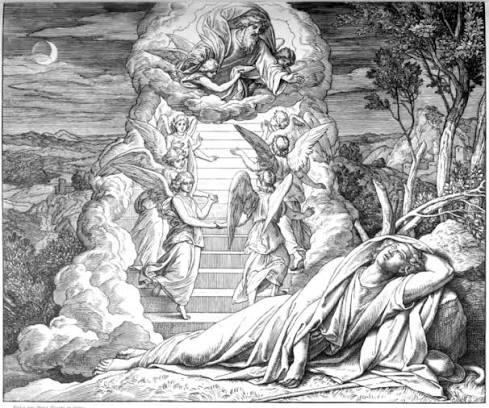
Jacob’s dream of a ladder between heaven and earth