On 28th March 2026, we were privileged to be able to go in person to the wonderful Service of Welcome for our new Archbishop. People from all across the diocese were there and we were all worshipping together.
On 29th March 2026, we went to a wonderful Palm Sunday service with Bishop Rose and 4 out of the 5 churches of Sheppey Group Ministry were all worshipping together and united in our faith.
Where was the 5th I hear you ask. They, sadly, quite simply do not want to be a part of the wider journey of serving Jesus. They claim they cannot get to the other churches; but the rest of us managed it and the day before representatives from across the whole diocese managed it. They claim the age of their congregation is a barrier as it makes them unable to go anywhere else. Yet on 29th March 2026 we had all ages with us, as we did on the day before, young and old and all in-between. They claim there is insufficient transport and that only one of their number has a car. This is untrue! I counted up how many cars are accessible to that congregation and they could have all car shared and still have space for extra people. There were some who do not drive or do not have a car with us on Palm Sunday but whom were able to attend through sharing with others. The day before also people shared their cars and travelled together. An essential part of our journey, in fact, is to do just that – to travel together, supporting each other.
Sadly, this missing church of which I speak feels like it has lost its way and instead of following Jesus, who is the true and only way, it feels like they are growing more and more like a cult, worshipping one of their own instead of our Lord Jesus Christ.
Brothers and Sisters, pray for them, do not let them mar the wonderful time and opportunity of united worship as we ground ourselves in the Lord and give thanks for His grace and salvation. Be strong in our Lord and follow only Him, who is the true way, the true truth and the true light.
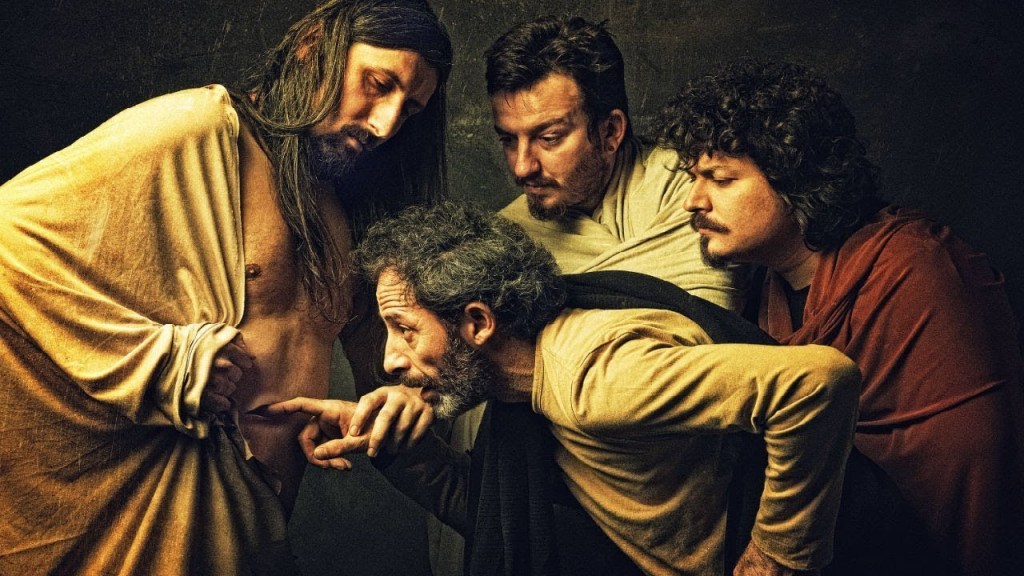
When it was evening on that day, the first day of the week, and the doors of the house where the disciples had met were locked for fear of the Jews, Jesus came and stood among them and said, ‘Peace be with you.’ After he said this, he showed them his hands and his side. Then the disciples rejoiced when they saw the Lord. Jesus said to them again, ‘Peace be with you. As the Father has sent me, so I send you.’ When he had said this, he breathed on them and said to them, ‘Receive the Holy Spirit. If you forgive the sins of any, they are forgiven them; if you retain the sins of any, they are retained.’ But Thomas (who was called the Twin), one of the twelve, was not with them when Jesus came. So the other disciples told him, ‘We have seen the Lord.’ But he said to them, ‘Unless I see the mark of the nails in his hands, and put my finger in the mark of the nails and my hand in his side, I will not believe.’ A week later his disciples were again in the house, and Thomas was with them. Although the doors were shut, Jesus came and stood among them and said, ‘Peace be with you.’ Then he said to Thomas, ‘Put your finger here and see my hands. Reach out your hand and put it in my side. Do not doubt but believe.’ Thomas answered him, ‘My Lord and my God!’ Jesus said to him, ‘Have you believed because you have seen me? Blessed are those who have not seen and yet have come to believe.’ Now Jesus did many other signs in the presence of his disciples, which are not written in this book. But these are written so that you may come to believe that Jesus is the Messiah, the Son of God, and that through believing you may have life in his name.
The Gospel of John, chapter 20 starting at verse 19
This reading is the one from which the name Doubting Thomas originates.
I always feel sorry for Thomas. He was an extremely faithful disciple. Indeed, in an earlier passage from John, when Lazarus has died and the other disciples do not want to go with Jesus back to Judea, it is Thomas who persuades them; and even says “Let us also go, that we may die with him”.
Again, when Jesus explains He is going to prepare a place in His Father’s house for His followers, it is Thomas who had the foresight to ask “Lord, we don’t know where you are going so how can we know the way?” This gained us that vital answer from Jesus that He is the way, the truth and the life; revealing that Jesus is the only path to God, moving the focus from a physical location to a spiritual relationship.
In that locked room where all the disciples except Thomas were gathered, Jesus appeared to them. He stood among them and said, “Peace be with you.” After saying this, Jesus showed His disciples His hands and His side.
Then the disciples rejoiced when they saw the Lord.
Let’s be clear on this, the disciples had already had the testimony of the empty tomb with the folded grave clothes from Peter and John. They had had the testimony of the women and from Mary who had seen the risen Christ. Yet Jesus still joined them in the room although all the doors were locked and showed them His wounds before they recognised Him.
Thomas, on the other hand, by not being with the other disciples had missed out on seeing the proof of the resurrection that the others had been shown freely by Jesus without having to ask for it.
Thomas, like the others had been, was in mourning for Jesus.
When we look at it this way, it does seem a little unfair that Thomas should be dubbed for all time The Doubter when he merely asked to experience the same as the others had already received.
Thomas is a wonderful gift to us … and we are, and should be, so thankful for the gift of Thomas.
He demonstrates true love, loyalty and faithfulness in going back to Judea with Jesus, even if it meant death, and persuading the other disciples to do likewise.
He demonstrated wisdom and courage in asking Jesus how we find our way to His Father’s house; which gifts us the teaching and understanding that Jesus is the way and we must follow His example and become like Him.
It is because of Thomas that we can be reassured that it is okay to have doubts.
Doubt can, after all, serve to bring us to deeper faith and understanding. It can be an invitation to ask sincere questions which can lead to a stronger relationship with God. Doubt is questioning that seeks answers. Honest questions are part of the spiritual journey for many. “Thinking is believing and believing is thinking” is a crucial part of our faith.
Thomas, by declaring “my Lord and my God” when Christ reappeared and showed Thomas His wounds, was the first person to explicitly acknowledge Jesus’s divinity.
Thomas was an enthusiastic apostle full of great fervor, an extremely human figure, close to each of us, symbolizing the doubts that can lead to greater awareness and the uncertainty that nurtures faith.
When the disciples scattered after Pentecost to bring the news of new life in Christ to all, Thomas went east, first to the Persians and then to India. From there he eventually reached the Malabar coast (present -day Kerala).
Thomas was completely filled with the Light of the Resurrection. In this light, full of the deepest faith and belief, Thomas was martyred in Chennai, India, in 72AD.
In a kind of paradox, Thomas’s death turned his statement from the events of Lazarus’s death and resurrection into a prophecy, for Thomas did indeed die to go with Christ.
The hand of the LORD came upon me, and he brought me out by the spirit of the LORD and set me down in the middle of a valley; it was full of bones. He led me all around them; there were very many lying in the valley, and they were very dry. He said to me, “Mortal, can these bones live?” I answered, “O Lord GOD, you know.” Then he said to me, “Prophesy to these bones, and say to them: O dry bones, hear the word of the LORD. Thus says the Lord GOD to these bones: I will cause breath to enter you, and you shall live. I will lay sinews on you, and will cause flesh to come upon you, and cover you with skin, and put breath in you, and you shall live; and you shall know that I am the LORD.” So I prophesied as I had been commanded; and as I prophesied, suddenly there was a noise, a rattling, and the bones came together, bone to its bone. I looked, and there were sinews on them, and flesh had come upon them, and skin had covered them; but there was no breath in them. Then he said to me, “Prophesy to the breath, prophesy, mortal, and say to the breath: Thus says the Lord GOD: Come from the four winds, O breath, and breathe upon these slain, that they may live.” I prophesied as he commanded me, and the breath came into them, and they lived, and stood on their feet, a vast multitude. Then he said to me, “Mortal, these bones are the whole house of Israel. They say, ‘Our bones are dried up, and our hope is lost; we are cut off completely.’ Therefore prophesy, and say to them, Thus says the Lord GOD: I am going to open your graves, and bring you up from your graves, O my people; and I will bring you back to the land of Israel. And you shall know that I am the LORD, when I open your graves, and bring you up from your graves, O my people. I will put my spirit within you, and you shall live, and I will place you on your own soil; then you shall know that I, the LORD, have spoken and will act, says the LORD.”
Ezekiel 37: 1 – 14
When I read this passage it always reminds me of the scene from the 1963 Jason and the Argonauts when the bones rise out of the ground and reform into skeleton soldiers marching across the valley. When I shared this with my husband and explained the intricacies of this stop motion creation by Ray Harryhausen, unbelievably, of course, my husband had no idea what I was talking about. Well, obviously that had to be rectified and so I showed him the scene in question so that he could see the animation of the skeletons – to help him visualise the life to dry bones. If, like him, you have missed out on this cultural experience the clip is available to view on YouTube.
Having slightly detoured, let’s get back to Ezekiel and the dry bones.
“The hand of the Lord came upon me and brought me out in the Spirit of the Lord”, basically, Ezekiel had a vision. And in his vision he saw a large valley, the Valley of Death. Everywhere he looked Ezekiel could see bones all over the ground. Bones laying on the surface of the ground are from people in disgrace who have been denied a proper burial; and being dry bones they are from people who have been dead a long time. They had had life once but it had long departed. Yet God asked Ezekiel whether these bones could live.
Ezekiel had no hope in the bones, but he did have hope in God. Ezekiel did not presume to know what God wanted to do with the bones; but he was confident that God DID know.
Ezekiel deliberately left the matter with God, to God’s power and wisdom. In return God commanded Ezekiel to prophesy to these dry, dead bones.
To an outsider looking in this would probably be conceived as foolishness. In Corinthians Paul acknowledged that God’s rescue of humanity in the person and work of Jesus, especially His sacrifice on the cross, was foolishness to those intent on perishing.
Ezekiel preached his message full of faith in God, he was confident that he was speaking God’s word and that the word of God is full of power.
God promised to restore life to these bones. The bones could not create life themselves but as the word of God was proclaimed over them they received God’s promise of life.
This restoration of life was to be marked by breath living once again in these bones – God’s Spirit, the breath of life.
Ezekiel did as God commanded and as he continued to prophesy to the bones their revival took place in stages. First the bones stirred, then they assembled, sinews and flesh were added, the skin covered the tissues and they awaited the breath of God. This is a direct reversal of the decomposition process.
Next God told Ezekiel to call upon the Spirit of God to come upon those on whom the word of God was working. Ezekiel proclaimed God’s message, the breath of God breathed into the reanimated bodies and they stood on their feet becoming an exceedingly great army who lived to act under the orders of God who gave and restored their life. They had God’s word and Spirit, an army of life willingly under the command of God.
If we have word but no Spirit we are like a dead army, assembled but without the true breath of life.
God then explains the vision to Ezekiel. God is promising to restore the whole house of Israel in a restoration so wide and deep that it will be fulfilled as part of God’s plan for Israel in the very last days.
This whole passage highlights to us how God works in revival and how God’s servants should think and act relevant to God’s mighty reviving work: – God’s servant knows the bones are dead and dry – God’s servant must walk among the dead and the unrevived – God’s servant must proclaim God’s word – God’s servant must have almost a foolish confidence in God’s word – God’s servant must understand that the Spirit works in a process – God’s servant must recognise that the work of the Holy Spirit is essential – God’s servant must boldly pray for the Spirit to move – God’s servant must speak in the power of faith – God’s servant must notice every evidence of the Spirit’s work – God’s servant must look for God’s people to be revived into an army of service – God’s servant must not say that hope is lost
Upon the valley, wide and sear, Where death had settled, year on year, The Spirit set me in the cold, Amidst the dry bones, grey and old. Can these bones live? The Voice did ask, This impossible, heavy task? I answered not with my own thought, But “Sovereign Lord, You know,” I brought.
Then came the word: “Prophesy, O son, To what is broken, dead, and done! Tell them to hear the LORD on high, Who brings back breath, who gives them sky.” As I did speak, a rattling song, As bone to bone rushed to belong! Tendons and sinews, flesh and skin, Wrapped around the void within. The forms stood up in silent grace, A breathless army in that place.
“Prophesy again,” the Word did say, “Call from the four winds, breath of day! Breathe on these slain, that they may live, The resurrection I will give.” The breath of God, the spirit-wind, Filled the lungs and freed the pinned. They stood on feet, a vast, huge host, Alive by Son and Holy Ghost.
“These are my people,” saith the Lord, “Lost in the graves, by hope ignored. But I will open up the tomb, And bring them out of death’s cold gloom. I’ll put My Spirit in your heart, A new life, right from the start. Then you shall know, from dust and sigh, The Lord has spoken—and will not lie.”
Mothering Sunday – the day put aside for visiting one’s “mother” church (the main church or cathedral in the area and often the one in which they had been baptised), to reaffirm their faith and family ties symbolised in the return to the source of their spiritual upbringing. This allowed servants and apprentices a rare day off to visit their families and bring gifts.
This festival is tied to the church calendar and occurs three weeks before Easter, on the fourth Sunday of Lent – also known as Laetare Sunday (Rejoice Sunday). Laetare Sunday is the Sunday on which we are offered a break from the Lenten Fast and as such it was a perfect day for those getting that rare chance to visit their families.
Over time, the honouring of the Virgin Mary and the mother church grew into a broader celebration of all mothers and those fulfilling the role of a mother figure.
It is not a coincidence, therefore, that our readings today involve mothers. In Exodus we are reminded of Moses’s Israelite mother and the Egyptian princess who adopted and mothered him. Our Psalm refers to God looking after His children, Colossians talks about how to live with one another. Luke reminds us of Jesus as a baby being presented at the Temple and the words of Simeon about Jesus’s death for our salvation. And John takes us to that point where the sword did indeed, metaphorically, pierce Mary’s soul. As Jesus is dying on the cross He sees His mother and the disciple John and He demonstrates His love and care for His mother by putting His mother into John’s care, ensuring she would be looked after by putting John in the position of being as a son to Mary and granting her permission to be as a mother to John.
Today is not, however, a celebration for everyone. For some it is incredibly difficult for various reasons. Some long for a child and are unable to become mothers. Some have lost children through death or circumstances. Some have lost their mother through death or Dementia, Alzheimer’s Disease or similar conditions. Some are at conflict with their mother or never knew one at all.
Our Gospel reading from Luke acknowledges this as Simeon warns Mary of the pain and suffering she will experience. As Mary watched her son dying on the cross she would have remembered Simeon’s words and finally understand their meaning. I’m sure that Mary would have given anything to swap places with Jesus and die in His place. It’s something many parents say – that they would die in place of their child and is part of the protective instinct built into the love between parent and child.
Our reading from John’s Gospel also acknowledges the part suffering plays as it links the pain of motherhood with the pain of the crucifixion.
As parents, we experience anguish over our children many times throughout our lives. As children, there comes a time when we anguish over our earthly parents. For those who have lost their own children or parents, Mary can be an important figure of compassion and solidarity as one who identifies with deep pain.
As Mary thinks about Jesus, He is thinking about His mother and knows how much she is suffering. Also, Mary was a widow and Jesus was concerned that no one would care for her. Even as He was dying Jesus was concerned for those whom He loved. And so He gives His mother to John and John to His mother.
Why was Jesus so concerned for His mother? After all, He had both brothers and sisters who were still alive.
Both Jesus’s mother Mary and His disciple John believed in Him and His mission. They believed He was indeed the Son of God and Saviour of the world. This is in direct contrast to Jesus’s brothers. In John 7:5 we are told “Not even His brothers believed in Him.”
Jesus created a new family in the shadow of the cross. At the foot of the cross, as Jesus’s blood is shed, Mary and John formed the church in their relationship with each other, offering each other comfort, strength, encouragement and hospitality.
We are all blood relatives – not through our own blood but through the blood Jesus shed on the cross.
Mothering Sunday is a time we can give thanks for those who cared for us but it is also a time to give thanks for mother church, formed through the blood of Christ at the foot of the cross; where we find comfort and support, encouragement, hospitality and love. It is also a time we can give thanks for our church family – our relatives through Jesus’s blood.
But Mothering Sunday also helps to widen our view. In addition to reminding us of the mother church, it reminds us of the parenthood of God, who is both mother and father combined when it comes to His parenting of us, His children.
God’s love for us is so huge, strong and faithful. It transcends the closest bond between parent and child.
Even when we go through times of suffering, anxiety or confusion. Even when we feel like the world is closing in on us. Even when those who care for us don’t understand or help how we need them to. Even when we feel alone and forgotten; God is with us and will never forsake us.
We can give to Him all our fears, our grief, our disappointments, our sufferings and He will bear these burdens with us. We are loved with an eternal love, just as we are. We are God’s children and He is mother and father to us in a way that brings healing, peace and fullness of life.
Let us pray: Loving God, we thank you for children and those in the role of mother. Be with those who are grieving because they have no mother; be close to those who are struggling because they have no children; be near to those who are sad because they are far apart from those they love. Let your love be present in every home, and help your church to have eyes to see and ears to hear the needs of all who come.
Jesus, like a mother you gather your people to you; you are gentle with us as a mother with her children. Despair turns to hope through your sweet goodness; through your gentleness we find comfort in fear. Your warmth gives life to the dead, your touch makes sinners righteous. Lord Jesus, in your mercy heal us; in your love and tenderness remake us. In your compassion bring grace and forgiveness, for the beauty of heaven may your love prepare us. Amen
A gift of flowers and chocolates (Photo by Dana Garcia on Pexels.com)
From the wilderness of Sin the whole congregation of the Israelites journeyed by stages, as the LORD commanded. They camped at Rephidim, but there was no water for the people to drink. The people quarrelled with Moses, and said, “Give us water to drink.” Moses said to them, “Why do you quarrel with me? Why do you test the LORD?” But the people thirsted there for water; and the people complained against Moses and said, “Why did you bring us out of Egypt, to kill us and our children and livestock with thirst?” So Moses cried out to the LORD, “What shall I do with this people? They are almost ready to stone me.” The LORD said to Moses, “Go on ahead of the people, and take some of the elders of Israel with you; take in your hand the staff with which you struck the Nile, and go. I will be standing there in front of you on the rock at Horeb. Strike the rock, and water will come out of it, so that the people may drink.” Moses did so, in the sight of the elders of Israel. He called the place Massah and Meribah, because the Israelites quarrelled and tested the LORD, saying, “Is the LORD among us or not?”
Exodus chapter 17, verses 1-7
Jesus came to a Samaritan city called Sychar, near the plot of ground that Jacob had given to his son Joseph. Jacob’s well was there, and Jesus, tired out by his journey, was sitting by the well. It was about noon. A Samaritan woman came to draw water, and Jesus said to her, “Give me a drink.” (His disciples had gone to the city to buy food.) The Samaritan woman said to him, “How is it that you, a Jew, ask a drink of me, a woman of Samaria?” (Jews do not share things in common with Samaritans.) Jesus answered her, “If you knew the gift of God, and who it is that is saying to you, ‘Give me a drink, you would have asked him, and he would have given you living water.” The woman said to him, “Sir, you have no bucket, and the well is deep. Where do you get that living water? Are you greater than our ancestor Jacob, who gave us the well, and with his sons and his flocks drank from it?” Jesus said to her, “Everyone who drinks of this water will be thirsty again, but those who drink of the water that I will give them will never be thirsty. The water that I will give will become in them a spring of water gushing up to eternal life.” The woman said to him, “Sir, give me this water, so that I may never be thirsty or have to keep coming here to draw water.” Jesus said to her, “Go, call your husband, and come back.” The woman answered him, “I have no husband.” Jesus said to her, “You are right in saying, ‘I have no husband’; for you have had five husbands, and the one you have now is not your husband. What you have said is true!” The woman said to him, “Sir, I see that you are a prophet. Our ancestors worshipped on this mountain, but you say that the place where people must worship is in Jerusalem. “Jesus said to her, “Woman, believe me, the hour is coming when you will worship the Father neither on this mountain nor in Jerusalem. You worship what you do not know; we worship what we know, for salvation is from the Jews. But the hour is coming, and is now here, when the true worshippers will worship the Father in spirit and truth, for the Father seeks such as these to worship him. God is spirit, and those who worship him must worship in spirit and truth.” The woman said to him, “| know that Messiah is coming” (who is called Christ). “When he comes, he will proclaim all things to us.” Jesus said to her, “I am he, the one who is speaking to you.” Just then his disciples came. They were astonished that he was speaking with a woman, but no one said, “What do you want?” “Why are you speaking with her?” Then the woman left her water-jar and went back to the city. She said to the people, see a man who told me everything I have ever done! He cannot be the Messiah, can he?” They left the city and were on their way to him. Meanwhile the disciples were urging him, “Rabbi, eat something.” But he said to them, “I have food to eat that you do not know about.” So the disciples said to one another, “Surely no one has brought him something to eat?” Jesus said to them, “My food is to do the will of him who sent me and to complete his work. Do you not say, ‘Four months more, then comes the harvest’? But I tell you, look around you, and see how the fields are ripe for harvesting. The reaper is already receiving wages and is gathering fruit for eternal life, so that sower and reaper may rejoice together. For here the saying holds true, ‘One sows and another reaps.’ I sent you to reap that for which you did not labour. Others have laboured, and you have entered into their labour.” Many Samaritans from that city believed in Jesus because of the woman’s testimony, “He told me everything I have ever done.” So when the Samaritans came to him, they asked him to stay with them; and he stayed there for two days. And many more believed because of his word. They said to the woman, “It is no longer because of what you said that we believe, for we have heard for ourselves, and we know that this is truly the Saviour of the world.”
John, chapter 4, verses 5 – 42
When we are looking at passages from the Bible, it often helps to put them back into context. At the beginning of this passage from the Gospel of John, Jesus is on His way back to Galilee from Jerusalem. His popularity is increasing, much to the annoyance of the religious leaders of the time, and a conflict is brewing. But it is not yet time for this to take place and so Jesus removes Himself and He takes the unpopular route through Samaria.
Most Jews travelling on similar journeys would take a different route to avoid Samaria. To say that Jews and Samaritans did not get on is an understatement. The city of Sychar was ancient Shechem, the capital city of the Samaritans and the location of Jacob’s well, as was a lot of Jewish history. For example, this is where Abram first came when he arrived into Canaan from Babylonia, where God first appeared to Abram in Canaan, and renewed the promise of giving the land to him and his descendants, where Abram built an altar and called upon the name of the Lord, where Jacob came safely when he returned with his wives and children from his sojourn with Laban, where Jacob bought a piece of land from a Canaanite named Hamor, for 100 pieces of silver, where Jacob built an altar to the Lord, this was the plot of ground that Jacob gave his son Joseph, and where the bones of Joseph were eventually buried when they were carried up from Egypt. This is where Joshua made a covenant with Israel, renewing their commitment to the God of Israel and proclaiming, as for me and my house, we will serve the Lord.
Jesus, as God in human form, experienced the same tiredness and thirstiness we all do after a very long walk; and He experienced the same relief at a chance to finally sit and drink. Even better, a Samaritan woman came to the well to draw water and so He could ask her to draw water for Him to drink. By asking the woman for a drink enables the interaction that follows. Jesus drew upon the woman’s curiosity making her more curious about Him, more curious about God and more curious about what it is Jesus can give. Jesus often speaks to us as if we were more spiritual or understanding than we actually are. He does this on purpose in a manner similar to “If you knew more, you would pray more.”
Knowing that everyone in the local town or villages would use this well daily for the water they needed to drink; Jesus used being thirsty as a metaphor for spiritual need and longing and promised that the water He gives will become a fountain of water springing up into everlasting life. The effect of this water creates something good, something life-giving in the heart of the one who drinks it.
The response of the Samaritan woman was logical, but not yet spiritual. She wanted to avoid the work of coming to the well every day. “Jesus, if you want to make my life easier and more convenient, then I’m all for it. Give it to me!”
The conversation moves on to the life of the Samaritan woman. Jesus wants her to confront and admit her sins.
Having discussed the woman’s life, the conversation moves on to worship. Jesus states “You worship what you do not know; we know what we worship”. He sets Jews and Samaritans in sharp contrast. And He associates Himself quite definitely with the Jews. Like all faith that tries to combine elements of different religions, the Samaritans worship what they do not know. The Samaritans also only accepted the first five books of the Hebrew Scripture, taking the bits of scripture they wished to, and rejecting the rest.
Jesus pointed out that a time was coming when worship would no longer be focused on places. The greater work of Jesus would bring a greater, more spiritual worship. God is Spirit, and those who worship Him must worship in spirit and truth: With these words Jesus described the basis for true worship: it is not found in places and trappings, but in spirit and in truth.
Though this woman was a sinner, Jesus revealed Himself to her. Jesus reveals Himself to sinners. The Samaritan woman was so impressed by the love of Jesus that she now sought out her fellow villagers, even when they had treated her as an outcast before. Jesus displayed so much love that she felt safe with Him even when her sin was exposed. It’s important that people today likewise have a safe place to confess their sin, repent, and put their trust in Jesus.
The woman’s invitation was effective. The people came when she told them who Jesus was and how He had impacted her life with their brief conversation.
The disciples had gone into the Samaritan village to get food, and, having returned, wanted Jesus to eat what they brought to Him. Jesus wanted His disciples to know that, whilst food and rest is important, life was more than those things; that man does not eat by bread alone. Jesus found great satisfaction in doing the will of God even when He was weary. In fact, the conscious doing of God’s will refreshed the weary Jesus.
Jesus then used the idea of food and harvest to communicate spiritual ideas. The idea of harvest meant that there were many people ready to be received into the Kingdom of God, and that the disciples should see themselves as workers – reapers – in that harvest. “As he was speaking, the Samaritans were leaving the town and coming across the fields toward him. The eagerness of the people the Jews regarded as alien and rejected showed that they were like grain ready for harvesting.” He who reaps receives wages, and gathers fruit for eternal life, hence both he who sows and he who reaps may rejoice together.
Many of the Samaritans of that city came to believe in Jesus as the Messiah of God because of the word of the woman who testified. Jesus stayed there two days teaching and many more believed.
Jesus is indeed the Christ, the Saviour of the world. “Not of the Jews only, but of the Samaritans, and of the whole Gentile world.”
Jesus was led up by the Spirit into the wilderness to be tempted by the devil. He fasted forty days and forty nights, and afterwards he was famished. The tempter came and said to him, “If you are the Son of God, command these stones to become loaves of bread.” But he answered, “It is written, ‘One does not live by bread alone, but by every word that comes from the mouth of God.'” Then the devil took him to the holy city and placed him on the pinnacle of the temple, saying to him, “If you are the Son of God, throw yourself down; for it is written, ‘He will command his angels concerning you,’ and ‘On their hands they will bear you up, so that you will not dash your foot against a stone.'” Jesus said to him, “Again it is written, ‘Do not put the Lord your God to the test.'” Again, the devil took him to a very high mountain and showed him all the kingdoms of the world and their splendour; and he said to him, “All these I will give you, if you will fall down and worship me.” Jesus said to him, “Away with you, Satan! for it is written, ‘Worship the Lord your God, and serve only him.'” Then the devil left him, and suddenly angels came and waited on him.
Matthew 4: 1 – 11
After Jesus’s baptism, He was led by the Holy Spirit into the Wilderness for forty days (and nights) to fast and prepare for His ministry. Here He resisted the devil and the temptations laid before Him and strengthened Himself to be ready for what lay ahead.
Forty is a number that pops up time and time again in the Bible. In the account of Noah, once he and his family are on the ark it rains for forty days and nights. Moses fasted on Mount Sinai for forty days and nights. Elijah fasted in the desert for, wait for it, forty days and nights. After leaving Egypt the Israelites wandered the wilderness for forty years.
A lot of forties and we should also recognise that we are in one ourselves as we travel the forty days of the season of Lent, participating in Jesus’s ministry and following His way toward the cross. We remember Jesus’s time in the Wilderness during this time of Lent but are we taking the opportunity of the Lenten time of preparation to patiently prepare spiritually, seek God and deepen prayer?
After identifying with sinners in His baptism, Jesus then identified with them again in severe temptation. This was a necessary part of His ministry, so He truly was led up by the Spirit into the wilderness. Jesus did not need to be tempted to help Him grow. Instead, He endured temptation both so that He could identify with us (Hebrews 2:18 and 4:15), and to demonstrate His own holy, sinless character.
Temptation is a certainty for everyone. Yet Jesus’s temptation was more severe because He was tempted directly by the devil himself, while we contend mainly with lesser demons. It was also more severe because there is a sense in which temptation is “relieved” by giving in, and Jesus never did yield. Therefore He bore levels of temptation we will never know by experience.
Jesus is tempted by food, by who to worship, and by the power of the nations. This is another way in which Jesus identified with us as all three of these were faced by the Israelites in their exile. Sometimes they were able to withstand the temptation, and sometimes they did not. Jesus, on the other hand, withstood all His temptations even though what Satan offered him is firmly within Jesus’s rights and power.
Jesus’s wilderness temptations “prove” to us what sort of God He is. The tempter starts each of his offers with the Greek word, ei, which is often translated as “if” but also translates as “since…” Satan knows Jesus is the Son of God, he knows the power and authority that belong to Jesus, he also knows that what he is tempting Jesus with are well within Jesus’s rights and capability. Satan is both tempting and taunting Jesus but Jesus refuses to fall for either, proving His humility through denying Himself for the sake of others.
So Jesus was tempted just like us but Jesus succeeded where we fail. Jesus succeeded because He knew that His life was in God’s hands. We do not live by our power of provision but by God’s help and blessings. Jesus succeeded because He knew that God was with Him and He did not need another display of power to prove it.
The cross reminds us that God is with us. We do not need to tell God how to run our lives or how to do things differently; God is with us no matter what. God is with us whether He leads us through the valley of the shadow of death or to the mountain peaks of joy. Jesus succeeded because He knew that worshiping God meant doing God’s will and not seeking His own desires. We do not live for our own desires but for God’s glory so that in the end we will be glorified by God.
We can have victory over temptation if we will look at the root of what the devil is putting in front of us. Ultimately, every temptation challenges whether or not we believe that God is with us, that God will provide for us, that God is for our good, and that God will deliver on His promises to us. Jesus had victory in the wilderness so that He could set us free from these enslaving temptations and sins. Jesus had victory so that he could stand before the Father on our behalf, interceding for us when we fail. His success is even more proof that He is the King who has come to save us from our sins.
…if you want to see an example of true patience watch a cat waiting patiently for the mouse it knows is there to crawl to the optimum position for its capture.
The cat will wait for hours, eyes on the prize, as still as a statue until the mouse has come right up to it … and then he pounces. But the point isn’t the pounce it’s the waiting. The cat has to wait in the right way to achieve its goal – patiently preparing. It can not and does not allow itself to get distracted by things around it or it will lose out.
In a couple of weeks we, once again, reach the time of Lent. A time of patient preparation leading up to the resurrection of Jesus and the Salvation of the world.
Many will proudly claim they are giving up wine or chocolate or Facebook or cake for Lent and some will equally proudly share when they give into the temptation and indulge anyway.
The giving up of something for Lent is representative of fasting. Despite some of the more recent modern fads this is not a new-fangled dieting technique but a tool to prepare both the physical and the spiritual body to gain discipline, seek God and deepen prayer.
It is often used before undertaking specific significant tasks. After Jesus’s baptism, He was led by the Holy Spirit into the Wilderness to fast and prepare for His ministry. Here He resisted the devil and the temptations laid before Him and strengthened Himself to be ready for what lay ahead. We remember Jesus’s time in the Wilderness during Lent but are we taking the opportunity of the Lenten time of preparation to patiently prepare spiritually, seek God and deepen prayer?
Are we using the time like the cat waiting for our mouse or are we letting ourselves get too distracted by worldly things around us?
Do we even know what our mouse is? What the task God has for us is? Let’s use this Lent to find out!
Cat waiting patiently. (Photo by Francesco Ungaro on Pexels.com)
The 25th January is the day in the church calendar when we remember the conversion of Saul into Paul. However, first I would like to share a story with you called The Making of a Saint.
Johnny was out shopping with his mother one morning in the high street. Feeling a bit bored, he happened to look up at the windows of the nearby cathedral. He wasn’t very impressed. From the outside, they looked drab and dull and a bit grimy. He said as much to his mother when she came out of the supermarket.
‘Just let’s go inside,’ she said to him. So they went into the cathedral, and his mother took him to where the big stained – glass windows were.
At first, Johnny was entranced by the magical coloured patterns on the stone floor of the ancient church. They seemed to dance in front of him as the morning light streamed through the mighty windows.
‘Look at that,’ he pointed to the dancing image on the stone floor. ‘What is it, Mum?’
‘Well,’ his mother replied, ‘actually, that’s a saint. See the window up there, which looked so dull from the outside? There is a saint up there in the stained – glass, and the light is shining through her and making her picture dance for us here on the stone floor.’
Johnny stored up this information in his heart, and the two of them went home for dinner. A few days later, Johnny’s class was having a religious instruction lesson. The teacher was talking about saints. ‘What do you think makes a saint?’ he asked the class.
Johnny’s hand shot up. ‘A saint is someone the sun shines through,’ he explained, ‘and when that happens, the stones come to life.’
Let’s not beat about the bush here. Paul’s conversion story on the road to Damascus is one which is still widely known and well documented. Saul the Jew and Pharisee held the Temple and the Law as precious. Saul witnesses the speech of Stephen. He looks after the coats of the witnesses as they kill Stephen, making Stephen the first Martyr. He heard Stephen’s last words: “Lord, set not this sin to their charge.”
Saul persecuted Followers of The Way (or to use the name of today Christians). He sought them out with this aim and so, having got the relevant papers from the Sanhedrin, he walked the 140 miles from Jerusalem to Damascus. Although officers of the Sanhedrin went with him, being a Pharisee, Saul could not have anything to do with them and so walked alone with his thoughts. The journey took them through Galilee which may well have made Saul think of Jesus. In addition, it is likely that Saul’s thoughts also included the calm way Stephen accepted his death and his last words. Before they reach Damascus the road climbs Mount Hermon with the city of Damascus laying in the plain below.
That region had a characteristic phenomenon of electrical storms being created by the hot air of the plains hitting the cold air of the mountain. As Saul reached this point there was just such an electrical storm and, out of the storm came Jesus Christ saying “Saul, Saul, why do you persecute me?” Saul asked who was speaking to him and the reply was, “I am Jesus whom you are persecuting but rise, go into the city and you will be told what to do.” Saul got up but could no longer see and had to be led into the city of Damascus. He could not see and did not eat or drink for 3 days.
The conflict between Saul and Jesus’s followers was at an end. Saul surrendered completely to Jesus. Up until this moment Saul had been doing what he wanted to do. But from the moment Jesus told him “Go into the city and you will be told what to do”, Saul would be told what to do. A Christian is someone who has ceased to do what they want and who has begun to do what Jesus wants.
Saul enters Damascus and Ananias enters the scene. Ananias received a message from God that he was to help Saul and would find him on the street called Straight. Ananias knew who Saul was and would have been apprehensive about this task, but he did what God told him to do.
Some say that the prayer of Stephen was a key element of Paul’s conversion and so is the brotherliness demonstrated by Ananias. As soon as Ananias sees Saul he greets him as “Brother Saul” in a perfect example of Christian love. In Christ, Saul and Ananias, people who had been on opposite sides, came together as brothers. Once Saul’s sight was restored to him he was baptised, took food and recovered his strength. Saul became Paul, a brand new person in Christ.
Paul immediately began witnessing in Damascus in an act of great courage. Paul was saying “I am a changed man and I am determined that those who know me best should know it. I am not ashamed of the gospel of Christ.” He then went to Arabia. Paul had experienced a shattering change and went to be alone with God for guidance and strength for the new and very different life that now lay ahead of him.
Paul underwent true conversion. True conversion to the Spirit of Christ, is a deeply spiritual and deeply necessary phenomenon. It is a conversion to grace, and a transformation to truth, and those things can cost a lot. And true conversion is always, always, a conversion to the future, not to the past.
True conversion is not being converted backwards, into some worldview that simply repeats the errors of history. It is being converted forwards, into the future, into an entirely new way of seeing the world. Many of us today need to be converted to something new! To a vision of true unity, for instance, where there is neither male nor female, neither Gentile nor Jew, neither Muslim nor Christian, neither black nor white.
Faith is not static! Conversion is implicit and necessary in the ongoing life of Christians; once we are converted we have to be converted over and over again. To model grace to the world, we also need to model how to be converted – how to change, gracefully, over and over again.
As Paul says in Romans 8:38-39, “For I am convinced that neither death nor life, neither angels nor demons, neither the present nor the future, nor any powers, neither height nor depth, nor anything else in all creation, will be able to separate us from the love of God that is in Christ Jesus our Lord.”
Light Storm (Photo by Johannes Plenio on Pexels.com)
Recently, I happened to hear someone teaching on the Baptism of Jesus. The question was asked “Why are people baptised?” And the answer given was “ To become a Christian”.
So I ask you, why then was Jesus baptised?
You, like me, can probably see the flaw in the answer previously referred to – there’s a few to spot.
The term Christian was first used around 44AD in the city of Antioch, as recorded in Acts 11:26 which says “And the disciples were called Christians first in Antioch”, to describe followers of Jesus. Earlier followers called themselves “The Way” and the term Christian was not more widely adopted until later. It became a more standard term around 100AD when the word “christianity” was first recorded.
So Jesus did not get baptised to become a Christian – a word that was not even in existence at that time.
Neither did He need to be baptised to follow Himself -especially as Facebook didn’t exist then either.
Likewise, Jesus didn’t need to be baptised to believe in Jesus. He knew He was and is the Son of God.
When a baby is baptised the parents have made the decision and make the declarations on behalf of the baby (or young child). If, like Jesus, someone is getting baptised as an adult then they have found their faith, believe in Christ and, as a believer of Christ, are already a Christian.
People are baptised as a public declaration of their faith, symbolising the person’s identification with Jesus’s death, burial, and resurrection, and a commitment to a new life in Christ. It serves as an outward sign of an inward change, a public testimony of one’s belief and a way to formally join a Christian community.
But, at the time of Jesus’s baptism, He hadn’t been crucified, dead, buried and resurrected yet.
So why did Jesus get baptised?
His cousin John, who was already known as John the Baptist, was calling people to be baptised and was baptising them. Yet Jesus was still alive, had not yet met His death and had not yet started His ministry. So why did the crowds flock to John in such great numbers and why did they and Jesus get baptised?
John’s mission was to prepare the way for the Messiah. He was calling the people to repentance for the forgiveness of sins and his baptism was a symbolic cleansing – a public declaration of turning away from sin and having a new start. It was also an act to make way for Jesus, who would baptise with the Holy Spirit, and served as a way to demonstrate a commitment to God’s law.
It was about spiritual readiness; John was urging the people to change their ways so they wouldn’t reject the Lord when He came.
Jesus was baptised to fulfil all righteousness, publicly launch His ministry as God’s Son, identify with all humanity (including sinners), and inaugurated a new covenant. All this was confirmed by the descent of the Holy Spirit and by the Voice of God.
Jesus’s baptism symbolised His union with sinners, foreshadowed His death and resurrection and established a model for the baptism we have today.
By getting baptised by John, Jesus was signifying His obedience to God’s will and His immersion into humanity’s condition. It was a public act marking the start of His ministry and mission as the Messiah, validated by the Trinity (Father, Son and Holy Spirit). John’s baptism was a baptism of repentance. By being baptised by John Jesus identified with sinful humanity, taking humanity’s burden upon Himself.
The water symbolised death and burial and the chance of a new life (or a new start). It points to Jesus’s ultimate “baptism” on the cross – His death and resurrection.
Jesus’s action set an example to His followers, showing the path to God and infusing the sacrament of baptism with God’s grace for us and for future believers.
Finally, when Jesus was baptised the heavens opened, the Holy Spirit descended like a dove, and God’s voice declared, “This is my beloved Son, with whom I am well pleased” – the indisputable confirmation of Jesus’s divine identity and mission.