
Luke 20:27-38
A question about the resurrection.
When I was looking deeper into this reading from Luke, I noticed that one of the commentaries entitles it “The Sadducees ask Jesus a ridiculous question”.
The Sadducees were like an ancient version of modern liberal theologians. They only accepted the first five books of Moses as authentic; disregarding what was written in them whenever they chose to do so. They did not believe in the resurrection, spirits or angels. They liked worldly things and cooperated with the Romans in order to keep their privileges.
There is a saying that there are no stupid questions only stupid answers but, in this case, it is the other way around. The Sadducees ask a ridiculous, hypothetical question based on Deuteronomy 25:5-10 in the hope of tricking Jesus into justifying their views. It is even feasible that the story they told was one of their stock in trade, told regularly purely in an attempt to cast ridicule on the resurrection of the dead.
Jesus’s reply, however, was a reminder that life in the resurrection is quite different to this worldly life with practices that are different to earthly life practices.
Revelation tells us that the glory of heaven will be a relationship and connection with God that surpasses anything else.
The question was not actually asked, however, to debate about those in heaven who had been married more than once; although Jesus tells us here that jealousy and exclusion have no place in heaven.
It was asked in order to attempt to refute the resurrection.
Jesus’s reply: “Nor can they die anymore, for they are equal to the angels, are sons of God, being sons of the resurrection.”
Jesus reminds us that life in heaven is eternal and shares some of the characteristics of the existence angels experience; although by being called children of God and children of the resurrection is a greater honour than that of the angels – these titles not having been given to angelic beings.
Jesus confirmed (and goes on to prove in the passage) that the resurrection is real and that there is no death in that life to come. And of course, this was a double blow for the Sadducees having had Jesus also confirm the existence of angels.
This teaching of Jesus , confirming the resurrection, is particularly poignant on Remembrance Sunday, when our thoughts turn to those who gave their lives, the mystery of death and what happens next.
We remember those who, throughout the centuries, received the news of their loved one’s death or that they were Missing In Action.
We remember those, who, today, yesterday, and in years long past made the ultimate sacrifice; and those who, sadly, will be making that sacrifice tomorrow.
They gave, and give, their lives for our tomorrows, for peace, freedom, justice and stability.
The scale and horror of the First World War was such that, at the time, it seemed impossible and unthinkable that such atrocity could be repeated – giving it the name “the war to end all wars”.
Sadly, reality turned out very different. Many millions more lives have since been, and continue to be, lost in all the many conflicts that have continued since around the world.
Most of us, most people, at least most of the time, want to live in peace.
So, what is it that is within humanity that creates this, appearingly, insatiable, appetite for conflict and war. Both for actual conflict and war and that which is created for, rather shamefully named I think, “entertainment purposes” such as video games.
Deep down beneath all the surface reasons or, dare I say, excuses, for conflict is that much used and much misunderstood word sin. The difference between the people we are and the people God made us to be. And what did God make us to be? He created us in His image. In the image and likeness of a loving God for the express purpose of being a loving people that love one another.
As Jesus said in John 15: “This is my commandment that you love one another as I have loved you” and “I am giving you these commandments so that you may love one another.”
There are far too many shocking stories, accounts and images of the atrocities of war – including those that continued to be committed after peace treaties were signed. We are supposed to learn from our mistakes and yet these still continue to take place.
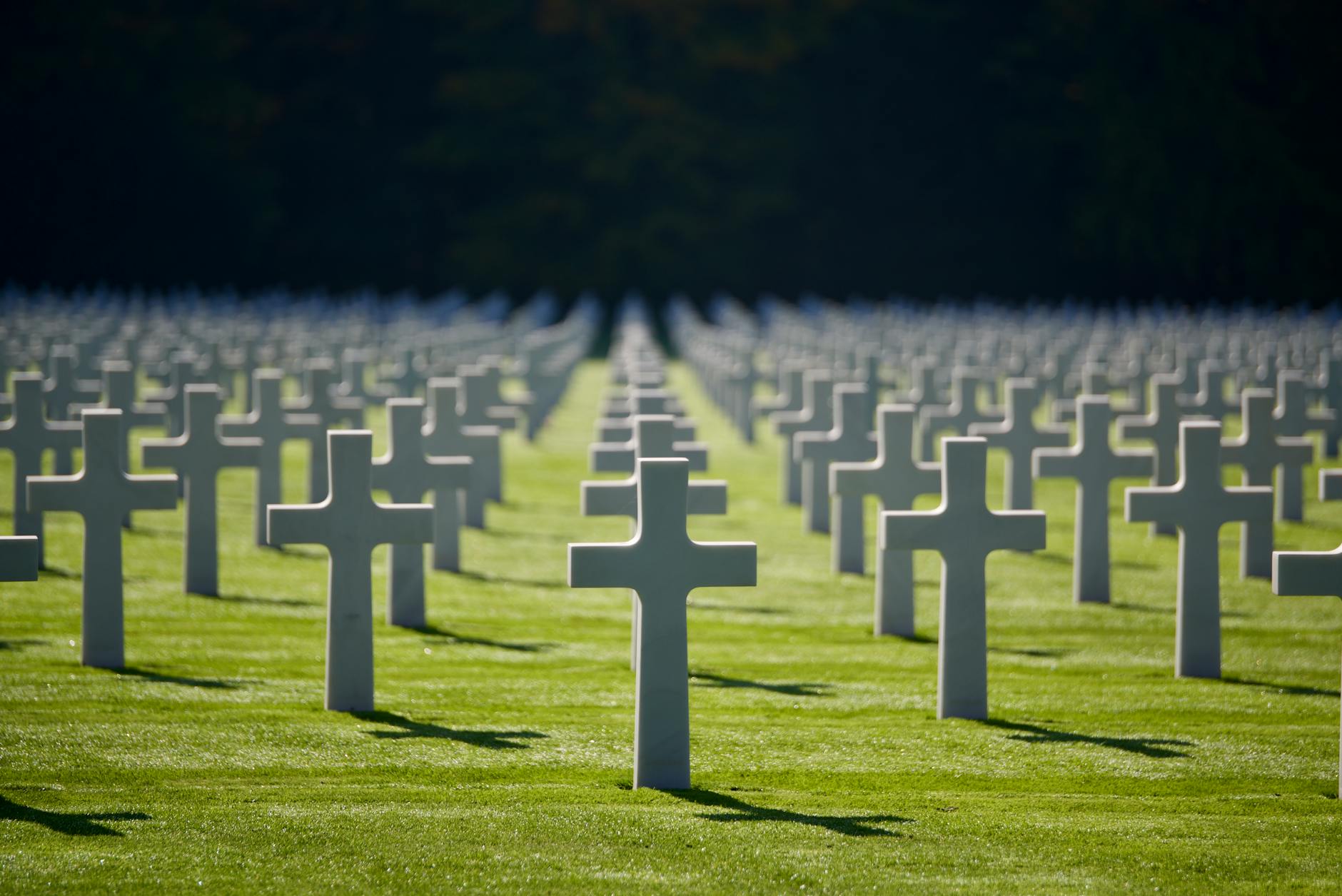
But, there are also the poignant images of the Allied and German cemeteries filled with crosses.
Picture those rows of white crosses, be immersed in the silence.
Rows and rows of white crosses.
Take the command to love one another seriously.
Row upon row.
Understand that Christ went to the cross to overcome our separation from God and from each other.
Rows and rows and rows of white crosses.
If only this commandment was followed and the sacrifice understood all around the world then maybe, just maybe, the glimmer of hope given by the light of Christ will stay lit, not all will be lost and we would actually be able to allow Remembrance Day to fulfil it’s dream and truly mark the end of war!
 Just because