Gratitude

The passage from Luke 17:11-19 about the ten lepers clearly corresponds with the passage from 2 Kings in which Naaman the Syrian is healed of leprosy through Elisha the Prophet.

Leprosy in Jesus’s time was a deadly skin disease. Anyone who caught it had to live away from the healthy people and had to keep a distance away. Most would join a group of other lepers and be part of a leper colony.

When the lepers call out to Jesus, they call him “Master” – just like the disciples do.

In a similar way to other instances of lepers cleansing or healing, Jesus sent the lepers to the priests to confirm the healing.

The law was that if a leper was cured, they had to go to the priest to be inspected, and if they were healed (clean), the priest would give them a certificate. Only when they have the certificate would they be allowed back into society.

Jesus sent these ten lepers to the priest before the healing took place. They were required to obey and step out in faith to be healed; and they were healed whilst on their way to the priests.

God is at work when Jesus notices and heals hurts and brokenness that are not noticed by others.

Those living on the edges of our community, who are treated as invisible because of how they look, who they are, or where they come from. Jesus notices them and loves them and calls us to do the same.

But Jesus also notices the parts of ourselves that we hide, and he heals our hidden brokenness.

Jesus cares for the marginalised. In this example of the ten lepers, at least one of them was not a Jew.

After the ten lepers were healed, and once they had their certificates from the priests, they were free to go their own way, even to rejoin their families.

Ten were healed, and one returns full of gratitude and thanksgiving. That one, as it turned out, was a Samaritan, and Jesus said to them, “Your faith has made you well (saved you).”

Jesus’s life is full of people glorifying God – from the shepherds at his birth to the centurion at his death. Here, as in many other instances, it is as a result of Jesus’s work of healing and restoration.

The right response to Jesus is to praise and glorify God.

The Samaritan recognised God at work. He understood that to thank Jesus is to glorify God. He gave the response of faithful recognition and gratitude.

All ten lepers were willing to go to the priest in faith, but only one was filled with true praise and thanksgiving.

Jesus noticed that nine of the lepers did not return to give thanks. He notices our ingratitude.

There is no reason to assume that the other nine lepers were not grateful: they may have just been too wrapped up in their relief and amazement to even think of returning to give thanks to Jesus.

But one did return to Jesus. He recognised his gratitude and returned to say thank you and to form a relationship with Jesus.

It is one thing to offer words of thanks or feel thankful, but gratitude is a state of mind which transforms us.

The leper was transformed physically, emotionally, and socially. Jesus wants to physically, emotionally, and socially transform us too.

Ingratitude is a horrible thing. It is the enemy of the soul.

St. Paul tells us we should give thanks in all circumstances. Part of the vocation of any Christian is to give thanks and praise.

We can always find reasons for gratitude before God.

The nine lepers who leave without acknowledging Jesus highlight how blessings can be missed when gratitude is absent.

A blind boy sat on the steps of a building with a hat by his feet. He held up a sign which read, “I am blind, please help.”

There were only a few coins in the hat – spare change from folks as they hurried past.

A man was walking by. He took a few coins from his pocket and dropped them into the hat. He then took the sign, turned it around, and wrote some words. Then he put the sign back in the boy’s hand so that everyone who walked by would see the new words.

Soon the hat began to fill up. A lot more people were giving money to the blind boy.

That afternoon, the man who had changed the sign returned to see how things were. The boy recognised his footsteps and asked, “Were you the one who changed my sign this morning? What did you write?”

The man said, “I only wrote the truth. I said what you said but in a different way.”

I wrote, “Today is a beautiful day, but I cannot see it.”

Both signs spoke the truth. But the first sign simply the boy was blind, while the second sign conveyed to everyone walking by how they should be able to see…

When life is full of difficulty it can be hard to be full of gratitude. When things are going well we take it for granted.

Gratitude is a habit; a way of looking at the world and all the good things in it with appreciation regardless of whether we are going through the good times or the bad.

Gratitude is a heart-centred approach to being at peace with yourself, others, what you have, and the world around you.

We need to practice gratitude and give thanks and praise to God in all we do, and think and say.

Gratitude

The Spirit Of God

The union between the Father and the Son is such a live concrete thing that this union itself is also a Person. I know this is almost inconceivable, but look at it thus. You know that among human beings, when they get together in a family, or a club, or trade union, people talk about the ‘spirit’ of that family, or club, or trade union. They talk about its ‘spirit’ because the individual members, when they are together, do really develop particular ways of talking and behaving which they would not have if they were apart. It is as if a sort of communal personality came into existence. Of course, it is not a real person: it is only rather like a person. But that is just one of the differences between God and us. What grows out of the joint life of the Father and the Son is a real Person, is in fact the Third of the three Persons who are God.

This third Person is called, in technical language, the Holy Ghost or the ‘Spirit’ of God. Do not be worried or surprised if you find it (or Him) rather vaguer or more shadowy in your mind than the other two. I think there is a reason why that must be so. In the Christian life you are not usually looking at Him. He is always acting through you. If you think of the Father as something ‘out there’, in front of you, and of the Son as someone standing by your side, helping you to pray, trying to turn you into another son, then you have to think of the third Person as something inside you, or behind you. Perhaps some people might find it easier to begin with the third Person and work backwards. God is love, and that love is, from all eternity, a love going on between the Father and the Son.

C.S. Lewis Mere Christianity

Today1 we are celebrating the feast of Pentecost. A regular feature of Pentecost tends to be a talk based on the Acts reading, Joel’s prophecy and tongues of fire.

And so, I am going to talk about our Gospel reading from John; where Jesus us reassuring the disciples that this is not the end of their relationship with Him. They would not be abandoned or left helpless as Jesus was going to the Father to send the Holy Spirit to be with them … and us.

Jesus said, “Believe in God, believe also in me”. This is a fundamental relationship of trust.

Jesus graciously left the gift of His peace. He said, “Peace I leave with you, my peace I give you”.

True peace is not derived from circumstances, people or things; true peace is derived from Jesus. His peace is peculiarly His to give as He purchased it with His precious blood. Jesus was the substitution for a perishing world. Jesus was commissioned to bring peace to mankind.

Jesus is The Way!

To know Jesus is to know both the way and the destination, which is communion with the Father. In order to complete His atonement for our sin Jesus had to leave and return to the Father. But Jesus leaving is linked to the role of the Holy Spirit – the Helper Jesus had referred to previously.

Jesus was returning to the Father to prepare a place for us.

Jesus is The Way, The Truth and The Life!

Jesus in His life, ministry, actions, everything that He did showed us GOd. Now it is time for Him to return to the Father, He promises the companionship of the Holy Spirit so that the disciples, and us, will be able to continue in Jesus’s way of doing things.

We can only understand and know the Holy Spirit if we know and understand the unity of the other two Persons of the Trinity – the Father and the Son. The Holy Spirit is often thought of as this bond of love between Father and Son.

Jesus describes the Holy Spirit a “another Advocate to be with you forever”. The love of the Father and His desire to be reconciled with His creation is what led to Jesus’s incarnation in the first place and is the reason for God sending the Spirit to us; God is our Advocate – the one who is by our side, no matter what, no matter which persona of the Trinity (Father, Son and Holy Spirit) it is.

The Holy Spirit is the Spirit of Truth and will be in us – not just by our side.

This Spirit is in us, united with us, the way the Father and the Son are united in each other. This bond with the Spirit enables the Spirit to be our guide in life just as Jesus did the will of God His Father.

The Holy Spirit is our guiding light – our tongue of fire – if the Spirit dwells in us.

But because it is the guiding light for those in whom it dwells, the world cannot receive the Spirit. The world refuses to see the Spirit of Truth alongside them, tapping them on the shoulder with a call to repentance. They do not want to return to being God’s original and beautiful masterpiece. They only see their own gain and not the loveliness of God.

If we can see it in Jesus, if we can see that the Holy Spirit is by our side and in our lives. If we can recognise the real truth and call upon our God to help us do the things He would have us do, then we will know the presence of God within us and His guiding light before us – our tongue of Spirit fire.

Tongues of Fire
  1. 8th June 2025 ↩︎

Do You Want To Be Healed?

John 5:1-9

This short but potent passage from John contains themes of healing, restoration and the transforming power of faith. It symbolises humanity’s need for divine intervention and the opportunity of spiritual renewal through encountering Christ. The pool represents the need to seek God’s grace and trust in His ability to heal both physically and spiritually.

The man in this passage had been unable to walk for 38 years and had given up hope that he could be healed.

From John’s brief account and if we were to read on further we can ascertain that this inform man was old (well over the life expectancy of the time), a dependant who was unable to care for himself, he liked to complain and put the blame on others, he was an unrepentant sinner who was ungrateful and disloyal.

Jesus’s healing of this man would have been at the direction of God the Father and is an example of God’s complete and utter grace.

God saves sinners.

God saw us in our hopeless, helpless condition and rescued us. He gives hope to the hopeless and help to the helpless.

Jesus cares about people even when problems make them feel hopeless or sad.

Jesus healed the man and he was able to walk again.

Jesus brushes off the excuses of the lame man. Don’t make excuses – work around them.

We wait too long to ask for healing. Instead seize the moment and ask God to work in your life. It’s not easy to live with illness and hope for healing.

Spiritual healing may occur without physical healing. A positive outlook in the face of our own disease or injury, and as our bodies age, is a miracle in itself. We have to do our part to maintain good health. Small changes to improve our health is part of the healing process.

God helps those who can not help themselves.

God helps those who see their inability to save or help themselves, who turn from self to the saviour and trust in God.

All the healings Jesus performed remind us that God saves sinners.

Without God it is impossible for man to save himself.

We need God to give us feet to walk in His ways, we need to receive eyes to see His truth and have strength to walk in obedience to Him.

This is a picture of God’s initiative in salvation and He saves us by His grace.

Jesus saw the man. He knew him. He spoke to him.

God sees us. God knows us. He then speaks to us.

Jesus came to give us life abundantly.

Healing

Advent Is For Life Not Just For Christmas

Our reading from Luke (Luke 21:25-36) today is part of a longer apocalyptic teaching. So, why are we starting Advent with these warnings instead of with the message that a baby will be born?

Well, Advent doesn’t just precede Christmas when we remember the birth of Jesus. Advent is that time of waiting, of preparation, of making sure we are ready. It is about preparing our hearts and opening our minds.

But we are not just ensuring we are ready for baby Jesus. We also need to be ready for when Jesus comes again.

Advent is for life, not just for Christmas!

It is about being ready for Jesus, for watching and waiting and preparing for Him to come, both as a baby and when He comes again in glory. We must be alert, ready for the coming of the end. Not caught up in the commercialisation, the excess and the worries of the day but remaining ever watchful, confident and eager for the events Jesus tells us of – the signs that our deliverance is nigh. That He IS come again.

We all know what waiting is like. In smaller concepts there’s waiting for a bus, waiting for an appointment, waiting for the right vicars to be called to Sheppey. Sometimes the wait seems interminably long…

… and yet it does come to an end with fulfilment as that bus, appointment, those vicars, anything else we’re waiting for … Ashley’s Amazon parcels, the shopping, all arrive.

And they don’t always arrive when we expect them – sometimes the waiting is dragged out and they are a bit (at least in our eyes) late.

But then they arrive and that moment of waiting, that moment of expectation, changes into certainty, realisation and fulfilment of what we have received. No one waits without good reason. How long we wait is determined by the reward at the end. And Jesus is the greatest reward!

So we wait, patiently, trusting in God as we wait.

Waiting faithfully and being prepared, for our Lord will come again – but only God knows the exact day and time. We wait patiently through suffering for the wait is worth it.

Often people fill the waiting with distractions and keep busy to avoid the waiting. How easy it is to miss the very thing we are waiting for if we do that; because we are paying attention to the distractions instead of watching and waiting.

Advent is taking time, slowing down, opening our minds, being prepared to change.

It is the chance to wait and change our lives. Don’t miss that by running around. Instead get our hearts ready for Jesus to be in our lives more fully that ever before.

We must trust and be prepared to trust.

We must trust God in both the good and the bad times.

Take a step back, let God into every situation, listen to His guidance, pray on it, trust and wait.

We know God’s promise will be fulfilled. We must trust in His promise with faith and prayer.

We must be ready as we wait.

If Jesus returned tomorrow, or even this afternoon, are we prepared? Do we put enough planning and preparation into being ready for Him?

Make time for God. Live how Jesus wants us to live. Ask yourself what would Jesus do? Are our hearts and minds focussed on Him? Are we ready?

Tradition is actually the passing on of belief – despite the vernacular it isn’t staying the same or doing things this way because that’s how they were done 20 or 30 years ago. No! It’s actual meaning is the passing on of belief. If we are not ready we could miss out. Pass on the belief so all God’s children can be ready. Keep an open mind. Think and be prepared.

Faith is about going deeper in our personal journey with Christ. Know Jesus and be open to Jesus.

Ensure we have what we need to be prepared so that, no matter what day or hour He returns, we are ready. Don’t be complacent.

Keep relationship with God, and work on it doing God’s will every day.

Advent is a time when we have to look at our lives. Do we accept forgiveness and follow Him?

Humans are very good at procrastination.

Procrastination is very different to waiting.

So, humans procrastinate, run out of time and think I’ll do it tomorrow. But tomorrow might not come, the chance might never come again.

We must respond to God immediately when He calls us.

We must NOT be resistant to change or let rituals become idols.

Don’t procrastinate. Prepare now and keep the preparation ongoing.

Be ready and continue to be ready.

For God’s time is not our time but His promises are always kept. Jesus came, Jesus IS coming again!

So again I say, Advent is for life not just for Christmas!

Advent

Advent

How many of us have Advent Calendars, and the accompanying daily chocolate?

Interesting isn’t it? Advent is synonymous with Lent and yet this is the difference between them – for Lent we attempt to give something up but in Advent we excitedly open doors and eat chocolate.

Lent is a time when we aim to cut out the distractions, preparing and making ourselves ready for the work Jesus has for us and for Him to be in our hearts.

Advent is a time when we have to look at our lives and make a choice. Do we accept forgiveness and follow Jesus; preparing and making ourselves ready and cutting out the distractions?

Or do we allow ourselves to get swept up in the commercialism, the busyness, the chaos, the overindulgence, the excess food, the drama, the darkness? It is easy to do – there is, after all, so much of it all around us.

Are we ready?

No, I don’t mean do you have the tree and decorations up, presents and cards all wrapped/written/sent, parties organised, invites sent, that Christmas food shop booked and all the other activities we think of when we use the term festivities.

Are we ready for Jesus?

This passage from Mark* is full of imagery. Jesus was talking in a way that the Jews of the time would understand. There are however, several key points.

The first is that Jesus is foretelling the second coming – that He will come again. He does not know the exact time of His return but He will be returning. This is an excellent example of faith and trust in God. Jesus knows that if God has told Him He will come again that will indeed happen. Jesus does not need to question all the finer details.

Jesus was also foretelling the destruction of the Great Temple in Jerusalem and the fall of Jerusalem. When Jesus says “this generation will not pass away until these things happen” it is this destruction that He is referring to. And this prophecy was indeed fulfilled when Jerusalem and the Temple were destroyed in 70AD.

We do not need to doubt Jesus prophecies. We know they will come to pass. We know He will come again.

Jesus likens us to men who know that their master is coming but who do not know exactly when he will arrive. We do not need to be afraid of this. But we must live our lives in a way that means we are ready no matter when He arrives. Every moment of every day becomes a preparation for the moment we meet Him face to face.

The next point is that, of all things, it is most foolish to be so wrapped up in earthly distractions that we forget God. The wise are those who never forget that they must be ready when the summons come, so that, for them, the end will be eternal joy.

“Come, Lord Jesus, come quickly. We long for the day, when we will see your face, we will be with you, you as our light.” This prayer sums up waiting for the Lord and the fulfilment of God’s plan. No one waits without a good reason and how long we wait is determined by the reward at the end. Jesus is surely the best reward.

The farmer does not know (exactly) what day the rain will come or the crops be ripened but the farmer knows they will and waits patiently and faithfully, ready and prepared for when that time comes. Likewise, we must wait patiently and trust in God whilst we wait, faithfully and prepared.

But when we are waiting for something how do we wait? Do we fill our lives with distractions and keep busy to avoid the waiting?

We have the chance to wait and change our lives but we miss it by running around. We forget our heart.

Do we use advent as a time to slow down as we prepare for Jesus to be born again in our hearts at Christmas or do we rush around more than ever letting life get more and more hectic?

Advent is a time of preparation and waiting. A time to slow down and open up – opening up our hearts and minds.

Advent is a time for prayer. A time for tradition – by which I mean it’s actual meaning of sharing and passing on belief. It is about going deeper in our personal journey with Christ. It is a chance to reset and ensure we have what we need to be prepared so that we are ready no matter what day or hour He returns. It is a time to stop being complacent. A time to keep relationship with God and work on it; doing God’s will everyday.

Advent is a time to put our hearts right with God and prepare them. Are we ready to use this Advent to prepare ourselves so that we are always ready for Jesus’s return and ready to welcome Him into our hearts once again?

*Mark 13.24-37

Light of the world

First or Last

One of the things that this country is famous for is queuing. We’re all guilty of it – we all end up queuing at some point or other. From what I’ve been told, and seen on the news, some people will queue for hours – many many hours – for something they feel is important to them. For example, paying respects to our late queen.

And we’re not happy when people queue jump, are we? Remember the backlash to those two ITV morning television hosts doing it.

Yet here Jesus says the last shall be first and the first will be last. Not only that but He tells us that the workers all received the same pay. Those who only worked for one hour received that same amount as those who worked for the entire day!

If we take this literally, to us, it seems a bit unfair and contrary to our knowledge of God as a fair and generous God.

But! We are not supposed to take this passage literally. It is important to remember that Jesus taught in metaphors and stories. And, Jesus us telling this parable to explain several things:

Jesus uses this parable to further explain what the Kingdom of God is like and to highlight God’s continuing care for His people. He is also highlighting the importance of choosing eternal life with Him over the temptation of worldly wealth whilst teaching His disciples to serve others. Greatness is not ruling over others but serving others. Jesus came to serve – not to be served.

In the Kingdom of God all are treated the same.

Everyone comes to faith (the vineyard) at different times of life.

Some are “lifelong” followers, or disciples, of Jesus. Some find Jesus much later in life.

It is never too late to find faith, belief in Jesus, and to begin living faithfully.

God wants ALL people to have faith in Him and return to a life with Him. Not all do; but that does not mean we should give up. We should continue to persevere, to spread the word, to live by Jesus’s example and plant those mustard seeds to continue to draw others back to Christ.

ALL believers, who repent, no matter how long or how hard they work during this lifetime, will receive the same reward:

  • eternal life
  • God’s grace
  • God’s forgiveness and reconciliation with Him

However, we must be careful not to compare and become envious of others and what we perceive they have been given (thinking they are being given more that they’ve earned).

It is not really possible for us to see what others have experienced as they serve God. We cannot see their inner conflicts or their background struggles. Neither can they fully see ours.

In the end, all of us truly need to trust God and know that all we have is from His grace, which He has freely given.

So, going back to that queue, it doesn’t matter if we are at the front, the back, or in the middle! It doesn’t matter at what age we found Christ. God freely gave us His grace and what matters is that we did find Him. Regardless of where we are in that “queue”, if we turn to Christ, follow Him, reject evil and repent our sins then God forgives us and we are reconciled with Him.

Talk given at Holy Trinity Sheerness and Minster Abbey 24th September 2023 (Matthew 20:1-16).

People queuing

A Journey of Truth and Faith

(Talk on Luke 24:13-35 23rd April 2023)

This passage from Luke teaches us a lot about truth and faith. It is, in both a literal and a spiritual sense, about journeys. Literally, it is about two disciples (followers of Jesus) walking from Jerusalem to Emmaus. Spiritually, it is about their and our journey from not knowing Jesus to truly knowing Jesus and sharing our experiences of Jesus. It is about rediscovering Christ’s presence in our lives, gaining a fresher understanding of God’s transforming grace, allowing our hearts to be ignited with the Holy Spirit as we too walk with Christ.

The Bible makes very clear and specific statements about Jesus. As the disciples walked along they were discussing the scriptures and the recent events that had happened. When Jesus appeared to them they were walking the wrong way – away from Jerusalem. They were preoccupied with their own difficulties, overwhelmed with sadness, grief and hopelessness. They were unable to identify God’s purpose in what had happened.

Humans like to know reasons for…well everything. We ask (both aloud and to ourselves) why? We analyse, we interpret, we assume, we conclude. And we use the answers as a Sat Nav! What we decide the answers are determine/direct what and where we do/go next.

The disciples did not fully understand the Scriptures or the meaning of what had happened to Jesus. They had knowledge but it was incomplete and not understood. It was not true knowledge of the right information.

Jesus appeared and started to walk with them. They did not see Jesus. They were kept from recognising him. The Risen Christ walking with them on their journey, but unrecognised, igniting the fire of God’s love in their hearts. Like the Footsteps poem when there is only one set of footprints (because Jesus is carrying us).

But, this enabled Jesus to impart true knowledge. He explains and interprets for them. This teaches us that the key to interpreting the Old Testament is Jesus.

Jesus explained everything from Moses to the prophets, how the Messiah would save God’s people through His death and resurrection, rescuing a sinful, unholy people by reconciling them with The Holy God.

Jesus is the Messiah whose life, death and resurrection grants us salvation. Jesus Himself told us “I am the way, the truth and the life, no man comes to the Father except through me”.

God cannot be near sin. The only way for us sinners to be reconciled to Him was for Jesus to become sin, be punished for our sin, to die and defeat death; so that through His resurrection we could, with faith and repentance, be forgiven and have a relationship with God.

But it is not sufficient to just know the facts. We must also believe in that knowledge, we must truly believe in Jesus and in what He taught. Like the disciples recognising Jesus (when He broke the bread) and rushing back to tell the others, we have to open our eyes in faith. If we believe in Him then we strive to be in His image and this is shown in how we live. We need to believe in God’s word and be motivated by faith. We know God fulfils His promises but we also need to believe this. We know He is always with us, all the time, especially those times when we only see one set of footprints. But, we also need to believe this.

There is a story that gets quoted a lot so apologies if you, like me, have heard it used before:

There was a young boy caught in a house fire and forced to flee to the roof. The father stood on the ground below with outstretched arms, calling to his son, “Jump! I’ll catch you”. He knew the boy had to jump to save his life. All the boy could see was flame, smoke and darkness. The boy was too afraid to leave the roof. His father kept yelling “Jump! I WILL catch you”. The boy protested “Daddy, I can’t see you” The father replied, “But I CAN see you and that’s all that matters”.

Reece Sherman’s Faith Lessons

Do we understand truly? Or do we rely on our assumptions? Do we truly believe and trust in God? I pray that we do.

God is always there for us and will catch us. He can see us even if we cannot see Him. Do we have enough faith to jump into those life saving arms? I pray that we do.

Thank you.

Poppet on a journey, running through grass

Witnessing and Doubting

(Talk given at Minster Abbey 16th April 2023)

So…witnessing and Doubting Thomas!

The other day I read that the public (according to the newspapers) claim the church do not promote Easter as much as Christmas. Easter and Christmas… two very important events for us – Christmas the celebration of the birth of Christ, the incarnation, God becoming man to save us…and Easter where Jesus is sacrificed in our place to defeat death, rise again, and enable us to be forgiven for our sins and reconciled with God.

So I thought about this and here’s a couple of comparisons:

The Church

At Christmas:

  • Advent – 4 Sundays
    • Hope, Prophecy, Patriarchs
    • Peace, Bethlehem, Prophets
    • Joy, Shepherds, John the Baptist
    • Love, Angels, Mary
  • Carol Service
  • Christingle Service
  • Crib Service
  • Midnight Mass
  • Christmas Morning Service
  • Candlemass

At Easter:

  • Ash Wednesday Ashing Service
  • Lent – 6 Sundays
    • Invocabit
    • Reminiscere
    • Oculi
    • Laetare
    • Judica
    • Palm Sunday
  • Maundy Thursday Service
  • Good Friday Pilgrimage and Gathering at the Cross
  • Stations of the Cross
  • Holy Saturday Vigil/Service of Light
  • Easter Sunday Service
  • Ascension
  • Pentecost
  • Corpus Christi

Versus

What I think is most appropriate to call commercialisation:

Where Christmas is promoted with:

  • Father Christmas
  • School Nativity Plays
  • Carols
  • Christmas number ones/Christmas songs
  • Grottos
  • TV Ads
  • Work Dos/Christmas parties
  • Decorations
  • Cards
  • Presents
  • Trees
  • High Street decorations and lights
  • Shop displays and more decorations
  • Christmas dinner menu options at pubs and restaurants for approx. 2 months
  • Pantomimes
  • Etc

And where Easter is promoted with:

  • Chocolate and chocolate eggs
  • The Easter Bunny
  • TV Ads but on a smaller scale
  • Small shop displays normally in seasonal aisles
  • Small amount of Easter decorations
  • Small amount of Easter cards
  • Easter dinner menu options for 1 day

In my opinion, having compared the aforementioned; the media, yet again, is showing a biased and incomplete picture. The evidence suggests that on the contrary the church does more at Easter but the sway of commercialisation makes the commercial version of Christmas more widely known.

This needs to be combated, but how? Simply, we need to follow the instruction and example of Peter in Acts and go out and witness, spreading the good news of the true meaning of both Christmas and Easter, sharing what, through love, Christ did for us and the joy of His resurrection with all it’s connotations of redemption.

Meanwhile, where does Thomas fit into all this?

Personally, I feel sorry for Thomas. I think he got a bit of a rough deal. Thomas the Doubter…in actuality he was a fervent believer yet what do we remember him for – doubting – the one who wouldn’t believe without seeing for himself and touching his beloved Master’s wounds.

Maybe, despite it being unfair, one of the reasons we remember Thomas specifically for this event is because it shows us that doubt is okay!

Doubt is something we all experience at some point and in reality, faith and doubt can and do co-exist side by side.

Thomas was not evicted from the group of disciples for his doubt. He was not condemned by Jesus for his doubt. He continued to be a valued part of the disciples as they stayed together, discussing all that had happened, sharing meals, continuing to accept each other.

Thomas had not been there when Jesus had appeared to the group of disciples initially. What was he doing? Where and why wasn’t he there are interesting questions.

BUT, it occurs to me that maybe, just maybe, he wasn’t there so that God could use him for the benefit of those too scared to admit their doubt both then and now.

Thomas only doubted for one week! He then met the risen Jesus and believed. In fact, he believed so fervently for the rest of his life that he was killed (or martyred) for his belief. Yet, still, he is referred to as “Doubting Thomas”.

One small brief moment of doubt, one incident, one mistake, one failing – and a label is applied – something that is still very much done today. And, whilst that person learns, believes, repents, changes, moves on, that label sticks.

Instead of calling Thomas “Believing Thomas” – a far more accurate name/label; because of that one brief moment of doubt he is known as “The Doubter”.

Through this and through Thomas, maybe God is teaching and reminding us that we should not label people. That we should allow people to change and accept that people do change. That we all make mistakes but when we repent God forgives us; likewise when others make mistakes we should allow them to repent and forgive them.

One more thing: asking questions.

There is a common phrase heard in classrooms and training rooms throughout the land:

“There are no stupid questions” and “if you ask a question most of the people in the room are probably thinking it and are just too scared to ask”.

Children in particular ask a lot of questions and, whilst these are often ‘when or what is for dinner?’, they often ask the really big questions:

  • What is God’s name?
  • What does God look like?
  • What does it mean to be reborn?
  • How is Jesus alive?

The questions children, and indeed some adults, ask are, in their own way, blessings. They make us think and help us gain deeper understanding and insight together.

The person that both expressed the doubts of everyone and asked the question everyone else was thinking was Thomas. For this we owe him a great deal for if the question had not been asked the answer would not have been given. Thomas the Brave who said to Jesus “Lord we do not know where you are going. How can we know the way?” To whom we owe thanks for Jesus’s answer “I am the [only] way [to God], the [real] truth and the [real] life, no one comes to the Father but through me”.

Thanks to Thomas we know it is okay to be honest about our doubts as well as our faith, we know that labels do not reflect who people truly are and we can realise how questions can lead us to deeper knowledge and growth. Thanks to Thomas, who believed because he had seen, we can see because we believe.

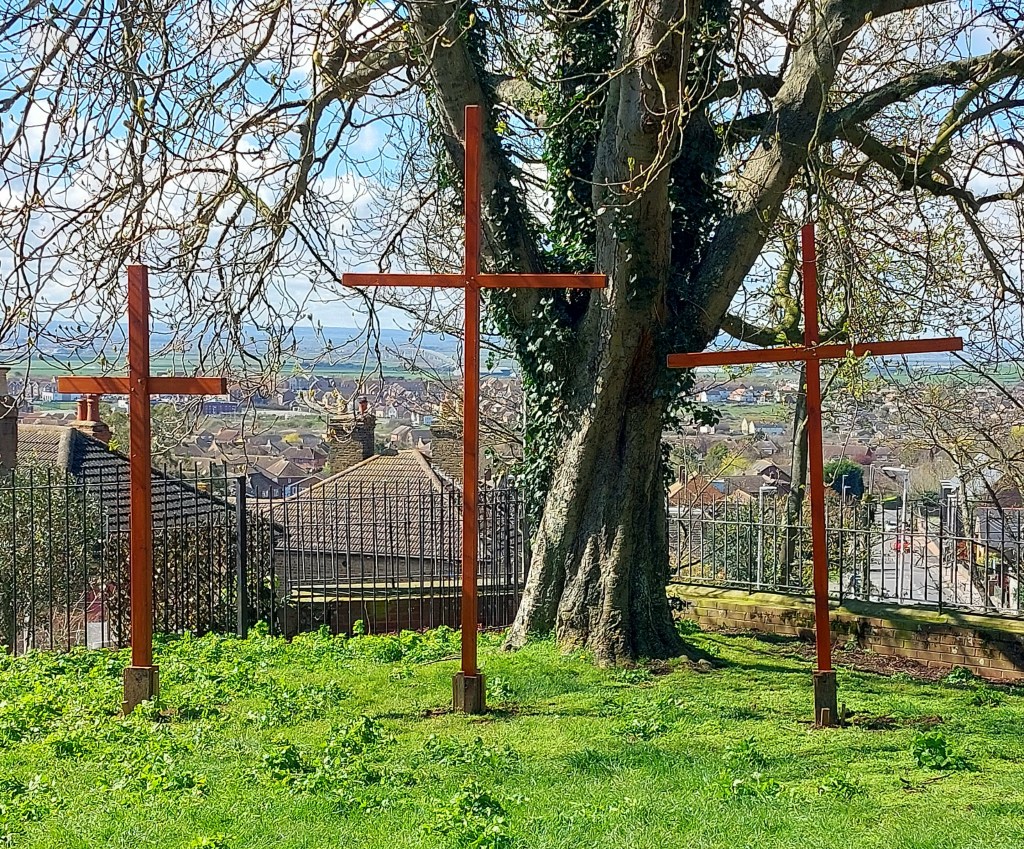
Three crosses

Easter Spoilers

Talk from 26th March (John 11:1-45)

Who likes reading spoiler alerts to find out what will happen ahead of the next episode?

Who avoids them like the proverbial plague? Ah okay, you might want to put your hands over your ears then because in some ways this passage from John is a little bit like a trailer or spoiler for two weeks time!

Today we hear about and celebrate the resurrection of Lazarus. In two weeks we hear about and celebrate the resurrection of Jesus.

There are lots of parallels in this story pointing towards what was going to happen. John even mentions at the beginning of this passage an event (Mary anointing Jesus’s feet) which does not occur until after the resurrection of Lazarus.

Jesus was very clear right from the beginning that EVERYTHING He does is for the glory of God. His wisdom and knowledge far exceeds ours.

It was still difficult for Martha and Mary that Jesus did not immediately drop everything and come to them upon hearing that Lazarus was severely ill.

Today’s society tend to want everything immediately. Patience and waiting are hard. Whilst I know that waiting times for ambulances are much longer than ideal at the moment; how many of us have to wait over two days before one leaves to attend to us?

But Jesus knew what He was doing and so He waited. Once the time was right He told the disciples He was going back to Judea. The religious leaders there already wanted Jesus dead and this worried His disciples. Ironically, it is Thomas (later to be known as the doubter) who persuaded the disciples to accompany Jesus even if it meant death.

Jesus is the Light of the World. As He says, if we walk during the day (in the light) we will not stumble because we see (have) the light of the world (Jesus).

Those who walk at night stumble because the Light (Jesus) is not in them.

By the time Jesus arrived, Lazarus had been in the tomb for four days.

Decomposing!

Stinky!

Yuk!

Martha (the sister who in another passage we are told did all the chores whilst Mary sat listening to Jesus) heard Jesus was on His way and came to meet Him.

Martha says “Lord, if you had been here…” Martha knows and believes that Jesus has the power to heal. Is she declaring her faith? Or is she displaying anger that Jesus was not there in time to stop Lazarus dying? Jesus tests her and she proclaims her faith and her belief.

Jesus is the resurrection and the life and He was about to prove it whilst showing, again, through this miracle that Jesus is the Giver of Life and the Saviour. He was also showing His followers a preview of how He would be defeating death.

It is important that we understand the relevance of Lazarus having been in the tomb for four days. Jesus had raised people to life before after all, so we need to know what makes the resurrection of Lazarus so different.

Well, previously when Jesus had raised people from the dead the timescale between their death and resurrection was a great deal shorter.

Jesus needed this miracle to be determinate.

To help us understand let me explain that at that time people believed that a person’s spirit left their body on the third day after their death. On the fourth day there is no doubt. The person is really dead. Not sleeping. Dead Dead!

This was important as it meant there could be no dispute over the fact that Lazarus was actually dead before Jesus resurrected him.

Martha went to Mary and told her “The Teacher is here”. Jesus is the Ultimate Teacher. Mary went to Jesus and used the same words as her sister, “Lord, if you had been here …” Mary and the Jews with her wept. Jesus wept. But, Jesus was not mourning Lazarus. Jesus knew all along that He would be raising Lazarus from the dead. Jesus wept for those who did not understand. He wept for those who had lost hope. He wept at the sight of the very suffering He came to save us from. Through Jesus believers are to grieve with hope.

Jesus went to the tomb, He called for the stone to be moved away. The stench of death was all around. Jesus prayed. He did everything with prayer. He knows God always hears Him and thanks God for this. But He also needed the crowd to see that God had sent Him and that He was acting with God’s authority.

Jesus called out in a loud voice “Lazarus, come out!” Jesus has compassion for each one of us and calls us by name.

Lazarus came out still bound in the burial cloths BUT no longer a rotting corpse. Instead he was fully and completely healed. Jesus told the crowd to unbind Lazarus and they helped free him.

Lazarus, a new creation, freed from the tomb and welcomed back to life.

Jesus died to defeat sin and death, the Ultimate Sacrifice and our Saviour is raised from the grave so we can be forgiven and reconciled with God.

Not only that but Jesus came to have a relationship with EVERYONE, not just the Jews.

So how does that affect us. Basically, we cannot experience the resurrection unless we experience death. By this I mean that we cannot accept new life in Christ, if we do not allow our old, sinful lives to die.

We need to let go of whatever is holding us back, whatever is stopping us from being a new creation in Christ.

Let us hear Jesus calling us by name, let us say goodbye to what is holding us back, let us leave the tomb and walk in the light of Jesus.

And more than that, as we are told in Romans; by believing and having faith in Jesus, what He has done, is doing and will do, we are able to take part in bringing glory to God in all we do.

Let us give Him the glory, great things He hath done.

Stone Cave

Cake

Cake is really the simplest thing to bake.  Obviously I am talking about really basic cake (like what I bake) and not the really amazing designs you can buy from experts for special occasions.

It follows the basic rule of three (like The Holy Trinity):

  • 150g butter (3×50g)
  • 150g sugar (3×50g)
  • 150g self raising flour (3×50g)
  • 3 eggs (3×1)

Mix it up and bake in the oven till cooked – yum yum yum.

So with cake being so popular in today’s society, if Jesus came to us today, what if He said “I am the cake of life” instead of “I am the bread of life”?

Would it have the same effect? Would it have the same meaning? Would it be more popular?

Okay, so we know that unless someone really hates cake the likelihood is that it would definitely be more popular. The thought of being able to live on cake is certainly popular around here.

But Jesus wasn’t trying to win a popularity contest. He came to save us. And if we are honest, if we want to be healthy, we can’t actually just eat cake (sadly). We have to accept that we must eat healthy food to live. So cake goes back to being bread and for this we are thankful as the sacrifice of Jesus and God’s forgiveness saves us from spiritual death. Trust in God and He will provide for us and sustain us.