

In Genesis 28, we catch up with Jacob as he is fleeing for his life. To say he’s been a bit of a naughty boy would be an understatement and his brother Esau (possibly along with a few others) are wanting to kill him.
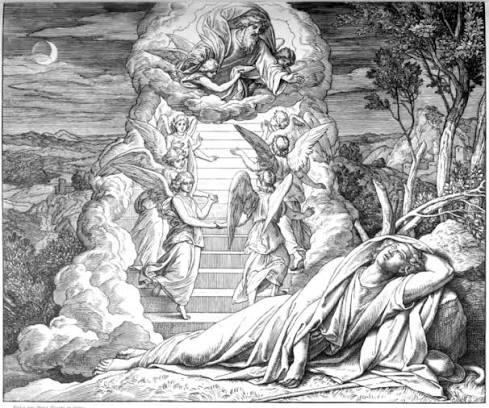
As the sun had set Jacob stopped for the night and found a flat stone he could use as a pillow before settling down to sleep. And he dreamed that famous dream we refer to as Jacob’s Ladder of a great ladder with its top in heaven and its feet on earth. Angels were going up and down the ladder which reassured Jacob that God was closer than he had realised and that there was interaction between earth and heaven.
It is often asked why we look up at our sky to point our eyes towards heaven and why we think of it being above us. It is imagery such as this which feeds our perception of a literal higher plane as opposed to a metaphorical upness.
As is made clear in John’s Gospel, Jesus is the access to heaven. He is how people can go to heaven and how heaven can come down to people. Jesus is the ladder Jacob saw in his dream.
John 1:51 says “And He said to them, ‘Most assuredly, I say to you, hereafter you shall see heaven open, and the angels of God ascending and descending upon the Son of Man’.”
Jesus is the way to heaven, He doesn’t just show us the way, He is the way. As He said, recorded in John 14:6, “I am the way, the truth and the life. No one comes to the Father except through me.”
God appeared to Jacob introducing Himself as the God of Abraham and Isaac and repeats to Jacob the terms of the covenant given to Abraham, Isaac, and now to Jacob. God gave Jacob the promise of land and descendants but He also promised that He would be with Jacob, protecting him, until all these promises had been fulfilled. God continues to work until His work is complete in His people. God’s blessing and faithfulness to Jacob can be seen in the several ways that His presence was described in Jacob’s life. Jacob woke and declared “Surely the Lord is in this place and I did not know it.”
Jacob therefore renamed the place Bethel meaning House of God. So if you ever wondered what Bethel meant when you see or hear of a Bethel Church now you know.
He was correct in sensing the presence of the Lord but mistaken if he had thought that God was in some places and not others. God is everywhere – as David clearly understood from his words in Psalm 139.
During his dream, Jacob did not use the ‘stairway to heaven’; instead God spoke to Jacob where he was, demonstrating God’s immanent presence. He is not a faraway removed God calling long-distance but an indwelling God right here with us.
This encounter comes completely from God breaking into Jacob’s sleep state bringing a break to his anxious fleeing. At this vulnerable point in Jacob’s life, God emphasizes that He is not only the God of the first and second generation but also the God of Jacob. The reiteration of God’s promise also serves as a powerful reminder that Jacob’s life should not be governed by self-interest but by becoming a channel of God’s blessing to others.
When Jacob wakes from his dream he is a totally changed man and makes a vow showing his commitment to God.
This is the same Jacob who later would be called Israel and whose sons become the start of the twelve tribes of Israel.
From little acorns (or little dreams) great things grow.
Which leads us to Matthew 13 starting at verse 24, a passage which addresses the evil among us, God’s patience and the separation of believers and unbelievers at the end of the age.
The devil places a corrupt presence amongst innocents or in more generalised parlance unbelievers amongst believers. They look like genuine believers and we can get it wrong and mix them up. Only God knows and can tell the difference.
The weeds or tares look just like the wheat until the ears are fully formed and it is ready for harvesting. This is why, to preserve and protect the true wheat, the tares are not separated out until the harvest. This prevents the wrong ones being destroyed when the tares are ripped out and burnt.
Whilst there are similarities between this parable and the parable of the sower from last week, what each element represents and the point of the parables are different. Last week’s parable showed how people receive and respond to the Word of God; whereas this week shows how God will divide His true people from false believers at the end of this age.
The field represents the entire world within which there is good seed representing the true believers and weeds or tares representing unbelievers.
Make no mistake – by unbelievers we don’t mean those who are currently unbelievers but who will believe – they are wheat which is still developing their ears. No, we are talking about the end of the age when it is time for God’s harvest and those who are false believers, unbelieving or counterfeits who have been put there by the enemy – the devil – to try and corrupt true believers.
It is interesting how many ‘children’s stories’ are great works of theology. In 1883, The Princess and Curdie by George MacDonald was published. George MacDonald was a Scottish writer, theologian and preacher, a mentor for Charles Lutwidge Dodgson and a profound influence on J R Tolkien and C S Lewis. In this story, Curdie is given the ability that when he holds someone’s hand he can feel what it’s like on the inside – or how God sees them. Hands that look elegant and beautiful are cold, clammy, rough and coarse. Others, despite looking rough and deformed, are beautiful.
Or take Beauty and the Beast. Handsome Gaston is horrific on the inside whereas the terrifying Beast has beauty deep within. Or, of course, the Empress Jadis from C S Lewis’s Magician’s Nephew, who later becomes The White Witch. Digory reflects that “in all his life he had never known a woman so beautiful…” and yet within she was arrogant, callous and cruel.
It is not our job to weed them out but God’s. We are not to separate the good from the bad because we can only see what people are like now. We cannot see what they will become and we cannot see what is written in their hearts.
Our job is to shine forth hope, to proclaim the Word of life, to speak of the love and forgiveness God has for us, of the power to change and the hope He gives us.
The reapers are the angels and will be sent out by Jesus the Son of Man.
There are two different paths and eternal destinies. A furnace of fire where the crop which came from the seeds of the devil will go and there is the radiant glory where the true believers shine forth as the sun.
The fire of the furnace will not destroy those thrown into it. Instead they will suffer a living torment with great woe, wailing and gnashing of teeth.
The wheat comes into God’s barn from all over the world, from all classes of society and from all ages. Yet all have one thing in common. They were all sown by the Lord from the good seed of His Word.


 Just because