This week we have the passage from Matthew 14 where Jesus walks on water. I have heard many talks that focus on this element of our Lord, who already showed His power over nature at The Cana Wedding before His ministry even began, walking on water.
But I put it to you that that is not what this passage is all about!
What is the biggest realisation you have received? Or, what is the lesson that has most shaped or affected you? Don’t say it out loud just think about it. We’ll come back to this later.
Jesus commands His disciples to get into the boat. He doesn’t give them a choice. Imagine you are sitting at a desk, there’s a paper face down in front of you and a pen. The teacher tells you to turn the paper over. You may not be or feel ready. You may or may not have paid sufficient attention to the lessons. But it is exam time and, for you, like for the disciples getting into the boat, the test is about to start.
In these types of scenarios you know in advance that there will be an exam or test. There is a time of learning before it takes place and, for some, the knowledge that the test is coming up will spur them to a deeper kind of learning, to pay more attention and to put more work in.
Jesus has been teaching the disciples for quite a while at this point. Some of it we are aware of from the Gospels such as The Sermon on the Mount, episodes of Jesus’s healing ministry, feeding the crowds; but there is also the wealth of teaching by Jesus that was not recorded in these four books. Now it is Disciple Assessment Test time to evaluate their progress and understanding.
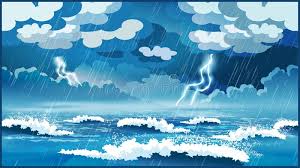
The disciples’ test this week was to be in the form of a storm, not just any old storm but a monster of a storm. The word used in the lectionary translation (New Revised Standard Version) is battered. The boat is battered by the waves. However, the original Greek word used meant demonic torment. The boat was being demonically tormented by the waves. A bit more than just rough weather is being described here!
There are fishermen amongst the disciples, they are skilled at handling boats. Every skill they know for handling a boat in a storm has been tried and the disciples are exhausted. They feel they have failed, been defeated, and are full of despair. At this, the darkest moment of despair, Jesus appears!
Jesus appears at the fourth watch, between 3 and 6 in the morning. The fourth watch is a recurring time of divine encounter in the Bible. It is during those hours that God moved through the sea and delivered Israel from Pharaoh’s army. It was then that Jesus rose to pray alone and then that the stone was rolled away from His tomb.
And so, Jesus appears. In their exhaustion the disciples don’t recognise Him at first; Jesus speaks “Take heart. I AM. Do not be afraid.”
“I AM.”
These two words tell us precisely who Jesus is. We don’t need anything else – it leaves us in no doubt. Jesus tells us over and over again. “I AM” is the covenant name for God (Yahweh) in the Old Testament, a name for God the Jews were very familiar with. Those well versed in Scripture knew exactly who Jesus was saying He was.
I AM the Bread of Life. God the Bread of Life. I AM the Good Shepherd. God the Good Shepherd, I AM the Light of the World. God the Light of the World. I AM the Gate for the sheep. God the Gate for the sheep. I AM the Resurrection and the Life. God the Resurrection and the Life. I AM the Way, the Truth and the Life. God the Way, the Truth and the Life. I AM the True Vine. God the True Vine.
Jesus the I AM – before this world was formed, before Abraham, who walked on the waters at creation and rules the surging sea, the one who is everything and who can help the disciples finish this test.
Peter is the one who overthinks the test and, as the saying goes, tried to run before he could walk. Peter is doing what our Freddie does – he sees someone doing something or hears someone ask for something and has to do/have that as well. Fear of missing out or jumping on the bandwagon. Peter sees Jesus walking on the top of the water and wants to do that too.
Maybe it’s a bit like copying someone’s homework. They’ve done the hard work and all you have to do is hand it in and hope they got it right. Or maybe it’s like trying to get a few more marks for a higher grade.
Peter says “If you are I AM let me do what you’re doing”. As we know, after taking a few steps, Peter sinks. It is at that point that for Peter the lesson sinks in.
The lesson was not ‘always make sure you score extra points’ or to ‘literally keep you eyes upon Jesus’ as though faith was only a matter of improved focus or in case He disappears if you blink. The lesson is three small words that make up a heartfelt plea, “Lord, save me.”
Let us briefly revisit the questions I asked at the beginning. What is the biggest realisation you have received? Or, what is the lesson that has most shaped or affected you? Hopefully, you did think about your answer to these questions because now I want you to think about when you received that realisation or when you learnt that lesson.
Was it during a time of calm, of ease, when things were going well? Or, was it during a time of darkness, difficulty, trial and hardship?
It is always darkest just before the dawn.
Did you learn the lesson in the bright light of day or in the darkest hour of the fourth watch?
In general only a very small amount of people learn the most formative or life saving lesson or receive their greatest epiphany when things are going at their best. For the majority of people they receive the most vital epiphany or learn the most important lesson in that fourth watch during the darkest most difficult times.
This is what Jesus was doing when He commanded the disciples into the boat. He knew the lesson He was teaching them had to not only be learnt but deeply embedded within the disciples. He knew the confession the disciples needed to make to give them the solid foundation that they would need to survive what was coming. The lesson that can only be learnt in the midst of the torment storm. When all else is stripped away and there is nothing left to blind us from the truth.
Peter calls out “Lord, save me.” Jesus reaches out and catches him and they get on the boat. The disciples fall down saying “Truly, you are the Son of God.” A phrase that appears only once more in Matthew when it is spoken by the Roman Centurion at the foot of the cross.
Both these scenarios, the sea and the cross, although different are linked through this phrase arrived at through the same kind of test.
The disciples did not arrive at this answer through hours and hours of study and revision or through the teaching they had received so far. They worked out the answer because Jesus made them get into a boat, sent them into a storm and let them struggle through it until Jesus was revealed as the answer.
I AM who saves. God who saves.
When we are sinking, in the belly of the storm, or sat at the desk with the test paper; Jesus will be there, waiting whilst we use up every resource and the only answer left is those three little words: “Lord, save me.”
But once learnt that lesson lives on and holds us in the next test and the next and the next. It is the lesson that makes us fall to our knees and declare that truly, Jesus is the Son of God.
To rise we fall.
One must fall before one can rise.
Courage is not simply one of the virtues but the form of every virtue at the testing point.
C.S.Lewis