Remembrance Sunday

Luke 20:27-38

A question about the resurrection.

When I was looking deeper into this reading from Luke, I noticed that one of the commentaries entitles it “The Sadducees ask Jesus a ridiculous question”.

The Sadducees were like an ancient version of modern liberal theologians. They only accepted the first five books of Moses as authentic; disregarding what was written in them whenever they chose to do so. They did not believe in the resurrection, spirits or angels. They liked worldly things and cooperated with the Romans in order to keep their privileges.

There is a saying that there are no stupid questions only stupid answers but, in this case, it is the other way around. The Sadducees ask a ridiculous, hypothetical question based on Deuteronomy 25:5-10 in the hope of tricking Jesus into justifying their views. It is even feasible that the story they told was one of their stock in trade, told regularly purely in an attempt to cast ridicule on the resurrection of the dead.

Jesus’s reply, however, was a reminder that life in the resurrection is quite different to this worldly life with practices that are different to earthly life practices.

Revelation tells us that the glory of heaven will be a relationship and connection with God that surpasses anything else.

The question was not actually asked, however, to debate about those in heaven who had been married more than once; although Jesus tells us here that jealousy and exclusion have no place in heaven.

It was asked in order to attempt to refute the resurrection.

Jesus’s reply: “Nor can they die anymore, for they are equal to the angels, are sons of God, being sons of the resurrection.”

Jesus reminds us that life in heaven is eternal and shares some of the characteristics of the existence angels experience; although by being called children of God and children of the resurrection is a greater honour than that of the angels – these titles not having been given to angelic beings.

Jesus confirmed (and goes on to prove in the passage) that the resurrection is real and that there is no death in that life to come. And of course, this was a double blow for the Sadducees having had Jesus also confirm the existence of angels.

This teaching of Jesus , confirming the resurrection, is particularly poignant on Remembrance Sunday, when our thoughts turn to those who gave their lives, the mystery of death and what happens next.

We remember those who, throughout the centuries, received the news of their loved one’s death or that they were Missing In Action.

We remember those, who, today, yesterday, and in years long past made the ultimate sacrifice; and those who, sadly, will be making that sacrifice tomorrow.

They gave, and give, their lives for our tomorrows, for peace, freedom, justice and stability.

The scale and horror of the First World War was such that, at the time, it seemed impossible and unthinkable that such atrocity could be repeated – giving it the name “the war to end all wars”.

Sadly, reality turned out very different. Many millions more lives have since been, and continue to be, lost in all the many conflicts that have continued since around the world.

Most of us, most people, at least most of the time, want to live in peace.

So, what is it that is within humanity that creates this, appearingly, insatiable, appetite for conflict and war. Both for actual conflict and war and that which is created for, rather shamefully named I think, “entertainment purposes” such as video games.

Deep down beneath all the surface reasons or, dare I say, excuses, for conflict is that much used and much misunderstood word sin. The difference between the people we are and the people God made us to be. And what did God make us to be? He created us in His image. In the image and likeness of a loving God for the express purpose of being a loving people that love one another.

As Jesus said in John 15: “This is my commandment that you love one another as I have loved you” and “I am giving you these commandments so that you may love one another.”

There are far too many shocking stories, accounts and images of the atrocities of war – including those that continued to be committed after peace treaties were signed. We are supposed to learn from our mistakes and yet these still continue to take place.

But, there are also the poignant images of the Allied and German cemeteries filled with crosses.

Picture those rows of white crosses, be immersed in the silence.

Rows and rows of white crosses.

Take the command to love one another seriously.

Row upon row.

Understand that Christ went to the cross to overcome our separation from God and from each other.

Rows and rows and rows of white crosses.

If only this commandment was followed and the sacrifice understood all around the world then maybe, just maybe, the glimmer of hope given by the light of Christ will stay lit, not all will be lost and we would actually be able to allow Remembrance Day to fulfil it’s dream and truly mark the end of war!

War cemetery, rows of white crosses. (Photo by Pascal Ingelrest on Pexels.com)

Minster Abbey Talk on John 17:1-11

“The time has come,” the Walrus said, “to talk of many things:…”

Lewis Carroll

And if we were having a conversation over some coffee and cake (hint hint) that is precisely what would happen. We would have a conversation; maybe about the weather, the coronation, a television drama, … all sorts.

Some of us find it easy to converse, some of us find it more difficult and communicate in other ways. Some of us are good at listening and for some of us it “goes in one ear and out the other”.

But, how do we pray?

There are many different ways we can pray, but ultimately, if we think about it, prayer is just the same as that conversation over coffee … isn’t it?

If not why not?

We have the opportunity to talk to God about anything and everything; and not just when we’re worried or in need or when things aren’t going as we’d like but also when we’re thankful, joyful and when things are going well.

We can do a lot of talking to God but we need to remember to listen as well. If we are honest none of us listen as much as we should.

Prayer is vitally important in our lives. An oft repeated quote “seven days without prayer makes one week (weak!)”.

Today’s Gospel reading is part of one of Jesus’s longest prayers.

In short it summarises Jesus’s relationship with the Father and the relationship He wanted His disciples to have with Himself and the Father.

Like the Holy Trinity (Father, Son and Holy Spirit) this prayer is in three sections.

  1. Jesus prays for Himself
  2. Jesus prays for His disciples
  3. Jesus prays for all believers past, present and future

Despite us having celebrated Jesus’s Ascension on Thursday, this prayer passage takes place before His arrest. But it is significant because it becomes Jesus’s evaluation of the purpose of His life, death, resurrection and ascension.

God’s glory and Jesus’s glory are one and the same. Through the death of Jesus God is glorified and all believers receive eternal life.

Eternal life is knowing the one true God; being in a living fellowship with God. And this life we receive when we accept Jesus into our hearts and lives. Jesus’s purpose, His mission, is salvation.

Jesus prays with great concern for His disciples. He was not concerned about Himself – He knew God’s plan, He knew He had to suffer and die to be victorious. Jesus’s victory was unquestionable. The disciples were just like us. They were not infallible. Jesus had predicted the disciples would desert Him. And so He prayed for them, that they would be kept safe and protected by the Father’s power and that they would fulfil their future ministry. The disciples were about to be tested and Jesus prayed that this would not separate them from Himself or from each other.

Again, like the Three-in-one, Jesus mentions three things about His disciples:

  1. They had accepted His teaching
  2. They had accepted the knowledge that Jesus is the Son of God
  3. They believed

Jesus prayed that the world would stop being opposed to God.

“All I have is Yours and all You have is Mine.” Jesus has equality with the Father.

He prays that, as He and God are one, the disciples and believers will remain as one.

In unity.

Not divided.

Division is the result of the failures of Christians.

God is awe-inspiring and loving. Jesus’s prayer is an outpouring of love and concern.

Jesus was shortly returning to the Father and to the glory He has before the world began. He had completed His mission. The Holy Spirit had been promised. With the help of the Holy Spirit it is now our turn.

Our mission, if we choose to accept it, is to bring glory to God through all we do in His name.

Are we ready?

Do we accept this mission?

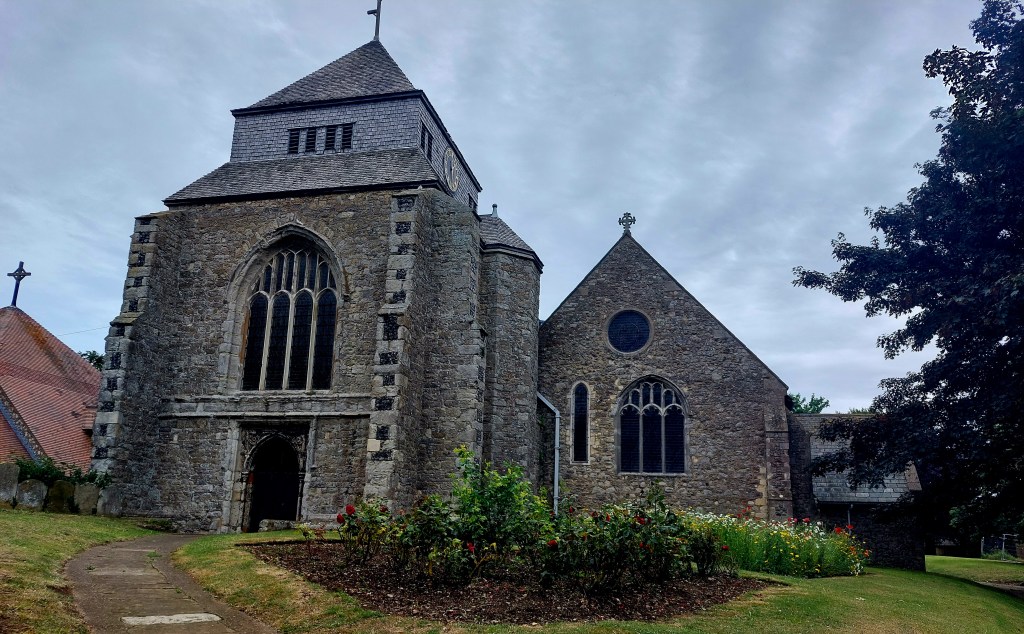
Minster Abbey, Sheppey

Witnessing and Doubting

(Talk given at Minster Abbey 16th April 2023)

So…witnessing and Doubting Thomas!

The other day I read that the public (according to the newspapers) claim the church do not promote Easter as much as Christmas. Easter and Christmas… two very important events for us – Christmas the celebration of the birth of Christ, the incarnation, God becoming man to save us…and Easter where Jesus is sacrificed in our place to defeat death, rise again, and enable us to be forgiven for our sins and reconciled with God.

So I thought about this and here’s a couple of comparisons:

The Church

At Christmas:

  • Advent – 4 Sundays
    • Hope, Prophecy, Patriarchs
    • Peace, Bethlehem, Prophets
    • Joy, Shepherds, John the Baptist
    • Love, Angels, Mary
  • Carol Service
  • Christingle Service
  • Crib Service
  • Midnight Mass
  • Christmas Morning Service
  • Candlemass

At Easter:

  • Ash Wednesday Ashing Service
  • Lent – 6 Sundays
    • Invocabit
    • Reminiscere
    • Oculi
    • Laetare
    • Judica
    • Palm Sunday
  • Maundy Thursday Service
  • Good Friday Pilgrimage and Gathering at the Cross
  • Stations of the Cross
  • Holy Saturday Vigil/Service of Light
  • Easter Sunday Service
  • Ascension
  • Pentecost
  • Corpus Christi

Versus

What I think is most appropriate to call commercialisation:

Where Christmas is promoted with:

  • Father Christmas
  • School Nativity Plays
  • Carols
  • Christmas number ones/Christmas songs
  • Grottos
  • TV Ads
  • Work Dos/Christmas parties
  • Decorations
  • Cards
  • Presents
  • Trees
  • High Street decorations and lights
  • Shop displays and more decorations
  • Christmas dinner menu options at pubs and restaurants for approx. 2 months
  • Pantomimes
  • Etc

And where Easter is promoted with:

  • Chocolate and chocolate eggs
  • The Easter Bunny
  • TV Ads but on a smaller scale
  • Small shop displays normally in seasonal aisles
  • Small amount of Easter decorations
  • Small amount of Easter cards
  • Easter dinner menu options for 1 day

In my opinion, having compared the aforementioned; the media, yet again, is showing a biased and incomplete picture. The evidence suggests that on the contrary the church does more at Easter but the sway of commercialisation makes the commercial version of Christmas more widely known.

This needs to be combated, but how? Simply, we need to follow the instruction and example of Peter in Acts and go out and witness, spreading the good news of the true meaning of both Christmas and Easter, sharing what, through love, Christ did for us and the joy of His resurrection with all it’s connotations of redemption.

Meanwhile, where does Thomas fit into all this?

Personally, I feel sorry for Thomas. I think he got a bit of a rough deal. Thomas the Doubter…in actuality he was a fervent believer yet what do we remember him for – doubting – the one who wouldn’t believe without seeing for himself and touching his beloved Master’s wounds.

Maybe, despite it being unfair, one of the reasons we remember Thomas specifically for this event is because it shows us that doubt is okay!

Doubt is something we all experience at some point and in reality, faith and doubt can and do co-exist side by side.

Thomas was not evicted from the group of disciples for his doubt. He was not condemned by Jesus for his doubt. He continued to be a valued part of the disciples as they stayed together, discussing all that had happened, sharing meals, continuing to accept each other.

Thomas had not been there when Jesus had appeared to the group of disciples initially. What was he doing? Where and why wasn’t he there are interesting questions.

BUT, it occurs to me that maybe, just maybe, he wasn’t there so that God could use him for the benefit of those too scared to admit their doubt both then and now.

Thomas only doubted for one week! He then met the risen Jesus and believed. In fact, he believed so fervently for the rest of his life that he was killed (or martyred) for his belief. Yet, still, he is referred to as “Doubting Thomas”.

One small brief moment of doubt, one incident, one mistake, one failing – and a label is applied – something that is still very much done today. And, whilst that person learns, believes, repents, changes, moves on, that label sticks.

Instead of calling Thomas “Believing Thomas” – a far more accurate name/label; because of that one brief moment of doubt he is known as “The Doubter”.

Through this and through Thomas, maybe God is teaching and reminding us that we should not label people. That we should allow people to change and accept that people do change. That we all make mistakes but when we repent God forgives us; likewise when others make mistakes we should allow them to repent and forgive them.

One more thing: asking questions.

There is a common phrase heard in classrooms and training rooms throughout the land:

“There are no stupid questions” and “if you ask a question most of the people in the room are probably thinking it and are just too scared to ask”.

Children in particular ask a lot of questions and, whilst these are often ‘when or what is for dinner?’, they often ask the really big questions:

  • What is God’s name?
  • What does God look like?
  • What does it mean to be reborn?
  • How is Jesus alive?

The questions children, and indeed some adults, ask are, in their own way, blessings. They make us think and help us gain deeper understanding and insight together.

The person that both expressed the doubts of everyone and asked the question everyone else was thinking was Thomas. For this we owe him a great deal for if the question had not been asked the answer would not have been given. Thomas the Brave who said to Jesus “Lord we do not know where you are going. How can we know the way?” To whom we owe thanks for Jesus’s answer “I am the [only] way [to God], the [real] truth and the [real] life, no one comes to the Father but through me”.

Thanks to Thomas we know it is okay to be honest about our doubts as well as our faith, we know that labels do not reflect who people truly are and we can realise how questions can lead us to deeper knowledge and growth. Thanks to Thomas, who believed because he had seen, we can see because we believe.

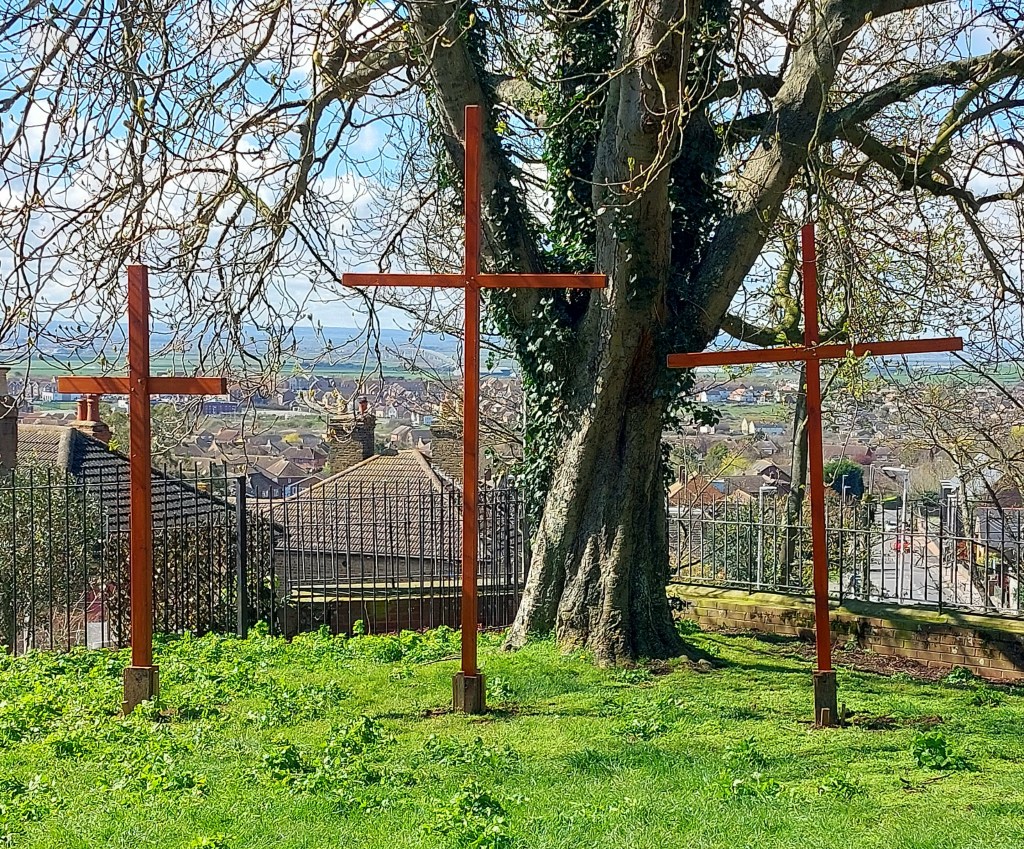
Three crosses

Easter Spoilers

Talk from 26th March (John 11:1-45)

Who likes reading spoiler alerts to find out what will happen ahead of the next episode?

Who avoids them like the proverbial plague? Ah okay, you might want to put your hands over your ears then because in some ways this passage from John is a little bit like a trailer or spoiler for two weeks time!

Today we hear about and celebrate the resurrection of Lazarus. In two weeks we hear about and celebrate the resurrection of Jesus.

There are lots of parallels in this story pointing towards what was going to happen. John even mentions at the beginning of this passage an event (Mary anointing Jesus’s feet) which does not occur until after the resurrection of Lazarus.

Jesus was very clear right from the beginning that EVERYTHING He does is for the glory of God. His wisdom and knowledge far exceeds ours.

It was still difficult for Martha and Mary that Jesus did not immediately drop everything and come to them upon hearing that Lazarus was severely ill.

Today’s society tend to want everything immediately. Patience and waiting are hard. Whilst I know that waiting times for ambulances are much longer than ideal at the moment; how many of us have to wait over two days before one leaves to attend to us?

But Jesus knew what He was doing and so He waited. Once the time was right He told the disciples He was going back to Judea. The religious leaders there already wanted Jesus dead and this worried His disciples. Ironically, it is Thomas (later to be known as the doubter) who persuaded the disciples to accompany Jesus even if it meant death.

Jesus is the Light of the World. As He says, if we walk during the day (in the light) we will not stumble because we see (have) the light of the world (Jesus).

Those who walk at night stumble because the Light (Jesus) is not in them.

By the time Jesus arrived, Lazarus had been in the tomb for four days.

Decomposing!

Stinky!

Yuk!

Martha (the sister who in another passage we are told did all the chores whilst Mary sat listening to Jesus) heard Jesus was on His way and came to meet Him.

Martha says “Lord, if you had been here…” Martha knows and believes that Jesus has the power to heal. Is she declaring her faith? Or is she displaying anger that Jesus was not there in time to stop Lazarus dying? Jesus tests her and she proclaims her faith and her belief.

Jesus is the resurrection and the life and He was about to prove it whilst showing, again, through this miracle that Jesus is the Giver of Life and the Saviour. He was also showing His followers a preview of how He would be defeating death.

It is important that we understand the relevance of Lazarus having been in the tomb for four days. Jesus had raised people to life before after all, so we need to know what makes the resurrection of Lazarus so different.

Well, previously when Jesus had raised people from the dead the timescale between their death and resurrection was a great deal shorter.

Jesus needed this miracle to be determinate.

To help us understand let me explain that at that time people believed that a person’s spirit left their body on the third day after their death. On the fourth day there is no doubt. The person is really dead. Not sleeping. Dead Dead!

This was important as it meant there could be no dispute over the fact that Lazarus was actually dead before Jesus resurrected him.

Martha went to Mary and told her “The Teacher is here”. Jesus is the Ultimate Teacher. Mary went to Jesus and used the same words as her sister, “Lord, if you had been here …” Mary and the Jews with her wept. Jesus wept. But, Jesus was not mourning Lazarus. Jesus knew all along that He would be raising Lazarus from the dead. Jesus wept for those who did not understand. He wept for those who had lost hope. He wept at the sight of the very suffering He came to save us from. Through Jesus believers are to grieve with hope.

Jesus went to the tomb, He called for the stone to be moved away. The stench of death was all around. Jesus prayed. He did everything with prayer. He knows God always hears Him and thanks God for this. But He also needed the crowd to see that God had sent Him and that He was acting with God’s authority.

Jesus called out in a loud voice “Lazarus, come out!” Jesus has compassion for each one of us and calls us by name.

Lazarus came out still bound in the burial cloths BUT no longer a rotting corpse. Instead he was fully and completely healed. Jesus told the crowd to unbind Lazarus and they helped free him.

Lazarus, a new creation, freed from the tomb and welcomed back to life.

Jesus died to defeat sin and death, the Ultimate Sacrifice and our Saviour is raised from the grave so we can be forgiven and reconciled with God.

Not only that but Jesus came to have a relationship with EVERYONE, not just the Jews.

So how does that affect us. Basically, we cannot experience the resurrection unless we experience death. By this I mean that we cannot accept new life in Christ, if we do not allow our old, sinful lives to die.

We need to let go of whatever is holding us back, whatever is stopping us from being a new creation in Christ.

Let us hear Jesus calling us by name, let us say goodbye to what is holding us back, let us leave the tomb and walk in the light of Jesus.

And more than that, as we are told in Romans; by believing and having faith in Jesus, what He has done, is doing and will do, we are able to take part in bringing glory to God in all we do.

Let us give Him the glory, great things He hath done.

Stone Cave

Jesus’s Baptism (notes for 9th January 2021)

Two weeks ago we celebrated Jesus’s birth – the birth of a tiny baby. Last week we remembered the Wise Men finding and worshipping Jesus – a toddler. Today, we jump forward nearly three decades, doesn’t time fly, Jesus is thirty and being baptised.

In some ways, it is not strange to us that we celebrate Jesus’s baptism shortly after His birth. After all, it is not a rare occurrence for a baby to be baptised, making them a part of the family of God, washing away the consequences of the original and actual sin, granting them the hope and promise of salvation and professing the faith on their behalf whilst promising to bring them up in that faith.

Baptism is linked by Jesus to salvation. It is a symbol of the forgiveness of sins, the death of old life and the start of new life and acceptance into God’s family.

However, Jesus was not a baby. He was a grown man and the sinless Son of God.

So why did Jesus need to be baptised?

Indeed, John the Baptist asked the same thing saying “I need to be baptised by you, yet you come to me?”

Jesus replied “Let it be so now; it is proper for us to do this to fulfill all righteousness.”

Jesus was to be the one to separate believers from betrayers. Jesus was also to bring a purifying and transforming baptism of fire; which enables us to be empowered by the Holy Spirit.

Jesus was baptised to identify Himself with sinful man, who He came to save. He took our sin to save us. His baptism marks the end of His old life marking the acceptance of and the start of His ministry. He is annointed by the Holy Spirit whilst He is affirmed by God as His Son (a parallel with Pentecost when the Holy Spirit came down on the church).

This affirmation from God that Jesus is the Messiah also provides confirmation to John that he has completed his mission of preparing the way for the Messiah; whilst Jesus begins His earthly ministry with the blessing of God His Father and the empowerment of the Holy Spirit.

Father God, we ask that you baptise us all again with your Holy Spirit empowering us to do your work. Amen.

A beautiful lake.