Minster Abbey Talk on John 17:1-11

“The time has come,” the Walrus said, “to talk of many things:…”

Lewis Carroll

And if we were having a conversation over some coffee and cake (hint hint) that is precisely what would happen. We would have a conversation; maybe about the weather, the coronation, a television drama, … all sorts.

Some of us find it easy to converse, some of us find it more difficult and communicate in other ways. Some of us are good at listening and for some of us it “goes in one ear and out the other”.

But, how do we pray?

There are many different ways we can pray, but ultimately, if we think about it, prayer is just the same as that conversation over coffee … isn’t it?

If not why not?

We have the opportunity to talk to God about anything and everything; and not just when we’re worried or in need or when things aren’t going as we’d like but also when we’re thankful, joyful and when things are going well.

We can do a lot of talking to God but we need to remember to listen as well. If we are honest none of us listen as much as we should.

Prayer is vitally important in our lives. An oft repeated quote “seven days without prayer makes one week (weak!)”.

Today’s Gospel reading is part of one of Jesus’s longest prayers.

In short it summarises Jesus’s relationship with the Father and the relationship He wanted His disciples to have with Himself and the Father.

Like the Holy Trinity (Father, Son and Holy Spirit) this prayer is in three sections.

  1. Jesus prays for Himself
  2. Jesus prays for His disciples
  3. Jesus prays for all believers past, present and future

Despite us having celebrated Jesus’s Ascension on Thursday, this prayer passage takes place before His arrest. But it is significant because it becomes Jesus’s evaluation of the purpose of His life, death, resurrection and ascension.

God’s glory and Jesus’s glory are one and the same. Through the death of Jesus God is glorified and all believers receive eternal life.

Eternal life is knowing the one true God; being in a living fellowship with God. And this life we receive when we accept Jesus into our hearts and lives. Jesus’s purpose, His mission, is salvation.

Jesus prays with great concern for His disciples. He was not concerned about Himself – He knew God’s plan, He knew He had to suffer and die to be victorious. Jesus’s victory was unquestionable. The disciples were just like us. They were not infallible. Jesus had predicted the disciples would desert Him. And so He prayed for them, that they would be kept safe and protected by the Father’s power and that they would fulfil their future ministry. The disciples were about to be tested and Jesus prayed that this would not separate them from Himself or from each other.

Again, like the Three-in-one, Jesus mentions three things about His disciples:

  1. They had accepted His teaching
  2. They had accepted the knowledge that Jesus is the Son of God
  3. They believed

Jesus prayed that the world would stop being opposed to God.

“All I have is Yours and all You have is Mine.” Jesus has equality with the Father.

He prays that, as He and God are one, the disciples and believers will remain as one.

In unity.

Not divided.

Division is the result of the failures of Christians.

God is awe-inspiring and loving. Jesus’s prayer is an outpouring of love and concern.

Jesus was shortly returning to the Father and to the glory He has before the world began. He had completed His mission. The Holy Spirit had been promised. With the help of the Holy Spirit it is now our turn.

Our mission, if we choose to accept it, is to bring glory to God through all we do in His name.

Are we ready?

Do we accept this mission?
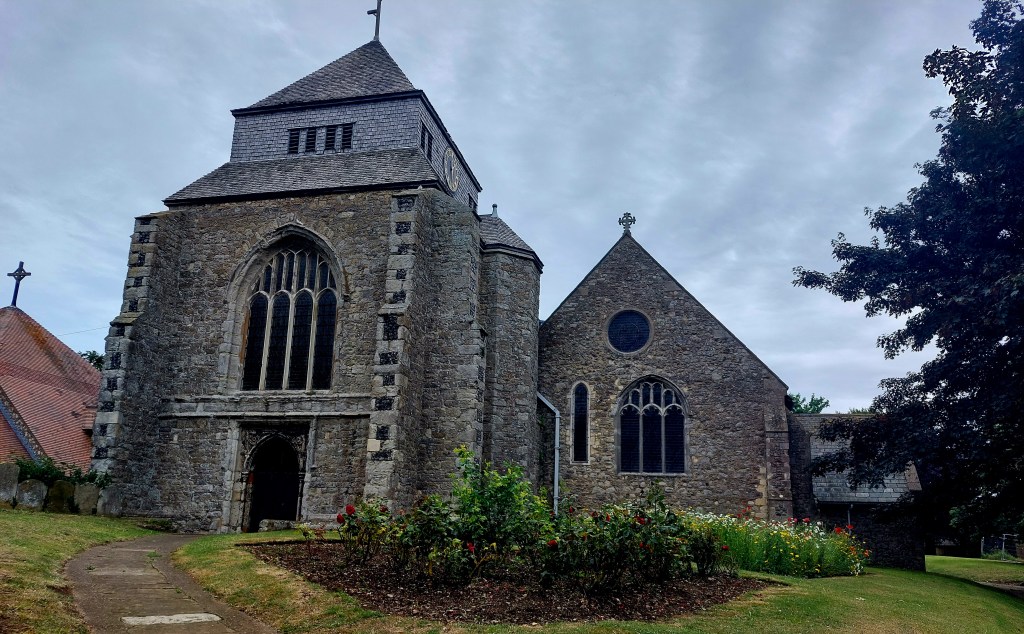
Minster Abbey, Sheppey

Witnessing and Doubting

(Talk given at Minster Abbey 16th April 2023)

So…witnessing and Doubting Thomas!

The other day I read that the public (according to the newspapers) claim the church do not promote Easter as much as Christmas. Easter and Christmas… two very important events for us – Christmas the celebration of the birth of Christ, the incarnation, God becoming man to save us…and Easter where Jesus is sacrificed in our place to defeat death, rise again, and enable us to be forgiven for our sins and reconciled with God.

So I thought about this and here’s a couple of comparisons:

The Church

At Christmas:

  • Advent – 4 Sundays
    • Hope, Prophecy, Patriarchs
    • Peace, Bethlehem, Prophets
    • Joy, Shepherds, John the Baptist
    • Love, Angels, Mary
  • Carol Service
  • Christingle Service
  • Crib Service
  • Midnight Mass
  • Christmas Morning Service
  • Candlemass

At Easter:

  • Ash Wednesday Ashing Service
  • Lent – 6 Sundays
    • Invocabit
    • Reminiscere
    • Oculi
    • Laetare
    • Judica
    • Palm Sunday
  • Maundy Thursday Service
  • Good Friday Pilgrimage and Gathering at the Cross
  • Stations of the Cross
  • Holy Saturday Vigil/Service of Light
  • Easter Sunday Service
  • Ascension
  • Pentecost
  • Corpus Christi

Versus

What I think is most appropriate to call commercialisation:

Where Christmas is promoted with:

  • Father Christmas
  • School Nativity Plays
  • Carols
  • Christmas number ones/Christmas songs
  • Grottos
  • TV Ads
  • Work Dos/Christmas parties
  • Decorations
  • Cards
  • Presents
  • Trees
  • High Street decorations and lights
  • Shop displays and more decorations
  • Christmas dinner menu options at pubs and restaurants for approx. 2 months
  • Pantomimes
  • Etc

And where Easter is promoted with:

  • Chocolate and chocolate eggs
  • The Easter Bunny
  • TV Ads but on a smaller scale
  • Small shop displays normally in seasonal aisles
  • Small amount of Easter decorations
  • Small amount of Easter cards
  • Easter dinner menu options for 1 day

In my opinion, having compared the aforementioned; the media, yet again, is showing a biased and incomplete picture. The evidence suggests that on the contrary the church does more at Easter but the sway of commercialisation makes the commercial version of Christmas more widely known.

This needs to be combated, but how? Simply, we need to follow the instruction and example of Peter in Acts and go out and witness, spreading the good news of the true meaning of both Christmas and Easter, sharing what, through love, Christ did for us and the joy of His resurrection with all it’s connotations of redemption.

Meanwhile, where does Thomas fit into all this?

Personally, I feel sorry for Thomas. I think he got a bit of a rough deal. Thomas the Doubter…in actuality he was a fervent believer yet what do we remember him for – doubting – the one who wouldn’t believe without seeing for himself and touching his beloved Master’s wounds.

Maybe, despite it being unfair, one of the reasons we remember Thomas specifically for this event is because it shows us that doubt is okay!

Doubt is something we all experience at some point and in reality, faith and doubt can and do co-exist side by side.

Thomas was not evicted from the group of disciples for his doubt. He was not condemned by Jesus for his doubt. He continued to be a valued part of the disciples as they stayed together, discussing all that had happened, sharing meals, continuing to accept each other.

Thomas had not been there when Jesus had appeared to the group of disciples initially. What was he doing? Where and why wasn’t he there are interesting questions.

BUT, it occurs to me that maybe, just maybe, he wasn’t there so that God could use him for the benefit of those too scared to admit their doubt both then and now.

Thomas only doubted for one week! He then met the risen Jesus and believed. In fact, he believed so fervently for the rest of his life that he was killed (or martyred) for his belief. Yet, still, he is referred to as “Doubting Thomas”.

One small brief moment of doubt, one incident, one mistake, one failing – and a label is applied – something that is still very much done today. And, whilst that person learns, believes, repents, changes, moves on, that label sticks.

Instead of calling Thomas “Believing Thomas” – a far more accurate name/label; because of that one brief moment of doubt he is known as “The Doubter”.

Through this and through Thomas, maybe God is teaching and reminding us that we should not label people. That we should allow people to change and accept that people do change. That we all make mistakes but when we repent God forgives us; likewise when others make mistakes we should allow them to repent and forgive them.

One more thing: asking questions.

There is a common phrase heard in classrooms and training rooms throughout the land:

“There are no stupid questions” and “if you ask a question most of the people in the room are probably thinking it and are just too scared to ask”.

Children in particular ask a lot of questions and, whilst these are often ‘when or what is for dinner?’, they often ask the really big questions:

  • What is God’s name?
  • What does God look like?
  • What does it mean to be reborn?
  • How is Jesus alive?

The questions children, and indeed some adults, ask are, in their own way, blessings. They make us think and help us gain deeper understanding and insight together.

The person that both expressed the doubts of everyone and asked the question everyone else was thinking was Thomas. For this we owe him a great deal for if the question had not been asked the answer would not have been given. Thomas the Brave who said to Jesus “Lord we do not know where you are going. How can we know the way?” To whom we owe thanks for Jesus’s answer “I am the [only] way [to God], the [real] truth and the [real] life, no one comes to the Father but through me”.

Thanks to Thomas we know it is okay to be honest about our doubts as well as our faith, we know that labels do not reflect who people truly are and we can realise how questions can lead us to deeper knowledge and growth. Thanks to Thomas, who believed because he had seen, we can see because we believe.

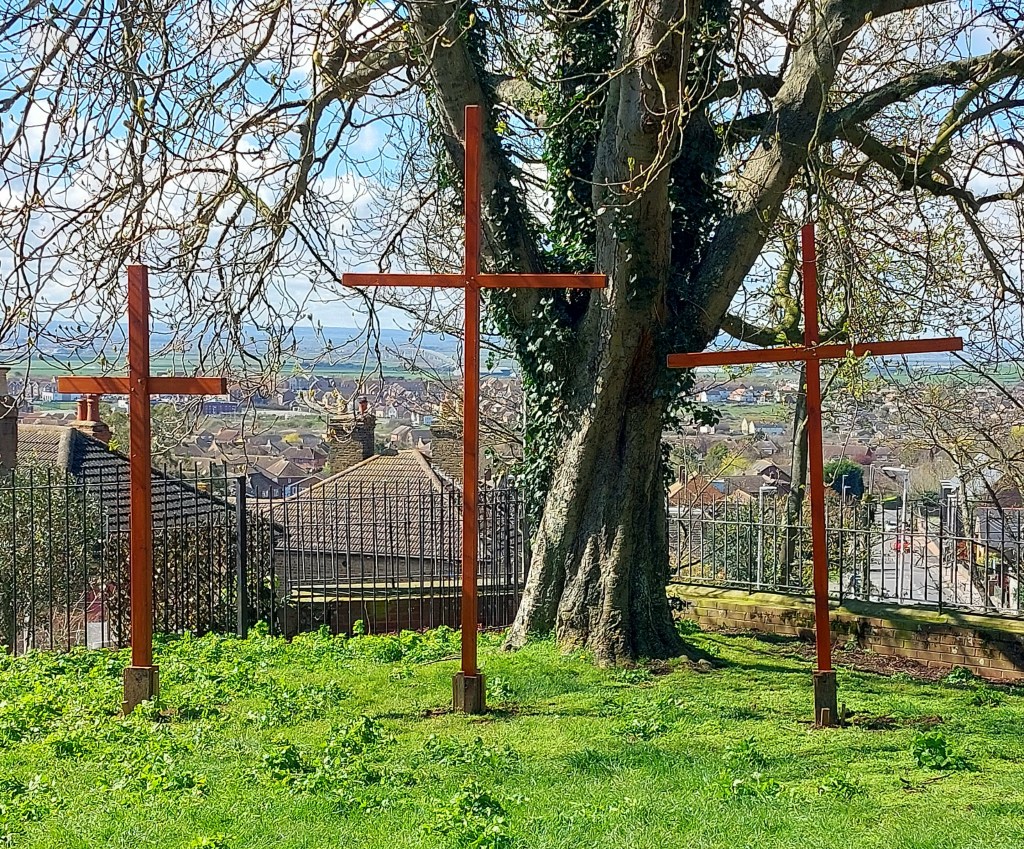
Three crosses