Grace and Prayer

Exodus 32:1-14, Philippians 4:1-9, Matthew 22:1-14

What do we do when there are delays and we don’t know what is going on? Do we remain calm, immersed in prayer and preparation? Or, do we panic?

In our Exodus reading, we pick up the journey of the Israelites at a point where Moses is on the mountain conversing with God. However, at this point he has been gone for forty days, the Israelites do not know what is going on or why he has not yet returned and they are, most certainly, panicking.

To them it has been a very very long time since Moses was last with them; but God’s time is not as our time and to Moses it seemed a relatively short time when compared to the out working of God’s plan for Israel. A delay ordained by God.

How we deal with, or handle, God’s ordained delays – times allocated for waiting and preparation – like Lent or Advent – is a good measure of our spiritual maturity. We should make good use of these times to deepen our perseverance in following God, to pray and study God’s Word, to ready ourselves for whatever will come next.

However, if we allow such delays to be used for drifting into sin, or lapsing into resignation to fate, then we are reacting poorly to those times – like the people of Israel did here. This episode of sin described in this passage started at the impulse of popular opinion. An example of where the will of the people is not always the will of God.

Not knowing what was happening with Moses, the people allowed their uncertainty to take over and turned to idolatry and sin instead of trusting God.

Aaron is just as guilty as the rest of the people. He asked them for their gold and they were generous in what they gave.

In general, people tend to be more generous in what they give to idols but we should be being more generous with what we give to God.

Aaron melted the gold, moulded it and fashioned it carefully with an engraving tool. This work was not led by the Holy Spirit but instead was inspired by sin and yet Aaron took the time to plan it out and carefully detail what he made.

Instead of refusing to go along with what he knew to be wrong, Aaron went along with the people and with popular opinion instead of standing firm for what is right.

Aaron and the people then put their energy, time, sleep, money in service to this idol. People usually find a way to rise early/give to things that are really important to them; but what should be really important to them (and us) is the Lord God.

God told Moses what the people were doing and was a tad upset. God offers to destroy all the people and still keep His promises by rebuilding the nation from Moses. He tells Moses to let Him alone so He could do this.

This implies that if Moses did nothing this plan would go ahead but Moses refused to do nothing. Just as when we see wrongs we should refuse to do nothing. Moses pleaded with the Lord in a short prayer. Prayer does not have to be long – it is the strength of the prayer that matters, not how long it is.

Moses was full of compassion for the people but also concerned with the honour of God. Just as what we do should bring honour to God.

Moses prayed: ‘Lord these people belong to you not me. We didn’t deserve to be freed from Egypt but you saved us by grace, continue to deal with us in your grace. If you kill the people the Egyptians will say you are a cruel God who only saved the Israelites to kill them – don’t let anybody say that about you. Lord you keep your promises and are always faithful, don’t break your promises.’

Now, the wording translation in our reading is “so the Lord changed His mind.”

This is a good place to pause and point out that Moses wrote in anthropomorphic or “man-centred” language. He described the actions of God as they appeared to him.

Moses’s prayer did not change God, but it did change the standing of the people in God’s sight – the people were now in a place of mercy, where previously they were in a place of judgement.

God did not destroy Israel and He knew He would not destroy Israel. He deliberately put Moses into this crucial place of intercession so that Moses’s heart could become like God’s heart for the people, a heart of love and compassion.

Moses prayed just as God wanted him to – as if heaven and earth, salvation and destruction depended upon his prayer.

This is how God wants us to pray.

He also wants us to live a life of prayer, which brings us to Paul’s letter to the Philippians.

The segment that forms our reading this morning starts with Paul addressing a disagreement between Euodia and Syntyche. Paul urges them to settle their differences or agree to differ and to remember their common ground in the Lord. He also advises the rest of the church to help them resolve this matter instead of taking sides and causing a rift.

Paul then moves on: “Rejoice in the Lord. Again, I will say rejoice!”

Joy in the Lord is a cure for all discord.

Let your gentleness be known to all men. The Lord is at hand. Have patience, forbearance, magnanimity, moderation to all men, not just to whom we please.

Live with the awareness that Jesus will return, that He will settle all wrongs and we can trust Him to make things right in our falling apart world.

Live a life of prayer.

Everything is the subject of prayer – there are no areas of our lives that are of no concern to God. Both prayer and supplication are required. Prayer means all our communications with God whereas supplication is directly asking God to do something.

Many of our prayers go unanswered because we do not ask God for anything. God invites us to make our requests known to Him. He wants us to ask with thanksgiving.

Pray about everything. Ask God our requests. Be thankful for anything we receive.

Paul goes on to say that the peace of God will guard our hearts and minds for us. God’s peace is a gift and is beyond our power of thinking. Peace with God is the relationship we enter into with God through the finished work of Jesus Christ.

Finally, Paul tells us to meditate on what is:

  • true
  • noble
  • just
  • pure
  • lovely
  • of good report
  • virtue
  • praiseworthy

This is a way to bring our thoughts and minds back to the obedience of Christ. Follow Jesus’s example and set that example.

Can we say of our lives “Follow me as I follow Jesus”?

If we do not follow Jesus we are rejecting Him. In the reading from Matthew’s gospel, Jesus tells the parable of the Wedding Feast to explain to the religious leaders and listening crowds the dangers of rejecting Him.

Those who had been invited were not willing to come to the Royal Wedding. It seems strange that all those invited refused and this illustrates that there is no logical reason for God’s good gifts to be refused.

The king made the invitation as attractive as possible. He really wanted these people to come and he sent more messengers to them, yet they still refused. Not only did they refuse but they laughed and killed the messengers. The king proclaimed judgement, sending an army to destroy these murderers. A prophesy of what would happen to Jerusalem where the religious leaders strongly, and repeatedly. rejected Jesus.

The king sent his servants to go out and invite everyone they came across. Everyone was to be invited.

This is both like God’s grace and like His invitation to both the Jews and the Gentiles.

Those invited and those who came to the wedding feast were undeserving of the invitation, much less the wedding feast itself.

We are undeserving of God’s grace, yet He freely and indiscriminately gives it to us.

The king came to see the guests just as we will all come before God in judgement. And there was a man there without a wedding garment. He was noticeably different from the other guests.

This man came only because he was invited but came only in appearance. The wedding banquet was to honour the king’s son but this man did not intend honour or respect. He came to eat the good things on offer but in his heart there was no love for the king (God) or his well-beloved son (Jesus).

This man has made too free with holy things and actively insulted the king. The result: this man suffered a terrible fate.

Those indifferent to the gospel and those antagonistic against the gospel and those unchanged by the gospel suffer the same fate – none of these will enjoy the king’s feast.

For many are called but few are chosen.

In this context , this statement of Jesus touches on the great working together of the choices of man and the choosing of God.

Why did they not come to the wedding feast? Because they refused the invitation. Why did they not come to the wedding feast? Because they were called but not chosen.

Do you accept the invitation? Will you be one of the chosen? Do you accept or reject Jesus? Will you come and follow Him if He but calls your name?

Grace and Prayer (Photo by Garrison Gao on Pexels.com)

Water, Humility and Authority

Exodus 17:1-7, Psalm 78, Philippians 2:1-13, Matthew 21:23-32

There is a saying that you cannot get blood out of a stone. Maybe not but, as described in our reading from Exodus, you can get water out of a rock!

The people of Israel had a teeny tiny problem – they had no water to drink! When we have a problem or a tricky situation, it can be much easier to blame somebody else for the problem than it is to just carefully and spiritually think through the problem. And this is the case with most situations throughout the history of humanity. For example, if the children or the husband do something less than endearing or particularly silly and I ask them “Why did you do that?” the response I will get is “It’s <insert appropriate name here e.g. Joe’s> fault – if they behaved properly then I wouldn’t have”. Likewise, if they want something, say a drink, instead of thinking through the problem and asking for or making a drink they will say “it’s your fault, you didn’t make me one” or “you didn’t tell me to make one”. Or instead of finishing their homework they do something else and then run out of time. Yep, you’ve guessed it, their response is “It’s your fault for not putting enough time on the phone”.

It was the same with the Israelites. They are thirsty. They have no water. Instead of thinking this through, something like, “We are in a desert, deserts don’t have much water, we need to ask God to meet this need”, the Israelites jumped straight to; “It’s Moses’s fault! We must complain to and about Moses.”

Whilst the lack of water was not the fault of Moses, as leader of Israel he had to set the example to follow. He has to lead them to the answer and show them that the right way to deal with the situation is to give it to the Lord in prayer.

Moses knew the right response was to ask God. The people of Israel had been taught this over and over again. And in a similar way to us when we are asked the same thing over and over again by someone who still can’t get it right, eliciting the response from us of “And what are we going to do with you?”; Moses says to the Lord “What am I going to do with these people?”

God gave Moses specific instructions, including to take with him some of the Elders of Israel to be witnesses. God was going to prove to Israel yet again that He was, is and ever shall be with His people.

And so Moses struck the rock God had chosen with his staff and God made water spring forth to quench the people’s thirst. Moses named that place Massah and Meribah because of the complaints and doubts of the Israelite people.

This event and these places are mentioned several times in the Bible, an example of such is in John 7: 37-39: “If anyone thirsts, let him come to me and drink. He who believes in me, as the scripture has said, out of his heart will flow rivers of living water.” This living water Jesus spoke of is the Holy Spirit; it is no less a miracle for God to bring the love and power of the Holy Spirit out of our hearts than it is to bring water out of a rock. Our hearts can be just as hard!

Today’s Psalm (78) extols the marvellous things God does citing the way He looked after the Israelites during their exodus from Egypt; leading them as cloud and fire, dividing the Red Sea, providing food for them to eat and splitting the rock to produce water for them to drink.

Paul, in his letter to the Philippians is giving a reminder to not do anything that is motivated out of selfish ambition or conceit, but instead in humility to regard others as better than ourselves. Putting the interests of others above our own. He is reminding us to have the mindset of Christ who, though He is God, became man, served, humbled Himself and was obedient to the point of death on the cross. All earth and heaven declares Jesus Christ is Lord; His name is above all names. We too must be obedient to God. It is God who is at work in us, enabling us to God’s will and to work to His own good pleasure.

We should not do things to boast of our own self-importance, rather we should view others as more important than ourselves, putting God and others first and in higher esteem that we place ourselves. Jesus’s example is the example we should be following.

Paul calls for love, humility and unity amongst believers. Everything we do should be out of love for God and our neighbours to glorify God and to serve Him with everything we have.

There is great consolation in Christ. There is great comfort in the love, fellowship of the Spirit, affection and mercy from God. Each of these are given to us directly from Jesus and from Jesus through His people. They are real and solid gifts for Christians to truly experience. Just like God was with His people in the desert, caring for, loving and providing for the Israelites, He is with us and doing the same for His people today, tomorrow and always.

Our reading from Matthew, like the Israelites complaining to and confronting Moses, details the Chief Priests confronting Jesus over His authority.

Jesus went back into the temple to teach. To put this passage into context, this is the day after Jesus had turned all the money-changers and merchants out of the temple. Whilst Jesus was mid-teaching, the Chief Priests challenged the authority Jesus had to do what He does.

Jesus answers their question by questioning their ability to judge, Jesus asks them where the authority of John the Baptist came from; knowing that the ability to judge John the Baptist and his ministry was a measure of their ability to judge Jesus. If the Chief Priests answer Jesus’s question and answer it correctly then they would have an answer to their own question as well.

The Chief Priests weighed up the potential outcomes of each answer. Their interest was in the opinions of the crowd and in trying to catch Jesus out. They couldn’t say, therefore, that the authority came from God because they were hypocrites and feared being asked why they did not believe. Likewise, they could not say from man because that would be going against the crowd who viewed John as a prophet from God. They resorted to “We don’t know” and as such they did not earn a response from Jesus in answer to their question.

Instead Jesus tells a parable about a man with two sons. He asks one of the sons to go and work in the vineyard and this son refuses. However, after thinking about it, this son then goes and does what his father asked him to do. Let’s call this son Xavier, who does precisely this. When we ask him to do something he will immediately reply “no” but a couple of minutes later, once he has thought about it and had time to process and understand the request, off he trots and does what he was asked to do.

The father goes and asks the other son to go and work in the vineyard and this son says “yes” but then does not do what he was asked. Let’s call this one Freddie, who agrees to do the task and when asked claims he has indeed done what was asked but who actually has not even started it. Jesus asks which son did his father’s will or bidding and the answer is Xavier (or the first son).

Many, including the Chief Priests in this passage, fall into the group of the second son. They admit God’s truth and the Word of God. They intend to get around to it ‘at some point’. They talk about doing the Father’s work and keep up appearances but their hearts are not right with God and they think words and promises are enough. The second son said he would go but didn’t, these people say they repent but have not. They speak of believing but don’t, they think about seeking the Lord and submitting to Him but they never get around to it. They are lying to the Holy Spirit despite knowing better.

What matters is living for God rather than saying the right words. The Chief Priests talked the talk but they didn’t walk the walk. Their lack of repentance meant that the truly repentant sinners would enter the kingdom of heaven before them. These proud Chief Priests should have been much more repentant having seen notorious sinners repent but they were not.

So let us move forward this week by walking the walk of Jesus, with the reassurances that God is with us, protecting us, guiding us and that we can bring to him all our hopes, fears and needs – for which He will provide.

Water from rock. (Photo by Marta Wave on Pexels.com)

Temptation in the Wilderness

Jesus was led up by the Spirit into the wilderness to be tempted by the devil. He fasted forty days and forty nights, and afterwards he was famished. The tempter came and said to him, “If you are the Son of God, command these stones to become loaves of bread.” But he answered, “It is written, ‘One does not live by bread alone, but by every word that comes from the mouth of God.'” Then the devil took him to the holy city and placed him on the pinnacle of the temple, saying to him, “If you are the Son of God, throw yourself down; for it is written, ‘He will command his angels concerning you,’ and ‘On their hands they will bear you up, so that you will not dash your foot against a stone.'” Jesus said to him, “Again it is written, ‘Do not put the Lord your God to the test.'” Again, the devil took him to a very high mountain and showed him all the kingdoms of the world and their splendour; and he said to him, “All these I will give you, if you will fall down and worship me.” Jesus said to him, “Away with you, Satan! for it is written, ‘Worship the Lord your God, and serve only him.'” Then the devil left him, and suddenly angels came and waited on him.

Matthew 4: 1 – 11

After Jesus’s baptism, He was led by the Holy Spirit into the Wilderness for forty days (and nights) to fast and prepare for His ministry. Here He resisted the devil and the temptations laid before Him and strengthened Himself to be ready for what lay ahead. 

Forty is a number that pops up time and time again in the Bible. In the account of Noah, once he and his family are on the ark it rains for forty days and nights. Moses fasted on Mount Sinai for forty days and nights. Elijah fasted in the desert for, wait for it, forty days and nights. After leaving Egypt the Israelites wandered the wilderness for forty years.

A lot of forties and we should also recognise that we are in one ourselves as we travel the forty days of the season of Lent, participating in Jesus’s ministry and following His way toward the cross. We remember Jesus’s time in the Wilderness during this time of Lent but are we taking the opportunity of the Lenten time of preparation to patiently prepare spiritually, seek God and deepen prayer?

After identifying with sinners in His baptism, Jesus then identified with them again in severe temptation. This was a necessary part of His ministry, so He truly was led up by the Spirit into the wilderness. Jesus did not need to be tempted to help Him grow. Instead, He endured temptation both so that He could identify with us (Hebrews 2:18 and 4:15), and to demonstrate His own holy, sinless character.

Temptation is a certainty for everyone. Yet Jesus’s temptation was more severe because He was tempted directly by the devil himself, while we contend mainly with lesser demons. It was also more severe because there is a sense in which temptation is “relieved” by giving in, and Jesus never did yield. Therefore He bore levels of temptation we will never know by experience.

Jesus is tempted by food, by who to worship, and by the power of the nations. This is another way in which Jesus identified with us as all three of these were faced by the Israelites in their exile. Sometimes they were able to withstand the temptation, and sometimes they did not. Jesus, on the other hand, withstood all His temptations even though what Satan offered him is firmly within Jesus’s rights and power.

Jesus’s wilderness temptations “prove” to us what sort of God He is. The tempter starts each of his offers with the Greek word, ei, which is often translated as “if” but also translates as “since…” Satan knows Jesus is the Son of God, he knows the power and authority that belong to Jesus, he also knows that what he is tempting Jesus with are well within Jesus’s rights and capability. Satan is both tempting and taunting Jesus but Jesus refuses to fall for either, proving His humility through denying Himself for the sake of others.

So Jesus was tempted just like us but Jesus succeeded where we fail. Jesus succeeded because He knew that His life was in God’s hands. We do not live by our power of provision but by God’s help and blessings. Jesus succeeded because He knew that God was with Him and He did not need another display of power to prove it. 

The cross reminds us that God is with us. We do not need to tell God how to run our lives or how to do things differently; God is with us no matter what. God is with us whether He leads us through the valley of the shadow of death or to the mountain peaks of joy. Jesus succeeded because He knew that worshiping God meant doing God’s will and not seeking His own desires. We do not live for our own desires but for God’s glory so that in the end we will be glorified by God.

We can have victory over temptation if we will look at the root of what the devil is putting in front of us. Ultimately, every temptation challenges whether or not we believe that God is with us, that God will provide for us, that God is for our good, and that God will deliver on His promises to us. Jesus had victory in the wilderness so that He could set us free from these enslaving temptations and sins. Jesus had victory so that he could stand before the Father on our behalf, interceding for us when we fail. His success is even more proof that He is the King who has come to save us from our sins.

Wilderness (Photo by Luis Quintero on Pexels.com)

Patience …

…if you want to see an example of true patience watch a cat waiting patiently for the mouse it knows is there to crawl to the optimum position for its capture.

The cat will wait for hours, eyes on the prize, as still as a statue until the mouse has come right up to it … and then he pounces. But the point isn’t the pounce it’s the waiting. The cat has to wait in the right way to achieve its goal – patiently preparing. It can not and does not allow itself to get distracted by things around it or it will lose out.

In a couple of weeks we, once again, reach the time of Lent. A time of patient preparation leading up to the resurrection of Jesus and the Salvation of the world.

Many will proudly claim they are giving up wine or chocolate or Facebook or cake for Lent and some will equally proudly share when they give into the temptation and indulge anyway.

The giving up of something for Lent is representative of fasting. Despite some of the more recent modern fads this is not a new-fangled dieting technique but a tool to prepare both the physical and the spiritual body to gain discipline, seek God and deepen prayer.

It is often used before undertaking specific significant tasks. After Jesus’s baptism, He was led by the Holy Spirit into the Wilderness to fast and prepare for His ministry. Here He resisted the devil and the temptations laid before Him and strengthened Himself to be ready for what lay ahead. We remember Jesus’s time in the Wilderness during Lent but are we taking the opportunity of the Lenten time of preparation to patiently prepare spiritually, seek God and deepen prayer?

Are we using the time like the cat waiting for our mouse or are we letting ourselves get too distracted by worldly things around us?

Do we even know what our mouse is? What the task God has for us is? Let’s use this Lent to find out!

Cat waiting patiently. (Photo by Francesco Ungaro on Pexels.com)

Don’t be a Pharisee …

The Legend of the Stones

Two women approached a wise man and asked for instruction. One of them regarded herself as a terrible sinner. In her youth, she had deceived her husband, and she tortured herself constantly with the memory of her infidelity.

The second, on the other hand, had lived her entire life within the law and by the rules. She wasn’t conscious of any serious sin, had nothing much to reproach herself with and felt quite pleased with herself.

The wise man asked both women about their life. The first went as she confessed her great sin. She felt her sin had been so great that she had no right to expect forgiveness. The second said that she had not committed any particular sins.

The wise man said to the first woman, ‘Go, daughter of God, and look for the heaviest boulder you can find – one that you can barely manage to carry – and bring it to me.’

‘And you,’ he said to the second woman, who could not recall any serious sin, ‘go and bring me as many stones as you can carry, but they must all be small ones.’

The women went off to do as the wise man had told them. The first brought a huge boulder; the second brought a whole sackful of small pebbles.

The wise man examined the stones and said, ‘Now do as follows. Take the stones back and replace each one of them exactly where you picked it up, and when you have put them all back where you found them, come back to me.’

The women went off again to carry out the wise man’s instructions. The first very easily found the place from where she had taken the huge boulder, and she replaced it where it had been. But the second had no idea where she had picked up all her little pebbles, and had to return to the wise man without having carried out his instruction.

‘You see,’ said the wise man, ‘that’s how it is with our sins. It was easy to take the big, heavy boulder back to its place because you knew exactly where you first found it. But it was impossible to remember where all those little pebbles came from.’

And to the first woman, he said, ‘You are very conscious of your sin. You carry in your heart the reproach of your husband and of your conscience; you have learned humility, and in this way you have been freed of your wrongdoing. You, however,’ he said to the second woman, who had come back still carrying her sack of little pebbles, ‘you, who have sinned in many small ways, do not know any more when and how you did wrong; you are not able to repent. You have grown accustomed to a life of little sins, to passing judgement on the sins of others while becoming more deeply entangled in your own. It has become impossible to free yourself of them.’

A story by Leo Tolstoy retold by Margaret Silf

To paraphrase from part of the Gospel of Luke, chapter 18: The Pharisee thanks God that he is not like other people. He details his religious practices and self perceived righteousness and considers himself more virtuous and superior to others.

The tax collector feels unworthy and simply asks God to have mercy on him, a sinner.

Jesus states it is the tax collector and not the Pharisee who went home justified by God. God values the tax collector’s humility, not the Pharisee’s self-righteousness.

Jesus told this parable to warn those who trusted in themselves but who treated others with contempt. He warns them against spiritual pride and calls for us to have humility in prayer and in life. Our justification comes solely from God’s grace and mercy and not from our own achievements.

Humility is essential for a right relationship with God whilst spiritual pride leads to self-righteousness and being rejected by God.

It is easy to fall into the trap of behaving like the Pharisee. I know someone who, on a regular basis, beats their chest and says “I thank God I am not like other men”.

Modern day Pharisees are not all as obvious as this but are characterised by their self-righteousness, a tendency to burden others with strict rules whilst not following them themselves and a focus on power and control of over serving.

They may appear religious whilst lacking genuine faith whilst adhering to certain rules or attending church yet without a corresponding difference in their daily life. They may focus on strict adherence to rules and traditions, creating heavy burdens for others yet ignoring the spirit of the law. They judge and condemn others, even misrepresenting their motives whilst projecting their own shortcomings onto them.

They believe they are more righteous than others but are unwilling to admit to their own sins or weaknesses.

They are more concerned about other’s opinion of them and how they are seen than they are about having a genuine relationship with God.

But, even for Pharisees, there is hope.

To not be a Pharisee, hear the words of Jesus. Jesus is the Light of the world, whoever follows Him will not walk in darkness but have the light of life.

Don’t ignore the content of what Jesus says, or you’ll miss out. Hear Jesus’s word and His message. Actively listen to Him by reading and paying attention to Scripture. If you ignore Scripture, if you ignore the Bible, if it just sits on a shelf gathering dust, then you are ignoring the word of Jesus.

Regardless of how busy we are, we make time for what matters most. Nobody is too busy to hear Jesus’s word.

Hearing Jesus’s word – reading the Bible is non-negotiable for both first-time faith and for growing faith. You can’t believe in and become like Jesus without His word. Hear His word.

See Jesus’s light. Light is a big metaphor. Jesus is an exposing light, an illuminating light, and a welcoming light.

He exposes what is hidden, calls out sin, and banishes darkness. He illuminates, revealing or making known the way, shining out in the darkness and showing us what we need to see. He is a welcoming light guiding us and inviting us home.

See the light, put your faith in Jesus, and be welcomed home. Follow Jesus’s path. Jesus’s promises of light and life are only for those who follow Him. Truly believe and truly follow Jesus.

This doesn’t mean just recognising that Jesus was a real person – and there is historical evidence of this – it means seeing and listening to Jesus, going wherever He leads and doing what He says. Literally following Him. Not just being a Christian but being a Christ-Follower. True believing where your highest allegiance is to Jesus; whatever He wants, that’s what you want.

Don’t be a Pharisee.
Hear Jesus’s word.
See Jesus’s light.
Follow Jesus’s path.
Be humble.

Lord Jesus Christ, Son of God, have mercy on us, all sinners.

Stones and Pebbles

How can I pray?

Do you think everyone else knows how to pray? You are not alone if you think this. Prayer is something we are often not taught. How often do we sit and kneel in church looking at other people and wondering what it is they are doing in their silent prayers? They always look so holy and yet here we are, trying to say something to God …

Do you feel like giving up? Don’t! Prayer is like every human skill. It is something that we need to learn how to do. We can use books, or ask a friend, or seek the guidance of a priest. But, in many ways, prayer is something that we do have to find out about for ourselves. God has made us all different, and so we will all pray differently. We will also pray differently in different situations.

What is prayer? Prayer is the way in which we keep in touch with God. Many people think that they can change God: ‘If I ask really nicely, then God will do what I want.’ For others, prayer is a form of magic: ‘If I say it in the right way then God will answer.’ Neither of these is true. Prayer is the way in which we open up to God, so that God can work in us. And God does always answer, although not always in the way that we want.

What is prayer like? If you love someone, you keep in touch. Prayer is the same. If we love God, we stay in touch. We talk to God and we listen to God. It’s a conversation!

How do we get in touch with God? To begin our conversation with God we need to get ready: to come consciously into God’s presence, to sit or kneel in a way that is comfortable and attentive. Then we need to calm down. Normally, our minds are full of distractions; thoughts just keep happening. One way of calming down is to listen to our breathing, the regular pattern of it. Another way is to repeat over and over, ‘Be still and know that I am God.’ After a while we settle down, our minds are less full, and then we are ready to pray.

When we are calm, then we can start to pray. Sometimes, this just means continuing to listen, just letting the awareness of God enfold us, like loving arms – we don’t need to say anything else, the contact is enough. At other times we need to say something, This can be anything: ‘Dear Father…’ or ‘Hello God…’ If you are going to say something (whether aloud or silently), then just say what you want to say. God doesn’t stand on ceremony.

We need to take time to say what we want: ‘Thank you.’ ‘Sorry.’ ‘Guess what?’ ‘I love you.’ Take time to listen – to your breathing, to your thoughts and feelings. Be aware of yourself and don’t push it. Give God time to speak to you. Conversations take time … and patience.

Traditionally, Christians pray every morning and evening. The more we are in touch, the better it gets. The more time we take, the more rewarding it can be. As we pray regularly, the more natural prayer becomes.

‘What a friend we have in Jesus,
All our sins and griefs to bear!
What a privilege to carry
Everything to God in prayer!
O what peace we often forfeit!
O what needless pain we bear!
All because we do not carry
Everything to God in prayer!

The Lord’s Prayer:
Though there are many versions and interpretations of the Bible, the Lord’s Prayer remains much the same and sets a pattern for our own prayers. Speaking to our Father in Heaven should be much like speaking to someone in the room, as He is there in spirit. It should be personal, intimate and all disclosing of the thoughts in our minds and the feelings in our hearts.

From the King James Bible, Matthew 6:9-13, these are the words of the Lord’s Prayer:

After this manner therefore pray ye: Our Father which art in heaven,
Hallowed be thy name.
Thy kingdom come. Thy will be done in earth as it is in heaven.
Give us this day our daily bread.
And forgive us our debts, as we forgive our debtors.
And lead us not into temptation, but deliver us from evil: For thine is the kingdom, and the power, and the glory, forever. Amen.

If we break this down we can see the pattern more clearly:

After this manner therefore pray ye: This discloses that this is the pattern or way we are to pray, not by rote, by following these guidelines.

Our Father which art in heaven. Hallowed be thy name: We should begin our prayer by acknowledging that God is our Father in heaven and that we honour him. This is an important step in humbling yourself before him and telling him that he is our God and we trust in his words and wisdom.

Thy kingdom come. Thy will be done in earth as it is in heaven: We let God know that we understand he is still in charge, that his kingdom will roll forth and that it is his will and not our own that we are to listen and obey. It is that same authority that was, and is, used to govern his home in heaven. At this point we should acknowledge all that he has done for us, all the bounteous blessings he has provided for our good, all the trials that he has blessed us with in order for us to learn what we need to learn, and every good thing in our lives.

Give us this day our daily  bread: We petition God for our needs and the righteous desires of our hearts, not our whims or worldly desires. Our daily bread could include harmony in our homes. Patience, more holiness in speech and actions, the ability to support ourselves and our families, all the things that are daily necessities for our growth and salvation.

And forgive us our debts, as we forgive our debtors: We should lay before God our sins and transgressions asking for forgiveness and for the strength to forgive everyone who has wronged us. This could also be financial debts, but includes so much more. This is our opportunity to repent for our weakness, our thoughtlessness, and our disobedience.

And lead us not into temptation, but deliver us from evil: We pray to God fervently for guidance in our walk and the power to overcome the evils that impede our paths. We pray that our self-mastery will be enough to conquer the adversary and keep us out of hot water!

For thine is the kingdom, and the power, and the glory, forever. Amen: We close our prayer by, once again, acknowledging that this is God’s kingdom and that he has all the power. The glory of what we do belongs to him for all that he provides for us. We should close in the holy name of Jesus Christ, our saviour and redeemer, and the only way back to our Father.

We are so blessed to know the goodness of God and the way he has prepared for us to return to him. Prayer is an essential part of that plan. Daily honest communication with our Heavenly Father keeps us in tune to the spirit, forces us to be honest with ourselves about our shortcomings, allows us to repent for them, blesses us with an accounting and acknowledgement of our many blessings which is particularly important on days when we think we have nothing and bonds us with deity.

So have:

Conversation with God.
Become familiar with prayer as conversation that involves a delightful rhythm of asking God questions and waiting on God for responses.

Pray with authenticity.
Understand that praying authentically involves expressing doubts and fears as well as truth, believing God can give strength and grace.

Make requests of God in terms of God’s concerns, not just our own.

Listen to God in prayer.
To bring our questions to God, being open to God’s answers and obeying what we hear.

Pray for others as Jesus did.
To make intercession by praying for others’ oneness with God, not ‘patching up’ folks or getting them to do what we think they should do.

Practice God’s presence.
Practice prayer that infuses all of life as we practice the presence of God.

Prayer

The Feast of St Peter and St Paul

(2 Timothy 4:6-8,17-18, Matthew 16:13-19)

St Peter and St Paul do not have separate feast days and are celebrated together as foundation members of the church – they were instrumental in establishing and spreading Christianity They had complementary ministries with Peter often being called the Apostle to the Jews and Paul the Apostle to the Gentiles.

Peter, originally a fisherman, was chosen by Jesus to lead His church. Paul, originally a pharisee, persecuted Christians until his conversion on the road to Damascus. Their deaths in Rome solidified their connection and their importance to the early church.

In our Gospel reading, Peter is praised for his belief and faith in Jesus as the Son of the Living God. Peter had times of doubt and unfaithfulness but the first call in his following of Jesus was to grow in the faith that would sustain his life.

Jesus withdrew from the mainly Jewish region of Galilee to a place more populated by Gentiles as a kind of retreat or respite. Whilst there He asked the disciples who the crowds thought He was – not because He didn’t know but as an ice breaker to His next question; who do the disciples say He is. And, of course, Peter answered “You are the Christ, the Son of the Living God”.

This question is asked of all who hear of Jesus, it is us, not Him, who are judged by the answer. If we really believe Jesus is who He said He is then that will affect the way we live.

Jesus presupposes that His disciples would have thought differently to the men of the crowds.

Jesus was a national reformer, a miracle worker, a prophet. He is the Christ.

Peter understood that Jesus was not just God’s Messiah but also God Himself. Jesus praises Peter for his bold and correct declaration. Jesus reveals to Peter that Peter had spoken by divine inspiration.

The name Peter means Rock. Peter was and would become a Rock. God was transforming his character into something solid and reliable.

“On this rock I will build my church”. Jesus is the cornerstone – the church’s one foundation. Peter was the first Rock among many Rocks. Interestingly, this is the first use of the word church in the New Testament. It came from a Greek word which just meant “group” or “called out group”.

Jesus prophesies the building of the church and claims ownership – “My church”. Jesus brings His people together, on a firm foundation, building them into something that belongs to Him and which is a stronghold.

“I will build, on this Rock, My church, the gates of Hades shall not prevail against it”.

Jesus promises that the forces of death and darkness cannot prevail against or conquer the church.

Jesus gave Peter the keys to the kingdom. Peter opened the doors of the kingdom to the Jesus (Acts 2:38-39). Peter opened the doors of the kingdom to the Gentiles (Acts 10:34-44). Peter was allocated special privileges but Jesus did not grant him the authority to pass the special privileges or authority to future generations.

Jesus gave permission and authority to the first generation apostles to make rules for the early church. This was a responsibility of the disciple group as a whole.

Jesus told His disciples not to tell anyone He was The Christ. He was pleased His disciples were coming to know who He was in truth, but He didn’t want His identity known before the proper time.

Before they could preach that Jesus was the Messiah, they had to learn what that meant.

The Epistle focuses on Paul’s impending death and God’s faithfulness. Paul’s life was a sacrifice and his death was a transition to be with the Lord. Faith is not faith in one’s own abilities bit in God’s faith planted within us which turns us, despite the upheavals and setbacks and failures of life into faithful workers in the vineyard. It speaks of conformity in Christ and is full of verses filled of hope.

Hope in the present, seeing the world with different eyes, with knowledge that Christ is present today. Hope from the certainty that God works through Him at all times, for the community, in the community, with the community.

“The Lord will rescue me from every evil attack and save me for His heavenly kingdom”. This is the prayer of one who relies solely on God and knows that it is not his work but God who will hold him, justify him and bless him. There is no other help but what God gives.

In this promise, we are all invited to pray.

Rocks

The Wilderness of Lent

Mark*, in just a few short verses, has summarised for us two key elements from Jesus’s life which took place just before the start of His ministry.

The first is Jesus’s baptism of water by His cousin John. John’s baptism was one of repentance, one of cleansing and forgiveness. God cleansed the earth by flood in Genesis – in a sense starting again. Baptism gives us a chance to start again; to say sorry for our wrongdoings, receive forgiveness and to start a new life in Christ striving to follow in His footsteps.

So why did Jesus, God’s Son, the only truly perfect human, need to be baptised by John.

John was the forerunner to prepare the way. This was also an indication for Jesus that it was time for His ministry to commence. By being baptised by John, Jesus was affirming that He was ready and willing to take the next step on His journey for our salvation. He was saying “yes” to what God wanted Him to do. And God confirmed His approval as He says to Jesus “You are my beloved Son”. He was also showing us what we needed to do.

At that time the Holy Spirit descended upon Jesus, equipping Him for what was to come. It descended in the form of a dove, just like the dove that carried the olive branch back to Noah, symbolising gentleness, peace and love.

Straight away the Spirit took Jesus into the wilderness. Jesus was being prepared and tested. He was not being set up to fail but instead to strengthen His mind, heart and soul.

The wilderness is mentioned many times in the Bible. It is a place of preparation – like Lent which we can use to say goodbye to our old selves and find Christ.

It is a place where God communes with His people – God spoke to Abraham, Moses, Elijah and John the Baptist in the wilderness. It is not a place of hopelessness. Jesus, John, Elijah, Isaiah, Moses, Abraham etc were not in the desert by accident but by God’s design. God wanted to speak to them somewhere there would not be distractions. Jesus often went into the wilderness for rest, prayer and to teach His disciples. It provided peace away from the crowds and other distractions.

We often want to escape what we perceive as the discomfort of the desert – hardships and difficult times. But these are the times when God’s presence is greatest. It is an invitation from God for us to encounter Him and listen to Him – He wants to speak to us.

Likewise, Lent is about cutting out the distractions, about preparing and making ourselves ready for the work Jesus has for us and for Him to be in our hearts.

It is not about a show of giving up something that we don’t intend to stick to – for example, chocolate or wine or Facebook – when we know full well that we intend to indulge in what we have cut out as soon as Lent is over.

It is about preparation. In Advent we wait and prepare for the coming of Jesus as a tiny baby. In Lent we prepare for Holy Week and Easter – awaiting the sacrifice of Jesus and His resurrection. In both we should be preparing our hearts and minds, getting them ready for our Lord and the work He has for us.

Lent is about meeting God in the wilderness, listening to Him, strengthening ourselves for the work He has for us. It is about prayer. Praying more, communing with God more, conversing and listening to God. Setting aside that time for Him. So let us ask God to use this time of Lent to prepare and strengthen us for whatever lies ahead.

Wilderness

*Mark 1: 9-14

“We’re All Going On A Summer Holiday…

…no more worries for a week or two…”

…except we all know that isn’t the reality. The school year has ended, costs have dramatically increased – but, of course, certain things are always more expensive during that long Summer holiday break. In addition, the expectation of schools and organisations, and even within other areas of society, is that families must indulge in expensive activities taking the children out to a multitude of places and trips away over this time period. This year, from one of the groups the children were even sent home with a notebook where they were instructed to carefully detail all these activities. This, like non school uniform days, places even more pressure on the parents as, just as they cannot be seen by the other school parents sending the children in anything less than designer wear even though they cannot afford it, they are made to feel the same about what holiday activities are undertaken. Sadly, prejudice and competition are still rife and the class system is still very much evident with children still being mocked if they cannot do similar activities to their peers.

This causes a drain on parents, a drain on the resources available, worry and stress over whether the effort put in to find alternative activities will be enough to cover the inability to take the children to expensive holiday resorts or Disneyland. Parents who are already trying to cope with childcare arrangements with the children being off school, the extra food costs, and additionally any additional support their child needs to assist with Autism, ADHD etc.

However, despite economic, worldly and social pressures, it does not have to be like that!

When we were growing up we considered ourselves lucky to be able to play outside with the neighbouring children, playing in the garden, borrowing different books from the library, going to our parents’ workplaces and helping out, visiting our grandparents and helping them, completing jigsaw puzzles, playing board or card games, helping out around the home and garden, even naming our own school uniform for the new school year. We were not bored! We did not need electronic devices. We enjoyed our holidays and learnt a lot. We visited whole new worlds and made whole new friends through our reading. The holidays used to fly by – in a good way. We did not ask our parents whether we would be going out on a day trip every day and then complain if the answer was no. The school projects were not always “What we did on our holidays” but were based on what we would be studying in the Autumn term or on something topical that was happening in the world. We would enjoy spending time researching these in the library and making a scrap book about the theme.

Yes, there would be the occasional trip out, a family picnic or a family day out. But, these were not demanded upon or an expected requirement; they were a treat.

In 1987, Tales of A Church Mouse by Revd Alec Shearwood was published. In one of these tales, called Holidays, the mice children on school holiday visit Grandfather Sebastian, who tells them to go away as he is recreating himself. When asked what this means they get the response, “you must know what recreation means, don’t you?” When the mice children suggest that means games and having fun they are told, “Stuff and nonsense! Recreation means recreating yourself.” On their return home the Rector was in the church and so they asked him what recreation meant:

“Well William,” he said, ” it means making a thing again, making it as fresh and good as it was before, and that is what holidays are for. Some people go away to the seaside for their recreation so that when they come home they are no longer tired and stale. Some play games, or garden, or go for long walks.”

I told him about Grandfather.

“Yes,” he went on, “some just need a good rest.”

Revd Alec Shearwood

Jesus says to us:

“Come to Me, all you who labour and are heavy laden, and I will give you rest. Take my yoke upon you and learn of me, for I am gentle and lowly in heart, and you will find rest for your souls. For My yoke is easy and My burden is light.” 

Matthew 11:28-30

We are lucky to have been granted the privilege to bring everything to God in prayer. Instead of forfeiting peace and carrying needless pain and worries around as a heavy burden, we can give these to God and be grateful receivers of His peace and strength as He guides us through all difficulties.

So let us all have a good holiday with lots of fun, let us give all our burdens to Jesus, let us be refreshed and eager to do God’s work through all that we do, let us be “recreated”!

Walking by the sea.

Minster Abbey Talk on John 17:1-11

“The time has come,” the Walrus said, “to talk of many things:…”

Lewis Carroll

And if we were having a conversation over some coffee and cake (hint hint) that is precisely what would happen. We would have a conversation; maybe about the weather, the coronation, a television drama, … all sorts.

Some of us find it easy to converse, some of us find it more difficult and communicate in other ways. Some of us are good at listening and for some of us it “goes in one ear and out the other”.

But, how do we pray?

There are many different ways we can pray, but ultimately, if we think about it, prayer is just the same as that conversation over coffee … isn’t it?

If not why not?

We have the opportunity to talk to God about anything and everything; and not just when we’re worried or in need or when things aren’t going as we’d like but also when we’re thankful, joyful and when things are going well.

We can do a lot of talking to God but we need to remember to listen as well. If we are honest none of us listen as much as we should.

Prayer is vitally important in our lives. An oft repeated quote “seven days without prayer makes one week (weak!)”.

Today’s Gospel reading is part of one of Jesus’s longest prayers.

In short it summarises Jesus’s relationship with the Father and the relationship He wanted His disciples to have with Himself and the Father.

Like the Holy Trinity (Father, Son and Holy Spirit) this prayer is in three sections.

  1. Jesus prays for Himself
  2. Jesus prays for His disciples
  3. Jesus prays for all believers past, present and future

Despite us having celebrated Jesus’s Ascension on Thursday, this prayer passage takes place before His arrest. But it is significant because it becomes Jesus’s evaluation of the purpose of His life, death, resurrection and ascension.

God’s glory and Jesus’s glory are one and the same. Through the death of Jesus God is glorified and all believers receive eternal life.

Eternal life is knowing the one true God; being in a living fellowship with God. And this life we receive when we accept Jesus into our hearts and lives. Jesus’s purpose, His mission, is salvation.

Jesus prays with great concern for His disciples. He was not concerned about Himself – He knew God’s plan, He knew He had to suffer and die to be victorious. Jesus’s victory was unquestionable. The disciples were just like us. They were not infallible. Jesus had predicted the disciples would desert Him. And so He prayed for them, that they would be kept safe and protected by the Father’s power and that they would fulfil their future ministry. The disciples were about to be tested and Jesus prayed that this would not separate them from Himself or from each other.

Again, like the Three-in-one, Jesus mentions three things about His disciples:

  1. They had accepted His teaching
  2. They had accepted the knowledge that Jesus is the Son of God
  3. They believed

Jesus prayed that the world would stop being opposed to God.

“All I have is Yours and all You have is Mine.” Jesus has equality with the Father.

He prays that, as He and God are one, the disciples and believers will remain as one.

In unity.

Not divided.

Division is the result of the failures of Christians.

God is awe-inspiring and loving. Jesus’s prayer is an outpouring of love and concern.

Jesus was shortly returning to the Father and to the glory He has before the world began. He had completed His mission. The Holy Spirit had been promised. With the help of the Holy Spirit it is now our turn.

Our mission, if we choose to accept it, is to bring glory to God through all we do in His name.

Are we ready?

Do we accept this mission?

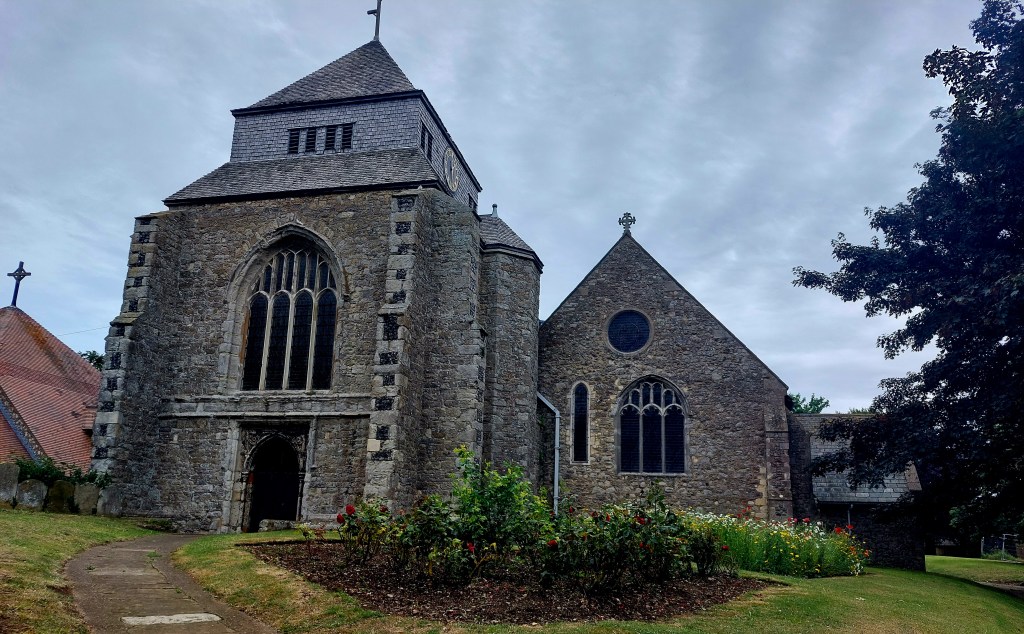
Minster Abbey, Sheppey