Mary …

We tend to use a mixture of readings from the Gospels of Matthew and Luke to revisit the miracle of Jesus’s birth. Here, Matthew doesn’t tell us how the Virgin Birth took place—except that it was by the Holy Spirit. Whereas, Luke gives a little more detail, the angel telling Mary that the Holy Spirit will come upon her, and the power of the Most High will overshadow her. The Virgin Birth is a divine miracle in the power of the Holy Spirit.

But Matthew does tell us two things about Jesus, one being what he does: “You shall call his name Jesus for he shall save his people from their sins”. Many Jews were looking for a Messiah who would come in conquering power. But Matthew shows us the much deeper human need. Jesus comes to save us from our sins—our spiritual needs far outweighing other needs.

The miracle of the Virgin Birth is also a sign of the far greater miracle and mystery of God becoming flesh and taking his place amongst us as one of us – the Incarnation. God didn’t just send angels, prophets and messengers—he came! In Jesus, God has come close; has taken human nature and human life to himself joining human nature to his own divine being. This is all of the Grace of God, who is a God who stoops to take us by the hand. In this respect, Matthew quotes from the Old Testament: ‘The virgin will be with child and will give birth to a son, and they will call him “Immanuel”—which means, “God with us.”’ If the name Jesus is descriptive of what Jesus does, Immanuel is descriptive of who Jesus is—God with us.

The miracle of the Virgin Birth points towards both the humanity and the deity of Jesus. He was a human person born in the normal way. He is also the eternal God who has come to us—the God-man. Jesus didn’t begin his existence at Christmas, but as eternal God, entered into time and space at Christmas. For unto us a Child is born, unto us a Son is given… (Isaiah 9:6).
So many people are ‘in the dark’ about God and don’t see him clearly. Yet, if you want to know what God is like, you only have to look at Jesus. Jesus Christ is the “Word of the Father, now in flesh appearing…” He is the revelation of the will, wisdom and person of God. His teaching is the
instruction of God. His death is the death of God-for-us. His resurrection is the victory of God! The meaning of Christmas is first and foremost a message of amazing grace, of a God who comes near.

The miracle of the Virgin Birth is a new creation, the beginning of a whole new world. What we can’t do for ourselves, God has and is doing. Into a world of brokenness and sadness God has come by means of a supernatural birth in the power of the Holy Spirit. But it doesn’t end there: the same Spirit who hovered over Mary and brought about a miracle of new life and transformation in her can also do the same in us! Regardless of who you are or what you have done you can start a whole new life as part of the new world. Jesus is the answer to our deepest needs. He is God come among us in order to save us from our sins and to rescue us from the deepest cause of our alienation and brokenness. When we start from the inside out we can have hope that the entirety of our life can experience the transformation he brings.

Mary, mother of Jesus (Photo by Juan Carlos Leva on Pexels.com)

Minster Abbey Talk on John 17:1-11

“The time has come,” the Walrus said, “to talk of many things:…”

Lewis Carroll

And if we were having a conversation over some coffee and cake (hint hint) that is precisely what would happen. We would have a conversation; maybe about the weather, the coronation, a television drama, … all sorts.

Some of us find it easy to converse, some of us find it more difficult and communicate in other ways. Some of us are good at listening and for some of us it “goes in one ear and out the other”.

But, how do we pray?

There are many different ways we can pray, but ultimately, if we think about it, prayer is just the same as that conversation over coffee … isn’t it?

If not why not?

We have the opportunity to talk to God about anything and everything; and not just when we’re worried or in need or when things aren’t going as we’d like but also when we’re thankful, joyful and when things are going well.

We can do a lot of talking to God but we need to remember to listen as well. If we are honest none of us listen as much as we should.

Prayer is vitally important in our lives. An oft repeated quote “seven days without prayer makes one week (weak!)”.

Today’s Gospel reading is part of one of Jesus’s longest prayers.

In short it summarises Jesus’s relationship with the Father and the relationship He wanted His disciples to have with Himself and the Father.

Like the Holy Trinity (Father, Son and Holy Spirit) this prayer is in three sections.

  1. Jesus prays for Himself
  2. Jesus prays for His disciples
  3. Jesus prays for all believers past, present and future

Despite us having celebrated Jesus’s Ascension on Thursday, this prayer passage takes place before His arrest. But it is significant because it becomes Jesus’s evaluation of the purpose of His life, death, resurrection and ascension.

God’s glory and Jesus’s glory are one and the same. Through the death of Jesus God is glorified and all believers receive eternal life.

Eternal life is knowing the one true God; being in a living fellowship with God. And this life we receive when we accept Jesus into our hearts and lives. Jesus’s purpose, His mission, is salvation.

Jesus prays with great concern for His disciples. He was not concerned about Himself – He knew God’s plan, He knew He had to suffer and die to be victorious. Jesus’s victory was unquestionable. The disciples were just like us. They were not infallible. Jesus had predicted the disciples would desert Him. And so He prayed for them, that they would be kept safe and protected by the Father’s power and that they would fulfil their future ministry. The disciples were about to be tested and Jesus prayed that this would not separate them from Himself or from each other.

Again, like the Three-in-one, Jesus mentions three things about His disciples:

  1. They had accepted His teaching
  2. They had accepted the knowledge that Jesus is the Son of God
  3. They believed

Jesus prayed that the world would stop being opposed to God.

“All I have is Yours and all You have is Mine.” Jesus has equality with the Father.

He prays that, as He and God are one, the disciples and believers will remain as one.

In unity.

Not divided.

Division is the result of the failures of Christians.

God is awe-inspiring and loving. Jesus’s prayer is an outpouring of love and concern.

Jesus was shortly returning to the Father and to the glory He has before the world began. He had completed His mission. The Holy Spirit had been promised. With the help of the Holy Spirit it is now our turn.

Our mission, if we choose to accept it, is to bring glory to God through all we do in His name.

Are we ready?

Do we accept this mission?

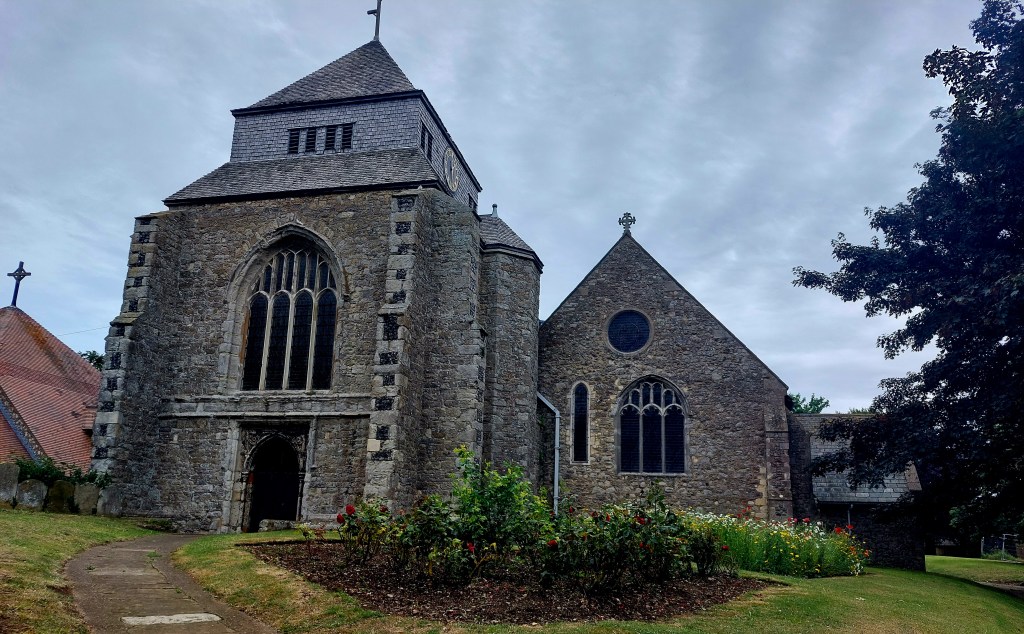
Minster Abbey, Sheppey

Harvest Festival

As normal, for our area, donations received during the Harvest Festival were mainly in the form of long life goods for the food bank. A representative for the food bank passed on their thanks from themselves and on the behalf of those who need to use the food bank – which was nice!

But, during the service I glanced around at all the tins of food and I was thinking…

I thought back to when I was a child and we were asked to take something in for the school and church harvest festivals. Mother would go through the cupboard and present us with a tin, “You can take that” she’d say “no one likes that one”!

I thought about comments I have heard from varying sources on such occasions of: “And everybody bring a tin. Everyone always has something in the cupboard they don’t like so there’s no excuse.”

I thought that, whilst given the choice between nothing and a tin of food that has only been chosen as a donation because nobody likes it then there may well be some gratitude, because anything may well be better than nothing – if it is the only food you can get and you are actually starving. BUT does that make our reason the right reason when we choose what to give?

I thought, shouldn’t we be giving the best we can offer. It is to God to whom we are giving our offerings. It is to God we are giving thanks for the harvest and that we are fortunate enough to have something to eat. When donations leave the altar and make their way to the food bank to feed those in need they are also “feeding Jesus”. Surely, therefore, it should indeed be the best we can offer.

Whilst it is true that people have different tastes and it may well be that a food one person hates is another person’s favourite; the important thing is the motive. What is the motive behind the choice of product? Is it the best we can offer or is it actually just a case of wanting that item out our cupboard? Are we giving our Lord the best of our harvest or the dregs?

What is written in our hearts is known. No excuses can be made.

So when such choices are to be made, remember we should be giving of our best with a pure heart (the right motive) – not finally getting rid of that tin that nobody likes but providing a feast fit for a King – our Saviour.

Poppet lying on a sofa hugging her pumpkin.