Temptation in the Wilderness

Jesus was led up by the Spirit into the wilderness to be tempted by the devil. He fasted forty days and forty nights, and afterwards he was famished. The tempter came and said to him, “If you are the Son of God, command these stones to become loaves of bread.” But he answered, “It is written, ‘One does not live by bread alone, but by every word that comes from the mouth of God.'” Then the devil took him to the holy city and placed him on the pinnacle of the temple, saying to him, “If you are the Son of God, throw yourself down; for it is written, ‘He will command his angels concerning you,’ and ‘On their hands they will bear you up, so that you will not dash your foot against a stone.'” Jesus said to him, “Again it is written, ‘Do not put the Lord your God to the test.'” Again, the devil took him to a very high mountain and showed him all the kingdoms of the world and their splendour; and he said to him, “All these I will give you, if you will fall down and worship me.” Jesus said to him, “Away with you, Satan! for it is written, ‘Worship the Lord your God, and serve only him.'” Then the devil left him, and suddenly angels came and waited on him.

Matthew 4: 1 – 11

After Jesus’s baptism, He was led by the Holy Spirit into the Wilderness for forty days (and nights) to fast and prepare for His ministry. Here He resisted the devil and the temptations laid before Him and strengthened Himself to be ready for what lay ahead. 

Forty is a number that pops up time and time again in the Bible. In the account of Noah, once he and his family are on the ark it rains for forty days and nights. Moses fasted on Mount Sinai for forty days and nights. Elijah fasted in the desert for, wait for it, forty days and nights. After leaving Egypt the Israelites wandered the wilderness for forty years.

A lot of forties and we should also recognise that we are in one ourselves as we travel the forty days of the season of Lent, participating in Jesus’s ministry and following His way toward the cross. We remember Jesus’s time in the Wilderness during this time of Lent but are we taking the opportunity of the Lenten time of preparation to patiently prepare spiritually, seek God and deepen prayer?

After identifying with sinners in His baptism, Jesus then identified with them again in severe temptation. This was a necessary part of His ministry, so He truly was led up by the Spirit into the wilderness. Jesus did not need to be tempted to help Him grow. Instead, He endured temptation both so that He could identify with us (Hebrews 2:18 and 4:15), and to demonstrate His own holy, sinless character.

Temptation is a certainty for everyone. Yet Jesus’s temptation was more severe because He was tempted directly by the devil himself, while we contend mainly with lesser demons. It was also more severe because there is a sense in which temptation is “relieved” by giving in, and Jesus never did yield. Therefore He bore levels of temptation we will never know by experience.

Jesus is tempted by food, by who to worship, and by the power of the nations. This is another way in which Jesus identified with us as all three of these were faced by the Israelites in their exile. Sometimes they were able to withstand the temptation, and sometimes they did not. Jesus, on the other hand, withstood all His temptations even though what Satan offered him is firmly within Jesus’s rights and power.

Jesus’s wilderness temptations “prove” to us what sort of God He is. The tempter starts each of his offers with the Greek word, ei, which is often translated as “if” but also translates as “since…” Satan knows Jesus is the Son of God, he knows the power and authority that belong to Jesus, he also knows that what he is tempting Jesus with are well within Jesus’s rights and capability. Satan is both tempting and taunting Jesus but Jesus refuses to fall for either, proving His humility through denying Himself for the sake of others.

So Jesus was tempted just like us but Jesus succeeded where we fail. Jesus succeeded because He knew that His life was in God’s hands. We do not live by our power of provision but by God’s help and blessings. Jesus succeeded because He knew that God was with Him and He did not need another display of power to prove it. 

The cross reminds us that God is with us. We do not need to tell God how to run our lives or how to do things differently; God is with us no matter what. God is with us whether He leads us through the valley of the shadow of death or to the mountain peaks of joy. Jesus succeeded because He knew that worshiping God meant doing God’s will and not seeking His own desires. We do not live for our own desires but for God’s glory so that in the end we will be glorified by God.

We can have victory over temptation if we will look at the root of what the devil is putting in front of us. Ultimately, every temptation challenges whether or not we believe that God is with us, that God will provide for us, that God is for our good, and that God will deliver on His promises to us. Jesus had victory in the wilderness so that He could set us free from these enslaving temptations and sins. Jesus had victory so that he could stand before the Father on our behalf, interceding for us when we fail. His success is even more proof that He is the King who has come to save us from our sins.


Wilderness (Photo by Luis Quintero on Pexels.com)

Holy Innocents

The Feast of the Holy Innocents takes place on 28th December.

Doctor Who tells us that time is “wibbly wobbly timey wimey”. That is what we experience throughout the forty days of Christmastide.

Just a few days before the Remembrance of the Holy Innocents we celebrated Jesus’s birth as a teeny tiny human baby. Then at this feast day we jump forward a couple of years to after the magi’s visit and Herod is ordering the slaughter of many children in an attempt to kill Jesus. Then the following week we go back to that visit of the magi before we leap forward to Jesus being a man at His baptism and then a couple of weeks later Jesus is a teeny tiny baby again as He is presented at the Temple.

But for now, let us return to the day when we remember the Holy Innocents whose deaths Herod was responsible for.

Each year we remember that Joseph heeded the warnings and instructions he received, that he took his family to Egypt and that as a result of this the prophecy was fulfilled and Jesus was kept safe to grow into a man, fulfil His mission and be our salvation.

But we skim over the bit where many innocent children were killed by a scared but cruel man who wanted Jesus dead because he thought he would lose his power.

A voice was heard in Ramah, sobbing and loud lamentation; Rachel weeping for her children, and she would not be consoled, since they were no more.”

In the Holocaust, approximately 1.5 million Jewish children, and tens of thousands of non-Jewish children were murdered.

The Nazi’s targeted children as part of their ideological goal to create a “radically pure” society and eliminate future generations of “unwanted groups” including Romani, Polish and disabled children.

In the hope of killing one child, Herod had many killed.

Looking back at Moses, who came into the world to bring a kind of deliverance, a new king had risen to power in Egypt. This new king knew nothing of Joseph1 (the Israelite who saved Egypt from the famine). He just saw how numerous the Israelite people were and, wanting to stop the numbers increasing, ordered the death of every Israelite boy born.

There is a constant battle between good and evil in the world and in our own lives.

Evil will always lash out violently towards good. Evil will use any means necessary in an attempt to retain power. There will be resistance when we do good in the world. There will be temptations as we turn away from sin. The strength of these temptations show how committed to change and how committed to doing good we are.

There is wickedness in the world. There are, very sadly, people in this world who will slaughter or arrange the slaughter of thousands and thousands of beautiful, innocent, babies and children, for their own ends, to get what they want and to keep their power.

Evil does not hold back it’s hate for the young and God does not hold back His grace from the young.

God gives us His grace freely and in abundance out of love for us. He is a generous God and there is more than enough grace to encompass everyone no matter their age. He protects us with His grace.

Our world today is, again very sadly, not that different from the world throughout history. We can still see the callousness of Herod and those like him. We still live in a world where innocents are murdered.

We can lament and cry for them. We can pray for their families and friends. But the massacres still continue. Change begins in the human heart and is expressed in what we do and think and say.

It is hard to change a world ingrained with death. But we can contribute to this change. We can demonstrate charity and patience and sanctity of life.

Christ came for our lives, to give us life abundant, sacred and unending.

Herod represents all the powers that stand against Christ; all the people that reject Christ and all the elements of ourselves that want nothing to do with Christ and prefer their independence to His will.

What are we willing to destroy because of our refusal of Christ? What aspects of our own lives and the lives of others are we ready to destroy because of our refusal of Christ?

Herod’s massacre of the innocents is a warning to us. After his death, Herod’s kingdom was divided between the sons he hated. In less than 100 years, everything Herod had built, including the monuments he had intended as structures for his glory, had been reduced to ruins.

Herod is remembered as a petty tyrant. He is not mourned.

We mourn the innocents, the children of Bethlehem, yet they are so often forgotten.

But, in heaven, “where like stars, His children crowned, all in white shall wait“.

Lit candles for prayer and remembrance. (Photo by Rodolfo Clix on Pexels.com)
  1. Genesis ↩︎

Mary …

We tend to use a mixture of readings from the Gospels of Matthew and Luke to revisit the miracle of Jesus’s birth. Here, Matthew doesn’t tell us how the Virgin Birth took place—except that it was by the Holy Spirit. Whereas, Luke gives a little more detail, the angel telling Mary that the Holy Spirit will come upon her, and the power of the Most High will overshadow her. The Virgin Birth is a divine miracle in the power of the Holy Spirit.

But Matthew does tell us two things about Jesus, one being what he does: “You shall call his name Jesus for he shall save his people from their sins”. Many Jews were looking for a Messiah who would come in conquering power. But Matthew shows us the much deeper human need. Jesus comes to save us from our sins—our spiritual needs far outweighing other needs.

The miracle of the Virgin Birth is also a sign of the far greater miracle and mystery of God becoming flesh and taking his place amongst us as one of us – the Incarnation. God didn’t just send angels, prophets and messengers—he came! In Jesus, God has come close; has taken human nature and human life to himself joining human nature to his own divine being. This is all of the Grace of God, who is a God who stoops to take us by the hand. In this respect, Matthew quotes from the Old Testament: ‘The virgin will be with child and will give birth to a son, and they will call him “Immanuel”—which means, “God with us.”’ If the name Jesus is descriptive of what Jesus does, Immanuel is descriptive of who Jesus is—God with us.

The miracle of the Virgin Birth points towards both the humanity and the deity of Jesus. He was a human person born in the normal way. He is also the eternal God who has come to us—the God-man. Jesus didn’t begin his existence at Christmas, but as eternal God, entered into time and space at Christmas. For unto us a Child is born, unto us a Son is given… (Isaiah 9:6).
So many people are ‘in the dark’ about God and don’t see him clearly. Yet, if you want to know what God is like, you only have to look at Jesus. Jesus Christ is the “Word of the Father, now in flesh appearing…” He is the revelation of the will, wisdom and person of God. His teaching is the
instruction of God. His death is the death of God-for-us. His resurrection is the victory of God! The meaning of Christmas is first and foremost a message of amazing grace, of a God who comes near.

The miracle of the Virgin Birth is a new creation, the beginning of a whole new world. What we can’t do for ourselves, God has and is doing. Into a world of brokenness and sadness God has come by means of a supernatural birth in the power of the Holy Spirit. But it doesn’t end there: the same Spirit who hovered over Mary and brought about a miracle of new life and transformation in her can also do the same in us! Regardless of who you are or what you have done you can start a whole new life as part of the new world. Jesus is the answer to our deepest needs. He is God come among us in order to save us from our sins and to rescue us from the deepest cause of our alienation and brokenness. When we start from the inside out we can have hope that the entirety of our life can experience the transformation he brings.

Mary, mother of Jesus (Photo by Juan Carlos Leva on Pexels.com)

How can I pray?

Do you think everyone else knows how to pray? You are not alone if you think this. Prayer is something we are often not taught. How often do we sit and kneel in church looking at other people and wondering what it is they are doing in their silent prayers? They always look so holy and yet here we are, trying to say something to God …

Do you feel like giving up? Don’t! Prayer is like every human skill. It is something that we need to learn how to do. We can use books, or ask a friend, or seek the guidance of a priest. But, in many ways, prayer is something that we do have to find out about for ourselves. God has made us all different, and so we will all pray differently. We will also pray differently in different situations.

What is prayer? Prayer is the way in which we keep in touch with God. Many people think that they can change God: ‘If I ask really nicely, then God will do what I want.’ For others, prayer is a form of magic: ‘If I say it in the right way then God will answer.’ Neither of these is true. Prayer is the way in which we open up to God, so that God can work in us. And God does always answer, although not always in the way that we want.

What is prayer like? If you love someone, you keep in touch. Prayer is the same. If we love God, we stay in touch. We talk to God and we listen to God. It’s a conversation!

How do we get in touch with God? To begin our conversation with God we need to get ready: to come consciously into God’s presence, to sit or kneel in a way that is comfortable and attentive. Then we need to calm down. Normally, our minds are full of distractions; thoughts just keep happening. One way of calming down is to listen to our breathing, the regular pattern of it. Another way is to repeat over and over, ‘Be still and know that I am God.’ After a while we settle down, our minds are less full, and then we are ready to pray.

When we are calm, then we can start to pray. Sometimes, this just means continuing to listen, just letting the awareness of God enfold us, like loving arms – we don’t need to say anything else, the contact is enough. At other times we need to say something, This can be anything: ‘Dear Father…’ or ‘Hello God…’ If you are going to say something (whether aloud or silently), then just say what you want to say. God doesn’t stand on ceremony.

We need to take time to say what we want: ‘Thank you.’ ‘Sorry.’ ‘Guess what?’ ‘I love you.’ Take time to listen – to your breathing, to your thoughts and feelings. Be aware of yourself and don’t push it. Give God time to speak to you. Conversations take time … and patience.

Traditionally, Christians pray every morning and evening. The more we are in touch, the better it gets. The more time we take, the more rewarding it can be. As we pray regularly, the more natural prayer becomes.

‘What a friend we have in Jesus,
All our sins and griefs to bear!
What a privilege to carry
Everything to God in prayer!
O what peace we often forfeit!
O what needless pain we bear!
All because we do not carry
Everything to God in prayer!

The Lord’s Prayer:
Though there are many versions and interpretations of the Bible, the Lord’s Prayer remains much the same and sets a pattern for our own prayers. Speaking to our Father in Heaven should be much like speaking to someone in the room, as He is there in spirit. It should be personal, intimate and all disclosing of the thoughts in our minds and the feelings in our hearts.

From the King James Bible, Matthew 6:9-13, these are the words of the Lord’s Prayer:

After this manner therefore pray ye: Our Father which art in heaven,
Hallowed be thy name.
Thy kingdom come. Thy will be done in earth as it is in heaven.
Give us this day our daily bread.
And forgive us our debts, as we forgive our debtors.
And lead us not into temptation, but deliver us from evil: For thine is the kingdom, and the power, and the glory, forever. Amen.

If we break this down we can see the pattern more clearly:

After this manner therefore pray ye: This discloses that this is the pattern or way we are to pray, not by rote, by following these guidelines.

Our Father which art in heaven. Hallowed be thy name: We should begin our prayer by acknowledging that God is our Father in heaven and that we honour him. This is an important step in humbling yourself before him and telling him that he is our God and we trust in his words and wisdom.

Thy kingdom come. Thy will be done in earth as it is in heaven: We let God know that we understand he is still in charge, that his kingdom will roll forth and that it is his will and not our own that we are to listen and obey. It is that same authority that was, and is, used to govern his home in heaven. At this point we should acknowledge all that he has done for us, all the bounteous blessings he has provided for our good, all the trials that he has blessed us with in order for us to learn what we need to learn, and every good thing in our lives.

Give us this day our daily  bread: We petition God for our needs and the righteous desires of our hearts, not our whims or worldly desires. Our daily bread could include harmony in our homes. Patience, more holiness in speech and actions, the ability to support ourselves and our families, all the things that are daily necessities for our growth and salvation.

And forgive us our debts, as we forgive our debtors: We should lay before God our sins and transgressions asking for forgiveness and for the strength to forgive everyone who has wronged us. This could also be financial debts, but includes so much more. This is our opportunity to repent for our weakness, our thoughtlessness, and our disobedience.

And lead us not into temptation, but deliver us from evil: We pray to God fervently for guidance in our walk and the power to overcome the evils that impede our paths. We pray that our self-mastery will be enough to conquer the adversary and keep us out of hot water!

For thine is the kingdom, and the power, and the glory, forever. Amen: We close our prayer by, once again, acknowledging that this is God’s kingdom and that he has all the power. The glory of what we do belongs to him for all that he provides for us. We should close in the holy name of Jesus Christ, our saviour and redeemer, and the only way back to our Father.

We are so blessed to know the goodness of God and the way he has prepared for us to return to him. Prayer is an essential part of that plan. Daily honest communication with our Heavenly Father keeps us in tune to the spirit, forces us to be honest with ourselves about our shortcomings, allows us to repent for them, blesses us with an accounting and acknowledgement of our many blessings which is particularly important on days when we think we have nothing and bonds us with deity.

So have:

Conversation with God.
Become familiar with prayer as conversation that involves a delightful rhythm of asking God questions and waiting on God for responses.

Pray with authenticity.
Understand that praying authentically involves expressing doubts and fears as well as truth, believing God can give strength and grace.

Make requests of God in terms of God’s concerns, not just our own.

Listen to God in prayer.
To bring our questions to God, being open to God’s answers and obeying what we hear.

Pray for others as Jesus did.
To make intercession by praying for others’ oneness with God, not ‘patching up’ folks or getting them to do what we think they should do.

Practice God’s presence.
Practice prayer that infuses all of life as we practice the presence of God.

Prayer

Calling Levi

In chapter 9 of Matthew’s Gospel,  Matthew recounts his own call from Jesus to become a disciple. Matthew was the name Jesus gave him. Until he became one of Jesus’s disciples, he was called Levi. And he was at his place of work in the tax office. The Jewish people did not like those among their number who became tax collectors. They viewed these people as sinners and collaborators with the Romans against their own people. Tax collectors had the force of the Roman soldiers behind them to force the people to pay the taxes, but not only that, they were considered to be extortioners because they were allowed to keep any money they over-collected. Consequently, most if not all tax collectors over-charged on purpose to line their own pockets.

The call from Jesus gave Levi Matthew the opportunity to literally turn his life around. When he was a tax collector he was busy taking but Jesus was calling him to a work that was essentially giving.

Jesus said to him “Follow Me” and he did. He left his desk, taking nothing but his pen. Jesus called him and the only thing he took from his trade was the pen this trade had taught him to use; a skill he then used to compose his Gospel of Jesus’s teachings.

There is archaeological evidence that fish taken from the Sea of Galilee were taxed. So Jesus took as His disciple the taxman that may have taken money from Peter, James, and John and the other fishermen among the disciples. Certainly, initially, it would have been difficult for them to accept each other. Yet, in one way, Levi made more of a sacrifice than some of the other disciples. Peter, James, and John could easily go back to their fishing business, but it would be practically impossible for Levi to go back to tax collecting.

Jesus sat at the table in the house, and many tax collectors and sinners came and sat down with Him. This context suggests that this was a gathering of Matthew’s friends and former business associates. Possibly, Jesus took advantage of Matthew’s decision to also reach those whom he knew.

And so the disciples were asked, “Why does your Teacher eat with tax collectors and sinners?”  The answer to this question was simple, because Jesus is the friend of sinners. As Paul wrote in Romans 5:8 “But God demonstrates His own love toward us, in that while we were still sinners, Christ died for us”.

We are fortunate that God calls sinners and not just saintly people. Jesus came to benefit those who understood their inherent need for Him. Yet the proud who see no need for Jesus do not benefit.

Jesus quoted Hosea 6:6, “I desire mercy and not sacrifice”. In Hosea’s day, God’s people were still good at bringing sacrifice, but they had abandoned mercy because they gave up the knowledge of God and truth. God would rather have right hearts, full of truth and mercy than sacrifice.

These words are more striking when we remember that they were addressed to the teachers of men. This rebuke showed that they did not know God, and Jesus bade them go and learn the meaning of their own Scriptures. These “teachers of men” thought they knew everything already, and the rebuke made them angry.

This event illustrates Jesus’s mission to seek and save the lost, calling them to repentance and a new life.

Collecting taxes

“We’re All Going On A Summer Holiday…

…no more worries for a week or two…”

…except we all know that isn’t the reality. The school year has ended, costs have dramatically increased – but, of course, certain things are always more expensive during that long Summer holiday break. In addition, the expectation of schools and organisations, and even within other areas of society, is that families must indulge in expensive activities taking the children out to a multitude of places and trips away over this time period. This year, from one of the groups the children were even sent home with a notebook where they were instructed to carefully detail all these activities. This, like non school uniform days, places even more pressure on the parents as, just as they cannot be seen by the other school parents sending the children in anything less than designer wear even though they cannot afford it, they are made to feel the same about what holiday activities are undertaken. Sadly, prejudice and competition are still rife and the class system is still very much evident with children still being mocked if they cannot do similar activities to their peers.

This causes a drain on parents, a drain on the resources available, worry and stress over whether the effort put in to find alternative activities will be enough to cover the inability to take the children to expensive holiday resorts or Disneyland. Parents who are already trying to cope with childcare arrangements with the children being off school, the extra food costs, and additionally any additional support their child needs to assist with Autism, ADHD etc.

However, despite economic, worldly and social pressures, it does not have to be like that!

When we were growing up we considered ourselves lucky to be able to play outside with the neighbouring children, playing in the garden, borrowing different books from the library, going to our parents’ workplaces and helping out, visiting our grandparents and helping them, completing jigsaw puzzles, playing board or card games, helping out around the home and garden, even naming our own school uniform for the new school year. We were not bored! We did not need electronic devices. We enjoyed our holidays and learnt a lot. We visited whole new worlds and made whole new friends through our reading. The holidays used to fly by – in a good way. We did not ask our parents whether we would be going out on a day trip every day and then complain if the answer was no. The school projects were not always “What we did on our holidays” but were based on what we would be studying in the Autumn term or on something topical that was happening in the world. We would enjoy spending time researching these in the library and making a scrap book about the theme.

Yes, there would be the occasional trip out, a family picnic or a family day out. But, these were not demanded upon or an expected requirement; they were a treat.

In 1987, Tales of A Church Mouse by Revd Alec Shearwood was published. In one of these tales, called Holidays, the mice children on school holiday visit Grandfather Sebastian, who tells them to go away as he is recreating himself. When asked what this means they get the response, “you must know what recreation means, don’t you?” When the mice children suggest that means games and having fun they are told, “Stuff and nonsense! Recreation means recreating yourself.” On their return home the Rector was in the church and so they asked him what recreation meant:

“Well William,” he said, ” it means making a thing again, making it as fresh and good as it was before, and that is what holidays are for. Some people go away to the seaside for their recreation so that when they come home they are no longer tired and stale. Some play games, or garden, or go for long walks.”

I told him about Grandfather.

“Yes,” he went on, “some just need a good rest.”

Revd Alec Shearwood

Jesus says to us:

“Come to Me, all you who labour and are heavy laden, and I will give you rest. Take my yoke upon you and learn of me, for I am gentle and lowly in heart, and you will find rest for your souls. For My yoke is easy and My burden is light.” 

Matthew 11:28-30

We are lucky to have been granted the privilege to bring everything to God in prayer. Instead of forfeiting peace and carrying needless pain and worries around as a heavy burden, we can give these to God and be grateful receivers of His peace and strength as He guides us through all difficulties.

So let us all have a good holiday with lots of fun, let us give all our burdens to Jesus, let us be refreshed and eager to do God’s work through all that we do, let us be “recreated”!

Walking by the sea.

First Sunday in Advent 27th November 2022

Happy New Church Year! Today, we are celebrating both the first Sunday in the church year AND the first Sunday in Advent; and so, yes, the Christmas jumpers have been got out.

And in Matthew, Jesus tells us to “Stay Awake…”. I don’t know about you but I am most definitely going to need more coffee!!!

We are told that, if the house owner knew in advance exactly what time the thief was going to break into his house, then he would have stayed awake and not let his house be broken into. He would be prepared! He would have made plans to protect his home and for the thief to be caught.

Likewise, if we were to receive a warning that something would happen at a certain time then we would prepare and make sure we were ready. If an electricity company says at this time on this day we are turning the electric off then we would make sure that batteries were charged, the torches were working and so on.

We would be ready and alert!

“Keep awake for you do not know on what day or at what hour your Lord is coming.”

We know Christ will return – this is promised and God keeps His promises. What we do not know is the timing – and God’s time is not the same as ours.

So we must be ready and watchful.

Be prepared.

Advent is a time of waiting and preparation.

Are we prepared?

When I ask you “are you ready for Christmas” what do you think of?

Is it whether you’ve got all the presents?

Is it whether they are all wrapped or how much wrapping you need to do?

Is it whether the Christmas cards are all written or who you’ve still got to send one to or whether they’ll be posted in time with the planned postal strikes?

Is it when the decorations will go up or whether they are up already or when they’ll be got out of storage?

Is it whether the Christmas pudding and Christmas cake are made or when they’ll be made?

Be honest – when asked if you are ready for Christmas – who actually interprets this question as:

Are you ready for Jesus?

Are you ready for His birth?

Are you ready for Him to come again?

!!!

“Keep awake for we do not know the hour He will return.”

Thankfully, this does not mean that we all must become insomniacs. It means we need to be Spiritually awake. To be on our guard against spiritual distraction. To pay attention. To spend time with God in prayer and growing our faith. To be more fully alive in Christ.

I was writing Christmas cards this week. I’ve been writing quite a lot to give hope to people who would otherwise be forgotten. And I got quite cross because I found a range of cards that have the greeting “Happy Holidays”.

Now this really annoys me. It’s the same with a lot of television adverts on at this time of year.

Let me share why…

It misses the point!

It doesn’t just miss the point – it totally avoids it with an enormous detour.

And what is it that these Christmas cards and adverts are all missing out?

Well, the clue’s in the name. The reason for the season – Christ. The greatest gift of all.

So we must stay spiritually awake so that we do not commit the crime of leaving Christ out of Christmas. We must be alert and watchful to make sure that we do not demote Jesus to the bottom of the list. We must be on our guard to ensure that we are not just giving Him a cursory nod/brief acknowledgement or lip service just so that we can “tick that box”.

We must be prepared and ensure that we are putting Jesus at the forefront of our lives. Before everything else. First.

So this year let us use this time of Advent to wait patiently for Christ.

Waiting can seem boring. It can be hard to be patient. Especially when there are so many other distractions.

But waiting does not actually mean doing nothing!

It is an opportunity to prepare our hearts, our minds, our souls.

It is an opportunity to put our trust in the Lord. To truly repent, to forgive and to accept forgiveness. It is an opportunity to seek God more deeply in prayer and to surrender to His ways – becoming more alive in Christ.

I’m going to deviate slightly to quote from a Christmas film, which due to this quote is, in my opinion, one of the best Christmas films:

Tonight I want to tell you the story of an empty stocking. Once upon a midnight clear, there was a child’s cry. A blazing star hung over a stable and wise men came with birthday gifts.

We haven’t forgotten that night down the centuries; we celebrate it with stars on Christmas trees, the sound of bells and with gifts. But especially with gifts. You give me a book; I give you a tie. Aunt Martha has always wanted an orange squeezer and Uncle Henry could do with a new pipe.

We forget nobody, adult or child. All the stockings are filled…all that is, except one. And we have even forgotten to hang it up. The stocking for the child born in a manger. It’s his birthday we are celebrating. Don’t ever let us forget that.
Let us ask ourselves what he would wish for most…and then let each put in his share. Loving kindness, warm hearts and the stretched out hand of tolerance. All the shining gifts that make peace on earth.

The Bishop’s Wife (1947)

So let us use this advent to be ready for and to remember Christ this Christmas as we pray:

Lord, grant that we may stay awake, remain watchful and stand firm in the faith out of our love for you. Amen.

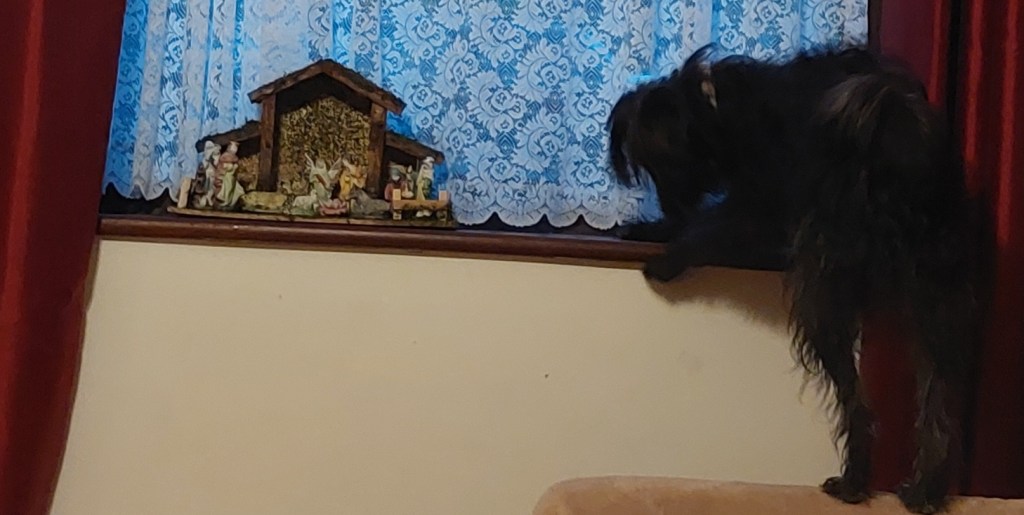
Poppet bowing to the Posada nativity