Inconsiderate people,
They really are a pain.
They inconvenience others
Again and again.
They'll say they "really do not care"
No matter what is said
And treat others more unfairly
To spite them all instead.

They don't care if they're in the way
Or talking very loud.
They stand in front of all the seats
In every football crowd.
They'll take the last cake muffin
Just because that's all you'll eat,
And make sure vegetarians
Are only left with meat.

They don’t believe in fairness,
They just believe in gain.
Deliberately salting all the chips
To spite their wife again.
They hover and intimidate
And strop and cause a fuss.
They want their own way all the time
And 'sod' the rest of us.

They don't give way at roundabouts
Or even indicate.
They think it should be all their way;
The whole world's their estate
... (except it's not).
They think that they are Champion
And the rest of us are rats;
We're only there to serve them
And, of course, to hold their hats.

One day they'll get their comeuppance!
People standing in the ‘do not stand’ area blocking the stands at a football match.
The Feast of the Holy Innocents takes place on 28th December.
Doctor Who tells us that time is “wibbly wobbly timey wimey”. That is what we experience throughout the forty days of Christmastide.
Just a few days before the Remembrance of the Holy Innocents we celebrated Jesus’s birth as a teeny tiny human baby. Then at this feast day we jump forward a couple of years to after the magi’s visit and Herod is ordering the slaughter of many children in an attempt to kill Jesus. Then the following week we go back to that visit of the magi before we leap forward to Jesus being a man at His baptism and then a couple of weeks later Jesus is a teeny tiny baby again as He is presented at the Temple.
But for now, let us return to the day when we remember the Holy Innocents whose deaths Herod was responsible for.
Each year we remember that Joseph heeded the warnings and instructions he received, that he took his family to Egypt and that as a result of this the prophecy was fulfilled and Jesus was kept safe to grow into a man, fulfil His mission and be our salvation.
But we skim over the bit where many innocent children were killed by a scared but cruel man who wanted Jesus dead because he thought he would lose his power.
“A voice was heard in Ramah, sobbing and loud lamentation; Rachel weeping for her children, and she would not be consoled, since they were no more.”
In the Holocaust, approximately 1.5 million Jewish children, and tens of thousands of non-Jewish children were murdered.
The Nazi’s targeted children as part of their ideological goal to create a “radically pure” society and eliminate future generations of “unwanted groups” including Romani, Polish and disabled children.
In the hope of killing one child, Herod had many killed.
Looking back at Moses, who came into the world to bring a kind of deliverance, a new king had risen to power in Egypt. This new king knew nothing of Joseph1 (the Israelite who saved Egypt from the famine). He just saw how numerous the Israelite people were and, wanting to stop the numbers increasing, ordered the death of every Israelite boy born.
There is a constant battle between good and evil in the world and in our own lives.
Evil will always lash out violently towards good. Evil will use any means necessary in an attempt to retain power. There will be resistance when we do good in the world. There will be temptations as we turn away from sin. The strength of these temptations show how committed to change and how committed to doing good we are.
There is wickedness in the world. There are, very sadly, people in this world who will slaughter or arrange the slaughter of thousands and thousands of beautiful, innocent, babies and children, for their own ends, to get what they want and to keep their power.
Evil does not hold back it’s hate for the young and God does not hold back His grace from the young.
God gives us His grace freely and in abundance out of love for us. He is a generous God and there is more than enough grace to encompass everyone no matter their age. He protects us with His grace.
Our world today is, again very sadly, not that different from the world throughout history. We can still see the callousness of Herod and those like him. We still live in a world where innocents are murdered.
We can lament and cry for them. We can pray for their families and friends. But the massacres still continue. Change begins in the human heart and is expressed in what we do and think and say.
It is hard to change a world ingrained with death. But we can contribute to this change. We can demonstrate charity and patience and sanctity of life.
Christ came for our lives, to give us life abundant, sacred and unending.
Herod represents all the powers that stand against Christ; all the people that reject Christ and all the elements of ourselves that want nothing to do with Christ and prefer their independence to His will.
What are we willing to destroy because of our refusal of Christ? What aspects of our own lives and the lives of others are we ready to destroy because of our refusal of Christ?
Herod’s massacre of the innocents is a warning to us. After his death, Herod’s kingdom was divided between the sons he hated. In less than 100 years, everything Herod had built, including the monuments he had intended as structures for his glory, had been reduced to ruins.
Herod is remembered as a petty tyrant. He is not mourned.
We mourn the innocents, the children of Bethlehem, yet they are so often forgotten.
But, in heaven, “where like stars, His children crowned, all in white shall wait“.
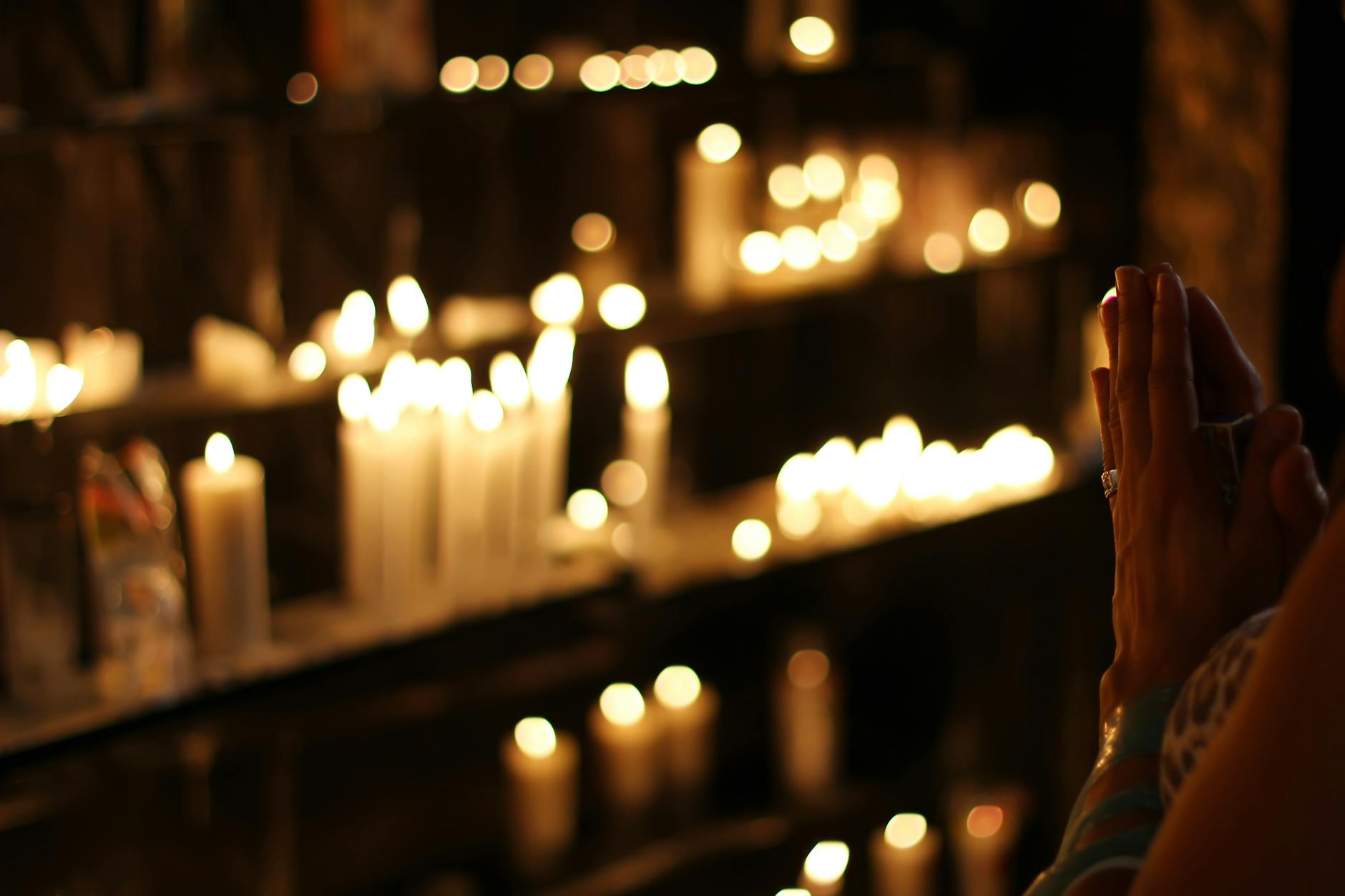
Lit candles for prayer and remembrance. (Photo by Rodolfo Clix on Pexels.com)
I’ll start by admitting that, whilst I was thinking about what I might say today, I was tempted to include a vote on who wants a talk about Mothering Sunday versus who wants a talk on today’s readings (Colossians 3:12-17, Luke 2:33-35, John 19:25b-27). Instead, in a good news bad news kind of result, you’ve got a bit of both.
The other week my husband asked me if I would be taking the Mothers’ Day break in the Lenten fast. Being me I asked why and got told it’s because it’s Respite Sunday. Well, those of us with the job title of Mother might agree that respite is a myth! So I looked it up.
In medieval times this Sunday, called Mid-Lent or Refreshment Sunday, was indeed used as a day of respite from the Lenten fast.
So why, I thought, would you break the fast, or resolution if you like, for one day when (assuming you’ve been able to keep it so far) you are half way through and it’s beginning to get easier. After all, it takes 6 weeks to make a new routine stick and only 1 to break it. Breaking the fast surely just makes it harder to keep for the final half of Lent.
Penny drops!
That’s why, I thought, because it had got easier, it’s not a temptation in the same way anymore, it’s easier to resist, that habit of having whatever it is we’ve given up is becoming a habit of not having it. We are not having to make as much effort and so the motive of Lent, the preparation, the trials, the testing need refreshing so that we are putting the same amount or even more effort into the second half of Lent as we did in the first half. It is not supposed to be easy.
So how did this become associated with Mothering Sunday? Simply because of the texts read at Mass during those medieval times which were full of many metaphors for and references to mothers; which are often linked to the personification of the church as the Bride of Christ and with the Virgin Mary.
Time passed. (It didn’t know the answer to the question). After the English Reformation (when coincidently the same readings were still being assigned to this Sunday in the Book of Common Prayer) Christians would ‘Go a Mothering’. This means they would return to their “Mother Church” for a service on this Sunday. By “Mother Church” we normally mean either the church in which we were baptised, the local parish church or the nearest cathedral (the cathedral being the “Mother Church” of all the churches in the diocese).
In more recent history, Mothering Sunday became a day when domestic servants were given a day off to visit their Mother Church, usually with their own mothers and family members.
Nowadays, we use Mothering Sunday to give thanks to all those who mother us. A day when we celebrate all who have and do give us motherly care.
Providing this love and care is, in itself, a vocation. It is a vocation of nurturing, care, love and joy. Equally, it is a vocation of tiredness and worry, pain and sacrifice.
There can be no doubt that Mary experienced all these elements of motherhood. She accepted the vocation and all the pain that was to come with it.
Jesus was born to be our Saviour and this involved Him being the Ultimate Sacrifice. In this short passage from Luke, Simeon receives Jesus like a priest receiving a sacrifice. He warns Mary that “a sword will pierce” her soul also.
We are told that Mary treasured and pondered on all these things she was told about Jesus. We can only imagine how much she may have dwelt on and worried or dreaded that time coming. Did it give her a chance to be prepared? A chance to be ready when that moment came?
Mary understood the joy of motherhood. But, she also had to understand the pain as she saw Jesus humiliated, tortured and die an extremely painful death. The sword piercing her soul.
Mary was there at important moments in Jesus’s life. Likewise, she was at the cross at His time of death. Yet, even at the moment of death Jesus’s heart is open. He sees the pain and grief of the mother who sacrificed for Him, whom He loves and respects. He sees the grief of a trusted disciple and friend and He gives them to each other to support and care for each other. He ensures that they will be okay by this act. An act of compassion at His darkest hour.
So as we move towards communion and towards our time of prayer let us bring to the Lord all our joys and sorrows. Let us bring to Him our thanks for all those who have provided us with a mothering care and all those who have been like mothers to us.
As we remember Jesus’s sacrifice for us upon the cross, His act of love, may we try and understand the pain of those who suffer out of love and may we strive to follow His example and walk in His footsteps striving to act with compassion, kindness, humility, meekness, patience, forgiveness and love.
Freddie was a young raccoon,
He liked to run and run.
Sadly, he also liked to thieve
From all and everyone.
It didn't matter what it was
Or to whom it did belong.
So long as he could make it his
He thought he'd done no wrong.

"But Freddie" said Police Dog
"You will soon end up in jail,
And if you continue as you are
No one will pay your bail."
Freddie, he just did not believe,
He stole more and more and more.
Telling him it was a crime had now become a bore,
And Freddie being oh so young was too young for the law.

"But one day Fred they'll get you"
All his family did warn.
Yet Freddie he just looked at them
With a face of scorn.
But on Freddie's tenth birthday
All his thieving it did cease,
For on that day he stole again
And was cornered by police.
"Ah ha my lad we've got you now" Police Dog he did say
And Freddie can no longer steal,
For he is locked away!
Cake is really the simplest thing to bake. Obviously I am talking about really basic cake (like what I bake) and not the really amazing designs you can buy from experts for special occasions.
It follows the basic rule of three (like The Holy Trinity):
150g butter (3×50g)
150g sugar (3×50g)
150g self raising flour (3×50g)
3 eggs (3×1)
Mix it up and bake in the oven till cooked – yum yum yum.
So with cake being so popular in today’s society, if Jesus came to us today, what if He said “I am the cake of life” instead of “I am the bread of life”?
Would it have the same effect? Would it have the same meaning? Would it be more popular?
Okay, so we know that unless someone really hates cake the likelihood is that it would definitely be more popular. The thought of being able to live on cake is certainly popular around here.
But Jesus wasn’t trying to win a popularity contest. He came to save us. And if we are honest, if we want to be healthy, we can’t actually just eat cake (sadly). We have to accept that we must eat healthy food to live. So cake goes back to being bread and for this we are thankful as the sacrifice of Jesus and God’s forgiveness saves us from spiritual death. Trust in God and He will provide for us and sustain us.
Nicodemus was a pharisee well educated and well versed in the scriptures. He recognised and acknowledged that Jesus was from God and that God was with him. Yet he came to see Jesus at night, being at the beginning of his belief in Jesus, not wanting his fellow pharisees to know that he had sought out Jesus.
Later, once Nicodemus’s faith and believe had grown he defended Jesus in front of the council and annointed Jesus’s body after the crucifixion.
Jesus responded to Nicodemus’s greeting by starting to teach him how the Kingdom of Heaven can be reached. As is a common factor in conversations today, we are given the impression that Nicodemus has taken Jesus’s answer literally. Nicodemus is an intelligent man and some question whether he was merely stalling for time. However, whether he took Jesus’s answer literally or whether he was questioning it to allow him time to think, it is beneficial to us because this questioning opened up a further response from Jesus and the conversation that followed.
What does lend credence to the idea that Nicodemus was stalling for thinking time is that the Jews were not unfamiliar with the idea of rebirth and considered those converted to Judaism to have been reborn – just as we take those who have turned to Christ to have been reborn in Christ. As usual, like with the parables, Jesus was using metaphors and terminology the Jews were very familiar with.
So, being born again does not, thankfully, mean that Mothers are giving birth to the same person twice. In fact the actual rebirth is not even done by us but by God. What we must do is believe, believe and be baptised in water and in the Holy Spirit. We must receive the gift of the Holy Spirit and, with Jesus as our root, let it be fruitful so that we live with love, joy, patience, kindness, goodness, faithfulness, gentleness and self control.
Aptly, this reading this year fell on Trinity Sunday when we celebrate that God is Three in One – the Father (Presence of God), the Son (Voice of God) and the Holy Spirit (Breath of God). As we who believe are born of man, water and the Spirit. Three in One and One in Three.
Those Doctor Who aficionados in the room will recognise that quote. There is a point! The Doctor brings down the Prime Minister with just those words because she made one mistake. But, and here’s the thing, when the Earth was moved and was out of phase and they needed The Doctor to save them, it was that same person who gathered his old companions and helpers and found a way to show how to find the Earth and who then sacrificed herself.
The Doctor had judged her on one mistake and didn’t see past that to what she was capable of and who she really was.
The Jews in the Gospel reading (John 6:41–58) knew Jesus as Mary and Joseph’s son, as a man in their small community. They rejected Him. They did not believe. Pride prevented them from seeing Him as anything other than a poor lowly man and stopped them seeing who He really was – the Son of God – the one from God.
We likewise make assumptions about others. We put them in little boxes instead of seeing them with open hearts and minds, instead of seeing who they really are and what they will achieve.
So do we see Jesus as the Bread of Life? As the one who will sustain us?
Jesus said “I AM the Bread of Life”.
“I AM”.
These two words tell us precisely who Jesus is. We don’t need anything else. We are left in no doubt about who Jesus is.
“I AM” – the covenant name for God (Yahweh) in the Old Testament, a name for God that the Jews were very familiar with. The Jews, well versed in the Scriptures, knew precisely who Jesus was claiming to be.
But Jesus is also taking His miracle of the day before, providing actual bread, to the next level – the spiritual level. “I am the living bread that came down from heaven…The bread I will give to you is my flesh which I give so the world might live”.
Jesus is the incarnation of God who came down from heaven. He, like bread, is essential to life. Our Spiritual life, our Spiritual nourishment, renewed in our sacrament of Holy Communion.
Dying on the cross to save and forgive us and rising to new life. Just as, when we believe, our old life dies and we are raised to new life with Christ.
A repeated thread throughout the Scriptures is man’s desire for righteousness with God, a desire for eternity and to earn our way to heaven.
Jesus says those who believe in Him will never hunger or thirst. He is referring to our spiritual hunger.
By believing in Him and having faith in Him and His sacrifice for us on the cross, where He takes our sins and atones for them, He does what no one else can and feeds our spiritual hunger allowing us to be right with God.
The very moment a sinner believes in Jesus he is justified, welcomed, loved and accepted with no condemnation. He has peace with God instantly.
However, knowledge is nothing if you don’t believe! Knowing that Jesus died on the cross for us is not enough to save us. We have nothing if we do not believe in Him. The point now to be considered is whether we do actually believe.
“He that believes has everlasting life but he that does not believe will not see life” (John 3:36).
So let us believe and allow Jesus to be in our hearts, sustaining us as our Bread of Life.
Is it a friend?
Or an enemy?
Endless ages spinning in a wheel.
Is it a beginning?
Or an end?
Or an everlasting circle?
Is it now?
Or then?
Or yet to come?
Is it the clock ticking?
Or the silence inbetween?
Is it an invention to imprison each second?
Or free flowing like an everlasting waterfall?
Is it a burden?
Or a joy?
A trial?
Or a challenge?
A struggle?
Or an adventure?
A curse?
Or a blessing?
An illusion?
Or reality?
Linear?
Or “wibbly wobbly”?
Darkness?
Or light?
What if time is all those things and more.
After all life is what we make of it. We can either be negative or positive. We can let difficulties, bad moments/days, events drag us down; or we can use them as stepping stones to a better place, looking at them positively as learning experiences with, and being full of, hope, smiling at adversity and with the determination that each new second is better than the last.






 Just because