Obedient or Disobedient?

“You’re disobedient. Genesis says only men can lead the flock and women shouldn’t lead, preach or teach” I was told by a congregant this week.

Seriously! (shocked cat)

Firstly, I would like to just state that following God’s call and doing His will is not disobedient. The opposite in fact is true. However, ignoring His call, not listening and deliberately ignoring a vocation is indeed disobedient.

Genesis does not, in fact, explicitly state that a woman cannot hold a leadership role, minster, preach or teach. In actuality, NO WHERE in the Old Testament does it explicitly forbid a woman to hold these roles.

What often happens is that less accurate translations of Genesis 2:18 and Genesis 3:16 are misquoted and taken out of context.

Genesis 2:18 – And the Lord God said “It is not good for the human being to be along; let us make him a helper just like him.”

Genesis 3:16 – And to the woman he said “I shall greatly multiply your griefs and your groaning; in pain you will bring forth children, and your inclination shall be for him. And he will lord it over you”

Nicholas King Translation

So it was not good for the human being to be alone and a helper just like him was created. Equal. A companion. Sharing the load, living and working together as equals. And to “lord it over you” meaning false authority, displaying an inflated sense of self importance, condescending and intimidating instead of genuine leadership and humble service. This does not grant man power over woman. It does not say that women cannot be ministers, preach, lead, or teach. It just says that man will think he has power and importance that he does not actually have.

Indeed there are many examples in the Old Testament where God called and used women to lead, preach and teach. Whilst the Old Testament is patriarchal it also shows that God used women in ways which defied the cultural norms. These women had direct access to God and communicated directly with God. They did not need a man to be a go-between.

Examples of such women from the Old Testament are:

  • Deborah (Judges 4-5)
  • Miriam (Exodus 15:20)
  • Esther (Esther)
  • Huldah (2 Kings 22:14)
  • Athallah (2 Chronicles 22:10-12)
  • Abigail (1 Samuel 25)
  • The Wise Woman of Abel (2 Samuel 20:15-22)
  • King Lemuel’s mother (Proverbs 31:1)

Moving on to the New Testament, again there are two small misinterpreted sections in Paul’s letters to the Corinthians (1 Corinthians 14: 34-35) and Timothy (1 Timothy 2:12). The rest of the New Testament does not, in fact, explicitly state that a woman cannot hold a leadership role, minster, preach or teach; on the contrary the examples in the New Testament actively promotes women taking on these roles.

To address the aforementioned verses from Paul’s epistles it must be remembered that we only have one half of the conversation, that Paul’s letters were addressing particular situations and that they are heavily weighted by the male dominant culture of the time. Paul was not addressing all women in ministry. He was instead addressing those in the congregation who were out of order, who were gossiping instead of worshipping, speaking out of turn and who were not displaying modesty and restraint in a reverent way.

This is evidenced in the fact that many women held influential leadership roles in the early church. Not only is this documented in the New Testament but in Romans Paul is commending their service as ministers and deacons, preachers and teachers of the church.

Examples of these women from the New Testament are:

  • Phoebe – Deacon and Minister (Romans 16:1-7)
  • Junia – Apostle (Romans 16:1-7)
  • Priscilla – Church Planter and Leader (Romans 16:1-7)
  • Lydia – held church in her home (Acts 16:14-150
  • Philip’s daughters (Acts 21)
  • Nympha – held church in her home (Colossions 4:15)
  • “Chosen Lady” – Church and Pastoral Leader (2 John 1:1)

There is neither Jew nor Greek, slave nor free, male nor female, for all are one in Jesus Christ.

Galations 3:28

Leadership roles are assigned by God as a spiritual gift.

God bestows capabilities and positions upon individuals for His own purposes, these subjects told me, and when He looks for a human vessel He “sees” only the willingness of the soul to serve.

Kwilecki 1987,66

More importantly, Jesus regarded women as fit for preaching and delivering news about Himself to other men. In John 4 the Samaritan woman is the evangelist to an entire community. Jesus entrusts the news of the resurrection to women before men. Also, women are listed as prophets in Acts and Corinthians and prophets clearly have the authority to preach and teach.

Or long answer short: “Tough! God tells me to so I will continue to follow His call whether you agree or not”

Guinea pig studying The Word!

Epiphany

There are several elements in the nativity scenes we see and in the carols that we sing that could be said to have used dramatic license – despite the clues in the Gospel passages. For example, when the magi reach Jesus He is no longer a baby in a manger in a stable but a child with his
mother in a house. (It is probable that Joseph, at the time of the magi’s visit, was at work), the shepherds were no longer there. They had visited when Jesus was a baby and then returned from whence they came, spreading the good news as they went. And if we shut out the images of these nativity scenes that we are so familiar with and just concentrate on the Gospel passages then we gain a clearer understanding and see the different responses to Jesus.

Herod displayed an open hatred and hostility toward Jesus. He wanted Jesus dead and slaughtered many children in an attempt to achieve this. The chief priests and the scribes were indifferent toward Jesus; they were more concerned about their status and their religious respectability.

But the wise men sought out Jesus and worshipped Him – even at great cost. If we then compare the visit of the wise men to the earlier visit of the shepherds, documented in Luke, we can discern that:
Jesus came to the Jew first, then to the Gentile.
Jesus came to the humble and ignorant first, then the honourable and learned.
Jesus came to the poor first, then the rich.

There are also lessons we can learn from the wise men such as not being satisfied with merely looking at the star and admiring it; the wise men did something about the star, and set out and followed it. They persevered in their search and in following after the star. They were not discouraged in the search by Herod or the doubtful religious leaders. They rejoiced at the star and when they arrived at the destination the star led them to, they entered in and worshipped with a sense of urgency to worship Jesus immediately and not wait to a later time. When they
worshipped, it was to give something – not empty-handed adoration.

There is a wonderful pattern to be seen: “Those who look for Jesus will see him: those who truly see him will worship him: those who worship him will consecrate their substance to him.”

Star (Photo by byMALENS on Pexels.com)

Holy Innocents

The Feast of the Holy Innocents takes place on 28th December.

Doctor Who tells us that time is “wibbly wobbly timey wimey”. That is what we experience throughout the forty days of Christmastide.

Just a few days before the Remembrance of the Holy Innocents we celebrated Jesus’s birth as a teeny tiny human baby. Then at this feast day we jump forward a couple of years to after the magi’s visit and Herod is ordering the slaughter of many children in an attempt to kill Jesus. Then the following week we go back to that visit of the magi before we leap forward to Jesus being a man at His baptism and then a couple of weeks later Jesus is a teeny tiny baby again as He is presented at the Temple.

But for now, let us return to the day when we remember the Holy Innocents whose deaths Herod was responsible for.

Each year we remember that Joseph heeded the warnings and instructions he received, that he took his family to Egypt and that as a result of this the prophecy was fulfilled and Jesus was kept safe to grow into a man, fulfil His mission and be our salvation.

But we skim over the bit where many innocent children were killed by a scared but cruel man who wanted Jesus dead because he thought he would lose his power.

A voice was heard in Ramah, sobbing and loud lamentation; Rachel weeping for her children, and she would not be consoled, since they were no more.”

In the Holocaust, approximately 1.5 million Jewish children, and tens of thousands of non-Jewish children were murdered.

The Nazi’s targeted children as part of their ideological goal to create a “radically pure” society and eliminate future generations of “unwanted groups” including Romani, Polish and disabled children.

In the hope of killing one child, Herod had many killed.

Looking back at Moses, who came into the world to bring a kind of deliverance, a new king had risen to power in Egypt. This new king knew nothing of Joseph1 (the Israelite who saved Egypt from the famine). He just saw how numerous the Israelite people were and, wanting to stop the numbers increasing, ordered the death of every Israelite boy born.

There is a constant battle between good and evil in the world and in our own lives.

Evil will always lash out violently towards good. Evil will use any means necessary in an attempt to retain power. There will be resistance when we do good in the world. There will be temptations as we turn away from sin. The strength of these temptations show how committed to change and how committed to doing good we are.

There is wickedness in the world. There are, very sadly, people in this world who will slaughter or arrange the slaughter of thousands and thousands of beautiful, innocent, babies and children, for their own ends, to get what they want and to keep their power.

Evil does not hold back it’s hate for the young and God does not hold back His grace from the young.

God gives us His grace freely and in abundance out of love for us. He is a generous God and there is more than enough grace to encompass everyone no matter their age. He protects us with His grace.

Our world today is, again very sadly, not that different from the world throughout history. We can still see the callousness of Herod and those like him. We still live in a world where innocents are murdered.

We can lament and cry for them. We can pray for their families and friends. But the massacres still continue. Change begins in the human heart and is expressed in what we do and think and say.

It is hard to change a world ingrained with death. But we can contribute to this change. We can demonstrate charity and patience and sanctity of life.

Christ came for our lives, to give us life abundant, sacred and unending.

Herod represents all the powers that stand against Christ; all the people that reject Christ and all the elements of ourselves that want nothing to do with Christ and prefer their independence to His will.

What are we willing to destroy because of our refusal of Christ? What aspects of our own lives and the lives of others are we ready to destroy because of our refusal of Christ?

Herod’s massacre of the innocents is a warning to us. After his death, Herod’s kingdom was divided between the sons he hated. In less than 100 years, everything Herod had built, including the monuments he had intended as structures for his glory, had been reduced to ruins.

Herod is remembered as a petty tyrant. He is not mourned.

We mourn the innocents, the children of Bethlehem, yet they are so often forgotten.

But, in heaven, “where like stars, His children crowned, all in white shall wait“.

Lit candles for prayer and remembrance. (Photo by Rodolfo Clix on Pexels.com)
  1. Genesis ↩︎

Let Our Little Lights Shine

A long time ago, possibly even in Bethlehem, a story about a little owl called Plop was very popular. The main thing about this story was that Plop, the baby owl, was scared of the dark.

I wonder, who here is, or used to be, scared of the dark?

And how many of you sometimes think that there are monsters or bad things in the dark? Or that the darkness is something bad?

And when a light appears do you feel better?

The opposite of dark is light. So if darkness is bad or scary then the light is good and friendly.

The magical thing about light is that you only need a teeny tiny spark to transform the darkness.

That light, that tiny spark, shines in the darkness and the darkness cannot overcome it.

There is a lot of darkness in the world, selfishness, greed, things that cause hurt, sin. But a light came into the world and the darkness cannot overcome it.

Jesus is the light of the world, the light in the darkness. And like when one candle shines in the darkness and then another is lit, and then another and another; soon all there is is light.

Jesus starts with us, forgiving the darkness in us so that we can shine; and as each of us are filled with His love, light and forgiveness, the light shines brighter and the darkness diminishes.

Jesus shows us the way to live a good life, full of light and offers us His power to live that way. When He comes again and God’s final judgement comes upon the world the darkness will be banished forever.

When you hold your Christingles look at the candle, as it is lit remember Jesus, the light of the world, whose light vanquishes the darkness.

Let that light into your hearts and lives lighting the way for others to find their way out of darkness into light.

Our task is to be those Christingles (it’s okay, dressing up is optional) to share the joy that comes to us through Jesus and to be His light bringing hope to those in the dark.

In the beginning there was nothing but God. And God created the world and everything in it. He filled the world with all sorts of good things – plants, animals, mountains, rivers, seas, the sun, the moon, and even people. And God saw that everything He had made was good.

But it didn’t stay good. The people did things they should not do. They did not look after what God had allowed them to borrow. They did not look after the world or each other.

This made God sad because He loves us. So He sent us a rescuer, but not just any rescuer. He sent us the best rescuer of all – His precious Son.

Jesus came to be the light to the world, to defeat the darkness and help people come to know God.

A light for everyone, shining in our world, our lives and our hearts.

Even though we are celebrating Christ’s birth (his first coming) on Christmas Day, we are already looking ahead to Easter when Jesus died on the cross and rose again to defeat all the powers of darkness, to defeat all those scary monsters, and to be our salvation.

The ribbon which represents the outpouring of Jesus’s blood also reminds us of the great outpouring of God’s love for us which encompasses the whole of creation.

Christmas and Easter are two parts of the story of God’s love for us. May we live out the truth of that story in our own lives, may we accept again this Christmas the greatest gift of Christ’s light and may we let our little light shine out of the darkness to the glory of God. Amen.

Christingle

Mary …

We tend to use a mixture of readings from the Gospels of Matthew and Luke to revisit the miracle of Jesus’s birth. Here, Matthew doesn’t tell us how the Virgin Birth took place—except that it was by the Holy Spirit. Whereas, Luke gives a little more detail, the angel telling Mary that the Holy Spirit will come upon her, and the power of the Most High will overshadow her. The Virgin Birth is a divine miracle in the power of the Holy Spirit.

But Matthew does tell us two things about Jesus, one being what he does: “You shall call his name Jesus for he shall save his people from their sins”. Many Jews were looking for a Messiah who would come in conquering power. But Matthew shows us the much deeper human need. Jesus comes to save us from our sins—our spiritual needs far outweighing other needs.

The miracle of the Virgin Birth is also a sign of the far greater miracle and mystery of God becoming flesh and taking his place amongst us as one of us – the Incarnation. God didn’t just send angels, prophets and messengers—he came! In Jesus, God has come close; has taken human nature and human life to himself joining human nature to his own divine being. This is all of the Grace of God, who is a God who stoops to take us by the hand. In this respect, Matthew quotes from the Old Testament: ‘The virgin will be with child and will give birth to a son, and they will call him “Immanuel”—which means, “God with us.”’ If the name Jesus is descriptive of what Jesus does, Immanuel is descriptive of who Jesus is—God with us.

The miracle of the Virgin Birth points towards both the humanity and the deity of Jesus. He was a human person born in the normal way. He is also the eternal God who has come to us—the God-man. Jesus didn’t begin his existence at Christmas, but as eternal God, entered into time and space at Christmas. For unto us a Child is born, unto us a Son is given… (Isaiah 9:6).
So many people are ‘in the dark’ about God and don’t see him clearly. Yet, if you want to know what God is like, you only have to look at Jesus. Jesus Christ is the “Word of the Father, now in flesh appearing…” He is the revelation of the will, wisdom and person of God. His teaching is the
instruction of God. His death is the death of God-for-us. His resurrection is the victory of God! The meaning of Christmas is first and foremost a message of amazing grace, of a God who comes near.

The miracle of the Virgin Birth is a new creation, the beginning of a whole new world. What we can’t do for ourselves, God has and is doing. Into a world of brokenness and sadness God has come by means of a supernatural birth in the power of the Holy Spirit. But it doesn’t end there: the same Spirit who hovered over Mary and brought about a miracle of new life and transformation in her can also do the same in us! Regardless of who you are or what you have done you can start a whole new life as part of the new world. Jesus is the answer to our deepest needs. He is God come among us in order to save us from our sins and to rescue us from the deepest cause of our alienation and brokenness. When we start from the inside out we can have hope that the entirety of our life can experience the transformation he brings.

Mary, mother of Jesus (Photo by Juan Carlos Leva on Pexels.com)

John the Baptist

Matthew 11:2-11 is a reading which often gets overlooked.

John the Baptist is in prison. He has been in prison for some time and knows he will not leave it alive because Herod’s wife wants him dead. She has not yet, however, found a way of securing his death and Herod is intrigued by John and so listens to what he has to say. Consequently, John is treated with respect and his disciples were allowed to visit him freely. His disciples keep him up to date with what is going on in the world outside and report to him what they have witnessed of Jesus.

John sends his disciples to Jesus with the question “Art thou he that should come?”

This is where opinion amongst well-known commentators differ.

Some state that John sent the disciples only to remove their doubts.

Others state that this question came directly from John with the answer being directed to John; who may have been feeling impatient at hearing about the signs and wonders but not seeing the appearance of God’s kingdom in a way he expected and so was falling into despair in prison.

Many Christians struggle with this passage and John’s question. This is not surprising considering what else we know about John.

John the forerunner. The one sent to “Prepare the way of the Lord”.

John, who, before he had even been born, recognised his cousin as Lord and Saviour and jumped for joy in his mother’s womb.

Seeds of doubt planted by the devil reach their peak at times of great despair and can cause people to question even the most important fundamental truths.

We hope that, nay we know that, John’s faith did not fail him.

However, at a time of despair, languishing in jail, confirmation of what he knew to be true would consolidate and strengthen his faith and hope.

Yet, if John had sent his disciples to Christ with the question for their satisfaction then we know that Christ pointed them to what they had heard and seen; directing them to the way in which salvation was to be found.

John, who at Jesus’s baptism witnessed the Holy Spirit descend on Jesus and heard the voice from heaven confirming Jesus as God’s beloved Son with whom He is well-pleased, had shown Christ to his disciples.

John saw that some of these disciples were envying for his sake and some were making the same misinterpretations as many of the Jews did about the Messiah. John wanted to ensure, before his own inevitable death took place, that his disciples were satisfied from their own experience of and sight of the works of Christ; and so he sent them on this errand.

“Poor men have the good news proclaimed to them,” Jesus added when He spoke to John’s disciples. He invited them to His kingdom and told them of peace and pardon.

It was predicted in Isaiah that the Messiah would indeed preach good tidings to the meek (the gospel to the poor).

Jesus knew that John the Baptist, whose heart was with the poor, knew that He was the one who united power and tenderness and could be none other than the expected king.

From verse 6: Blessed is he who shall not take offence at my poverty and lowliness of life and who will not reject me and my doctrine.

John wanted, not to force Christ’s hand into revealing Himself before His time came but, to ensure that he had completed his mission and passed the baton over to the one for whom he had been preparing the way.

Jesus then gave testimony to John, and to all he had achieved.

What Jesus said about John was not only to praise John but also for all the people.

Those who listen to the word will be called to give account of their improvements. Do we think that once the sermon is over the work is done? No! It most certainly is not. In fact, that is when the great work really begins.

Fervency and zeal are required by all. Self must be denied; the bent, frame and temper of the mind must be altered.

Those who have an interest in salvation will not mind what the terms are nor how hard they seem.

Things of God are of both great and common concern.

God requires no more from us than the right use of what he has given us.

People are ignorant because they will not learn.

John was sent to prepare the people to receive the Messiah and he fulfilled this commission. He preached repentance and faith in Christ.

As John prepared the way for Jesus then so we must prepare now.

We must prepare our hearts and minds, making them right and open ready to receive Him again this Christmas and for when He comes again in glory.

Not only that but we must spread that good news so that others also have the chance to repent and prepare.

Handing over the baton (Photo by BOOM ud83dudca5 Photography on Pexels.com)

Once Upon A Time …

there was a little baby born in a stable who would become the saviour of the world. He was visited by shepherds and magi, whilst the angels sang and a star shone.

And that is precisely the problem – too many people treat the reports of Jesus’s birth as if it was a nice little fairy story for children. There is too much complacency, too much commercialism and too much watering down the truth because it’s easier to fall in with non-believers, materialism and instant gratification than it is to stand firm in the faith. Humans like an easy life but the ironic thing is that taking the easier road leads, at the end, to suffering.

The road less travelled, narrow and difficult though it may seem at times, is the path to God’s house. Whilst the journey may seem hard, the end is worth it. It is better to travel the more difficult road with Christ by our side and wait for our reward at the end of the journey than it is to opt for the easy journey and the consequences that await.

Advent is a time of waiting, watching and preparing, of truly listening to God with our heart and with all our senses, of opening our hearts and minds, of making changes and being prepared to be changed, of praying and inviting Jesus into our lives and our hearts. It is a time to get ready to climb that difficult path up the mountain. 

Jesus is the gift that keeps on giving. He is real and the path to life, not just a story for Christmas. He is our Saviour, our Redeemer, the King of Kings and Lord of Lords who rules through love not war. He sacrificed himself to defeat death and the devil to save us. He shows us God’s mercy, love and grace. He grants us forgiveness and shows us how to live.

This year, why not use this time of Advent to evaluate yourself and your faith, to choose Jesus, the greatest gift of all, to choose life not death. Yes that means making difficult choices and choosing the harder path over the easier one. It means loving the Lord your God with all your heart, mind, soul and strength and loving your neighbour as yourself. It means loving, forgiving and praying for your enemies. It means listening and obeying our Lord and Master and following him.

But what a friend we have in Jesus, all our sins and griefs he bears. What Joy, Love, Light and Peace we gain as a child of our Heavenly Father. 

Hell is truly an absence of God, of not being in his loving presence. So stop treating Jesus’s birth as a fairy story and give it back the significance it requires.

I pray that you all receive God’s blessing this Christmas.

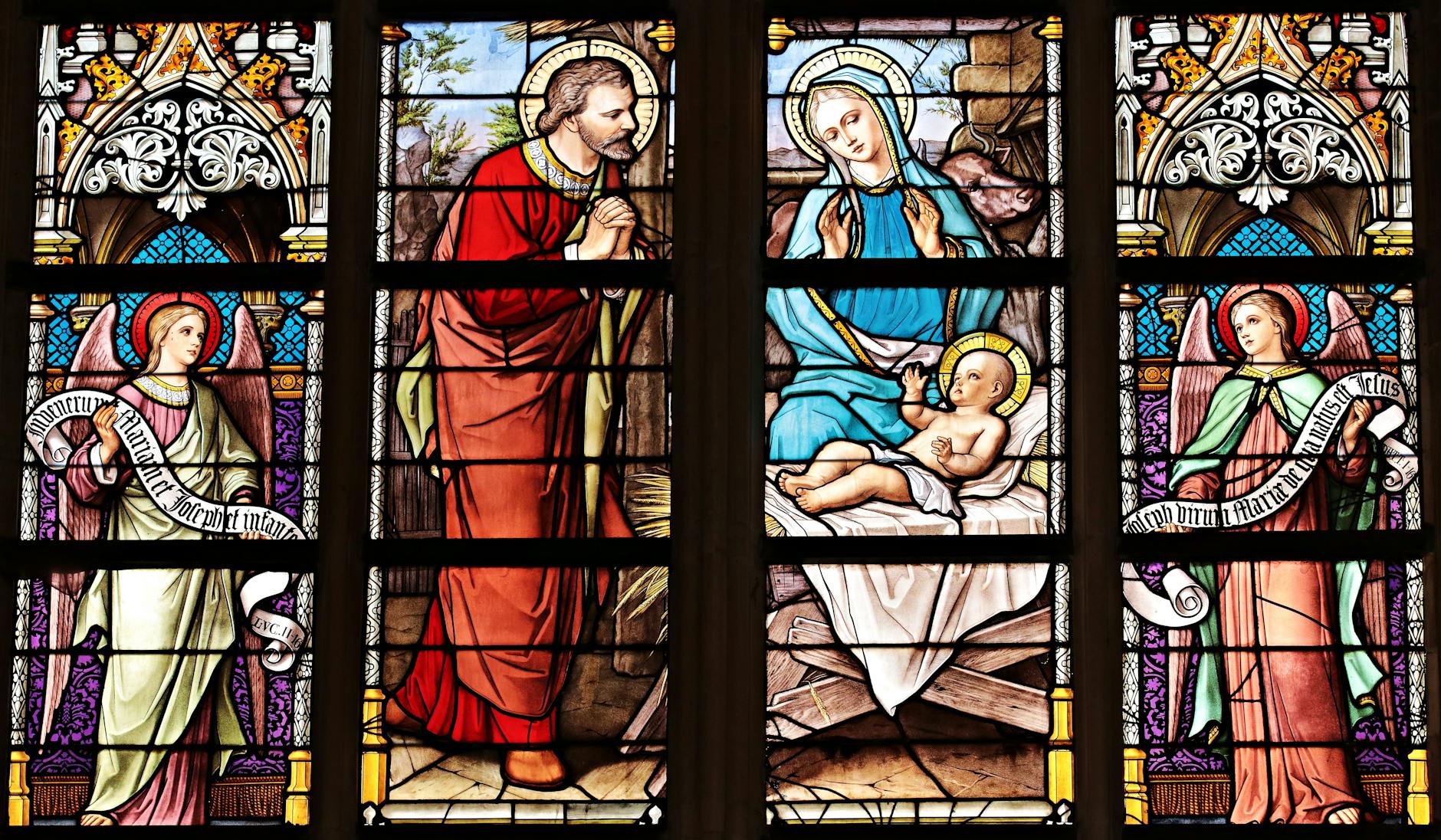
Image of a stained glass window depicting Jesus’s birth (Photo by Pixabay on Pexels.com)

King of Kings

The Sunday before Advent, we celebrate Christ the King, which concludes the church year as we begin the Advent Season and the new church year the following Sunday.

Whilst one of the more recent festival days of the church, having been added to the church calendar in 1925, it is when we join together to give thanks to Christ our King and to be reminded that all nations fall under the reign of God’s Son, and to remind the world that we all live under this reign, whether or not we acknowledge it.

Jesus is our King and is the King of kings.

So, what kind of king is he?

In his epistle to the Colossians, Paul tells us that in Jesus, our King, all things in heaven and earth, both seen and unseen, have been created through Jesus and for Jesus. There is nothing, no nation, no government, no earthly ruler that has not been created through Jesus and for Jesus. He is the Lord over all. King of kings and Lord of lords.

Paul goes on to tell us that without Jesus being an active part of our world everything would fall apart. Jesus is the glue that holds all things together. The ultimate sticky back plastic.

Paul tells us that our Almighty and all powerful God rescued us from the power of darkness into Jesus’s kingdom, where there is love, forgiveness, grace and mercy. All ruled over by the gentle, loving hand of Jesus. An all – powerful king who chooses not to rule by force but by love.

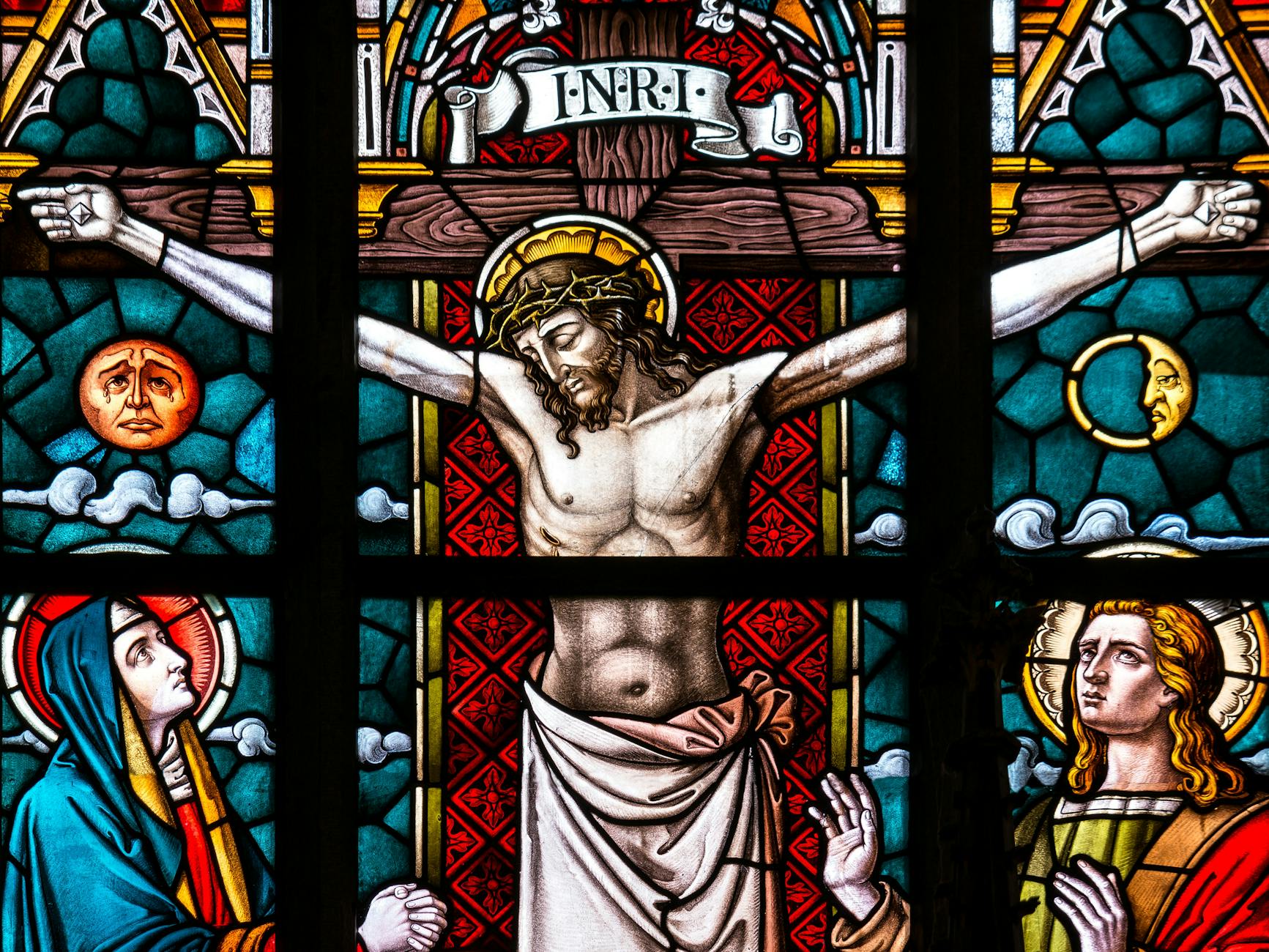
In Luke chapter 23, Jesus is being crucified and mocked. Jesus, our all – powerful king, allows himself to be crucified – killed in a cruel, torturous, shaming way; choosing to reign from a cross, willingly dying for us.

Yet it is this that shows us what it means to have Jesus as our king and what kind of king He is.

A king who is literally dying to save us. A king who took our humiliation and punishment for us. A king who was tortured and died and refused to save himself. A king who gets what he does not deserve – death on a cross – so that we can have what we do not deserve – life in his kingdom. A king of overflowing love showing us God’s overflowing love for us.

And he does not stop there, as demonstrated when, even though he was dying, he still found the breath to forgive the repentant thief.

Jesus is a king who is always ready to forgive and to welcome a repentant sinner home.

Christ, our king of love has let us off the cross, giving us the opportunity to be his disciples and live each day for him.

I invite you to think about what that means for you.

We give thanks for Christ our King, the all-powerful, who chooses to reign by love. The king who died so that we might live.

So, let us live not for ourselves but for him. Let us make the most of the opportunity to live each day for the king who died to save us and continue to do so until that blessed day when his kingdom will come in all it’s fullness and glory.

Christ The King (Photo by Pixabay on Pexels.com)

Remembrance Sunday

Luke 20:27-38

A question about the resurrection.

When I was looking deeper into this reading from Luke, I noticed that one of the commentaries entitles it “The Sadducees ask Jesus a ridiculous question”.

The Sadducees were like an ancient version of modern liberal theologians. They only accepted the first five books of Moses as authentic; disregarding what was written in them whenever they chose to do so. They did not believe in the resurrection, spirits or angels. They liked worldly things and cooperated with the Romans in order to keep their privileges.

There is a saying that there are no stupid questions only stupid answers but, in this case, it is the other way around. The Sadducees ask a ridiculous, hypothetical question based on Deuteronomy 25:5-10 in the hope of tricking Jesus into justifying their views. It is even feasible that the story they told was one of their stock in trade, told regularly purely in an attempt to cast ridicule on the resurrection of the dead.

Jesus’s reply, however, was a reminder that life in the resurrection is quite different to this worldly life with practices that are different to earthly life practices.

Revelation tells us that the glory of heaven will be a relationship and connection with God that surpasses anything else.

The question was not actually asked, however, to debate about those in heaven who had been married more than once; although Jesus tells us here that jealousy and exclusion have no place in heaven.

It was asked in order to attempt to refute the resurrection.

Jesus’s reply: “Nor can they die anymore, for they are equal to the angels, are sons of God, being sons of the resurrection.”

Jesus reminds us that life in heaven is eternal and shares some of the characteristics of the existence angels experience; although by being called children of God and children of the resurrection is a greater honour than that of the angels – these titles not having been given to angelic beings.

Jesus confirmed (and goes on to prove in the passage) that the resurrection is real and that there is no death in that life to come. And of course, this was a double blow for the Sadducees having had Jesus also confirm the existence of angels.

This teaching of Jesus , confirming the resurrection, is particularly poignant on Remembrance Sunday, when our thoughts turn to those who gave their lives, the mystery of death and what happens next.

We remember those who, throughout the centuries, received the news of their loved one’s death or that they were Missing In Action.

We remember those, who, today, yesterday, and in years long past made the ultimate sacrifice; and those who, sadly, will be making that sacrifice tomorrow.

They gave, and give, their lives for our tomorrows, for peace, freedom, justice and stability.

The scale and horror of the First World War was such that, at the time, it seemed impossible and unthinkable that such atrocity could be repeated – giving it the name “the war to end all wars”.

Sadly, reality turned out very different. Many millions more lives have since been, and continue to be, lost in all the many conflicts that have continued since around the world.

Most of us, most people, at least most of the time, want to live in peace.

So, what is it that is within humanity that creates this, appearingly, insatiable, appetite for conflict and war. Both for actual conflict and war and that which is created for, rather shamefully named I think, “entertainment purposes” such as video games.

Deep down beneath all the surface reasons or, dare I say, excuses, for conflict is that much used and much misunderstood word sin. The difference between the people we are and the people God made us to be. And what did God make us to be? He created us in His image. In the image and likeness of a loving God for the express purpose of being a loving people that love one another.

As Jesus said in John 15: “This is my commandment that you love one another as I have loved you” and “I am giving you these commandments so that you may love one another.”

There are far too many shocking stories, accounts and images of the atrocities of war – including those that continued to be committed after peace treaties were signed. We are supposed to learn from our mistakes and yet these still continue to take place.

But, there are also the poignant images of the Allied and German cemeteries filled with crosses.

Picture those rows of white crosses, be immersed in the silence.

Rows and rows of white crosses.

Take the command to love one another seriously.

Row upon row.

Understand that Christ went to the cross to overcome our separation from God and from each other.

Rows and rows and rows of white crosses.

If only this commandment was followed and the sacrifice understood all around the world then maybe, just maybe, the glimmer of hope given by the light of Christ will stay lit, not all will be lost and we would actually be able to allow Remembrance Day to fulfil it’s dream and truly mark the end of war!

War cemetery, rows of white crosses. (Photo by Pascal Ingelrest on Pexels.com)