

Genesis 7, Acts 2:42ff, Psalm 23, 1 Peter 2:19ff, John 10:1-10
As is so often the case, whilst it might not initially seem like it, our Old Testament and New Testament readings go hand in hand.
Our Old Testament reading details the onset of The Great Flood; representing God’s righteous judgement on a corrupt world and His merciful salvation of Noah’s family.
Indeed, its key themes are the finality of God’s judgement when it comes and the Ark as a type of Christ – a place of absolute sanctuary, provided by God.
There is the invitation into safety: “Come into the Ark” – a final invitation to salvation, not merely survival but true salvation and sanctuary prepared by God. It is a promise of protection. When God sends judgement He also provides total shelter for His people.
God closed the door of the Ark signifying that the time of mercy and warnings has passed. It is a seal of safety for those who accepted God’s invitation and finality for those who remain outside.
Of course, there is also the obedience of Noah, like a sheep steered by a shepherd, who only entered the Ark once he was commanded, completing a long and difficult task of faith.
The Ark highlights a stark contrast between salvation for the obedient and judgement for the rebellious; mirroring the finality of Judgement Day.
In our New Testament readings we are like sheep who have gone astray. Jesus describes Himself as the Shepherd and the Gate for the sheep. Like the Ark, Jesus is concerned with keeping His people, His sheep, safe and cares deeply for them. Both Jesus and the Ark are protectors, gatekeepers and shepherds.
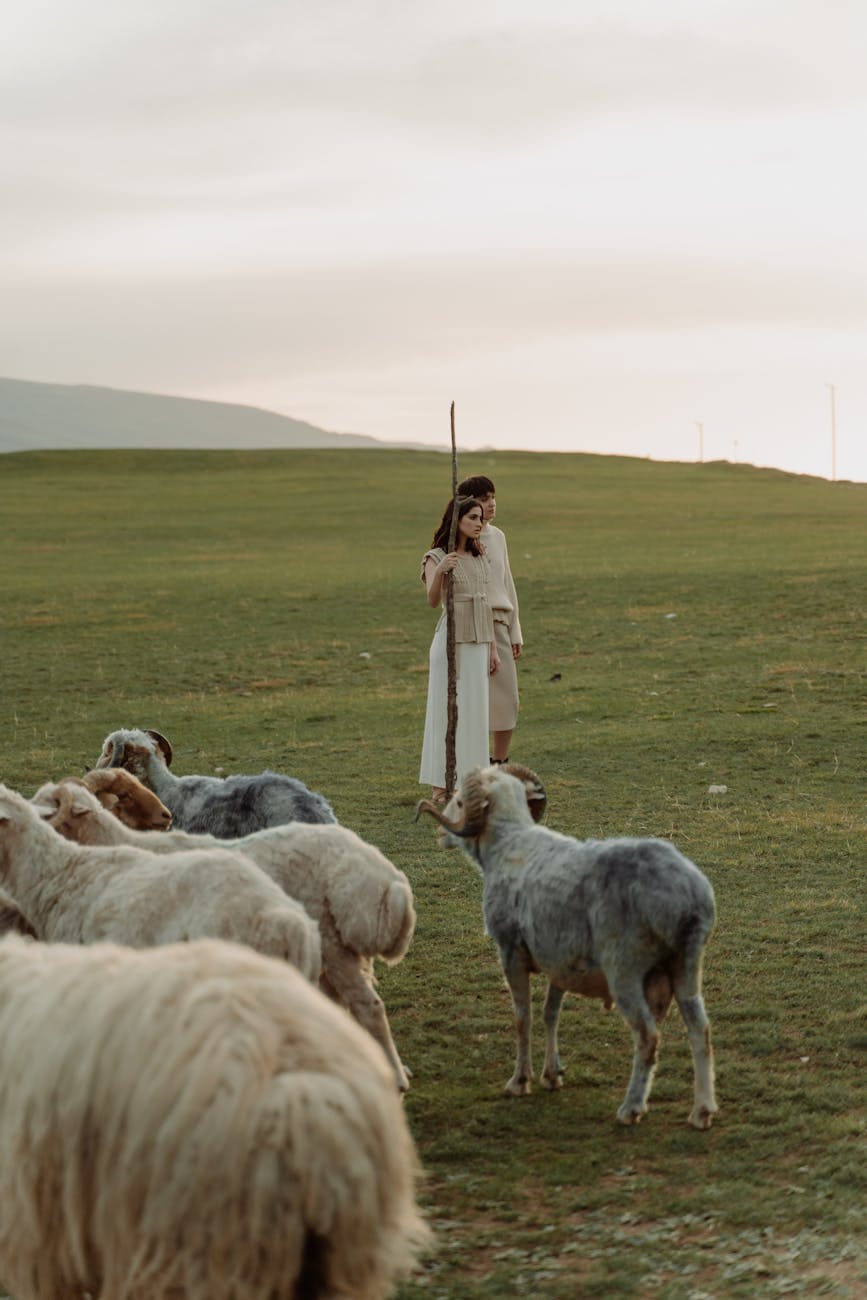
A shepherd tends, herds, feeds and guards their sheep.
Some denominations call their church leaders Pastors. Pastor is the Latin word for shepherd.
Shepherds lead sheep by building trust, using vocal cues, and employing protective, guiding techniques. Often they work in groups, working together to share the responsibilities.
Sometimes they lead the sheep from the front, such as leading them to pasture, breaking a trail, clearing danger, and demonstrating a safe path.
Sometimes the shepherd leads from behind to guide and protect the sheep from danger, keeping the flock together from the rear and allowing the fastest to go first to direct the herd’s overall movement. Herding the sheep instead of expecting them to follow.
By walking opposite to the flock, shepherds can push them into a new direction.
To contain or direct them, shepherds might walk along the side of the sheep, keeping full view of the flock.
Shepherds focus on providing security and nourishment, which ensures the sheep trust them enough to follow.
And, of course, there is the famous shepherd’s crook, which is used to guide, separate, or protect the sheep. The distinct hook at the end is used for managing, catching and guiding sheep by their necks or legs without causing injury. It is especially useful for catching lambs or holding a sheep in the pasture. The long handle is used to guide the sheep through the gates, separate, or steer them without getting close enough to scare/frighten them.
It also supports the shepherd, like a hiking pole, when travelling across rough, uneven or steep terrain.
The shepherd can also use the crook as a defensive weapon against predators to protect the flock or to shake fruit from high branches or to part thick undergrowth.
This highlights how deeply a good shepherd knows their sheep and how well they know their shepherd. The sheep know the shepherd’s voice. The shepherd brings security and life. Jesus as the Shepherd and Gatekeeper is the protector and provider, offering security and life, in direct contrast with the Pharisees or “thieves” who come to steal, kill and destroy.
The gate and the shepherd work together. The function of the gate is to keep the sheep together during the night, safe from predators. During the day the gate is opened so that the shepherd can guide the sheep to pasture. It is important to emphasise that the gate is not a gate of exclusion. It is not to keep out other sheep. Jesus said “I have other sheep that do not belong to this field. I must bring them also, and they will listen to my voice. So there will be one flock, one shepherd.” The gate is purely to guard against all that threatens the sheep.
Not only do the gate and shepherd work together but they are one and the same. Hence, Jesus using both in this teaching. Many get confused by this but it is simpler than it seems.
Let me tell you about an Arab shepherd. This shepherd was not a christian and did not know the Bible. But he did know his sheep and was showing off his flock to a scholar, and also showed off the penned area where his sheep slept every night. “And when they go in there” the shepherd said proudly, “they are perfectly safe”.
But then the scholar noticed something and said, “Your sheep sleep in that pen and yet I notice that the pen does not have a gate on it”.
“Yes that’s right,” the shepherd replied, “I am the gate”.
“What do you mean?” the man asked.
“After my sheep are in the pen, I lay my body across the opening. No sheep will step over me and no wolf can get in without getting past me first. I am the gate.”
The other interesting part of this passage from John is verse 6: “This figure of speech Jesus used with them, but they did not understand what he was saying to them.”
There are many shepherds in the Old Testament, Moses, Rachel, David are just a few. Shepherding was a common job at the time. In addition, the shepherd/sheep metaphors are used over and over again throughout the Old Testament. Yet, despite this, the Pharisees, the people who claimed to be experts in the Old Testament, didn’t understand what Jesus was talking about. They did not understand because they did not believe.
The role of the good shepherd is to take care of the sheep, to protect the sheep, to lay down their life for the sheep and to love the sheep. There is no better metaphor to describe the nature of Jesus’s bond with His people. He is a gentle shepherd who leads His sheep.
On the other hand, Jesus is calling the Pharisees “bad shepherds”. They were the very people who were supposed to spiritually nourish and protect the people of God and yet they were leading the people astray. Jesus was comparing these false teachers to thieves, robbers and strangers. He is saying that His sheep, the sheep of the true shepherd will not be controlled by the pharisees.
Jesus is saying, just in a different way, the same thing that He says in John 14:6, “I am the way, the truth, and the life. No one comes to the Father except through me.”
Enter salvation through the Jesus Gate. Be a Jesus Sheep, in the sanctuary of the Ark, tended, herded, fed, cared for and guarded by the Jesus Shepherd; and receive abundant everlasting life, green pastures, still waters, peace and joy.

 Just because