Here's a little hug for you, Whenever you are feeling blue. Now shut your eyes and slow your breath, And feel the comforting caress, As Jesus takes you in His arms. He'll take your sorrows and your frowns, Replacing them with love and calm. He'll take your worries and your fears, And gently wipe away your tears. He whispers "I am here for you", And you know these words are true.
Two weeks ago we celebrated Jesus’s birth – the birth of a tiny baby. Last week we remembered the Wise Men finding and worshipping Jesus – a toddler. Today, we jump forward nearly three decades, doesn’t time fly, Jesus is thirty and being baptised.
In some ways, it is not strange to us that we celebrate Jesus’s baptism shortly after His birth. After all, it is not a rare occurrence for a baby to be baptised, making them a part of the family of God, washing away the consequences of the original and actual sin, granting them the hope and promise of salvation and professing the faith on their behalf whilst promising to bring them up in that faith.
Baptism is linked by Jesus to salvation. It is a symbol of the forgiveness of sins, the death of old life and the start of new life and acceptance into God’s family.
However, Jesus was not a baby. He was a grown man and the sinless Son of God.
So why did Jesus need to be baptised?
Indeed, John the Baptist asked the same thing saying “I need to be baptised by you, yet you come to me?”
Jesus replied “Let it be so now; it is proper for us to do this to fulfill all righteousness.”
Jesus was to be the one to separate believers from betrayers. Jesus was also to bring a purifying and transforming baptism of fire; which enables us to be empowered by the Holy Spirit.
Jesus was baptised to identify Himself with sinful man, who He came to save. He took our sin to save us. His baptism marks the end of His old life marking the acceptance of and the start of His ministry. He is annointed by the Holy Spirit whilst He is affirmed by God as His Son (a parallel with Pentecost when the Holy Spirit came down on the church).
This affirmation from God that Jesus is the Messiah also provides confirmation to John that he has completed his mission of preparing the way for the Messiah; whilst Jesus begins His earthly ministry with the blessing of God His Father and the empowerment of the Holy Spirit.
Father God, we ask that you baptise us all again with your Holy Spirit empowering us to do your work. Amen.
Nicodemus was a pharisee well educated and well versed in the scriptures. He recognised and acknowledged that Jesus was from God and that God was with him. Yet he came to see Jesus at night, being at the beginning of his belief in Jesus, not wanting his fellow pharisees to know that he had sought out Jesus.
Later, once Nicodemus’s faith and believe had grown he defended Jesus in front of the council and annointed Jesus’s body after the crucifixion.
Jesus responded to Nicodemus’s greeting by starting to teach him how the Kingdom of Heaven can be reached. As is a common factor in conversations today, we are given the impression that Nicodemus has taken Jesus’s answer literally. Nicodemus is an intelligent man and some question whether he was merely stalling for time. However, whether he took Jesus’s answer literally or whether he was questioning it to allow him time to think, it is beneficial to us because this questioning opened up a further response from Jesus and the conversation that followed.
What does lend credence to the idea that Nicodemus was stalling for thinking time is that the Jews were not unfamiliar with the idea of rebirth and considered those converted to Judaism to have been reborn – just as we take those who have turned to Christ to have been reborn in Christ. As usual, like with the parables, Jesus was using metaphors and terminology the Jews were very familiar with.
So, being born again does not, thankfully, mean that Mothers are giving birth to the same person twice. In fact the actual rebirth is not even done by us but by God. What we must do is believe, believe and be baptised in water and in the Holy Spirit. We must receive the gift of the Holy Spirit and, with Jesus as our root, let it be fruitful so that we live with love, joy, patience, kindness, goodness, faithfulness, gentleness and self control.
Aptly, this reading this year fell on Trinity Sunday when we celebrate that God is Three in One – the Father (Presence of God), the Son (Voice of God) and the Holy Spirit (Breath of God). As we who believe are born of man, water and the Spirit. Three in One and One in Three.
Those Doctor Who aficionados in the room will recognise that quote. There is a point! The Doctor brings down the Prime Minister with just those words because she made one mistake. But, and here’s the thing, when the Earth was moved and was out of phase and they needed The Doctor to save them, it was that same person who gathered his old companions and helpers and found a way to show how to find the Earth and who then sacrificed herself.
The Doctor had judged her on one mistake and didn’t see past that to what she was capable of and who she really was.
The Jews in the Gospel reading (John 6:41–58) knew Jesus as Mary and Joseph’s son, as a man in their small community. They rejected Him. They did not believe. Pride prevented them from seeing Him as anything other than a poor lowly man and stopped them seeing who He really was – the Son of God – the one from God.
We likewise make assumptions about others. We put them in little boxes instead of seeing them with open hearts and minds, instead of seeing who they really are and what they will achieve.
So do we see Jesus as the Bread of Life? As the one who will sustain us?
Jesus said “I AM the Bread of Life”.
“I AM”.
These two words tell us precisely who Jesus is. We don’t need anything else. We are left in no doubt about who Jesus is.
“I AM” – the covenant name for God (Yahweh) in the Old Testament, a name for God that the Jews were very familiar with. The Jews, well versed in the Scriptures, knew precisely who Jesus was claiming to be.
But Jesus is also taking His miracle of the day before, providing actual bread, to the next level – the spiritual level. “I am the living bread that came down from heaven…The bread I will give to you is my flesh which I give so the world might live”.
Jesus is the incarnation of God who came down from heaven. He, like bread, is essential to life. Our Spiritual life, our Spiritual nourishment, renewed in our sacrament of Holy Communion.
Dying on the cross to save and forgive us and rising to new life. Just as, when we believe, our old life dies and we are raised to new life with Christ.
A repeated thread throughout the Scriptures is man’s desire for righteousness with God, a desire for eternity and to earn our way to heaven.
Jesus says those who believe in Him will never hunger or thirst. He is referring to our spiritual hunger.
By believing in Him and having faith in Him and His sacrifice for us on the cross, where He takes our sins and atones for them, He does what no one else can and feeds our spiritual hunger allowing us to be right with God.
The very moment a sinner believes in Jesus he is justified, welcomed, loved and accepted with no condemnation. He has peace with God instantly.
However, knowledge is nothing if you don’t believe! Knowing that Jesus died on the cross for us is not enough to save us. We have nothing if we do not believe in Him. The point now to be considered is whether we do actually believe.
“He that believes has everlasting life but he that does not believe will not see life” (John 3:36).
So let us believe and allow Jesus to be in our hearts, sustaining us as our Bread of Life.
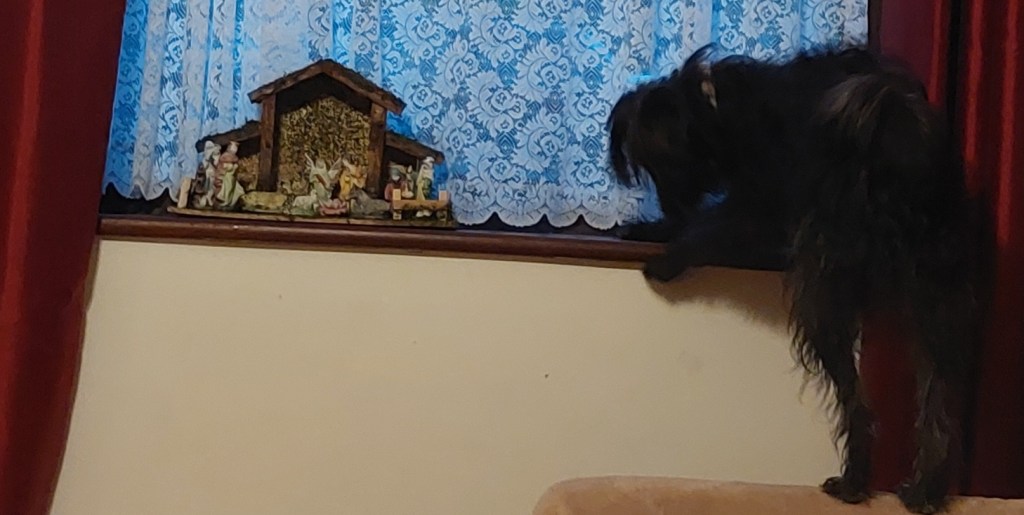
Why do I like the idea of always having a lamb (or sheep) on top of the (Nativity) stable (especially when there is also a cross depicted on it)?
Well, there is, of course, the simple icebreaker reason. Children, and indeed adults, walk into the church, see the Nativity Scene and ask “Why is there a sheep on the roof?” Bingo! There is your cue to talk to them, tell them what the scene represents, why we actually celebrate Christmas, that Jesus is ‘The Lamb of God’ or even just have a chat with them. Evangelicalism at it’s best in fact because it has been started by someone actually asking a question, which can led to a much wider discussion and spreading the word.
As just mentioned, then there is the description of Jesus being the Lamb of God. A title given to Jesus in John’s Gospel and referenced in the Book of Revelation; symbolizing Jesus as the greatest sacrifice. His blood shed to take away the sins of the world. How apt then, especially if the stable used is one with a cross depicted, that a lamb be placed on the roof symbolizing Jesus coming down from heaven, being born human at that first Christmas to His sacrifice on the cross at Easter to save us, rising from the grave and ascending to heaven.