What Goes In Must Come Out

In our reading from Matthew Chapter 15 (verses 10-28), the Scribes and Pharisees ask Jesus why the disciples are not following the tradition of the elders “for they do not wash their hands when they eat”. This is not saying the disciples were eating with unwashed hands – although they may have been. They are not telling Jesus “Yuk! Look at that one – he still has fish guts on his fingers and he’s eating. Can’t you make him wash his hands?” Which is reminiscent of meal times with the children: “Did you wash your hands?” “Yes.” “I’m not convinced – go wash them again!”

The Elders, who were past religious leaders not current living rulers of the people, had a tradition of ceremonial washings. These were continued by tradition and were not a commandment from God. The religious leaders asking the question here were offended that the disciples did not observe these rigid and extensive traditions. Traditions which these Scribes and Pharisees took very seriously – a lot more seriously than they took God’s commandments. Hence, Jesus’s reply “Why do you transgress the commandment of God because of your tradition?”

Jesus did what He often did. He answered a question with a question. He turns the accusations back to the accusers. “Because of your tradition” repeated Jesus. Not only was Jesus pointing out that the accusation was based purely on tradition and not on God’s actual commandments but He was pointing out that the Scribes and Pharisees are far too wrapped up in these trivialities. They were not paying attention to God’s Law and Scriptures but were condemning people based on tradition; declaring them unclean and denying them access to God based on a tradition.

Jesus went on to give examples of how their traditions were in conflict with God’s commandments and dishonoured God. Honour your father and mother, a clear command which even comes with a penalty for disobedience. When we are adults no longer living in our parent’s house or under their authority we do not have to obey them but we do have to honour them. Part of honouring them was to look after and aid them in times of necessity. This would be done by sharing resources with their parents to help them. Some Jewish people would declare their possessions or savings as a gift to God, especially dedicated to Him, and as such their resources were unavailable to help their parents despite those having made the vow still having access to the resources – money, property, possessions – for themselves.

Jesus doesn’t hold back, He goes straight into pointing out the hypocrisy of these traditions, calling the Scribes and Pharisees hypocrites. They honour Me with their lips but their heart is far from Me. We call this lip service. When we say the words but our hearts are not in it. It is a truth not limited to the Scribes and Pharisees being confronted by Jesus but is true of people of today too. Appearing to draw near to God when our heart is far away. It is easy to want and be impressed by the image of being near to God without actually really being there. God is interested in the internal and the real. He knows what is actually written on our hearts and minds. We tend to be much more interested in the merely external image. It is vital to take care to ensure that our relationship with God is not superficial.

All cultures and societies have various traditions, often which have been handed down. Like recipes: my gingerbread recipe came from my mother who got it from my grandmother who got it from my great grandmother and so on. And many families will have some sort of practice and tradition that has been taken on by each new generation.

So I want to pause here to point out that Jesus was not labelling all traditions as bad or all traditions as good. What He was doing was putting them in their place. Traditions are not the same as God’s Word, God’s commandments and how God wants us to live. Traditions have a lower priority than God.

Having told off these Scribes and Pharisees, Jesus now teaches the crowds about these ceremonial cleanliness traditions in regard to food in advance of the New Covenant where the old food laws would be void and all food allowed, as declared in Acts (chapter 10 verse 15). Jesus warns us that it is not what we eat that defiles us but what we say and that what we say reflects on the state of our hearts.

Now the disciples were only human and, similar to what might happen today, they mention to Jesus that they think He might have offended the Pharisees slightly. Well, yes, that was after all the intention. Jesus needed to get the point across that they valued man-made tradition too highly. The commandments of men will not last because they are not rooted in God or truth.

Peter, it’s always Peter, asked Jesus to explain because the disciples had not understood. ‘Do you still not understand?’ Jesus said.

I can empathise. There are times when I am explaining something which I think is quite simple to the children, or the husband, and they just look at me and … especially if it’s something which the rest of us would say was just common sense … they say what or but. They just don’t get it and it has to be explained again and sometimes again and again and then in words of half syllable. Very frustrating at times for those of us who do understand and can see how simple the concept actually is. I look at them and think ‘seriously how is it that you don’t understand, are you not listening, I’m not speaking a different language.’

Now, I’m not saying that all Jesus’s teachings are easy and should be immediately understood. I’m just saying that I empathise with His response to the disciples of “Are you also still without understanding?” Here were the disciples being accused of being spiritual unclean because they had not followed a ceremonial tradition and Jesus pointing out that following the tradition did not make a person spiritually clean or unclean as it was a tradition of man and not a commandment of God, and the disciples are saying to Him: “Hey Jesus, what do you mean?”

Jesus explains. It is not what food we eat or how we eat it that makes us spiritually clean or unclean but what is in our heart. The heart is where our true characters lie. It is not merely our emotions but the true self – the true person as they actually are instead of how they outwardly appear.

“Is this a dagger I see before me?” Possibly, but the dagger is merely the tool not the instigator of the murder; which is conceived in the heart and soul of the murderer.

Instead of worrying about what to eat and drink, what to wear and what hair style, as God’s people, we should be more concerned about what we do, and think and say.

There is a well-known saying “What goes in must come out”. This is what Jesus explains to the disciples. From food no moral defilement comes to the soul. The food is eaten, the body absorbs the nutrients it needs and the rest is ejected through the excrement process.

It is not what we eat or whether we have water poured over each hand alternately, three times each, from a two handled cup, reciting blessings as we dry our hands which determines righteousness but what is in our hearts.

Our reading from Matthew then moves on to the Canaanite woman who’s daughter was possessed by a demon and I would like to share a short reflection from August 2023 by Pope Francis.

Now let us look at the woman’s faith, which the Lord praises, saying that it is “great” (v. 28). According to the disciples, the only thing that seemed “great” was her insistence; but Jesus sees her faith. If we think about it, that foreign woman had probably little or no awareness of the laws and religious precepts of Israel. What does her faith consist of then? She does not have a wealth of concepts but of deeds — the Canaanite woman draws near, prostrates herself, insists, takes part in a close dialogue with Jesus, overcomes every obstacle just to speak with him. This is the concreteness of faith, which is not a religious label but is a personal relationship with the Lord. How many times we fall into the temptation to confuse faith with a label! This woman’s faith is not fraught with theological gallantry, but with insistence — she knocks at the door, knocks, knocks. Her faith is not made up of words, but of prayer. And God does not resist when he is prayed to. This is why he said, “Ask, and it will be given to you; seek, and you will find; knock, and it will be opened to you”. (Pope Francis, Angelus, 20 August 2023)

I leave you to ponder Ralph Waldo Emerson’s words “What lies behind us and what lies before us are tiny matters compared to what lies within us.”

Ceremonial Hand Washing (Photo by sanka sumedha on Pexels.com)

Advent

How many of us have Advent Calendars, and the accompanying daily chocolate?

Interesting isn’t it? Advent is synonymous with Lent and yet this is the difference between them – for Lent we attempt to give something up but in Advent we excitedly open doors and eat chocolate.

Lent is a time when we aim to cut out the distractions, preparing and making ourselves ready for the work Jesus has for us and for Him to be in our hearts.

Advent is a time when we have to look at our lives and make a choice. Do we accept forgiveness and follow Jesus; preparing and making ourselves ready and cutting out the distractions?

Or do we allow ourselves to get swept up in the commercialism, the busyness, the chaos, the overindulgence, the excess food, the drama, the darkness? It is easy to do – there is, after all, so much of it all around us.

Are we ready?

No, I don’t mean do you have the tree and decorations up, presents and cards all wrapped/written/sent, parties organised, invites sent, that Christmas food shop booked and all the other activities we think of when we use the term festivities.

Are we ready for Jesus?

This passage from Mark* is full of imagery. Jesus was talking in a way that the Jews of the time would understand. There are however, several key points.

The first is that Jesus is foretelling the second coming – that He will come again. He does not know the exact time of His return but He will be returning. This is an excellent example of faith and trust in God. Jesus knows that if God has told Him He will come again that will indeed happen. Jesus does not need to question all the finer details.

Jesus was also foretelling the destruction of the Great Temple in Jerusalem and the fall of Jerusalem. When Jesus says “this generation will not pass away until these things happen” it is this destruction that He is referring to. And this prophecy was indeed fulfilled when Jerusalem and the Temple were destroyed in 70AD.

We do not need to doubt Jesus prophecies. We know they will come to pass. We know He will come again.

Jesus likens us to men who know that their master is coming but who do not know exactly when he will arrive. We do not need to be afraid of this. But we must live our lives in a way that means we are ready no matter when He arrives. Every moment of every day becomes a preparation for the moment we meet Him face to face.

The next point is that, of all things, it is most foolish to be so wrapped up in earthly distractions that we forget God. The wise are those who never forget that they must be ready when the summons come, so that, for them, the end will be eternal joy.

“Come, Lord Jesus, come quickly. We long for the day, when we will see your face, we will be with you, you as our light.” This prayer sums up waiting for the Lord and the fulfilment of God’s plan. No one waits without a good reason and how long we wait is determined by the reward at the end. Jesus is surely the best reward.

The farmer does not know (exactly) what day the rain will come or the crops be ripened but the farmer knows they will and waits patiently and faithfully, ready and prepared for when that time comes. Likewise, we must wait patiently and trust in God whilst we wait, faithfully and prepared.

But when we are waiting for something how do we wait? Do we fill our lives with distractions and keep busy to avoid the waiting?

We have the chance to wait and change our lives but we miss it by running around. We forget our heart.

Do we use advent as a time to slow down as we prepare for Jesus to be born again in our hearts at Christmas or do we rush around more than ever letting life get more and more hectic?

Advent is a time of preparation and waiting. A time to slow down and open up – opening up our hearts and minds.

Advent is a time for prayer. A time for tradition – by which I mean it’s actual meaning of sharing and passing on belief. It is about going deeper in our personal journey with Christ. It is a chance to reset and ensure we have what we need to be prepared so that we are ready no matter what day or hour He returns. It is a time to stop being complacent. A time to keep relationship with God and work on it; doing God’s will everyday.

Advent is a time to put our hearts right with God and prepare them. Are we ready to use this Advent to prepare ourselves so that we are always ready for Jesus’s return and ready to welcome Him into our hearts once again?

*Mark 13.24-37

Light of the world

First Sunday in Advent 27th November 2022

Happy New Church Year! Today, we are celebrating both the first Sunday in the church year AND the first Sunday in Advent; and so, yes, the Christmas jumpers have been got out.

And in Matthew, Jesus tells us to “Stay Awake…”. I don’t know about you but I am most definitely going to need more coffee!!!

We are told that, if the house owner knew in advance exactly what time the thief was going to break into his house, then he would have stayed awake and not let his house be broken into. He would be prepared! He would have made plans to protect his home and for the thief to be caught.

Likewise, if we were to receive a warning that something would happen at a certain time then we would prepare and make sure we were ready. If an electricity company says at this time on this day we are turning the electric off then we would make sure that batteries were charged, the torches were working and so on.

We would be ready and alert!

“Keep awake for you do not know on what day or at what hour your Lord is coming.”

We know Christ will return – this is promised and God keeps His promises. What we do not know is the timing – and God’s time is not the same as ours.

So we must be ready and watchful.

Be prepared.

Advent is a time of waiting and preparation.

Are we prepared?

When I ask you “are you ready for Christmas” what do you think of?

Is it whether you’ve got all the presents?

Is it whether they are all wrapped or how much wrapping you need to do?

Is it whether the Christmas cards are all written or who you’ve still got to send one to or whether they’ll be posted in time with the planned postal strikes?

Is it when the decorations will go up or whether they are up already or when they’ll be got out of storage?

Is it whether the Christmas pudding and Christmas cake are made or when they’ll be made?

Be honest – when asked if you are ready for Christmas – who actually interprets this question as:

Are you ready for Jesus?

Are you ready for His birth?

Are you ready for Him to come again?

!!!

“Keep awake for we do not know the hour He will return.”

Thankfully, this does not mean that we all must become insomniacs. It means we need to be Spiritually awake. To be on our guard against spiritual distraction. To pay attention. To spend time with God in prayer and growing our faith. To be more fully alive in Christ.

I was writing Christmas cards this week. I’ve been writing quite a lot to give hope to people who would otherwise be forgotten. And I got quite cross because I found a range of cards that have the greeting “Happy Holidays”.

Now this really annoys me. It’s the same with a lot of television adverts on at this time of year.

Let me share why…

It misses the point!

It doesn’t just miss the point – it totally avoids it with an enormous detour.

And what is it that these Christmas cards and adverts are all missing out?

Well, the clue’s in the name. The reason for the season – Christ. The greatest gift of all.

So we must stay spiritually awake so that we do not commit the crime of leaving Christ out of Christmas. We must be alert and watchful to make sure that we do not demote Jesus to the bottom of the list. We must be on our guard to ensure that we are not just giving Him a cursory nod/brief acknowledgement or lip service just so that we can “tick that box”.

We must be prepared and ensure that we are putting Jesus at the forefront of our lives. Before everything else. First.

So this year let us use this time of Advent to wait patiently for Christ.

Waiting can seem boring. It can be hard to be patient. Especially when there are so many other distractions.

But waiting does not actually mean doing nothing!

It is an opportunity to prepare our hearts, our minds, our souls.

It is an opportunity to put our trust in the Lord. To truly repent, to forgive and to accept forgiveness. It is an opportunity to seek God more deeply in prayer and to surrender to His ways – becoming more alive in Christ.

I’m going to deviate slightly to quote from a Christmas film, which due to this quote is, in my opinion, one of the best Christmas films:

Tonight I want to tell you the story of an empty stocking. Once upon a midnight clear, there was a child’s cry. A blazing star hung over a stable and wise men came with birthday gifts.

We haven’t forgotten that night down the centuries; we celebrate it with stars on Christmas trees, the sound of bells and with gifts. But especially with gifts. You give me a book; I give you a tie. Aunt Martha has always wanted an orange squeezer and Uncle Henry could do with a new pipe.

We forget nobody, adult or child. All the stockings are filled…all that is, except one. And we have even forgotten to hang it up. The stocking for the child born in a manger. It’s his birthday we are celebrating. Don’t ever let us forget that.
Let us ask ourselves what he would wish for most…and then let each put in his share. Loving kindness, warm hearts and the stretched out hand of tolerance. All the shining gifts that make peace on earth.

The Bishop’s Wife (1947)

So let us use this advent to be ready for and to remember Christ this Christmas as we pray:

Lord, grant that we may stay awake, remain watchful and stand firm in the faith out of our love for you. Amen.

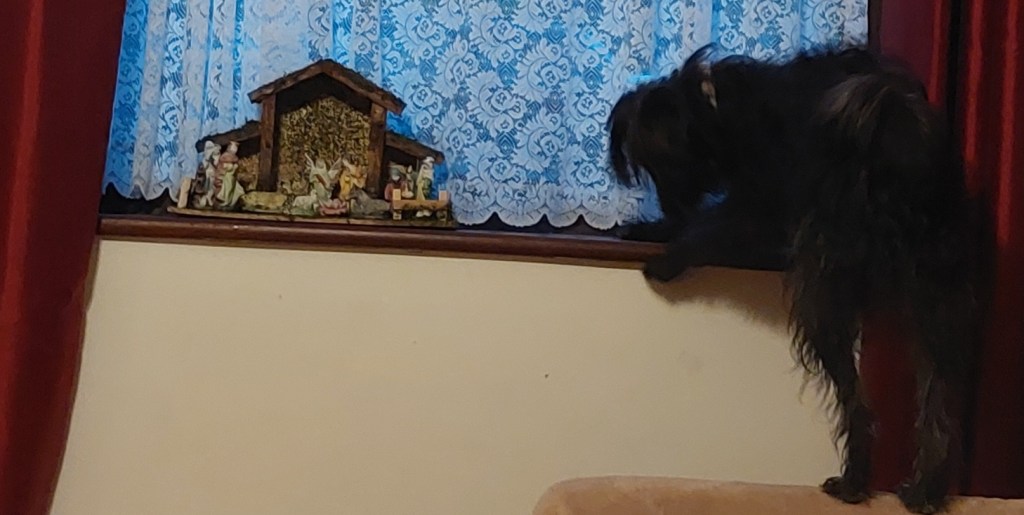
Poppet bowing to the Posada nativity

Harvest Festival

As normal, for our area, donations received during the Harvest Festival were mainly in the form of long life goods for the food bank. A representative for the food bank passed on their thanks from themselves and on the behalf of those who need to use the food bank – which was nice!

But, during the service I glanced around at all the tins of food and I was thinking…

I thought back to when I was a child and we were asked to take something in for the school and church harvest festivals. Mother would go through the cupboard and present us with a tin, “You can take that” she’d say “no one likes that one”!

I thought about comments I have heard from varying sources on such occasions of: “And everybody bring a tin. Everyone always has something in the cupboard they don’t like so there’s no excuse.”

I thought that, whilst given the choice between nothing and a tin of food that has only been chosen as a donation because nobody likes it then there may well be some gratitude, because anything may well be better than nothing – if it is the only food you can get and you are actually starving. BUT does that make our reason the right reason when we choose what to give?

I thought, shouldn’t we be giving the best we can offer. It is to God to whom we are giving our offerings. It is to God we are giving thanks for the harvest and that we are fortunate enough to have something to eat. When donations leave the altar and make their way to the food bank to feed those in need they are also “feeding Jesus”. Surely, therefore, it should indeed be the best we can offer.

Whilst it is true that people have different tastes and it may well be that a food one person hates is another person’s favourite; the important thing is the motive. What is the motive behind the choice of product? Is it the best we can offer or is it actually just a case of wanting that item out our cupboard? Are we giving our Lord the best of our harvest or the dregs?

What is written in our hearts is known. No excuses can be made.

So when such choices are to be made, remember we should be giving of our best with a pure heart (the right motive) – not finally getting rid of that tin that nobody likes but providing a feast fit for a King – our Saviour.

Poppet lying on a sofa hugging her pumpkin.

The Lesson Of A Dog

A dog is a bundle of never-questioning, unceasing love. An animal small (on average) in size but with an enormous heart of love.

Dogs are love.

God spelt backwards is dog. God is in dog.

God is love!

Like God, dogs:

  • love unconditionally
  • forgive freely
  • are always happy to see you
  • want to be by your side
  • do not abandon us
  • walk with us on our journey
  • are peaceful and calming
  • are full of grace and mercy
  • are our friend forever.

Dogs willingly take on this facet of God. Man was made in the image of God yet turned away by giving into sin.

How much better it would be if we learnt the lesson of the dog and walked in Jesus’s footsteps, returning to the way God created us.

Puppy Poppet.