

At first glance it doesn’t always seem apparent, but our readings for today are still all connected.
The passage from Genesis 29 is about reaping what we sow and God’s grace in messy situations.
Jacob’s mother, Rebekah, and her brother, Laban, are skilled in playing dirty tricks in order to get what they want. It was by following this path of behaviour that led to Jacob having to flee from his brother’s wrath and going to his Uncle Laban.
This brokenness was part of the foundation of the 12 tribes of Israel, built from Jacob’s sons. Into this brokenness God was quietly weaving His grace. God’s grace works within the messy realities of our lives.
Jacob and Laban are tricky customers and the Bible is not telling us to be like them. Instead it asks the question “just how is the great God going to make anything out of these tricksters?”
It reminds me of when a child does something really stupid and we say to them: “And just what are we going to do with you?”
Which leads us to “how is God going to make anything out of us?”
I can imagine God watching us as we, in our innate stubbornness get into all sorts of scrapes, and smiling as He says: “And just what are We going to do with you?”
I think the answer to that has to have something to do with fun and laughter for, with fools like me, who God continues to choose as witnesses throughout the ages, it is certain that God has a tremendous sense of humour – which is a very good thing for some of us!
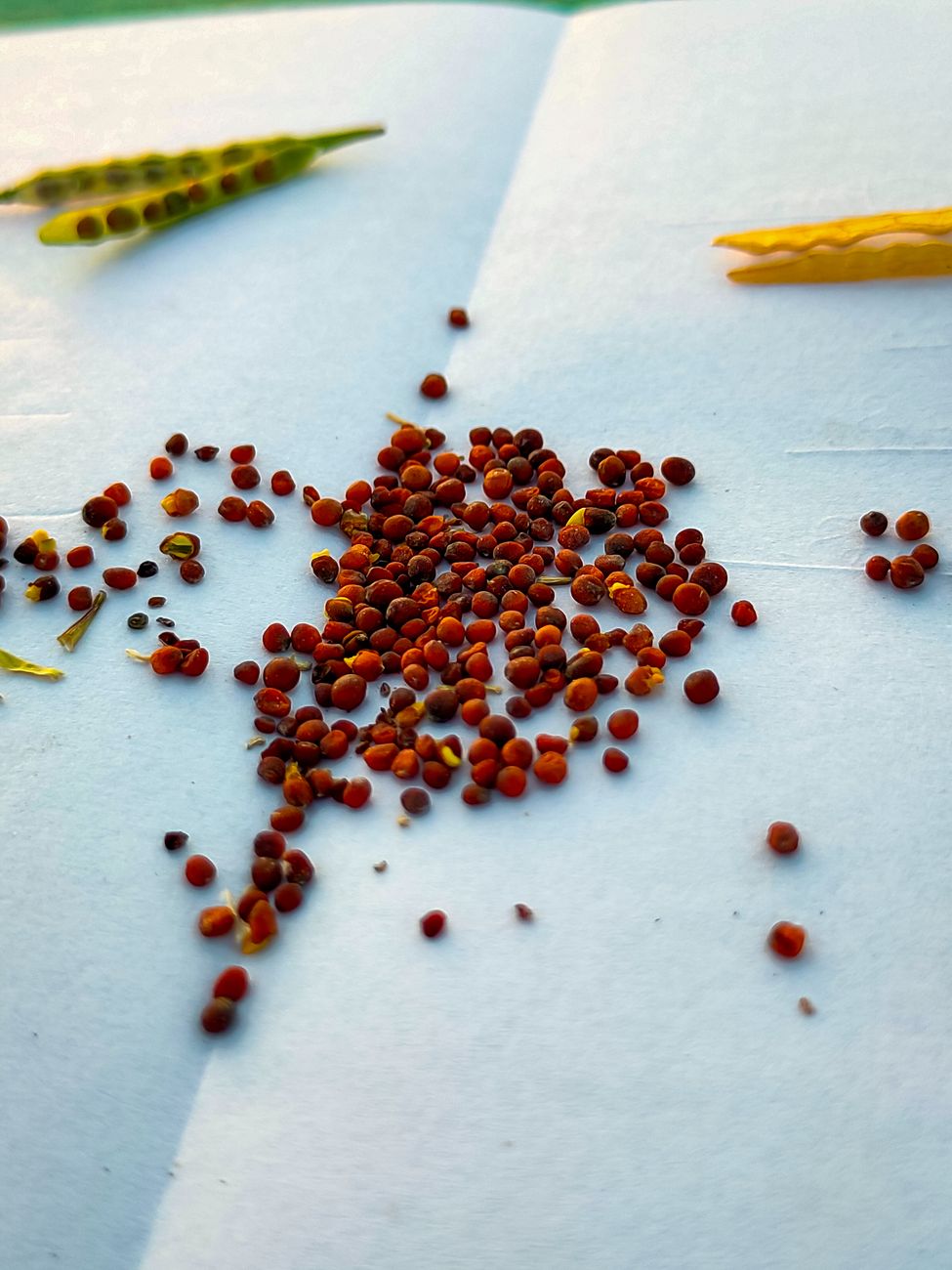
Which brings us back to reaping what we sow as we move onto Matthew 13. Our reading from Matthew consists of 4 parables and a question on understanding; starting with the mustard seed. The parable of the mustard seed reminds us of the parable of the sower, but now, we are not focusing on the soil. A mustard seed is so tiny but given the right conditions it will grow and spread into a bush. Here it is described as becoming a tree to highlight growth beyond expectation, but also to use the imagery of the scriptures where the image of a tree was used for a great kingdom. Just like the tiny seed becoming a great tree; this is a prophetic parable showing how from a small beginning the Gospel of Christ should reach all nations and fill them with righteousness and true holiness.
The mustard bush grows sturdy enough to house nests of birds. Birds also receive God’s care, such as in Matthew 6:26 where He feeds the birds of the air. Birds nesting in the branches of the mustard tree could be viewed as little ones sheltering in the overshadowing of God’s wings. However, in the Old Testament and other parables, birds have been used as symbols of the devil’s flock; for example the birds eating the seed of God’s Word in the parable of the sower. In this light the birds represent corruption taking refuge in Christianity’s shadow.
In our next parable, of the treasure hidden in the field, the field is the world. In Rabbinic Law, if a workman found treasure in a field and lifted it out then it would belong to the owner of the field. In this case the man did not lift up the treasure until after he had bought the field.
Jesus is the man who gave all He had to buy the field. The other parables we have looked at recently have spoken about corruption being alongside the true believers, like the weeds with the wheat. This one is focusing on how much God loves us – so much that He gave His only Son to die on the cross in order to redeem the world and the treasure within. So, if the field is the world and the man is Jesus then what is this treasure of so much value? It is us, it is true believers – God’s people.
The treasure in the field also reminds us that where your treasure is your heart is also. God does not ignore our needs but He challenges our material excess acquired for self serving purposes.
The parable of the costly pearl is similar to the treasure in the field. Here, a merchant finds a pearl of great value, sells all he has and buys it.
Again, we can look at the merchant as being Jesus and the valuable pearl as the believer whom Jesus gave everything for – including His life.
The ancient peoples considered a pearl to be the loveliest of all possessions. This highlights both how lovely the kingdom of heaven is and how much Jesus values His people.
Jesus also reminds us not to throw our pearls before swine for they will trample them underfoot and turn on us.
The dragnet is, as they say, exactly what it says on the tin. It was dragged throw the sea to capture and then herd fish to the shore where the fish would be sorted. Just like the weeds and the wheat, the good fish would be gathered and placed in vessels and the bad would be thrown away. This is revisiting the warning that, at the end of the age, angels will separate the wicked from the believers. The wicked to then be cast into the fiery furnace.
It is a bit like teaching a concept to a class and explaining it a different way for those who didn’t understand it the first time. Not only does Jesus explain what will happen at the eternal judgement multiple times but He also uses different metaphors. Everyone has had the chance to hear and understand, they just have to want to.
Jesus asked His disciples “Do you understand?”
“Yes, Lord” they answered.
Again, this reminds me of explaining something important to a child; after which asking them if they understood. They look up at you with their face a picture of innocence but looking so blank and say “yes.” If asked what they thought the meaning was the answer was, of course, “I don’t know”. Back to the beginning we go but this time looking at it a different way.
I can just imagine Jesus asking the disciples if they understood and, in the same way, they look at Him blankly saying ‘yes’, as He’s thinking ‘no, you really don’t’.
We could take that view – suspicious that they didn’t understand, and sometimes better understanding takes time to sink in.
Or, we could take it at face value that they did understand. Jesus did spend time with His disciples away from the crowd, explaining the parables to them and giving them extra teaching. The disciples had an advantage over the crowds – some of whom would not have understood.
Jesus said clearly that those who know and understand God’s word will know both the old and the new. The knowledge of the scriptures combined with the new teaching gives a deeper understanding of what they previously knew as it is lit up and re-understood through the new teaching.
The disciples are now responsible to share their understanding with others from a place of wisdom and understanding of things old and new.
Ministers and teachers of the Gospel should not be without sufficient knowledge and understanding of the Scriptures. They should be well versed in both the Old and New Testaments and have a sense of them with a stock of Spiritual knowledge.
Our Gospel started with the mustard seed and I would like to share the thought that we try to gift the tiny mustard seeds of Christ and we pray that they will be nurtured and grow into Jesus trees as I finish with the story ‘Only the Seed’.
Once upon a time, a pilgrim set out on the long journey in search of peace, joy and love. The pilgrim walked for many weary miles, and time passed. Gradually, the young, lively steps became slower and more laboured. The pilgrim’s journey passed through landscapes that were not always happy ones. Through war. Through sickness. Through quarrels and rejections and separations. A land where, it seemed, the more people possessed, the more warlike they became – the more they had to defend, the more they needed to attack each other. Longing for peace, they prepared for war. Longing for love, they surrounded themselves with walls of distrust and barriers of fear. Longing for life, they were walking deeper into death.
But one morning, the pilgrim came into a little cottage at the wayside. Something about this little cottage attracted the pilgrim. It was as though it was lit up from the inside. Full of curiosity, the pilgrim went inside. And inside the cottage was a little shop, and behind the counter stood a shopkeeper. It was hard to judge the age – hard even to say for sure whether it was a man or a woman. There was an air of timelessness about the place. “What would you like?” asked the shopkeeper in a kindly voice. “What do you stock here?” asked the pilgrim. “Oh, we have all the things here that you most long for,” replied that shopkeeper. “Just tell me what you desire.”
The pilgrim hardly knew where to begin. So many desires came rushing to mind at once. “I want peace – in my own family, in my native land and in the whole world. I want to make something good of my life. I want those who are sick to be well again and those who are lonely to have friends. I want those who are hungry to have enough to eat. I want every child born on this planet today to have a chance to be educated. I want everyone on earth to live in freedom. I want this world to be a kingdom of love.”
There was a pause while the pilgrim reviewed this shopping list. Gently, the shopkeeper broke in. “I’m sorry,” came the quiet reply. “I should have explained. We don’t supply the fruits here. We only supply the seeds.”
Only The Seed retold by Margaret Silf – origin source unknown.
 Just because