Jesus Trees From Mustard Seeds

At first glance it doesn’t always seem apparent, but our readings for today are still all connected.

The passage from Genesis 29 is about reaping what we sow and God’s grace in messy situations.

Jacob’s mother, Rebekah, and her brother, Laban, are skilled in playing dirty tricks in order to get what they want. It was by following this path of behaviour that led to Jacob having to flee from his brother’s wrath and going to his Uncle Laban.

This brokenness was part of the foundation of the 12 tribes of Israel, built from Jacob’s sons. Into this brokenness God was quietly weaving His grace. God’s grace works within the messy realities of our lives.

Jacob and Laban are tricky customers and the Bible is not telling us to be like them. Instead it asks the question “just how is the great God going to make anything out of these tricksters?”

It reminds me of when a child does something really stupid and we say to them: “And just what are we going to do with you?”

Which leads us to “how is God going to make anything out of us?”

I can imagine God watching us as we, in our innate stubbornness get into all sorts of scrapes, and smiling as He says: “And just what are We going to do with you?”

I think the answer to that has to have something to do with fun and laughter for, with fools like me, who God continues to choose as witnesses throughout the ages, it is certain that God has a tremendous sense of humour – which is a very good thing for some of us!

Which brings us back to reaping what we sow as we move onto Matthew 13. Our reading from Matthew consists of 4 parables and a question on understanding; starting with the mustard seed. The parable of the mustard seed reminds us of the parable of the sower, but now, we are not focusing on the soil. A mustard seed is so tiny but given the right conditions it will grow and spread into a bush. Here it is described as becoming a tree to highlight growth beyond expectation, but also to use the imagery of the scriptures where the image of a tree was used for a great kingdom. Just like the tiny seed becoming a great tree; this is a prophetic parable showing how from a small beginning the Gospel of Christ should reach all nations and fill them with righteousness and true holiness.

The mustard bush grows sturdy enough to house nests of birds. Birds also receive God’s care, such as in Matthew 6:26 where He feeds the birds of the air. Birds nesting in the branches of the mustard tree could be viewed as little ones sheltering in the overshadowing of God’s wings. However, in the Old Testament and other parables, birds have been used as symbols of the devil’s flock; for example the birds eating the seed of God’s Word in the parable of the sower. In this light the birds represent corruption taking refuge in Christianity’s shadow.

In our next parable, of the treasure hidden in the field, the field is the world. In Rabbinic Law, if a workman found treasure in a field and lifted it out then it would belong to the owner of the field. In this case the man did not lift up the treasure until after he had bought the field.

Jesus is the man who gave all He had to buy the field. The other parables we have looked at recently have spoken about corruption being alongside the true believers, like the weeds with the wheat. This one is focusing on how much God loves us – so much that He gave His only Son to die on the cross in order to redeem the world and the treasure within. So, if the field is the world and the man is Jesus then what is this treasure of so much value? It is us, it is true believers – God’s people.

The treasure in the field also reminds us that where your treasure is your heart is also. God does not ignore our needs but He challenges our material excess acquired for self serving purposes.

The parable of the costly pearl is similar to the treasure in the field. Here, a merchant finds a pearl of great value, sells all he has and buys it.

Again, we can look at the merchant as being Jesus and the valuable pearl as the believer whom Jesus gave everything for – including His life.

The ancient peoples considered a pearl to be the loveliest of all possessions. This highlights both how lovely the kingdom of heaven is and how much Jesus values His people.

Jesus also reminds us not to throw our pearls before swine for they will trample them underfoot and turn on us.

The dragnet is, as they say, exactly what it says on the tin. It was dragged throw the sea to capture and then herd fish to the shore where the fish would be sorted. Just like the weeds and the wheat, the good fish would be gathered and placed in vessels and the bad would be thrown away. This is revisiting the warning that, at the end of the age, angels will separate the wicked from the believers. The wicked to then be cast into the fiery furnace.

It is a bit like teaching a concept to a class and explaining it a different way for those who didn’t understand it the first time. Not only does Jesus explain what will happen at the eternal judgement multiple times but He also uses different metaphors. Everyone has had the chance to hear and understand, they just have to want to.

Jesus asked His disciples “Do you understand?”

“Yes, Lord” they answered.

Again, this reminds me of explaining something important to a child; after which asking them if they understood. They look up at you with their face a picture of innocence but looking so blank and say “yes.” If asked what they thought the meaning was the answer was, of course, “I don’t know”. Back to the beginning we go but this time looking at it a different way.

I can just imagine Jesus asking the disciples if they understood and, in the same way, they look at Him blankly saying ‘yes’, as He’s thinking ‘no, you really don’t’.

We could take that view – suspicious that they didn’t understand, and sometimes better understanding takes time to sink in.

Or, we could take it at face value that they did understand. Jesus did spend time with His disciples away from the crowd, explaining the parables to them and giving them extra teaching. The disciples had an advantage over the crowds – some of whom would not have understood.

Jesus said clearly that those who know and understand God’s word will know both the old and the new. The knowledge of the scriptures combined with the new teaching gives a deeper understanding of what they previously knew as it is lit up and re-understood through the new teaching.

The disciples are now responsible to share their understanding with others from a place of wisdom and understanding of things old and new.

Ministers and teachers of the Gospel should not be without sufficient knowledge and understanding of the Scriptures. They should be well versed in both the Old and New Testaments and have a sense of them with a stock of Spiritual knowledge.

Our Gospel started with the mustard seed and I would like to share the thought that we try to gift the tiny mustard seeds of Christ and we pray that they will be nurtured and grow into Jesus trees as I finish with the story ‘Only the Seed’.

Once upon a time, a pilgrim set out on the long journey in search of peace, joy and love. The pilgrim walked for many weary miles, and time passed. Gradually, the young, lively steps became slower and more laboured. The pilgrim’s journey passed through landscapes that were not always happy ones. Through war. Through sickness. Through quarrels and rejections and separations. A land where, it seemed, the more people possessed, the more warlike they became – the more they had to defend, the more they needed to attack each other. Longing for peace, they prepared for war. Longing for love, they surrounded themselves with walls of distrust and barriers of fear. Longing for life, they were walking deeper into death.

But one morning, the pilgrim came into a little cottage at the wayside. Something about this little cottage attracted the pilgrim. It was as though it was lit up from the inside. Full of curiosity, the pilgrim went inside. And inside the cottage was a little shop, and behind the counter stood a shopkeeper. It was hard to judge the age – hard even to say for sure whether it was a man or a woman. There was an air of timelessness about the place. “What would you like?” asked the shopkeeper in a kindly voice. “What do you stock here?” asked the pilgrim. “Oh, we have all the things here that you most long for,” replied that shopkeeper. “Just tell me what you desire.”

The pilgrim hardly knew where to begin. So many desires came rushing to mind at once. “I want peace – in my own family, in my native land and in the whole world. I want to make something good of my life. I want those who are sick to be well again and those who are lonely to have friends. I want those who are hungry to have enough to eat. I want every child born on this planet today to have a chance to be educated. I want everyone on earth to live in freedom. I want this world to be a kingdom of love.”

There was a pause while the pilgrim reviewed this shopping list. Gently, the shopkeeper broke in. “I’m sorry,” came the quiet reply. “I should have explained. We don’t supply the fruits here. We only supply the seeds.”

Only The Seed retold by Margaret Silf – origin source unknown.

Mustard Seeds (Photo by Siddharth Sharma on Pexels.com)

Jesus the Ladder

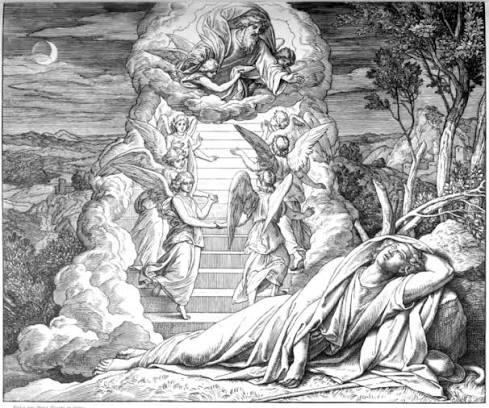
In Genesis 28, we catch up with Jacob as he is fleeing for his life. To say he’s been a bit of a naughty boy would be an understatement and his brother Esau (possibly along with a few others) are wanting to kill him.

As the sun had set Jacob stopped for the night and found a flat stone he could use as a pillow before settling down to sleep. And he dreamed that famous dream we refer to as Jacob’s Ladder of a great ladder with its top in heaven and its feet on earth. Angels were going up and down the ladder which reassured Jacob that God was closer than he had realised and that there was interaction between earth and heaven.

It is often asked why we look up at our sky to point our eyes towards heaven and why we think of it being above us. It is imagery such as this which feeds our perception of a literal higher plane as opposed to a metaphorical upness.

As is made clear in John’s Gospel, Jesus is the access to heaven. He is how people can go to heaven and how heaven can come down to people. Jesus is the ladder Jacob saw in his dream.

John 1:51 says “And He said to them, ‘Most assuredly, I say to you, hereafter you shall see heaven open, and the angels of God ascending and descending upon the Son of Man’.”

Jesus is the way to heaven, He doesn’t just show us the way, He is the way. As He said, recorded in John 14:6, “I am the way, the truth and the life. No one comes to the Father except through me.”

God appeared to Jacob introducing Himself as the God of Abraham and Isaac and repeats to Jacob the terms of the covenant given to Abraham, Isaac, and now to Jacob. God gave Jacob the promise of land and descendants but He also promised that He would be with Jacob, protecting him, until all these promises had been fulfilled. God continues to work until His work is complete in His people. God’s blessing and faithfulness to Jacob can be seen in the several ways that His presence was described in Jacob’s life. Jacob woke and declared “Surely the Lord is in this place and I did not know it.”

Jacob therefore renamed the place Bethel meaning House of God. So if you ever wondered what Bethel meant when you see or hear of a Bethel Church now you know.

He was correct in sensing the presence of the Lord but mistaken if he had thought that God was in some places and not others. God is everywhere – as David clearly understood from his words in Psalm 139.

During his dream, Jacob did not use the ‘stairway to heaven’; instead God spoke to Jacob where he was, demonstrating God’s immanent presence. He is not a faraway removed God calling long-distance but an indwelling God right here with us.

This encounter comes completely from God breaking into Jacob’s sleep state bringing a break to his anxious fleeing. At this vulnerable point in Jacob’s life, God emphasizes that He is not only the God of the first and second generation but also the God of Jacob. The reiteration of God’s promise also serves as a powerful reminder that Jacob’s life should not be governed by self-interest but by becoming a channel of God’s blessing to others.

When Jacob wakes from his dream he is a totally changed man and makes a vow showing his commitment to God.

This is the same Jacob who later would be called Israel and whose sons become the start of the twelve tribes of Israel.

From little acorns (or little dreams) great things grow.

Which leads us to Matthew 13 starting at verse 24, a passage which addresses the evil among us, God’s patience and the separation of believers and unbelievers at the end of the age.

The devil places a corrupt presence amongst innocents or in more generalised parlance unbelievers amongst believers. They look like genuine believers and we can get it wrong and mix them up. Only God knows and can tell the difference. 

The weeds or tares look just like the wheat until the ears are fully formed and it is ready for harvesting. This is why, to preserve and protect the true wheat, the tares are not separated out until the harvest. This prevents the wrong ones being destroyed when the tares are ripped out and burnt.

Whilst there are similarities between this parable and the parable of the sower from last week, what each element represents and the point of the parables are different. Last week’s parable showed how people receive and respond to the Word of God; whereas this week shows how God will divide His true people from false believers at the end of this age.

The field represents the entire world within which there is good seed representing the true believers and weeds or tares representing unbelievers. 

Make no mistake – by unbelievers we don’t mean those who are currently unbelievers but who will believe – they are wheat which is still developing their ears. No, we are talking about the end of the age when it is time for God’s harvest and those who are false believers, unbelieving or counterfeits who have been put there by the enemy – the devil – to try and corrupt true believers.

It is interesting how many ‘children’s stories’ are great works of theology. In 1883, The Princess and Curdie by George MacDonald was published. George MacDonald was a Scottish writer, theologian and preacher, a mentor for Charles Lutwidge Dodgson and a profound influence on J R Tolkien and C S Lewis. In this story, Curdie is given the ability that when he holds someone’s hand he can feel what it’s like on the inside – or how God sees them. Hands that look elegant and beautiful are cold, clammy, rough and coarse. Others, despite looking rough and deformed, are beautiful.

Or take Beauty and the Beast. Handsome Gaston is horrific on the inside whereas the terrifying Beast has beauty deep within. Or, of course, the Empress Jadis from C S Lewis’s Magician’s Nephew, who later becomes The White Witch. Digory reflects that “in all his life he had never known a woman so beautiful…” and yet within she was arrogant, callous and cruel.

It is not our job to weed them out but God’s. We are not to separate the good from the bad because we can only see what people are like now. We cannot see what they will become and we cannot see what is written in their hearts. 

Our job is to shine forth hope, to proclaim the Word of life, to speak of the love and forgiveness God has for us, of the power to change and the hope He gives us.

The reapers are the angels and will be sent out by Jesus the Son of Man.

There are two different paths and eternal destinies. A furnace of fire where the crop which came from the seeds of the devil will go and there is the radiant glory where the true believers shine forth as the sun.

The fire of the furnace will not destroy those thrown into it. Instead they will suffer a living torment with great woe, wailing and gnashing of teeth.

The wheat comes into God’s barn from all over the world, from all classes of society and from all ages. Yet all have one thing in common. They were all sown by the Lord from the good seed of His Word.

Jacob’s dream of a ladder between heaven and earth

Calling and Love

Now the Lord said to Abram, “Go from your country and your kindred and your father’s house to the land that I will show you. I will make of you a great nation, and I will bless you and make your name great, so that you will be a blessing. I will bless those who bless you, and the one who curses you I will curse, and in you all the families of the earth shall be blessed.” So Abram went, as the Lord had told him, and Lot went with him. Abram was seventy-five years old when he departed from Haran. Abram took his wife Sarai and his brother’s son Lot and all the possessions that they had gathered and the persons whom they had acquired in Haran, and they set forth to go to the land of Canaan. When they had come to the land of Canaan, Abram passed through the land to the place at Shechem, to the oak of Moreh. At that time the Canaanites were in the land. Then the Lord appeared to Abram and said, “To your offspring I will give this land.” So he built there an altar to the Lord, who had appeared to him. From there he moved on to the hill country on the east of Bethel and pitched his tent, with Bethel on the west and Ai on the east, and there he built an altar to the Lord and invoked the name of the Lord. And Abram journeyed on by stages toward the Negeb.

Genesis 12: 1-9

As Jesus was walking along, he saw a man called Matthew sitting at the tax-collection station, and he said to him, “Follow me.” And he got up and followed him. And as he sat at dinner in the house, many tax collectors and sinners came and were sitting with Jesus and his disciples. When the Pharisees saw this, they said to his disciples, “Why does your teacher eat with tax collectors and sinners?” But when he heard this, he said, “Those who are well have no need of a physician, but those who are sick. Go and learn what this means, ‘I desire mercy, not sacrifice.’ For I have not come to call the righteous but sinners.”

While he was saying these things to them, suddenly a leader came in and knelt before him, saying, “My daughter has just died, but come and lay your hand on her, and she will live.” And Jesus got up and followed him, with his disciples. Then suddenly a woman who had been suffering from a flow of blood for twelve years came up behind him and touched the fringe of his cloak, for she was saying to herself, “If I only touch his cloak, I will be made well.” Jesus turned, and seeing her he said, “Take heart, daughter; your faith has made you well.” And the woman was made well from that moment. When Jesus came to the leader’s house and saw the flute players and the crowd making a commotion, he said, “Go away, for the girl is not dead but sleeping.” And they laughed at him. But when the crowd had been put outside, he went in and took her by the hand, and the girl got up. And the report of this spread through all of that district.

Gospel of Matthew 9:9-13, 18-26

Have you noticed how it is always busy people that Jesus calls?

When He calls us to do something, He calls us away from something else. He calls ordinary people out of the ordinariness of their lives. They are not being called because they have nothing to do and are just sitting there twiddling their thumbs. Jesus doesn’t call people who do nothing.

Every one of the disciples Jesus called were busy people and were in the middle of their normal work at the time they were called. Peter and Andrew were fishing. James and John were mending their nets. Levi (who becomes Matthew), as we read in the first part of the Gospel passage, was in the middle of his work collecting taxes.

It is not that they don’t have anything else to do. It is that the most important thing to do is to hear and obey the Saviour’s call. Jesus, our Saviour, says “Drop what you are doing and follow me”. And the correct and best response is, of course, to get up and follow Him.

Matthew did not choose Jesus. Matthew was rather busy collecting taxes and was not contemplating following anyone.

Jesus chose Matthew. Not only did He choose Matthew but He did not grant the option of thinking it over. Jesus chose Matthew and told him to follow then and there. And Matthew got up and followed Him. Jesus calls us to do the same. No thinking time. No preparation time. No advance training – the only available training is on the job as we go! Just drop everything and follow Him.

When Jesus called Matthew, Matthew got up and left his desk. He left behind the symbol of his profession and the root of his sinfulness. We are never called to something without being called away from something else. We cannot come into full discipleship if we are unable to let go of what Jesus is calling us to leave behind.

In the passage from Genesis 12 Abram is called by God to leave his country, his kin, his father’s house and travel to an unknown land that God would show him. He was called to leave his past behind and to put his trust fully in God for the future. You cannot get to what God has for you without letting go of where you are and what is holding you back and following Him. It is not what Jesus sees in us that makes us worthy of following Him, but what He puts in us when we obey His command.

Jesus also said “I desire mercy not sacrifice. Go and find out what this means”.

Hosea 6:6 says “For I desire steadfast love and not sacrifice.”

The Hebrew word used is “hesed”. I desire hesed not sacrifice. Hesed is translated as steadfast love, mercy, goodness, kindness, compassion and loyalty. Jesus, God, desires all these things from us; not just sacrifice. And here, the meaning of sacrifice is tithing. Gifts given to God and used to support the priests leading worship. Tithing is important to God. I remember reading about a church in Africa where, as the choir sang, the people brought their offerings to God; mostly grain and produce. The people did this with great joy and enthusiasm, giving to God a portion of whatever they had. Tithes and offerings are important to our worship and important to God. But, they are not more important than our steadfast love and mercy.

What do we tithe? What do we give to God? Is it our time? Our talents? A portion of our income or possessions? Volunteering to help our community? All of these are a form of tithe and sacrifice, but, whilst they are important to God, they are not as important as our steadfast love and mercy.

Let us imagine that you help out at the food bank on a Monday morning, preparing and handing out food parcels to the hungry. This is a tithe and a sacrifice. But, whilst you are doing this work, are you gossiping with the other volunteers? Are you speculating about our new Priest in Charge to be? Making assumptions about what he is like without having met him and without waiting to find out? Are you googling him, claiming to know all about him, his experience and his qualifications, even though you haven’t actually read his C.V? Are you judging and claiming you know precisely what he will do before he has even got here? Are you gossiping about other people you know? About those you are serving?

If so, where is the love, the mercy and the kindness? It is noticeably absent from this scenario and, sadly, it is exactly what occurred on Monday and so we pray for them.

God wants us to sacrifice our time, our talents, a portion of our treasures or income, but not at the sacrifice of our steadfast love and mercy.

Our time, talents and money are no substitute for our steadfast love towards God and our neighbours or for our kindness and mercy.

God shows us, and it is detailed over and over again in scripture, the kind of steadfast love and mercy that is important to Him. He is not asking anything of us that He has not already given us.

There is a story about Gandhi. A mother asked him to talk to her son about giving up sweets. He agreed but weeks went by. The mother asked him why he had not yet spoken to her son. Gandhi replied that he still intended to speak with her son but that he was finding it harder to give up sweets than he had expected. The mother realised that Gandhi could not and would not ask someone else to do something he was not already doing and so the conversation with her son could not take place until Gandhi himself had managed to give up sweets.

Like this story about Gandhi, God only asks of us what He has already given us. God gives us and shows us that His steadfast love and mercy for us endures forever and will be with us all the days of our lives.

God demonstrated this by giving us His Son. God so loved the world that He gave His only begotten Son that whoever believeth in Him shall not perish but will have everlasting life.

And Jesus demonstrated God’s steadfast love and mercy over and over again.

We not only have the example of the calling of Matthew in our readings but also the healing of the woman who had been bleeding for 12 years and the resurrection of the synagogue leader’s daughter.

Jesus showed the same mercy to everyone whether they believed in Him or not. His love and mercy really are unconditional and for everybody.

He called sinners, He healed the sick, He raised the dead, He spoke against injustice, He showed us how to love with a steadfast, merciful, kind, pure, good, everlasting love that knows no bounds. God loves us completely, unconditionally with an endless love that is for everyone.

Drop everything!

Let it go!

Follow Him!

Starfish Story

The Wilderness of Lent

Mark*, in just a few short verses, has summarised for us two key elements from Jesus’s life which took place just before the start of His ministry.

The first is Jesus’s baptism of water by His cousin John. John’s baptism was one of repentance, one of cleansing and forgiveness. God cleansed the earth by flood in Genesis – in a sense starting again. Baptism gives us a chance to start again; to say sorry for our wrongdoings, receive forgiveness and to start a new life in Christ striving to follow in His footsteps.

So why did Jesus, God’s Son, the only truly perfect human, need to be baptised by John.

John was the forerunner to prepare the way. This was also an indication for Jesus that it was time for His ministry to commence. By being baptised by John, Jesus was affirming that He was ready and willing to take the next step on His journey for our salvation. He was saying “yes” to what God wanted Him to do. And God confirmed His approval as He says to Jesus “You are my beloved Son”. He was also showing us what we needed to do.

At that time the Holy Spirit descended upon Jesus, equipping Him for what was to come. It descended in the form of a dove, just like the dove that carried the olive branch back to Noah, symbolising gentleness, peace and love.

Straight away the Spirit took Jesus into the wilderness. Jesus was being prepared and tested. He was not being set up to fail but instead to strengthen His mind, heart and soul.

The wilderness is mentioned many times in the Bible. It is a place of preparation – like Lent which we can use to say goodbye to our old selves and find Christ.

It is a place where God communes with His people – God spoke to Abraham, Moses, Elijah and John the Baptist in the wilderness. It is not a place of hopelessness. Jesus, John, Elijah, Isaiah, Moses, Abraham etc were not in the desert by accident but by God’s design. God wanted to speak to them somewhere there would not be distractions. Jesus often went into the wilderness for rest, prayer and to teach His disciples. It provided peace away from the crowds and other distractions.

We often want to escape what we perceive as the discomfort of the desert – hardships and difficult times. But these are the times when God’s presence is greatest. It is an invitation from God for us to encounter Him and listen to Him – He wants to speak to us.

Likewise, Lent is about cutting out the distractions, about preparing and making ourselves ready for the work Jesus has for us and for Him to be in our hearts.

It is not about a show of giving up something that we don’t intend to stick to – for example, chocolate or wine or Facebook – when we know full well that we intend to indulge in what we have cut out as soon as Lent is over.

It is about preparation. In Advent we wait and prepare for the coming of Jesus as a tiny baby. In Lent we prepare for Holy Week and Easter – awaiting the sacrifice of Jesus and His resurrection. In both we should be preparing our hearts and minds, getting them ready for our Lord and the work He has for us.

Lent is about meeting God in the wilderness, listening to Him, strengthening ourselves for the work He has for us. It is about prayer. Praying more, communing with God more, conversing and listening to God. Setting aside that time for Him. So let us ask God to use this time of Lent to prepare and strengthen us for whatever lies ahead.

Wilderness

*Mark 1: 9-14