Grace and Prayer

Exodus 32:1-14, Philippians 4:1-9, Matthew 22:1-14

What do we do when there are delays and we don’t know what is going on? Do we remain calm, immersed in prayer and preparation? Or, do we panic?

In our Exodus reading, we pick up the journey of the Israelites at a point where Moses is on the mountain conversing with God. However, at this point he has been gone for forty days, the Israelites do not know what is going on or why he has not yet returned and they are, most certainly, panicking.

To them it has been a very very long time since Moses was last with them; but God’s time is not as our time and to Moses it seemed a relatively short time when compared to the out working of God’s plan for Israel. A delay ordained by God.

How we deal with, or handle, God’s ordained delays – times allocated for waiting and preparation – like Lent or Advent – is a good measure of our spiritual maturity. We should make good use of these times to deepen our perseverance in following God, to pray and study God’s Word, to ready ourselves for whatever will come next.

However, if we allow such delays to be used for drifting into sin, or lapsing into resignation to fate, then we are reacting poorly to those times – like the people of Israel did here. This episode of sin described in this passage started at the impulse of popular opinion. An example of where the will of the people is not always the will of God.

Not knowing what was happening with Moses, the people allowed their uncertainty to take over and turned to idolatry and sin instead of trusting God.

Aaron is just as guilty as the rest of the people. He asked them for their gold and they were generous in what they gave.

In general, people tend to be more generous in what they give to idols but we should be being more generous with what we give to God.

Aaron melted the gold, moulded it and fashioned it carefully with an engraving tool. This work was not led by the Holy Spirit but instead was inspired by sin and yet Aaron took the time to plan it out and carefully detail what he made.

Instead of refusing to go along with what he knew to be wrong, Aaron went along with the people and with popular opinion instead of standing firm for what is right.

Aaron and the people then put their energy, time, sleep, money in service to this idol. People usually find a way to rise early/give to things that are really important to them; but what should be really important to them (and us) is the Lord God.

God told Moses what the people were doing and was a tad upset. God offers to destroy all the people and still keep His promises by rebuilding the nation from Moses. He tells Moses to let Him alone so He could do this.

This implies that if Moses did nothing this plan would go ahead but Moses refused to do nothing. Just as when we see wrongs we should refuse to do nothing. Moses pleaded with the Lord in a short prayer. Prayer does not have to be long – it is the strength of the prayer that matters, not how long it is.

Moses was full of compassion for the people but also concerned with the honour of God. Just as what we do should bring honour to God.

Moses prayed: ‘Lord these people belong to you not me. We didn’t deserve to be freed from Egypt but you saved us by grace, continue to deal with us in your grace. If you kill the people the Egyptians will say you are a cruel God who only saved the Israelites to kill them – don’t let anybody say that about you. Lord you keep your promises and are always faithful, don’t break your promises.’

Now, the wording translation in our reading is “so the Lord changed His mind.”

This is a good place to pause and point out that Moses wrote in anthropomorphic or “man-centred” language. He described the actions of God as they appeared to him.

Moses’s prayer did not change God, but it did change the standing of the people in God’s sight – the people were now in a place of mercy, where previously they were in a place of judgement.

God did not destroy Israel and He knew He would not destroy Israel. He deliberately put Moses into this crucial place of intercession so that Moses’s heart could become like God’s heart for the people, a heart of love and compassion.

Moses prayed just as God wanted him to – as if heaven and earth, salvation and destruction depended upon his prayer.

This is how God wants us to pray.

He also wants us to live a life of prayer, which brings us to Paul’s letter to the Philippians.

The segment that forms our reading this morning starts with Paul addressing a disagreement between Euodia and Syntyche. Paul urges them to settle their differences or agree to differ and to remember their common ground in the Lord. He also advises the rest of the church to help them resolve this matter instead of taking sides and causing a rift.

Paul then moves on: “Rejoice in the Lord. Again, I will say rejoice!”

Joy in the Lord is a cure for all discord.

Let your gentleness be known to all men. The Lord is at hand. Have patience, forbearance, magnanimity, moderation to all men, not just to whom we please.

Live with the awareness that Jesus will return, that He will settle all wrongs and we can trust Him to make things right in our falling apart world.

Live a life of prayer.

Everything is the subject of prayer – there are no areas of our lives that are of no concern to God. Both prayer and supplication are required. Prayer means all our communications with God whereas supplication is directly asking God to do something.

Many of our prayers go unanswered because we do not ask God for anything. God invites us to make our requests known to Him. He wants us to ask with thanksgiving.

Pray about everything. Ask God our requests. Be thankful for anything we receive.

Paul goes on to say that the peace of God will guard our hearts and minds for us. God’s peace is a gift and is beyond our power of thinking. Peace with God is the relationship we enter into with God through the finished work of Jesus Christ.

Finally, Paul tells us to meditate on what is:

  • true
  • noble
  • just
  • pure
  • lovely
  • of good report
  • virtue
  • praiseworthy

This is a way to bring our thoughts and minds back to the obedience of Christ. Follow Jesus’s example and set that example.

Can we say of our lives “Follow me as I follow Jesus”?

If we do not follow Jesus we are rejecting Him. In the reading from Matthew’s gospel, Jesus tells the parable of the Wedding Feast to explain to the religious leaders and listening crowds the dangers of rejecting Him.

Those who had been invited were not willing to come to the Royal Wedding. It seems strange that all those invited refused and this illustrates that there is no logical reason for God’s good gifts to be refused.

The king made the invitation as attractive as possible. He really wanted these people to come and he sent more messengers to them, yet they still refused. Not only did they refuse but they laughed and killed the messengers. The king proclaimed judgement, sending an army to destroy these murderers. A prophesy of what would happen to Jerusalem where the religious leaders strongly, and repeatedly. rejected Jesus.

The king sent his servants to go out and invite everyone they came across. Everyone was to be invited.

This is both like God’s grace and like His invitation to both the Jews and the Gentiles.

Those invited and those who came to the wedding feast were undeserving of the invitation, much less the wedding feast itself.

We are undeserving of God’s grace, yet He freely and indiscriminately gives it to us.

The king came to see the guests just as we will all come before God in judgement. And there was a man there without a wedding garment. He was noticeably different from the other guests.

This man came only because he was invited but came only in appearance. The wedding banquet was to honour the king’s son but this man did not intend honour or respect. He came to eat the good things on offer but in his heart there was no love for the king (God) or his well-beloved son (Jesus).

This man has made too free with holy things and actively insulted the king. The result: this man suffered a terrible fate.

Those indifferent to the gospel and those antagonistic against the gospel and those unchanged by the gospel suffer the same fate – none of these will enjoy the king’s feast.

For many are called but few are chosen.

In this context , this statement of Jesus touches on the great working together of the choices of man and the choosing of God.

Why did they not come to the wedding feast? Because they refused the invitation. Why did they not come to the wedding feast? Because they were called but not chosen.

Do you accept the invitation? Will you be one of the chosen? Do you accept or reject Jesus? Will you come and follow Him if He but calls your name?

Grace and Prayer (Photo by Garrison Gao on Pexels.com)

An Orchestra Of Believers

If another member of the church sins against you, go and point out the fault when the two of you are alone. If the member listens to you, you have regained that one. But if you are not listened to, take one or two others along with you, so that every word may be confirmed by the evidence of two or three witnesses. If the member refuses to listen to them, tell it to the church; and if the offender refuses to listen even to the church, let such a one be to you as a Gentile and a tax-collector. 

Truly I tell you, whatever you bind on earth will be bound in heaven, and whatever you loose on earth will be loosed in heaven. Again, truly I tell you, if two of you agree on earth about anything you ask, it will be done for you by my Father in heaven. For where two or three are gathered in my name, I am there among them.’

Matthew 18:15-20

How many of us have siblings? And how many of us have never had any disagreements or conflicts with our siblings? Let’s face it, if we are honest we all have. Jesus is advising on how to deal with such situations within our extended family of believers.

Now Jesus’s teaching and the Bible tell us that we should bear with one another, be tolerant and long suffering towards each other. The teaching Jesus is giving here is for situations where it needs to be addressed for resolution.

We could say that Jesus gives us two options when your brother or sister sins against you. You can go to them directly and deal with it; or you can drop the matter under Christian tolerance, forgiveness and bearing with one another. All other options which involve holding onto bitterness, retaliation, and gossiping to others about the problem are not allowed.

Jesus did not say that your brother or sister must agree with you or immediately repent before you. They just need to hear you. There needs to be a preparedness to listen to the point of view of each party and the acceptance that we and our brothers and sisters may have different views.                                                                                                                                                                                                                                                           

It is possible that an arbitrator from our brethren may be required to help resolve the issue by hearing both sides of the matter. The view of the arbitrator having heard both sides may be different to what each had thought. The important thing is that the outcome must be the restoration of the relationship, which is more important than proving who is right. Whilst it can be considered unwise to interfere in a quarrel, sometimes an independent person who is prepared to listen to both sides is what is needed for restoration and Jesus makes it clear that we must be willing to assist in settling a difference.

This process needs to be done humbly and according to the Word, which  is quite binding in the eyes of God. In the ancient Greek, agree is literally “to symphonize.” Jesus wants us to complement each other like a great orchestra. “It is a metaphor taken from a number of musical instruments set to the same key, and playing the same tune: here, it means a perfect agreement of the hearts, desires, wishes, and voices, of two or more persons praying to God.” 

Jesus is just as much present in the little congregation as in the great mass meeting…He is not the slave of numbers. It is meeting in Jesus’s  name that is most essential.

Gathering together in His name means that we are known by Him and by His name. It means that He is our point of gathering; we gather around Jesus. Gathering together in His name means gathering according to the character and nature of Jesus and gathering in a manner that Jesus would endorse.

Orchestra (Photo by Arian Fernandez on Pexels.com)

Jesus the Ladder

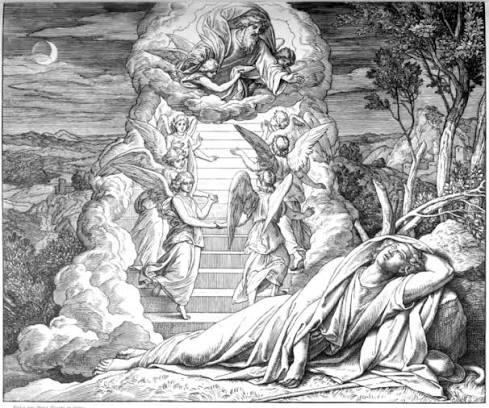
In Genesis 28, we catch up with Jacob as he is fleeing for his life. To say he’s been a bit of a naughty boy would be an understatement and his brother Esau (possibly along with a few others) are wanting to kill him.

As the sun had set Jacob stopped for the night and found a flat stone he could use as a pillow before settling down to sleep. And he dreamed that famous dream we refer to as Jacob’s Ladder of a great ladder with its top in heaven and its feet on earth. Angels were going up and down the ladder which reassured Jacob that God was closer than he had realised and that there was interaction between earth and heaven.

It is often asked why we look up at our sky to point our eyes towards heaven and why we think of it being above us. It is imagery such as this which feeds our perception of a literal higher plane as opposed to a metaphorical upness.

As is made clear in John’s Gospel, Jesus is the access to heaven. He is how people can go to heaven and how heaven can come down to people. Jesus is the ladder Jacob saw in his dream.

John 1:51 says “And He said to them, ‘Most assuredly, I say to you, hereafter you shall see heaven open, and the angels of God ascending and descending upon the Son of Man’.”

Jesus is the way to heaven, He doesn’t just show us the way, He is the way. As He said, recorded in John 14:6, “I am the way, the truth and the life. No one comes to the Father except through me.”

God appeared to Jacob introducing Himself as the God of Abraham and Isaac and repeats to Jacob the terms of the covenant given to Abraham, Isaac, and now to Jacob. God gave Jacob the promise of land and descendants but He also promised that He would be with Jacob, protecting him, until all these promises had been fulfilled. God continues to work until His work is complete in His people. God’s blessing and faithfulness to Jacob can be seen in the several ways that His presence was described in Jacob’s life. Jacob woke and declared “Surely the Lord is in this place and I did not know it.”

Jacob therefore renamed the place Bethel meaning House of God. So if you ever wondered what Bethel meant when you see or hear of a Bethel Church now you know.

He was correct in sensing the presence of the Lord but mistaken if he had thought that God was in some places and not others. God is everywhere – as David clearly understood from his words in Psalm 139.

During his dream, Jacob did not use the ‘stairway to heaven’; instead God spoke to Jacob where he was, demonstrating God’s immanent presence. He is not a faraway removed God calling long-distance but an indwelling God right here with us.

This encounter comes completely from God breaking into Jacob’s sleep state bringing a break to his anxious fleeing. At this vulnerable point in Jacob’s life, God emphasizes that He is not only the God of the first and second generation but also the God of Jacob. The reiteration of God’s promise also serves as a powerful reminder that Jacob’s life should not be governed by self-interest but by becoming a channel of God’s blessing to others.

When Jacob wakes from his dream he is a totally changed man and makes a vow showing his commitment to God.

This is the same Jacob who later would be called Israel and whose sons become the start of the twelve tribes of Israel.

From little acorns (or little dreams) great things grow.

Which leads us to Matthew 13 starting at verse 24, a passage which addresses the evil among us, God’s patience and the separation of believers and unbelievers at the end of the age.

The devil places a corrupt presence amongst innocents or in more generalised parlance unbelievers amongst believers. They look like genuine believers and we can get it wrong and mix them up. Only God knows and can tell the difference. 

The weeds or tares look just like the wheat until the ears are fully formed and it is ready for harvesting. This is why, to preserve and protect the true wheat, the tares are not separated out until the harvest. This prevents the wrong ones being destroyed when the tares are ripped out and burnt.

Whilst there are similarities between this parable and the parable of the sower from last week, what each element represents and the point of the parables are different. Last week’s parable showed how people receive and respond to the Word of God; whereas this week shows how God will divide His true people from false believers at the end of this age.

The field represents the entire world within which there is good seed representing the true believers and weeds or tares representing unbelievers. 

Make no mistake – by unbelievers we don’t mean those who are currently unbelievers but who will believe – they are wheat which is still developing their ears. No, we are talking about the end of the age when it is time for God’s harvest and those who are false believers, unbelieving or counterfeits who have been put there by the enemy – the devil – to try and corrupt true believers.

It is interesting how many ‘children’s stories’ are great works of theology. In 1883, The Princess and Curdie by George MacDonald was published. George MacDonald was a Scottish writer, theologian and preacher, a mentor for Charles Lutwidge Dodgson and a profound influence on J R Tolkien and C S Lewis. In this story, Curdie is given the ability that when he holds someone’s hand he can feel what it’s like on the inside – or how God sees them. Hands that look elegant and beautiful are cold, clammy, rough and coarse. Others, despite looking rough and deformed, are beautiful.

Or take Beauty and the Beast. Handsome Gaston is horrific on the inside whereas the terrifying Beast has beauty deep within. Or, of course, the Empress Jadis from C S Lewis’s Magician’s Nephew, who later becomes The White Witch. Digory reflects that “in all his life he had never known a woman so beautiful…” and yet within she was arrogant, callous and cruel.

It is not our job to weed them out but God’s. We are not to separate the good from the bad because we can only see what people are like now. We cannot see what they will become and we cannot see what is written in their hearts. 

Our job is to shine forth hope, to proclaim the Word of life, to speak of the love and forgiveness God has for us, of the power to change and the hope He gives us.

The reapers are the angels and will be sent out by Jesus the Son of Man.

There are two different paths and eternal destinies. A furnace of fire where the crop which came from the seeds of the devil will go and there is the radiant glory where the true believers shine forth as the sun.

The fire of the furnace will not destroy those thrown into it. Instead they will suffer a living torment with great woe, wailing and gnashing of teeth.

The wheat comes into God’s barn from all over the world, from all classes of society and from all ages. Yet all have one thing in common. They were all sown by the Lord from the good seed of His Word.

Jacob’s dream of a ladder between heaven and earth

Calling and Love

Now the Lord said to Abram, “Go from your country and your kindred and your father’s house to the land that I will show you. I will make of you a great nation, and I will bless you and make your name great, so that you will be a blessing. I will bless those who bless you, and the one who curses you I will curse, and in you all the families of the earth shall be blessed.” So Abram went, as the Lord had told him, and Lot went with him. Abram was seventy-five years old when he departed from Haran. Abram took his wife Sarai and his brother’s son Lot and all the possessions that they had gathered and the persons whom they had acquired in Haran, and they set forth to go to the land of Canaan. When they had come to the land of Canaan, Abram passed through the land to the place at Shechem, to the oak of Moreh. At that time the Canaanites were in the land. Then the Lord appeared to Abram and said, “To your offspring I will give this land.” So he built there an altar to the Lord, who had appeared to him. From there he moved on to the hill country on the east of Bethel and pitched his tent, with Bethel on the west and Ai on the east, and there he built an altar to the Lord and invoked the name of the Lord. And Abram journeyed on by stages toward the Negeb.

Genesis 12: 1-9

As Jesus was walking along, he saw a man called Matthew sitting at the tax-collection station, and he said to him, “Follow me.” And he got up and followed him. And as he sat at dinner in the house, many tax collectors and sinners came and were sitting with Jesus and his disciples. When the Pharisees saw this, they said to his disciples, “Why does your teacher eat with tax collectors and sinners?” But when he heard this, he said, “Those who are well have no need of a physician, but those who are sick. Go and learn what this means, ‘I desire mercy, not sacrifice.’ For I have not come to call the righteous but sinners.”

While he was saying these things to them, suddenly a leader came in and knelt before him, saying, “My daughter has just died, but come and lay your hand on her, and she will live.” And Jesus got up and followed him, with his disciples. Then suddenly a woman who had been suffering from a flow of blood for twelve years came up behind him and touched the fringe of his cloak, for she was saying to herself, “If I only touch his cloak, I will be made well.” Jesus turned, and seeing her he said, “Take heart, daughter; your faith has made you well.” And the woman was made well from that moment. When Jesus came to the leader’s house and saw the flute players and the crowd making a commotion, he said, “Go away, for the girl is not dead but sleeping.” And they laughed at him. But when the crowd had been put outside, he went in and took her by the hand, and the girl got up. And the report of this spread through all of that district.

Gospel of Matthew 9:9-13, 18-26

Have you noticed how it is always busy people that Jesus calls?

When He calls us to do something, He calls us away from something else. He calls ordinary people out of the ordinariness of their lives. They are not being called because they have nothing to do and are just sitting there twiddling their thumbs. Jesus doesn’t call people who do nothing.

Every one of the disciples Jesus called were busy people and were in the middle of their normal work at the time they were called. Peter and Andrew were fishing. James and John were mending their nets. Levi (who becomes Matthew), as we read in the first part of the Gospel passage, was in the middle of his work collecting taxes.

It is not that they don’t have anything else to do. It is that the most important thing to do is to hear and obey the Saviour’s call. Jesus, our Saviour, says “Drop what you are doing and follow me”. And the correct and best response is, of course, to get up and follow Him.

Matthew did not choose Jesus. Matthew was rather busy collecting taxes and was not contemplating following anyone.

Jesus chose Matthew. Not only did He choose Matthew but He did not grant the option of thinking it over. Jesus chose Matthew and told him to follow then and there. And Matthew got up and followed Him. Jesus calls us to do the same. No thinking time. No preparation time. No advance training – the only available training is on the job as we go! Just drop everything and follow Him.

When Jesus called Matthew, Matthew got up and left his desk. He left behind the symbol of his profession and the root of his sinfulness. We are never called to something without being called away from something else. We cannot come into full discipleship if we are unable to let go of what Jesus is calling us to leave behind.

In the passage from Genesis 12 Abram is called by God to leave his country, his kin, his father’s house and travel to an unknown land that God would show him. He was called to leave his past behind and to put his trust fully in God for the future. You cannot get to what God has for you without letting go of where you are and what is holding you back and following Him. It is not what Jesus sees in us that makes us worthy of following Him, but what He puts in us when we obey His command.

Jesus also said “I desire mercy not sacrifice. Go and find out what this means”.

Hosea 6:6 says “For I desire steadfast love and not sacrifice.”

The Hebrew word used is “hesed”. I desire hesed not sacrifice. Hesed is translated as steadfast love, mercy, goodness, kindness, compassion and loyalty. Jesus, God, desires all these things from us; not just sacrifice. And here, the meaning of sacrifice is tithing. Gifts given to God and used to support the priests leading worship. Tithing is important to God. I remember reading about a church in Africa where, as the choir sang, the people brought their offerings to God; mostly grain and produce. The people did this with great joy and enthusiasm, giving to God a portion of whatever they had. Tithes and offerings are important to our worship and important to God. But, they are not more important than our steadfast love and mercy.

What do we tithe? What do we give to God? Is it our time? Our talents? A portion of our income or possessions? Volunteering to help our community? All of these are a form of tithe and sacrifice, but, whilst they are important to God, they are not as important as our steadfast love and mercy.

Let us imagine that you help out at the food bank on a Monday morning, preparing and handing out food parcels to the hungry. This is a tithe and a sacrifice. But, whilst you are doing this work, are you gossiping with the other volunteers? Are you speculating about our new Priest in Charge to be? Making assumptions about what he is like without having met him and without waiting to find out? Are you googling him, claiming to know all about him, his experience and his qualifications, even though you haven’t actually read his C.V? Are you judging and claiming you know precisely what he will do before he has even got here? Are you gossiping about other people you know? About those you are serving?

If so, where is the love, the mercy and the kindness? It is noticeably absent from this scenario and, sadly, it is exactly what occurred on Monday and so we pray for them.

God wants us to sacrifice our time, our talents, a portion of our treasures or income, but not at the sacrifice of our steadfast love and mercy.

Our time, talents and money are no substitute for our steadfast love towards God and our neighbours or for our kindness and mercy.

God shows us, and it is detailed over and over again in scripture, the kind of steadfast love and mercy that is important to Him. He is not asking anything of us that He has not already given us.

There is a story about Gandhi. A mother asked him to talk to her son about giving up sweets. He agreed but weeks went by. The mother asked him why he had not yet spoken to her son. Gandhi replied that he still intended to speak with her son but that he was finding it harder to give up sweets than he had expected. The mother realised that Gandhi could not and would not ask someone else to do something he was not already doing and so the conversation with her son could not take place until Gandhi himself had managed to give up sweets.

Like this story about Gandhi, God only asks of us what He has already given us. God gives us and shows us that His steadfast love and mercy for us endures forever and will be with us all the days of our lives.

God demonstrated this by giving us His Son. God so loved the world that He gave His only begotten Son that whoever believeth in Him shall not perish but will have everlasting life.

And Jesus demonstrated God’s steadfast love and mercy over and over again.

We not only have the example of the calling of Matthew in our readings but also the healing of the woman who had been bleeding for 12 years and the resurrection of the synagogue leader’s daughter.

Jesus showed the same mercy to everyone whether they believed in Him or not. His love and mercy really are unconditional and for everybody.

He called sinners, He healed the sick, He raised the dead, He spoke against injustice, He showed us how to love with a steadfast, merciful, kind, pure, good, everlasting love that knows no bounds. God loves us completely, unconditionally with an endless love that is for everyone.

Drop everything!

Let it go!

Follow Him!

Starfish Story

Pentecost

Pentecost – the day the Holy Spirit was sent to be with us forever – is about much more than we realise. It is about the reversal of division, about overcoming human limitations, about the power to forgive and about continuous ministry.

It is the culmination of a series of events that began a long long time before. Let’s start with the reversal of division.

The Tower of Babel

Now the whole earth had one language and the same words. And as they migrated from the east, they came upon a plain in the land of Shinar and settled there. And they said to one another, ‘Come, let us make bricks, and burn them thoroughly.’ And they had brick for stone, and bitumen for mortar. Then they said, ‘Come, let us build ourselves a city, and a tower with its top in the heavens, and let us make a name for ourselves; otherwise we shall be scattered abroad upon the face of the whole earth.’ The Lord came down to see the city and the tower, which mortals had built. And the Lord said, ‘Look, they are one people, and they have all one language; and this is only the beginning of what they will do; nothing that they propose to do will now be impossible for them. Come, let us go down, and confuse their language there, so that they will not understand one another’s speech.’ So the Lord scattered them abroad from there over the face of all the earth, and they left off building the city. [Genesis 11:1-8]

Instead of obeying the Lord God and allowing Him to be their God, the people gathered to build the tower. This was much more than our concept of a tower and was to be a man-made sacred mountain on which humanity intended to live and be gods themselves.

Humanity shunned the Lord God and His plan to restore Eden through them, and so God scattered humankind, dividing them with different languages, wanting to start again.

Israel did not actually exist at this point. God then selected Abram; a man from the very heart of the rebellion. It is through God’s covenant with Abram that Israel was created from Abram’s descendants.

In this covenant, God said that all the nations of the earth would be blessed through Abram and his descendants. This shows the intention of God; that despite His decision to punish the nations of the earth, the Israelites would serve as a mediator for the return of the True God with a trail leading the nations back to God through Israel and The Messiah.

When the Holy Spirit came, as described in Acts, as wind and fire, this links back to the images used for God’s presence in the Old Testament.

But more than that are the signs that the reunification, the reversal of division, is in progress whilst pointing to the division point. The flaming tongues were divided, and the crowd formed from all the nations, were confused. The tongues are distributed amongst the disciples as they are commissioned to preach the good news.

As the people heard about Jesus and His resurrection and became His followers, they carried the news back to their nations. The people are being reunited and reconciled with God through the Holy Spirit.

This is part of the continuous mission. To witness and call the people back to God. 

The Holy Spirit unites people across boundaries. It replaces judgement and division with understanding, unity and peace.

So, what about the overcoming of human limitations?

The Holy Spirit provides the inner strength needed to work through hurts, resentment and shame. This allows forgiveness as an act enabled by the Holy Spirit instead of human effort on its own.

Forgiveness is also part of the continuous mission as we are called to continually release grievances, heal relationships and extend the same forgiveness to others as that we receive from God.

Which brings us to the power to forgive.

Again Jesus said, “Peace be with you! As the Father has sent me, I am sending you”. And with that He breathed on them and said “Receive the Holy Spirit. If you forgive anyone’s sins, their sins are forgiven; if you do not forgive them, they are not forgiven.” [John 20: 19-23]

As Christians we are obliged to forgive. It can be difficult to forgive. It can be difficult to forgive others. It can be difficult to forgive ourselves.

Forgiveness – forgiving does not mean forgetting. It does not mean making excuses or trying to justify what occurred. It does not mean that there won’t be consequences. It is about whether those involved can move forward in life or whether they are imprisoned by being unforgiven.

If we choose for sins to be retained we choose a state of unforgiveness and living in darkness. To live in such darkness is our choosing not God’s choosing.

The Holy Spirit gives us power to forgive. It opens doors and allows us to live in the light. 

The Lord breathes the Holy Spirit on us and gives us a new life, a new heart and a new mission:

Go and forgive!

Peace is not possible without forgiveness. Love is not possible without forgiveness.

At Easter we celebrate the Resurrection of the Lord. Just like Jesus did not stay in the tomb His instructions didn’t either. He instructed us to love, to forgive, to reconcile, to love God, to love our neighbours and to love our enemies.

The highest form of love is forgiveness. 

Forgiveness is unconditional love. It is not only loving those who are easy to love but also those who are difficult to love.

Jesus arrived in that locked room and said to His disciples “Peace be with you” He was telling them that they did not need to be afraid of Him, that He loved them and that He forgave them.

Go in peace! Go and forgive!

Tongues of Fire (Photo by Marek Piwnicki on Pexels.com)

Temptation in the Wilderness

Jesus was led up by the Spirit into the wilderness to be tempted by the devil. He fasted forty days and forty nights, and afterwards he was famished. The tempter came and said to him, “If you are the Son of God, command these stones to become loaves of bread.” But he answered, “It is written, ‘One does not live by bread alone, but by every word that comes from the mouth of God.'” Then the devil took him to the holy city and placed him on the pinnacle of the temple, saying to him, “If you are the Son of God, throw yourself down; for it is written, ‘He will command his angels concerning you,’ and ‘On their hands they will bear you up, so that you will not dash your foot against a stone.'” Jesus said to him, “Again it is written, ‘Do not put the Lord your God to the test.'” Again, the devil took him to a very high mountain and showed him all the kingdoms of the world and their splendour; and he said to him, “All these I will give you, if you will fall down and worship me.” Jesus said to him, “Away with you, Satan! for it is written, ‘Worship the Lord your God, and serve only him.'” Then the devil left him, and suddenly angels came and waited on him.

Matthew 4: 1 – 11

After Jesus’s baptism, He was led by the Holy Spirit into the Wilderness for forty days (and nights) to fast and prepare for His ministry. Here He resisted the devil and the temptations laid before Him and strengthened Himself to be ready for what lay ahead. 

Forty is a number that pops up time and time again in the Bible. In the account of Noah, once he and his family are on the ark it rains for forty days and nights. Moses fasted on Mount Sinai for forty days and nights. Elijah fasted in the desert for, wait for it, forty days and nights. After leaving Egypt the Israelites wandered the wilderness for forty years.

A lot of forties and we should also recognise that we are in one ourselves as we travel the forty days of the season of Lent, participating in Jesus’s ministry and following His way toward the cross. We remember Jesus’s time in the Wilderness during this time of Lent but are we taking the opportunity of the Lenten time of preparation to patiently prepare spiritually, seek God and deepen prayer?

After identifying with sinners in His baptism, Jesus then identified with them again in severe temptation. This was a necessary part of His ministry, so He truly was led up by the Spirit into the wilderness. Jesus did not need to be tempted to help Him grow. Instead, He endured temptation both so that He could identify with us (Hebrews 2:18 and 4:15), and to demonstrate His own holy, sinless character.

Temptation is a certainty for everyone. Yet Jesus’s temptation was more severe because He was tempted directly by the devil himself, while we contend mainly with lesser demons. It was also more severe because there is a sense in which temptation is “relieved” by giving in, and Jesus never did yield. Therefore He bore levels of temptation we will never know by experience.

Jesus is tempted by food, by who to worship, and by the power of the nations. This is another way in which Jesus identified with us as all three of these were faced by the Israelites in their exile. Sometimes they were able to withstand the temptation, and sometimes they did not. Jesus, on the other hand, withstood all His temptations even though what Satan offered him is firmly within Jesus’s rights and power.

Jesus’s wilderness temptations “prove” to us what sort of God He is. The tempter starts each of his offers with the Greek word, ei, which is often translated as “if” but also translates as “since…” Satan knows Jesus is the Son of God, he knows the power and authority that belong to Jesus, he also knows that what he is tempting Jesus with are well within Jesus’s rights and capability. Satan is both tempting and taunting Jesus but Jesus refuses to fall for either, proving His humility through denying Himself for the sake of others.

So Jesus was tempted just like us but Jesus succeeded where we fail. Jesus succeeded because He knew that His life was in God’s hands. We do not live by our power of provision but by God’s help and blessings. Jesus succeeded because He knew that God was with Him and He did not need another display of power to prove it. 

The cross reminds us that God is with us. We do not need to tell God how to run our lives or how to do things differently; God is with us no matter what. God is with us whether He leads us through the valley of the shadow of death or to the mountain peaks of joy. Jesus succeeded because He knew that worshiping God meant doing God’s will and not seeking His own desires. We do not live for our own desires but for God’s glory so that in the end we will be glorified by God.

We can have victory over temptation if we will look at the root of what the devil is putting in front of us. Ultimately, every temptation challenges whether or not we believe that God is with us, that God will provide for us, that God is for our good, and that God will deliver on His promises to us. Jesus had victory in the wilderness so that He could set us free from these enslaving temptations and sins. Jesus had victory so that he could stand before the Father on our behalf, interceding for us when we fail. His success is even more proof that He is the King who has come to save us from our sins.

Wilderness (Photo by Luis Quintero on Pexels.com)

Don’t be a Pharisee …

The Legend of the Stones

Two women approached a wise man and asked for instruction. One of them regarded herself as a terrible sinner. In her youth, she had deceived her husband, and she tortured herself constantly with the memory of her infidelity.

The second, on the other hand, had lived her entire life within the law and by the rules. She wasn’t conscious of any serious sin, had nothing much to reproach herself with and felt quite pleased with herself.

The wise man asked both women about their life. The first went as she confessed her great sin. She felt her sin had been so great that she had no right to expect forgiveness. The second said that she had not committed any particular sins.

The wise man said to the first woman, ‘Go, daughter of God, and look for the heaviest boulder you can find – one that you can barely manage to carry – and bring it to me.’

‘And you,’ he said to the second woman, who could not recall any serious sin, ‘go and bring me as many stones as you can carry, but they must all be small ones.’

The women went off to do as the wise man had told them. The first brought a huge boulder; the second brought a whole sackful of small pebbles.

The wise man examined the stones and said, ‘Now do as follows. Take the stones back and replace each one of them exactly where you picked it up, and when you have put them all back where you found them, come back to me.’

The women went off again to carry out the wise man’s instructions. The first very easily found the place from where she had taken the huge boulder, and she replaced it where it had been. But the second had no idea where she had picked up all her little pebbles, and had to return to the wise man without having carried out his instruction.

‘You see,’ said the wise man, ‘that’s how it is with our sins. It was easy to take the big, heavy boulder back to its place because you knew exactly where you first found it. But it was impossible to remember where all those little pebbles came from.’

And to the first woman, he said, ‘You are very conscious of your sin. You carry in your heart the reproach of your husband and of your conscience; you have learned humility, and in this way you have been freed of your wrongdoing. You, however,’ he said to the second woman, who had come back still carrying her sack of little pebbles, ‘you, who have sinned in many small ways, do not know any more when and how you did wrong; you are not able to repent. You have grown accustomed to a life of little sins, to passing judgement on the sins of others while becoming more deeply entangled in your own. It has become impossible to free yourself of them.’

A story by Leo Tolstoy retold by Margaret Silf

To paraphrase from part of the Gospel of Luke, chapter 18: The Pharisee thanks God that he is not like other people. He details his religious practices and self perceived righteousness and considers himself more virtuous and superior to others.

The tax collector feels unworthy and simply asks God to have mercy on him, a sinner.

Jesus states it is the tax collector and not the Pharisee who went home justified by God. God values the tax collector’s humility, not the Pharisee’s self-righteousness.

Jesus told this parable to warn those who trusted in themselves but who treated others with contempt. He warns them against spiritual pride and calls for us to have humility in prayer and in life. Our justification comes solely from God’s grace and mercy and not from our own achievements.

Humility is essential for a right relationship with God whilst spiritual pride leads to self-righteousness and being rejected by God.

It is easy to fall into the trap of behaving like the Pharisee. I know someone who, on a regular basis, beats their chest and says “I thank God I am not like other men”.

Modern day Pharisees are not all as obvious as this but are characterised by their self-righteousness, a tendency to burden others with strict rules whilst not following them themselves and a focus on power and control of over serving.

They may appear religious whilst lacking genuine faith whilst adhering to certain rules or attending church yet without a corresponding difference in their daily life. They may focus on strict adherence to rules and traditions, creating heavy burdens for others yet ignoring the spirit of the law. They judge and condemn others, even misrepresenting their motives whilst projecting their own shortcomings onto them.

They believe they are more righteous than others but are unwilling to admit to their own sins or weaknesses.

They are more concerned about other’s opinion of them and how they are seen than they are about having a genuine relationship with God.

But, even for Pharisees, there is hope.

To not be a Pharisee, hear the words of Jesus. Jesus is the Light of the world, whoever follows Him will not walk in darkness but have the light of life.

Don’t ignore the content of what Jesus says, or you’ll miss out. Hear Jesus’s word and His message. Actively listen to Him by reading and paying attention to Scripture. If you ignore Scripture, if you ignore the Bible, if it just sits on a shelf gathering dust, then you are ignoring the word of Jesus.

Regardless of how busy we are, we make time for what matters most. Nobody is too busy to hear Jesus’s word.

Hearing Jesus’s word – reading the Bible is non-negotiable for both first-time faith and for growing faith. You can’t believe in and become like Jesus without His word. Hear His word.

See Jesus’s light. Light is a big metaphor. Jesus is an exposing light, an illuminating light, and a welcoming light.

He exposes what is hidden, calls out sin, and banishes darkness. He illuminates, revealing or making known the way, shining out in the darkness and showing us what we need to see. He is a welcoming light guiding us and inviting us home.

See the light, put your faith in Jesus, and be welcomed home. Follow Jesus’s path. Jesus’s promises of light and life are only for those who follow Him. Truly believe and truly follow Jesus.

This doesn’t mean just recognising that Jesus was a real person – and there is historical evidence of this – it means seeing and listening to Jesus, going wherever He leads and doing what He says. Literally following Him. Not just being a Christian but being a Christ-Follower. True believing where your highest allegiance is to Jesus; whatever He wants, that’s what you want.

Don’t be a Pharisee.
Hear Jesus’s word.
See Jesus’s light.
Follow Jesus’s path.
Be humble.

Lord Jesus Christ, Son of God, have mercy on us, all sinners.

Stones and Pebbles

… for life not just for Christmas …

I wonder how many already have put all the decorations away? I wonder how many will rush to put them away on twelfth night? I wonder how many will keep them up until Candlemas when Jesus is presented at the temple? I wonder how many still have turkey and excess food to eat?

I further wonder how many of those who’ve already put their decorations away, excitedly got them out in November, and on putting them away said something along the lines of “thank goodness they’re away for another year”? I also wonder how many of those who have not yet put the decorations away will be saying something similar when they do?

And all this wondering is because I wonder how many put Jesus away with the decorations? How many try to box Him up and leave Him in the loft with a “thank goodness that’s done for another year”?!

We see the slogan, “A dog is for life not just for Christmas”. Something which is very true – they are a life long commitment!

Jesus is a life long commitment. Not only that, He is for life in more ways than one.

Jesus was born as that tiny baby at Christmas for our salvation. He came to save our lives. His sacrifice for the forgiveness of sins for us to have life. Jesus is for life.

When we commit ourselves to Jesus and let Him into our lives; this is a life long commitment. We spend each day trying to follow Jesus’s example.

So this year I pray that, instead of putting Jesus away with the decorations for another year, we open the door to Him – letting Him in for life!

Jesus is for life not just for Christmas!

First or Last

One of the things that this country is famous for is queuing. We’re all guilty of it – we all end up queuing at some point or other. From what I’ve been told, and seen on the news, some people will queue for hours – many many hours – for something they feel is important to them. For example, paying respects to our late queen.

And we’re not happy when people queue jump, are we? Remember the backlash to those two ITV morning television hosts doing it.

Yet here Jesus says the last shall be first and the first will be last. Not only that but He tells us that the workers all received the same pay. Those who only worked for one hour received that same amount as those who worked for the entire day!

If we take this literally, to us, it seems a bit unfair and contrary to our knowledge of God as a fair and generous God.

But! We are not supposed to take this passage literally. It is important to remember that Jesus taught in metaphors and stories. And, Jesus us telling this parable to explain several things:

Jesus uses this parable to further explain what the Kingdom of God is like and to highlight God’s continuing care for His people. He is also highlighting the importance of choosing eternal life with Him over the temptation of worldly wealth whilst teaching His disciples to serve others. Greatness is not ruling over others but serving others. Jesus came to serve – not to be served.

In the Kingdom of God all are treated the same.

Everyone comes to faith (the vineyard) at different times of life.

Some are “lifelong” followers, or disciples, of Jesus. Some find Jesus much later in life.

It is never too late to find faith, belief in Jesus, and to begin living faithfully.

God wants ALL people to have faith in Him and return to a life with Him. Not all do; but that does not mean we should give up. We should continue to persevere, to spread the word, to live by Jesus’s example and plant those mustard seeds to continue to draw others back to Christ.

ALL believers, who repent, no matter how long or how hard they work during this lifetime, will receive the same reward:

  • eternal life
  • God’s grace
  • God’s forgiveness and reconciliation with Him

However, we must be careful not to compare and become envious of others and what we perceive they have been given (thinking they are being given more that they’ve earned).

It is not really possible for us to see what others have experienced as they serve God. We cannot see their inner conflicts or their background struggles. Neither can they fully see ours.

In the end, all of us truly need to trust God and know that all we have is from His grace, which He has freely given.

So, going back to that queue, it doesn’t matter if we are at the front, the back, or in the middle! It doesn’t matter at what age we found Christ. God freely gave us His grace and what matters is that we did find Him. Regardless of where we are in that “queue”, if we turn to Christ, follow Him, reject evil and repent our sins then God forgives us and we are reconciled with Him.

Talk given at Holy Trinity Sheerness and Minster Abbey 24th September 2023 (Matthew 20:1-16).

People queuing

A Journey of Truth and Faith

(Talk on Luke 24:13-35 23rd April 2023)

This passage from Luke teaches us a lot about truth and faith. It is, in both a literal and a spiritual sense, about journeys. Literally, it is about two disciples (followers of Jesus) walking from Jerusalem to Emmaus. Spiritually, it is about their and our journey from not knowing Jesus to truly knowing Jesus and sharing our experiences of Jesus. It is about rediscovering Christ’s presence in our lives, gaining a fresher understanding of God’s transforming grace, allowing our hearts to be ignited with the Holy Spirit as we too walk with Christ.

The Bible makes very clear and specific statements about Jesus. As the disciples walked along they were discussing the scriptures and the recent events that had happened. When Jesus appeared to them they were walking the wrong way – away from Jerusalem. They were preoccupied with their own difficulties, overwhelmed with sadness, grief and hopelessness. They were unable to identify God’s purpose in what had happened.

Humans like to know reasons for…well everything. We ask (both aloud and to ourselves) why? We analyse, we interpret, we assume, we conclude. And we use the answers as a Sat Nav! What we decide the answers are determine/direct what and where we do/go next.

The disciples did not fully understand the Scriptures or the meaning of what had happened to Jesus. They had knowledge but it was incomplete and not understood. It was not true knowledge of the right information.

Jesus appeared and started to walk with them. They did not see Jesus. They were kept from recognising him. The Risen Christ walking with them on their journey, but unrecognised, igniting the fire of God’s love in their hearts. Like the Footsteps poem when there is only one set of footprints (because Jesus is carrying us).

But, this enabled Jesus to impart true knowledge. He explains and interprets for them. This teaches us that the key to interpreting the Old Testament is Jesus.

Jesus explained everything from Moses to the prophets, how the Messiah would save God’s people through His death and resurrection, rescuing a sinful, unholy people by reconciling them with The Holy God.

Jesus is the Messiah whose life, death and resurrection grants us salvation. Jesus Himself told us “I am the way, the truth and the life, no man comes to the Father except through me”.

God cannot be near sin. The only way for us sinners to be reconciled to Him was for Jesus to become sin, be punished for our sin, to die and defeat death; so that through His resurrection we could, with faith and repentance, be forgiven and have a relationship with God.

But it is not sufficient to just know the facts. We must also believe in that knowledge, we must truly believe in Jesus and in what He taught. Like the disciples recognising Jesus (when He broke the bread) and rushing back to tell the others, we have to open our eyes in faith. If we believe in Him then we strive to be in His image and this is shown in how we live. We need to believe in God’s word and be motivated by faith. We know God fulfils His promises but we also need to believe this. We know He is always with us, all the time, especially those times when we only see one set of footprints. But, we also need to believe this.

There is a story that gets quoted a lot so apologies if you, like me, have heard it used before:

There was a young boy caught in a house fire and forced to flee to the roof. The father stood on the ground below with outstretched arms, calling to his son, “Jump! I’ll catch you”. He knew the boy had to jump to save his life. All the boy could see was flame, smoke and darkness. The boy was too afraid to leave the roof. His father kept yelling “Jump! I WILL catch you”. The boy protested “Daddy, I can’t see you” The father replied, “But I CAN see you and that’s all that matters”.

Reece Sherman’s Faith Lessons

Do we understand truly? Or do we rely on our assumptions? Do we truly believe and trust in God? I pray that we do.

God is always there for us and will catch us. He can see us even if we cannot see Him. Do we have enough faith to jump into those life saving arms? I pray that we do.

Thank you.

Poppet on a journey, running through grass