Don’t be a Pharisee …

The Legend of the Stones

Two women approached a wise man and asked for instruction. One of them regarded herself as a terrible sinner. In her youth, she had deceived her husband, and she tortured herself constantly with the memory of her infidelity.

The second, on the other hand, had lived her entire life within the law and by the rules. She wasn’t conscious of any serious sin, had nothing much to reproach herself with and felt quite pleased with herself.

The wise man asked both women about their life. The first went as she confessed her great sin. She felt her sin had been so great that she had no right to expect forgiveness. The second said that she had not committed any particular sins.

The wise man said to the first woman, ‘Go, daughter of God, and look for the heaviest boulder you can find – one that you can barely manage to carry – and bring it to me.’

‘And you,’ he said to the second woman, who could not recall any serious sin, ‘go and bring me as many stones as you can carry, but they must all be small ones.’

The women went off to do as the wise man had told them. The first brought a huge boulder; the second brought a whole sackful of small pebbles.

The wise man examined the stones and said, ‘Now do as follows. Take the stones back and replace each one of them exactly where you picked it up, and when you have put them all back where you found them, come back to me.’

The women went off again to carry out the wise man’s instructions. The first very easily found the place from where she had taken the huge boulder, and she replaced it where it had been. But the second had no idea where she had picked up all her little pebbles, and had to return to the wise man without having carried out his instruction.

‘You see,’ said the wise man, ‘that’s how it is with our sins. It was easy to take the big, heavy boulder back to its place because you knew exactly where you first found it. But it was impossible to remember where all those little pebbles came from.’

And to the first woman, he said, ‘You are very conscious of your sin. You carry in your heart the reproach of your husband and of your conscience; you have learned humility, and in this way you have been freed of your wrongdoing. You, however,’ he said to the second woman, who had come back still carrying her sack of little pebbles, ‘you, who have sinned in many small ways, do not know any more when and how you did wrong; you are not able to repent. You have grown accustomed to a life of little sins, to passing judgement on the sins of others while becoming more deeply entangled in your own. It has become impossible to free yourself of them.’

A story by Leo Tolstoy retold by Margaret Silf

To paraphrase from part of the Gospel of Luke, chapter 18: The Pharisee thanks God that he is not like other people. He details his religious practices and self perceived righteousness and considers himself more virtuous and superior to others.

The tax collector feels unworthy and simply asks God to have mercy on him, a sinner.

Jesus states it is the tax collector and not the Pharisee who went home justified by God. God values the tax collector’s humility, not the Pharisee’s self-righteousness.

Jesus told this parable to warn those who trusted in themselves but who treated others with contempt. He warns them against spiritual pride and calls for us to have humility in prayer and in life. Our justification comes solely from God’s grace and mercy and not from our own achievements.

Humility is essential for a right relationship with God whilst spiritual pride leads to self-righteousness and being rejected by God.

It is easy to fall into the trap of behaving like the Pharisee. I know someone who, on a regular basis, beats their chest and says “I thank God I am not like other men”.

Modern day Pharisees are not all as obvious as this but are characterised by their self-righteousness, a tendency to burden others with strict rules whilst not following them themselves and a focus on power and control of over serving.

They may appear religious whilst lacking genuine faith whilst adhering to certain rules or attending church yet without a corresponding difference in their daily life. They may focus on strict adherence to rules and traditions, creating heavy burdens for others yet ignoring the spirit of the law. They judge and condemn others, even misrepresenting their motives whilst projecting their own shortcomings onto them.

They believe they are more righteous than others but are unwilling to admit to their own sins or weaknesses.

They are more concerned about other’s opinion of them and how they are seen than they are about having a genuine relationship with God.

But, even for Pharisees, there is hope.

To not be a Pharisee, hear the words of Jesus. Jesus is the Light of the world, whoever follows Him will not walk in darkness but have the light of life.

Don’t ignore the content of what Jesus says, or you’ll miss out. Hear Jesus’s word and His message. Actively listen to Him by reading and paying attention to Scripture. If you ignore Scripture, if you ignore the Bible, if it just sits on a shelf gathering dust, then you are ignoring the word of Jesus.

Regardless of how busy we are, we make time for what matters most. Nobody is too busy to hear Jesus’s word.

Hearing Jesus’s word – reading the Bible is non-negotiable for both first-time faith and for growing faith. You can’t believe in and become like Jesus without His word. Hear His word.

See Jesus’s light. Light is a big metaphor. Jesus is an exposing light, an illuminating light, and a welcoming light.

He exposes what is hidden, calls out sin, and banishes darkness. He illuminates, revealing or making known the way, shining out in the darkness and showing us what we need to see. He is a welcoming light guiding us and inviting us home.

See the light, put your faith in Jesus, and be welcomed home. Follow Jesus’s path. Jesus’s promises of light and life are only for those who follow Him. Truly believe and truly follow Jesus.

This doesn’t mean just recognising that Jesus was a real person – and there is historical evidence of this – it means seeing and listening to Jesus, going wherever He leads and doing what He says. Literally following Him. Not just being a Christian but being a Christ-Follower. True believing where your highest allegiance is to Jesus; whatever He wants, that’s what you want.

Don’t be a Pharisee.
Hear Jesus’s word.
See Jesus’s light.
Follow Jesus’s path.
Be humble.

Lord Jesus Christ, Son of God, have mercy on us, all sinners.

Stones and Pebbles

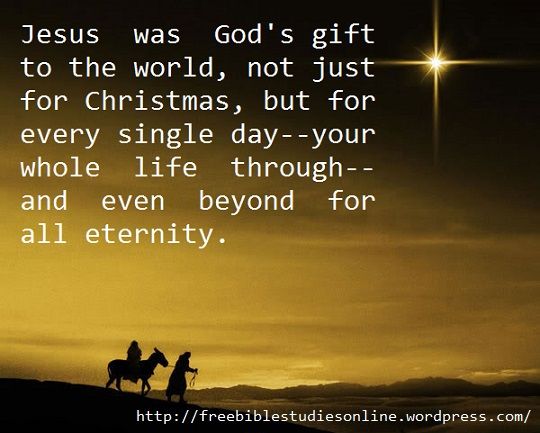
… for life not just for Christmas …

I wonder how many already have put all the decorations away? I wonder how many will rush to put them away on twelfth night? I wonder how many will keep them up until Candlemas when Jesus is presented at the temple? I wonder how many still have turkey and excess food to eat?

I further wonder how many of those who’ve already put their decorations away, excitedly got them out in November, and on putting them away said something along the lines of “thank goodness they’re away for another year”? I also wonder how many of those who have not yet put the decorations away will be saying something similar when they do?

And all this wondering is because I wonder how many put Jesus away with the decorations? How many try to box Him up and leave Him in the loft with a “thank goodness that’s done for another year”?!

We see the slogan, “A dog is for life not just for Christmas”. Something which is very true – they are a life long commitment!

Jesus is a life long commitment. Not only that, He is for life in more ways than one.

Jesus was born as that tiny baby at Christmas for our salvation. He came to save our lives. His sacrifice for the forgiveness of sins for us to have life. Jesus is for life.

When we commit ourselves to Jesus and let Him into our lives; this is a life long commitment. We spend each day trying to follow Jesus’s example.

So this year I pray that, instead of putting Jesus away with the decorations for another year, we open the door to Him – letting Him in for life!

Jesus is for life not just for Christmas!

First or Last

One of the things that this country is famous for is queuing. We’re all guilty of it – we all end up queuing at some point or other. From what I’ve been told, and seen on the news, some people will queue for hours – many many hours – for something they feel is important to them. For example, paying respects to our late queen.

And we’re not happy when people queue jump, are we? Remember the backlash to those two ITV morning television hosts doing it.

Yet here Jesus says the last shall be first and the first will be last. Not only that but He tells us that the workers all received the same pay. Those who only worked for one hour received that same amount as those who worked for the entire day!

If we take this literally, to us, it seems a bit unfair and contrary to our knowledge of God as a fair and generous God.

But! We are not supposed to take this passage literally. It is important to remember that Jesus taught in metaphors and stories. And, Jesus us telling this parable to explain several things:

Jesus uses this parable to further explain what the Kingdom of God is like and to highlight God’s continuing care for His people. He is also highlighting the importance of choosing eternal life with Him over the temptation of worldly wealth whilst teaching His disciples to serve others. Greatness is not ruling over others but serving others. Jesus came to serve – not to be served.

In the Kingdom of God all are treated the same.

Everyone comes to faith (the vineyard) at different times of life.

Some are “lifelong” followers, or disciples, of Jesus. Some find Jesus much later in life.

It is never too late to find faith, belief in Jesus, and to begin living faithfully.

God wants ALL people to have faith in Him and return to a life with Him. Not all do; but that does not mean we should give up. We should continue to persevere, to spread the word, to live by Jesus’s example and plant those mustard seeds to continue to draw others back to Christ.

ALL believers, who repent, no matter how long or how hard they work during this lifetime, will receive the same reward:

  • eternal life
  • God’s grace
  • God’s forgiveness and reconciliation with Him

However, we must be careful not to compare and become envious of others and what we perceive they have been given (thinking they are being given more that they’ve earned).

It is not really possible for us to see what others have experienced as they serve God. We cannot see their inner conflicts or their background struggles. Neither can they fully see ours.

In the end, all of us truly need to trust God and know that all we have is from His grace, which He has freely given.

So, going back to that queue, it doesn’t matter if we are at the front, the back, or in the middle! It doesn’t matter at what age we found Christ. God freely gave us His grace and what matters is that we did find Him. Regardless of where we are in that “queue”, if we turn to Christ, follow Him, reject evil and repent our sins then God forgives us and we are reconciled with Him.

Talk given at Holy Trinity Sheerness and Minster Abbey 24th September 2023 (Matthew 20:1-16).

People queuing

A Journey of Truth and Faith

(Talk on Luke 24:13-35 23rd April 2023)

This passage from Luke teaches us a lot about truth and faith. It is, in both a literal and a spiritual sense, about journeys. Literally, it is about two disciples (followers of Jesus) walking from Jerusalem to Emmaus. Spiritually, it is about their and our journey from not knowing Jesus to truly knowing Jesus and sharing our experiences of Jesus. It is about rediscovering Christ’s presence in our lives, gaining a fresher understanding of God’s transforming grace, allowing our hearts to be ignited with the Holy Spirit as we too walk with Christ.

The Bible makes very clear and specific statements about Jesus. As the disciples walked along they were discussing the scriptures and the recent events that had happened. When Jesus appeared to them they were walking the wrong way – away from Jerusalem. They were preoccupied with their own difficulties, overwhelmed with sadness, grief and hopelessness. They were unable to identify God’s purpose in what had happened.

Humans like to know reasons for…well everything. We ask (both aloud and to ourselves) why? We analyse, we interpret, we assume, we conclude. And we use the answers as a Sat Nav! What we decide the answers are determine/direct what and where we do/go next.

The disciples did not fully understand the Scriptures or the meaning of what had happened to Jesus. They had knowledge but it was incomplete and not understood. It was not true knowledge of the right information.

Jesus appeared and started to walk with them. They did not see Jesus. They were kept from recognising him. The Risen Christ walking with them on their journey, but unrecognised, igniting the fire of God’s love in their hearts. Like the Footsteps poem when there is only one set of footprints (because Jesus is carrying us).

But, this enabled Jesus to impart true knowledge. He explains and interprets for them. This teaches us that the key to interpreting the Old Testament is Jesus.

Jesus explained everything from Moses to the prophets, how the Messiah would save God’s people through His death and resurrection, rescuing a sinful, unholy people by reconciling them with The Holy God.

Jesus is the Messiah whose life, death and resurrection grants us salvation. Jesus Himself told us “I am the way, the truth and the life, no man comes to the Father except through me”.

God cannot be near sin. The only way for us sinners to be reconciled to Him was for Jesus to become sin, be punished for our sin, to die and defeat death; so that through His resurrection we could, with faith and repentance, be forgiven and have a relationship with God.

But it is not sufficient to just know the facts. We must also believe in that knowledge, we must truly believe in Jesus and in what He taught. Like the disciples recognising Jesus (when He broke the bread) and rushing back to tell the others, we have to open our eyes in faith. If we believe in Him then we strive to be in His image and this is shown in how we live. We need to believe in God’s word and be motivated by faith. We know God fulfils His promises but we also need to believe this. We know He is always with us, all the time, especially those times when we only see one set of footprints. But, we also need to believe this.

There is a story that gets quoted a lot so apologies if you, like me, have heard it used before:

There was a young boy caught in a house fire and forced to flee to the roof. The father stood on the ground below with outstretched arms, calling to his son, “Jump! I’ll catch you”. He knew the boy had to jump to save his life. All the boy could see was flame, smoke and darkness. The boy was too afraid to leave the roof. His father kept yelling “Jump! I WILL catch you”. The boy protested “Daddy, I can’t see you” The father replied, “But I CAN see you and that’s all that matters”.

Reece Sherman’s Faith Lessons

Do we understand truly? Or do we rely on our assumptions? Do we truly believe and trust in God? I pray that we do.

God is always there for us and will catch us. He can see us even if we cannot see Him. Do we have enough faith to jump into those life saving arms? I pray that we do.

Thank you.

Poppet on a journey, running through grass

Easter Spoilers

Talk from 26th March (John 11:1-45)

Who likes reading spoiler alerts to find out what will happen ahead of the next episode?

Who avoids them like the proverbial plague? Ah okay, you might want to put your hands over your ears then because in some ways this passage from John is a little bit like a trailer or spoiler for two weeks time!

Today we hear about and celebrate the resurrection of Lazarus. In two weeks we hear about and celebrate the resurrection of Jesus.

There are lots of parallels in this story pointing towards what was going to happen. John even mentions at the beginning of this passage an event (Mary anointing Jesus’s feet) which does not occur until after the resurrection of Lazarus.

Jesus was very clear right from the beginning that EVERYTHING He does is for the glory of God. His wisdom and knowledge far exceeds ours.

It was still difficult for Martha and Mary that Jesus did not immediately drop everything and come to them upon hearing that Lazarus was severely ill.

Today’s society tend to want everything immediately. Patience and waiting are hard. Whilst I know that waiting times for ambulances are much longer than ideal at the moment; how many of us have to wait over two days before one leaves to attend to us?

But Jesus knew what He was doing and so He waited. Once the time was right He told the disciples He was going back to Judea. The religious leaders there already wanted Jesus dead and this worried His disciples. Ironically, it is Thomas (later to be known as the doubter) who persuaded the disciples to accompany Jesus even if it meant death.

Jesus is the Light of the World. As He says, if we walk during the day (in the light) we will not stumble because we see (have) the light of the world (Jesus).

Those who walk at night stumble because the Light (Jesus) is not in them.

By the time Jesus arrived, Lazarus had been in the tomb for four days.

Decomposing!

Stinky!

Yuk!

Martha (the sister who in another passage we are told did all the chores whilst Mary sat listening to Jesus) heard Jesus was on His way and came to meet Him.

Martha says “Lord, if you had been here…” Martha knows and believes that Jesus has the power to heal. Is she declaring her faith? Or is she displaying anger that Jesus was not there in time to stop Lazarus dying? Jesus tests her and she proclaims her faith and her belief.

Jesus is the resurrection and the life and He was about to prove it whilst showing, again, through this miracle that Jesus is the Giver of Life and the Saviour. He was also showing His followers a preview of how He would be defeating death.

It is important that we understand the relevance of Lazarus having been in the tomb for four days. Jesus had raised people to life before after all, so we need to know what makes the resurrection of Lazarus so different.

Well, previously when Jesus had raised people from the dead the timescale between their death and resurrection was a great deal shorter.

Jesus needed this miracle to be determinate.

To help us understand let me explain that at that time people believed that a person’s spirit left their body on the third day after their death. On the fourth day there is no doubt. The person is really dead. Not sleeping. Dead Dead!

This was important as it meant there could be no dispute over the fact that Lazarus was actually dead before Jesus resurrected him.

Martha went to Mary and told her “The Teacher is here”. Jesus is the Ultimate Teacher. Mary went to Jesus and used the same words as her sister, “Lord, if you had been here …” Mary and the Jews with her wept. Jesus wept. But, Jesus was not mourning Lazarus. Jesus knew all along that He would be raising Lazarus from the dead. Jesus wept for those who did not understand. He wept for those who had lost hope. He wept at the sight of the very suffering He came to save us from. Through Jesus believers are to grieve with hope.

Jesus went to the tomb, He called for the stone to be moved away. The stench of death was all around. Jesus prayed. He did everything with prayer. He knows God always hears Him and thanks God for this. But He also needed the crowd to see that God had sent Him and that He was acting with God’s authority.

Jesus called out in a loud voice “Lazarus, come out!” Jesus has compassion for each one of us and calls us by name.

Lazarus came out still bound in the burial cloths BUT no longer a rotting corpse. Instead he was fully and completely healed. Jesus told the crowd to unbind Lazarus and they helped free him.

Lazarus, a new creation, freed from the tomb and welcomed back to life.

Jesus died to defeat sin and death, the Ultimate Sacrifice and our Saviour is raised from the grave so we can be forgiven and reconciled with God.

Not only that but Jesus came to have a relationship with EVERYONE, not just the Jews.

So how does that affect us. Basically, we cannot experience the resurrection unless we experience death. By this I mean that we cannot accept new life in Christ, if we do not allow our old, sinful lives to die.

We need to let go of whatever is holding us back, whatever is stopping us from being a new creation in Christ.

Let us hear Jesus calling us by name, let us say goodbye to what is holding us back, let us leave the tomb and walk in the light of Jesus.

And more than that, as we are told in Romans; by believing and having faith in Jesus, what He has done, is doing and will do, we are able to take part in bringing glory to God in all we do.

Let us give Him the glory, great things He hath done.

Stone Cave

Mothering Sunday

Talk from 19th March 2023

I’ll start by admitting that, whilst I was thinking about what I might say today, I was tempted to include a vote on who wants a talk about Mothering Sunday versus who wants a talk on today’s readings (Colossians 3:12-17, Luke 2:33-35, John 19:25b-27). Instead, in a good news bad news kind of result, you’ve got a bit of both.

The other week my husband asked me if I would be taking the Mothers’ Day break in the Lenten fast. Being me I asked why and got told it’s because it’s Respite Sunday. Well, those of us with the job title of Mother might agree that respite is a myth! So I looked it up.

In medieval times this Sunday, called Mid-Lent or Refreshment Sunday, was indeed used as a day of respite from the Lenten fast.

So why, I thought, would you break the fast, or resolution if you like, for one day when (assuming you’ve been able to keep it so far) you are half way through and it’s beginning to get easier. After all, it takes 6 weeks to make a new routine stick and only 1 to break it. Breaking the fast surely just makes it harder to keep for the final half of Lent.

Penny drops!

That’s why, I thought, because it had got easier, it’s not a temptation in the same way anymore, it’s easier to resist, that habit of having whatever it is we’ve given up is becoming a habit of not having it. We are not having to make as much effort and so the motive of Lent, the preparation, the trials, the testing need refreshing so that we are putting the same amount or even more effort into the second half of Lent as we did in the first half. It is not supposed to be easy.

So how did this become associated with Mothering Sunday? Simply because of the texts read at Mass during those medieval times which were full of many metaphors for and references to mothers; which are often linked to the personification of the church as the Bride of Christ and with the Virgin Mary.

Time passed. (It didn’t know the answer to the question). After the English Reformation (when coincidently the same readings were still being assigned to this Sunday in the Book of Common Prayer) Christians would ‘Go a Mothering’. This means they would return to their “Mother Church” for a service on this Sunday. By “Mother Church” we normally mean either the church in which we were baptised, the local parish church or the nearest cathedral (the cathedral being the “Mother Church” of all the churches in the diocese).

In more recent history, Mothering Sunday became a day when domestic servants were given a day off to visit their Mother Church, usually with their own mothers and family members.

Nowadays, we use Mothering Sunday to give thanks to all those who mother us. A day when we celebrate all who have and do give us motherly care.

Providing this love and care is, in itself, a vocation. It is a vocation of nurturing, care, love and joy. Equally, it is a vocation of tiredness and worry, pain and sacrifice.

There can be no doubt that Mary experienced all these elements of motherhood. She accepted the vocation and all the pain that was to come with it.

Jesus was born to be our Saviour and this involved Him being the Ultimate Sacrifice. In this short passage from Luke, Simeon receives Jesus like a priest receiving a sacrifice. He warns Mary that “a sword will pierce” her soul also.

We are told that Mary treasured and pondered on all these things she was told about Jesus. We can only imagine how much she may have dwelt on and worried or dreaded that time coming. Did it give her a chance to be prepared? A chance to be ready when that moment came?

Mary understood the joy of motherhood. But, she also had to understand the pain as she saw Jesus humiliated, tortured and die an extremely painful death. The sword piercing her soul.

Mary was there at important moments in Jesus’s life. Likewise, she was at the cross at His time of death. Yet, even at the moment of death Jesus’s heart is open. He sees the pain and grief of the mother who sacrificed for Him, whom He loves and respects. He sees the grief of a trusted disciple and friend and He gives them to each other to support and care for each other. He ensures that they will be okay by this act. An act of compassion at His darkest hour.

So as we move towards communion and towards our time of prayer let us bring to the Lord all our joys and sorrows. Let us bring to Him our thanks for all those who have provided us with a mothering care and all those who have been like mothers to us.

As we remember Jesus’s sacrifice for us upon the cross, His act of love, may we try and understand the pain of those who suffer out of love and may we strive to follow His example and walk in His footsteps striving to act with compassion, kindness, humility, meekness, patience, forgiveness and love.

A bouquet of flowers

First Sunday in Advent 27th November 2022

Happy New Church Year! Today, we are celebrating both the first Sunday in the church year AND the first Sunday in Advent; and so, yes, the Christmas jumpers have been got out.

And in Matthew, Jesus tells us to “Stay Awake…”. I don’t know about you but I am most definitely going to need more coffee!!!

We are told that, if the house owner knew in advance exactly what time the thief was going to break into his house, then he would have stayed awake and not let his house be broken into. He would be prepared! He would have made plans to protect his home and for the thief to be caught.

Likewise, if we were to receive a warning that something would happen at a certain time then we would prepare and make sure we were ready. If an electricity company says at this time on this day we are turning the electric off then we would make sure that batteries were charged, the torches were working and so on.

We would be ready and alert!

“Keep awake for you do not know on what day or at what hour your Lord is coming.”

We know Christ will return – this is promised and God keeps His promises. What we do not know is the timing – and God’s time is not the same as ours.

So we must be ready and watchful.

Be prepared.

Advent is a time of waiting and preparation.

Are we prepared?

When I ask you “are you ready for Christmas” what do you think of?

Is it whether you’ve got all the presents?

Is it whether they are all wrapped or how much wrapping you need to do?

Is it whether the Christmas cards are all written or who you’ve still got to send one to or whether they’ll be posted in time with the planned postal strikes?

Is it when the decorations will go up or whether they are up already or when they’ll be got out of storage?

Is it whether the Christmas pudding and Christmas cake are made or when they’ll be made?

Be honest – when asked if you are ready for Christmas – who actually interprets this question as:

Are you ready for Jesus?

Are you ready for His birth?

Are you ready for Him to come again?

!!!

“Keep awake for we do not know the hour He will return.”

Thankfully, this does not mean that we all must become insomniacs. It means we need to be Spiritually awake. To be on our guard against spiritual distraction. To pay attention. To spend time with God in prayer and growing our faith. To be more fully alive in Christ.

I was writing Christmas cards this week. I’ve been writing quite a lot to give hope to people who would otherwise be forgotten. And I got quite cross because I found a range of cards that have the greeting “Happy Holidays”.

Now this really annoys me. It’s the same with a lot of television adverts on at this time of year.

Let me share why…

It misses the point!

It doesn’t just miss the point – it totally avoids it with an enormous detour.

And what is it that these Christmas cards and adverts are all missing out?

Well, the clue’s in the name. The reason for the season – Christ. The greatest gift of all.

So we must stay spiritually awake so that we do not commit the crime of leaving Christ out of Christmas. We must be alert and watchful to make sure that we do not demote Jesus to the bottom of the list. We must be on our guard to ensure that we are not just giving Him a cursory nod/brief acknowledgement or lip service just so that we can “tick that box”.

We must be prepared and ensure that we are putting Jesus at the forefront of our lives. Before everything else. First.

So this year let us use this time of Advent to wait patiently for Christ.

Waiting can seem boring. It can be hard to be patient. Especially when there are so many other distractions.

But waiting does not actually mean doing nothing!

It is an opportunity to prepare our hearts, our minds, our souls.

It is an opportunity to put our trust in the Lord. To truly repent, to forgive and to accept forgiveness. It is an opportunity to seek God more deeply in prayer and to surrender to His ways – becoming more alive in Christ.

I’m going to deviate slightly to quote from a Christmas film, which due to this quote is, in my opinion, one of the best Christmas films:

Tonight I want to tell you the story of an empty stocking. Once upon a midnight clear, there was a child’s cry. A blazing star hung over a stable and wise men came with birthday gifts.

We haven’t forgotten that night down the centuries; we celebrate it with stars on Christmas trees, the sound of bells and with gifts. But especially with gifts. You give me a book; I give you a tie. Aunt Martha has always wanted an orange squeezer and Uncle Henry could do with a new pipe.

We forget nobody, adult or child. All the stockings are filled…all that is, except one. And we have even forgotten to hang it up. The stocking for the child born in a manger. It’s his birthday we are celebrating. Don’t ever let us forget that.
Let us ask ourselves what he would wish for most…and then let each put in his share. Loving kindness, warm hearts and the stretched out hand of tolerance. All the shining gifts that make peace on earth.

The Bishop’s Wife (1947)

So let us use this advent to be ready for and to remember Christ this Christmas as we pray:

Lord, grant that we may stay awake, remain watchful and stand firm in the faith out of our love for you. Amen.

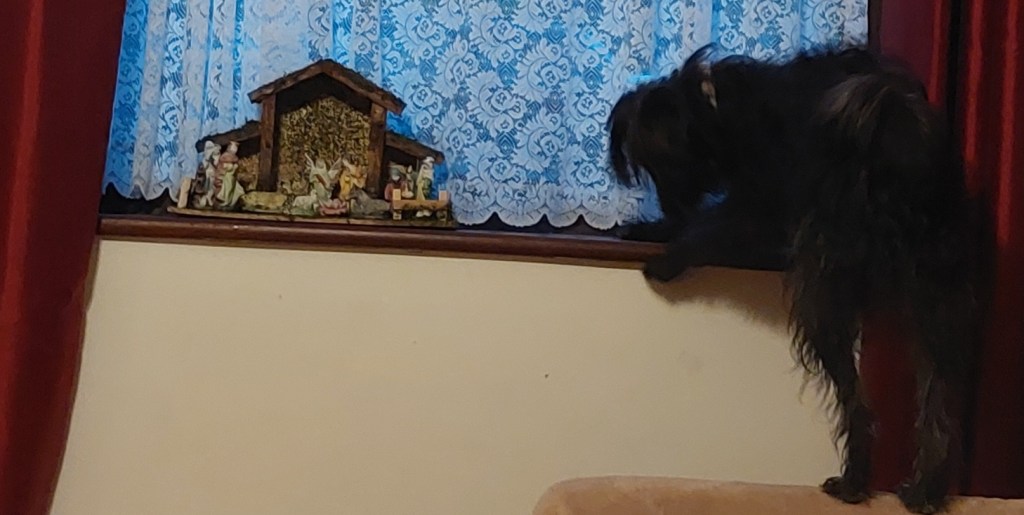
Poppet bowing to the Posada nativity

“It Wasn’t Me … It Was The Dinosaur”

Poppet loves her dinosaur. She has him with her when she naps. She carries him from room to room. She plays with him and, of course, she always wins. She also makes sure that it is always Dinosaur who is responsible for any wrong doing!

“Poppet was it you that put muddy pawprints everywhere?”
“Not me, that was Dinosaur. I saw him”
“Poppet was it you that ate Grumpy’s dinner?”
“Me? No definitely not! Mr Dinosaur ate it – he was sooooo hungry!”
“Poppet did you steal Daddy’s wallet?”
“I was just trying to find his credit card…wuff I mean no not me. That was most assuredly Dinosaur!”
“Poppet have you seen the important papers I was working on?”
“Mr Dinosaur wanted to play with them. I told him no, I did really.”

But the wonderful thing about Poppet is the way she is always so happy to see me – even if it’s only been a short while since she last saw me. The happy look in her eyes, the waggy tail, the leap into my arms to give me puppy kisses. It’s also the way she curls up on the sofa and puts her head on my knee when I’m ill, or sad, or feeling alone. She looks up at me with her beautiful eyes to say “I’m here”.

And, of course, she always gets forgiven. After all, I love her just as much as she loves me!

“Mr Dinosaur did it!”

Jesus’s Baptism (notes for 9th January 2021)

Two weeks ago we celebrated Jesus’s birth – the birth of a tiny baby. Last week we remembered the Wise Men finding and worshipping Jesus – a toddler. Today, we jump forward nearly three decades, doesn’t time fly, Jesus is thirty and being baptised.

In some ways, it is not strange to us that we celebrate Jesus’s baptism shortly after His birth. After all, it is not a rare occurrence for a baby to be baptised, making them a part of the family of God, washing away the consequences of the original and actual sin, granting them the hope and promise of salvation and professing the faith on their behalf whilst promising to bring them up in that faith.

Baptism is linked by Jesus to salvation. It is a symbol of the forgiveness of sins, the death of old life and the start of new life and acceptance into God’s family.

However, Jesus was not a baby. He was a grown man and the sinless Son of God.

So why did Jesus need to be baptised?

Indeed, John the Baptist asked the same thing saying “I need to be baptised by you, yet you come to me?”

Jesus replied “Let it be so now; it is proper for us to do this to fulfill all righteousness.”

Jesus was to be the one to separate believers from betrayers. Jesus was also to bring a purifying and transforming baptism of fire; which enables us to be empowered by the Holy Spirit.

Jesus was baptised to identify Himself with sinful man, who He came to save. He took our sin to save us. His baptism marks the end of His old life marking the acceptance of and the start of His ministry. He is annointed by the Holy Spirit whilst He is affirmed by God as His Son (a parallel with Pentecost when the Holy Spirit came down on the church).

This affirmation from God that Jesus is the Messiah also provides confirmation to John that he has completed his mission of preparing the way for the Messiah; whilst Jesus begins His earthly ministry with the blessing of God His Father and the empowerment of the Holy Spirit.

Father God, we ask that you baptise us all again with your Holy Spirit empowering us to do your work. Amen.

A beautiful lake.

Cake

Cake is really the simplest thing to bake.  Obviously I am talking about really basic cake (like what I bake) and not the really amazing designs you can buy from experts for special occasions.

It follows the basic rule of three (like The Holy Trinity):

  • 150g butter (3×50g)
  • 150g sugar (3×50g)
  • 150g self raising flour (3×50g)
  • 3 eggs (3×1)

Mix it up and bake in the oven till cooked – yum yum yum.

So with cake being so popular in today’s society, if Jesus came to us today, what if He said “I am the cake of life” instead of “I am the bread of life”?

Would it have the same effect? Would it have the same meaning? Would it be more popular?

Okay, so we know that unless someone really hates cake the likelihood is that it would definitely be more popular. The thought of being able to live on cake is certainly popular around here.

But Jesus wasn’t trying to win a popularity contest. He came to save us. And if we are honest, if we want to be healthy, we can’t actually just eat cake (sadly). We have to accept that we must eat healthy food to live. So cake goes back to being bread and for this we are thankful as the sacrifice of Jesus and God’s forgiveness saves us from spiritual death. Trust in God and He will provide for us and sustain us.