Father’s Day …

… originated in the United States in the early 20th century. In 1909, Sonora Smart Dodd, a woman from Spokane, Washington, proposed the idea of a day to honour fathers after hearing a Mother’s Day sermon. She wanted to recognize her father, who raised her and her siblings after her mother’s death.

As we enter into the month of June, Father’s Day is approaching and this gives us the opportunity to address why God is often referred to as Father.

Whilst referring to God as Father was less frequent prior to the birth of Jesus, God is referred to as Father in the Old Testament where He is called the Father of the nation of Israel. In the Gospels, when Jesus speaks about and prays to God He typically refers to Him as His “Abba, Father”. Teaching His disciples how to pray, Jesus said, “When you pray, you say, Our Father …” Jesus gave to us the right and privilege to come into the presence of the majesty of God and address Him as Father.

He transformed the meaning of the word for His time to call His people (Jews and Gentiles) to a true relationship with a caring, personal God, as scripture affirmed. It also puts an emphasis on God’s role as the source of all life, love and authority, similar to an ideal image of a father’s role in a family. It shows God’s interest in humanity, His care for His children and His ultimate power, providing, protecting and loving.

Galatians 4:4-4 “But when the set time had fully come, God sent his Son, born of a woman, born under the law, to redeem those under the law, that we might receive adoption to sonship. Because you are his sons, God sent the Spirit of his Son into our hearts, the Spirit who calls out, “Abba, Father.”

We don’t just call God Father because of Him being our creator but also because of the revelation given to us in Christ; which acknowledges a particular relationship with Him. God is also addressed as Father because He is His people’s redeemer and because we have been joined to Christ by adoption. Jesus died the death we deserve so that we might be joined to Him and adopted into God’s family.

“And by him we cry “Abba, Father.” The Spirit himself testifies with our spirit that we are God’s children. And now if we are children then we are heirs—heirs of God and co-heirs with Christ, if indeed we share in his sufferings in order that we may also share in his joy.”

Family of God

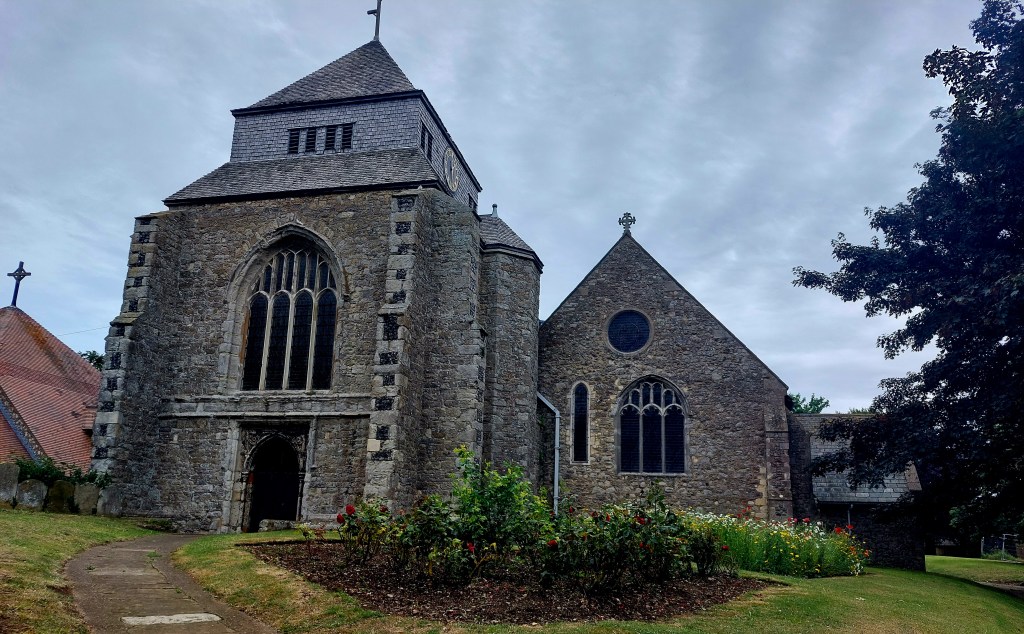
Minster Abbey Talk on John 17:1-11

“The time has come,” the Walrus said, “to talk of many things:…”

Lewis Carroll

And if we were having a conversation over some coffee and cake (hint hint) that is precisely what would happen. We would have a conversation; maybe about the weather, the coronation, a television drama, … all sorts.

Some of us find it easy to converse, some of us find it more difficult and communicate in other ways. Some of us are good at listening and for some of us it “goes in one ear and out the other”.

But, how do we pray?

There are many different ways we can pray, but ultimately, if we think about it, prayer is just the same as that conversation over coffee … isn’t it?

If not why not?

We have the opportunity to talk to God about anything and everything; and not just when we’re worried or in need or when things aren’t going as we’d like but also when we’re thankful, joyful and when things are going well.

We can do a lot of talking to God but we need to remember to listen as well. If we are honest none of us listen as much as we should.

Prayer is vitally important in our lives. An oft repeated quote “seven days without prayer makes one week (weak!)”.

Today’s Gospel reading is part of one of Jesus’s longest prayers.

In short it summarises Jesus’s relationship with the Father and the relationship He wanted His disciples to have with Himself and the Father.

Like the Holy Trinity (Father, Son and Holy Spirit) this prayer is in three sections.

  1. Jesus prays for Himself
  2. Jesus prays for His disciples
  3. Jesus prays for all believers past, present and future

Despite us having celebrated Jesus’s Ascension on Thursday, this prayer passage takes place before His arrest. But it is significant because it becomes Jesus’s evaluation of the purpose of His life, death, resurrection and ascension.

God’s glory and Jesus’s glory are one and the same. Through the death of Jesus God is glorified and all believers receive eternal life.

Eternal life is knowing the one true God; being in a living fellowship with God. And this life we receive when we accept Jesus into our hearts and lives. Jesus’s purpose, His mission, is salvation.

Jesus prays with great concern for His disciples. He was not concerned about Himself – He knew God’s plan, He knew He had to suffer and die to be victorious. Jesus’s victory was unquestionable. The disciples were just like us. They were not infallible. Jesus had predicted the disciples would desert Him. And so He prayed for them, that they would be kept safe and protected by the Father’s power and that they would fulfil their future ministry. The disciples were about to be tested and Jesus prayed that this would not separate them from Himself or from each other.

Again, like the Three-in-one, Jesus mentions three things about His disciples:

  1. They had accepted His teaching
  2. They had accepted the knowledge that Jesus is the Son of God
  3. They believed

Jesus prayed that the world would stop being opposed to God.

“All I have is Yours and all You have is Mine.” Jesus has equality with the Father.

He prays that, as He and God are one, the disciples and believers will remain as one.

In unity.

Not divided.

Division is the result of the failures of Christians.

God is awe-inspiring and loving. Jesus’s prayer is an outpouring of love and concern.

Jesus was shortly returning to the Father and to the glory He has before the world began. He had completed His mission. The Holy Spirit had been promised. With the help of the Holy Spirit it is now our turn.

Our mission, if we choose to accept it, is to bring glory to God through all we do in His name.

Are we ready?

Do we accept this mission?

Minster Abbey, Sheppey

A Journey of Truth and Faith

(Talk on Luke 24:13-35 23rd April 2023)

This passage from Luke teaches us a lot about truth and faith. It is, in both a literal and a spiritual sense, about journeys. Literally, it is about two disciples (followers of Jesus) walking from Jerusalem to Emmaus. Spiritually, it is about their and our journey from not knowing Jesus to truly knowing Jesus and sharing our experiences of Jesus. It is about rediscovering Christ’s presence in our lives, gaining a fresher understanding of God’s transforming grace, allowing our hearts to be ignited with the Holy Spirit as we too walk with Christ.

The Bible makes very clear and specific statements about Jesus. As the disciples walked along they were discussing the scriptures and the recent events that had happened. When Jesus appeared to them they were walking the wrong way – away from Jerusalem. They were preoccupied with their own difficulties, overwhelmed with sadness, grief and hopelessness. They were unable to identify God’s purpose in what had happened.

Humans like to know reasons for…well everything. We ask (both aloud and to ourselves) why? We analyse, we interpret, we assume, we conclude. And we use the answers as a Sat Nav! What we decide the answers are determine/direct what and where we do/go next.

The disciples did not fully understand the Scriptures or the meaning of what had happened to Jesus. They had knowledge but it was incomplete and not understood. It was not true knowledge of the right information.

Jesus appeared and started to walk with them. They did not see Jesus. They were kept from recognising him. The Risen Christ walking with them on their journey, but unrecognised, igniting the fire of God’s love in their hearts. Like the Footsteps poem when there is only one set of footprints (because Jesus is carrying us).

But, this enabled Jesus to impart true knowledge. He explains and interprets for them. This teaches us that the key to interpreting the Old Testament is Jesus.

Jesus explained everything from Moses to the prophets, how the Messiah would save God’s people through His death and resurrection, rescuing a sinful, unholy people by reconciling them with The Holy God.

Jesus is the Messiah whose life, death and resurrection grants us salvation. Jesus Himself told us “I am the way, the truth and the life, no man comes to the Father except through me”.

God cannot be near sin. The only way for us sinners to be reconciled to Him was for Jesus to become sin, be punished for our sin, to die and defeat death; so that through His resurrection we could, with faith and repentance, be forgiven and have a relationship with God.

But it is not sufficient to just know the facts. We must also believe in that knowledge, we must truly believe in Jesus and in what He taught. Like the disciples recognising Jesus (when He broke the bread) and rushing back to tell the others, we have to open our eyes in faith. If we believe in Him then we strive to be in His image and this is shown in how we live. We need to believe in God’s word and be motivated by faith. We know God fulfils His promises but we also need to believe this. We know He is always with us, all the time, especially those times when we only see one set of footprints. But, we also need to believe this.

There is a story that gets quoted a lot so apologies if you, like me, have heard it used before:

There was a young boy caught in a house fire and forced to flee to the roof. The father stood on the ground below with outstretched arms, calling to his son, “Jump! I’ll catch you”. He knew the boy had to jump to save his life. All the boy could see was flame, smoke and darkness. The boy was too afraid to leave the roof. His father kept yelling “Jump! I WILL catch you”. The boy protested “Daddy, I can’t see you” The father replied, “But I CAN see you and that’s all that matters”.

Reece Sherman’s Faith Lessons

Do we understand truly? Or do we rely on our assumptions? Do we truly believe and trust in God? I pray that we do.

God is always there for us and will catch us. He can see us even if we cannot see Him. Do we have enough faith to jump into those life saving arms? I pray that we do.

Thank you.

Poppet on a journey, running through grass

Witnessing and Doubting

(Talk given at Minster Abbey 16th April 2023)

So…witnessing and Doubting Thomas!

The other day I read that the public (according to the newspapers) claim the church do not promote Easter as much as Christmas. Easter and Christmas… two very important events for us – Christmas the celebration of the birth of Christ, the incarnation, God becoming man to save us…and Easter where Jesus is sacrificed in our place to defeat death, rise again, and enable us to be forgiven for our sins and reconciled with God.

So I thought about this and here’s a couple of comparisons:

The Church

At Christmas:

  • Advent – 4 Sundays
    • Hope, Prophecy, Patriarchs
    • Peace, Bethlehem, Prophets
    • Joy, Shepherds, John the Baptist
    • Love, Angels, Mary
  • Carol Service
  • Christingle Service
  • Crib Service
  • Midnight Mass
  • Christmas Morning Service
  • Candlemass

At Easter:

  • Ash Wednesday Ashing Service
  • Lent – 6 Sundays
    • Invocabit
    • Reminiscere
    • Oculi
    • Laetare
    • Judica
    • Palm Sunday
  • Maundy Thursday Service
  • Good Friday Pilgrimage and Gathering at the Cross
  • Stations of the Cross
  • Holy Saturday Vigil/Service of Light
  • Easter Sunday Service
  • Ascension
  • Pentecost
  • Corpus Christi

Versus

What I think is most appropriate to call commercialisation:

Where Christmas is promoted with:

  • Father Christmas
  • School Nativity Plays
  • Carols
  • Christmas number ones/Christmas songs
  • Grottos
  • TV Ads
  • Work Dos/Christmas parties
  • Decorations
  • Cards
  • Presents
  • Trees
  • High Street decorations and lights
  • Shop displays and more decorations
  • Christmas dinner menu options at pubs and restaurants for approx. 2 months
  • Pantomimes
  • Etc

And where Easter is promoted with:

  • Chocolate and chocolate eggs
  • The Easter Bunny
  • TV Ads but on a smaller scale
  • Small shop displays normally in seasonal aisles
  • Small amount of Easter decorations
  • Small amount of Easter cards
  • Easter dinner menu options for 1 day

In my opinion, having compared the aforementioned; the media, yet again, is showing a biased and incomplete picture. The evidence suggests that on the contrary the church does more at Easter but the sway of commercialisation makes the commercial version of Christmas more widely known.

This needs to be combated, but how? Simply, we need to follow the instruction and example of Peter in Acts and go out and witness, spreading the good news of the true meaning of both Christmas and Easter, sharing what, through love, Christ did for us and the joy of His resurrection with all it’s connotations of redemption.

Meanwhile, where does Thomas fit into all this?

Personally, I feel sorry for Thomas. I think he got a bit of a rough deal. Thomas the Doubter…in actuality he was a fervent believer yet what do we remember him for – doubting – the one who wouldn’t believe without seeing for himself and touching his beloved Master’s wounds.

Maybe, despite it being unfair, one of the reasons we remember Thomas specifically for this event is because it shows us that doubt is okay!

Doubt is something we all experience at some point and in reality, faith and doubt can and do co-exist side by side.

Thomas was not evicted from the group of disciples for his doubt. He was not condemned by Jesus for his doubt. He continued to be a valued part of the disciples as they stayed together, discussing all that had happened, sharing meals, continuing to accept each other.

Thomas had not been there when Jesus had appeared to the group of disciples initially. What was he doing? Where and why wasn’t he there are interesting questions.

BUT, it occurs to me that maybe, just maybe, he wasn’t there so that God could use him for the benefit of those too scared to admit their doubt both then and now.

Thomas only doubted for one week! He then met the risen Jesus and believed. In fact, he believed so fervently for the rest of his life that he was killed (or martyred) for his belief. Yet, still, he is referred to as “Doubting Thomas”.

One small brief moment of doubt, one incident, one mistake, one failing – and a label is applied – something that is still very much done today. And, whilst that person learns, believes, repents, changes, moves on, that label sticks.

Instead of calling Thomas “Believing Thomas” – a far more accurate name/label; because of that one brief moment of doubt he is known as “The Doubter”.

Through this and through Thomas, maybe God is teaching and reminding us that we should not label people. That we should allow people to change and accept that people do change. That we all make mistakes but when we repent God forgives us; likewise when others make mistakes we should allow them to repent and forgive them.

One more thing: asking questions.

There is a common phrase heard in classrooms and training rooms throughout the land:

“There are no stupid questions” and “if you ask a question most of the people in the room are probably thinking it and are just too scared to ask”.

Children in particular ask a lot of questions and, whilst these are often ‘when or what is for dinner?’, they often ask the really big questions:

  • What is God’s name?
  • What does God look like?
  • What does it mean to be reborn?
  • How is Jesus alive?

The questions children, and indeed some adults, ask are, in their own way, blessings. They make us think and help us gain deeper understanding and insight together.

The person that both expressed the doubts of everyone and asked the question everyone else was thinking was Thomas. For this we owe him a great deal for if the question had not been asked the answer would not have been given. Thomas the Brave who said to Jesus “Lord we do not know where you are going. How can we know the way?” To whom we owe thanks for Jesus’s answer “I am the [only] way [to God], the [real] truth and the [real] life, no one comes to the Father but through me”.

Thanks to Thomas we know it is okay to be honest about our doubts as well as our faith, we know that labels do not reflect who people truly are and we can realise how questions can lead us to deeper knowledge and growth. Thanks to Thomas, who believed because he had seen, we can see because we believe.

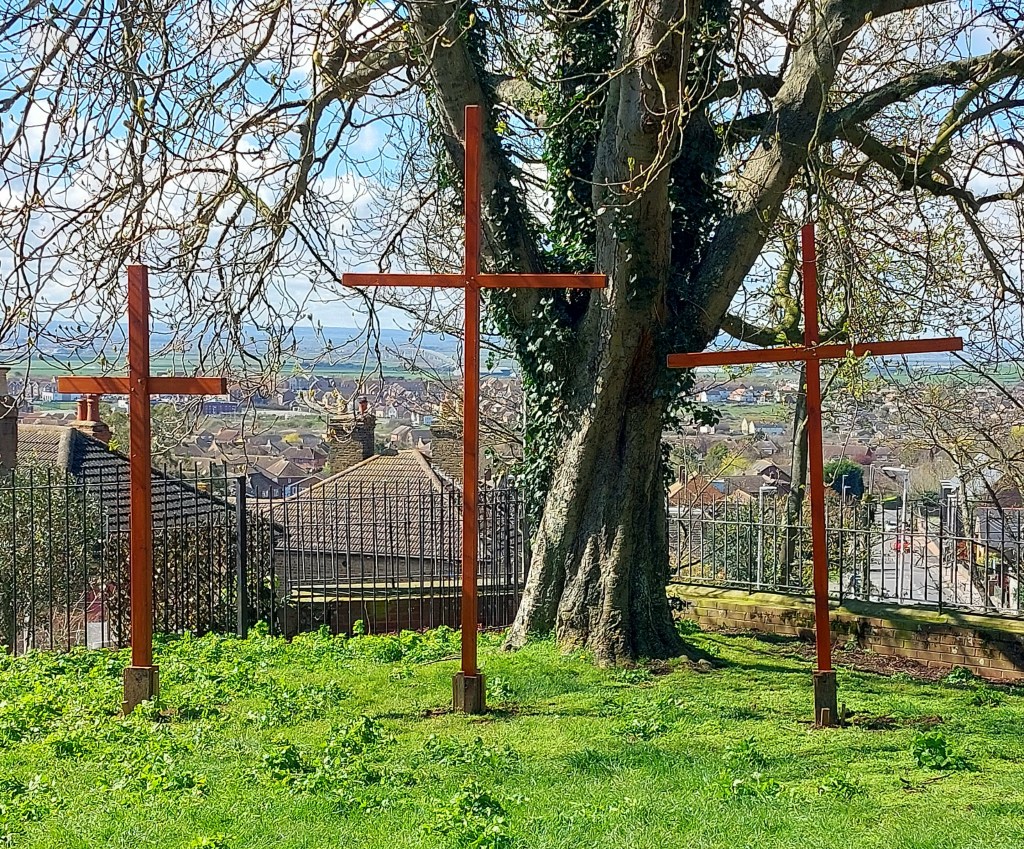
Three crosses

Be Born Again

(John 3:1-17)

Nicodemus was a pharisee well educated and well versed in the scriptures. He recognised and acknowledged that Jesus was from God and that God was with him. Yet he came to see Jesus at night, being at the beginning of his belief in Jesus, not wanting his fellow pharisees to know that he had sought out Jesus.

Later, once Nicodemus’s faith and believe had grown he defended Jesus in front of the council and annointed Jesus’s body after the crucifixion.

Jesus responded to Nicodemus’s greeting  by starting to teach him how the Kingdom of Heaven can be reached. As is a common factor in conversations today, we are given the impression that Nicodemus has taken Jesus’s answer literally. Nicodemus is an intelligent man and some question whether he was merely stalling for time. However, whether he took Jesus’s answer literally or whether he was questioning it to allow him time to think, it is beneficial to us because this questioning opened up a further response from Jesus and the conversation that followed.

What does lend credence to the idea that Nicodemus was stalling for thinking time is that the Jews were not unfamiliar with the idea of rebirth and considered those converted to Judaism to have been reborn – just as we take those who have turned to Christ to have been reborn in Christ. As usual, like with the parables, Jesus was using metaphors and terminology the Jews were very familiar with.

So, being born again does not, thankfully, mean that Mothers are giving birth to the same person twice. In fact the actual rebirth is not even done by us but by God. What we must do is believe, believe and be baptised in water and in the Holy Spirit. We must receive the gift of the Holy Spirit and, with Jesus as our root, let it be fruitful so that we live with love, joy, patience, kindness, goodness, faithfulness, gentleness and self control.

Aptly, this reading this year fell on Trinity Sunday when we celebrate that God is Three in One – the Father (Presence of God), the Son (Voice of God) and the Holy Spirit (Breath of God). As we who believe are born of man, water and the Spirit. Three in One and One in Three.

“Don’t You Think She Looks Tired?”

Those Doctor Who aficionados in the room will recognise that quote. There is a point! The Doctor brings down the Prime Minister with just those words because she made one mistake. But, and here’s the thing, when the Earth was moved and was out of phase and they needed The Doctor to save them, it was that same person who gathered his old companions and helpers and found a way to show how to find the Earth and who then sacrificed herself.

The Doctor had judged her on one mistake and didn’t see past that to what she was capable of and who she really was.

The Jews in the Gospel reading (John 6:41–58) knew Jesus as Mary and Joseph’s son, as a man in their small community. They rejected Him. They did not believe. Pride prevented them from seeing Him as anything other than a poor lowly man and stopped them seeing who He really was – the Son of God – the one from God.

We likewise make assumptions about others. We put them in little boxes instead of seeing them with open hearts and minds, instead of seeing who they really are and what they will achieve.

So do we see Jesus as the Bread of Life? As the one who will sustain us?

Jesus said “I AM the Bread of Life”.

“I AM”.

These two words tell us precisely who Jesus is. We don’t need anything else. We are left in no doubt about who Jesus is.

“I AM” – the covenant name for God (Yahweh) in the Old Testament, a name for God that the Jews were very familiar with. The Jews, well versed in the Scriptures, knew precisely who Jesus was claiming to be.

But Jesus is also taking His miracle of the day before, providing actual bread, to the next level – the spiritual level. “I am the living bread that came down from heaven…The bread I will give to you is my flesh which I give so the world might live”.

Jesus is the incarnation of God who came down from heaven. He, like bread, is essential to life. Our Spiritual life, our Spiritual nourishment, renewed in our sacrament of Holy Communion.

Dying on the cross to save and forgive us and rising to new life. Just as, when we believe, our old life dies and we are raised to new life with Christ.

A repeated thread throughout the Scriptures is man’s desire for righteousness with God, a desire for eternity and to earn our way to heaven.

Jesus says those who believe in Him will never hunger or thirst. He is referring to our spiritual hunger.

By believing in Him and having faith in Him and His sacrifice for us on the cross, where He takes our sins and atones for them, He does what no one else can and feeds our spiritual hunger allowing us to be right with God.

The very moment a sinner believes in Jesus he is justified, welcomed, loved and accepted with no condemnation. He has peace with God instantly.

However, knowledge is nothing if you don’t believe! Knowing that Jesus died on the cross for us is not enough to save us. We have nothing if we do not believe in Him. The point now to be considered is whether we do actually believe.

“He that believes has everlasting life but he that does not believe will not see life” (John 3:36).

So let us believe and allow Jesus to be in our hearts, sustaining us as our Bread of Life.

Slices of bread.

Trinity

Three in One and One in Three,
Just as you did say you’d be.
Father, Son and Holy Ghost,
And yet it doth confuse us most.

But it shouldn’t! As believers we know and accept that God is One and Three at the same time. God the Father, God the Son and God the Holy Spirit. This is an element of faith, an element of belief. One of the wonderful mysteries of God.

As humans, however, we do like to both complicate and explain everything. We have a need to break down and solve such mysteries- indeed all mysteries.

I believe God has a huge sense of humour and enjoys our uncomfortableness of Trinity Sunday immensely as He watches and listens to us trying to explain Him in a language that can never give the wonder and miraculous nature of God its full credit. God loves our stories.

It happens to be one of my favourite Sundays. I love coming up with different ways of explaining The Trinity and I am under no allusion that I also fall short in this as my feeble metaphors and analogies are nothing when compared to God Himself. I love listening to others giving sermons on this subject and increasing in faith and understanding. Indeed, one of my favourite and most remembered sermons as a child listening to the church service was on Trinity Sunday. It involves a rope.

Trinity Sunday is celebrated by the Church of England after Pentecost. I have heard different theories as to why this is but the one I like best is, simply put, because we had to wait until after the Spirit was sent to us to stay to fully experience the full aspect of God the Three in One. And, of course, it is Pentecost at which this occurred, where the promises and prophecies of Jesus (and the Old Testament) that the Holy Spirit would be sent after His Ascension became fulfilled. And, therefore, it is a logical progression (to me) that we celebrate Ascension, Pentecost and then Trinity Sunday.

So why a rope?

Take one thread. It is strong, it will hold weight, but pull it with a little pressure and it will snap. It is only one part of a whole and without the other parts it cannot fulfill it’s whole potential. I have faith in this thread – I sew buttons on with it. But I would not use it to save my life if I were falling off a mountain!

Take two threads and bind them together. Now they are even stronger and will withstand more weight and pressure. Yet pull them hard enough and they will still snap. Still they are incomplete and whilst they are indeed strong enough to be functional and useful, I still would not use it if I was falling off that mountain!

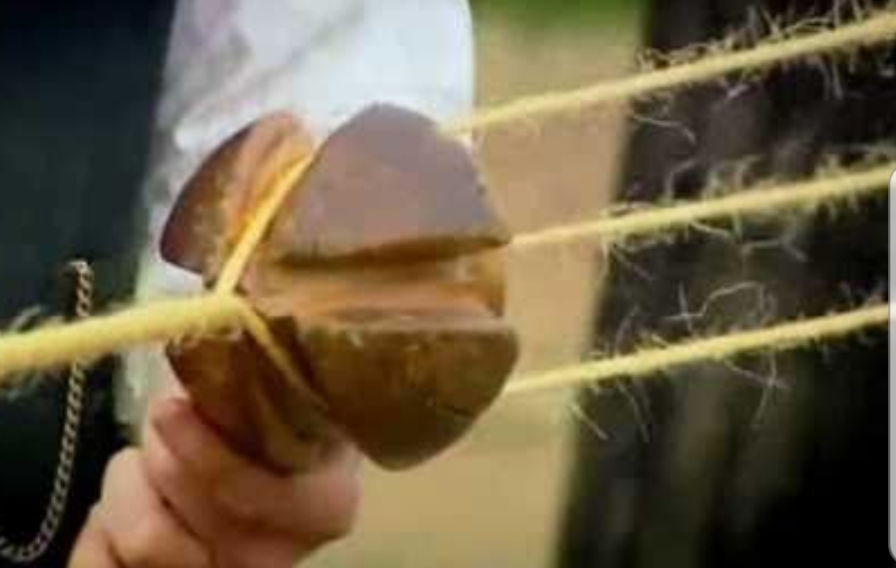
But, take three and bind them together. Now you have a rope which I can trust with my life (see picture)! The strongest ropes are not made of one strand and they are one rope.

Three in One and One in Three.
You my God are Destiny.
Word and Voice and Breath of God
Just as in the prophecy.

Father, Son and Spirit: Infinite, eternal, unchangeable, full of wisdom, power, holiness, goodness, strength, truth and love!

rope
Rope being made