Listening to the readings again on Easter Sunday with the women going to the tomb to prepare Jesus’s body reminds me of something I read recently about Mary – Jesus’s mother.
It is interesting, is it not, that Jesus’s mother – arguably His greatest disciple, a woman of tremendous faith, who stayed by Him to the bitter end, is not listed amongst the women going to attend to Jesus’s body.
And this poses the theory that the first person Jesus appeared to may well have been His mother and that this is why she was not among those going to the tomb at dawn. Such an appearance would be part of completing her participation in the essential parts of the paschal mystery.
Mary suffered above all others in the suffering and death of her son. Christ kept the commandments. He honoured His heavenly Father, His earthly father and His mother, so it makes sense that he’d visit her first.
If a son lived far away and his mother was told he’d died but he was actually alive and healthy and he returned to the area, it would highlight that he was not a good son if he visited his friends first and his mother last.
Jesus was the perfect son. So, why would He not visit His mother first. There’s also her faith, which, despite the apostles losing theirs at Jesus’s passion, Mary had in abundance. Scripture tells us that the Lord shows Himself to those who have faith in Him. And, of course, she loved her son so much and scripture tells us that those who love Him will be visited by Him.
How joyful she must have felt at seeing her son alive once more.
There is a special kind of joy at Easter. It’s not just the spring flowers springing up into life or the longer days. What it is is a deep, radiant joy born from our Lord’s victory over sin and death so that we might have eternal life with Him.
Jesus leaves the darkness and rises to new life. Through God’s grace, this gives us the gift that, no matter what our past was, we have permission to leave it behind and embrace the hope and joy of new lives in Christ. His sacrifice and act of intermediary reconciliation grants us forgiveness of our past sins, our present sins and our future sins.
Palm Sunday is the day we appoint to mark Jesus’s parade into Jerusalem.
Up to this point Jesus has told His disciples to keep the knowledge of His Messiahship to themselves because His hour had not yet come. But now, the time had arrived. Jesus was making a declaration and He took dramatic action to make the announcement. Jesus rode into Jerusalem in a way which would be an unmistakable claim to be the Messiah – God’s approved king.
This event had been carefully planned. “The Lord needs it” was a password chosen and set up a long time prior to this event taking place.
It was certainly an act of defiance and courage. There was already a price on Jesus’s head. And yet, He enters in a way which throws the lime-light upon Him – giving Him centre stage. Every eye now beheld Him.
Jesus was fulfilling the prophecy in Zechariah 9. Even with His deliberate claim to be king, Jesus underlined the kind of kingship He claimed – king of love and peace.
Jesus used the language of the culture of the time. His procession used symbols which were part of the common understanding; touching a hope and a need in the people’s hearts. Consequently. the people eagerly responded.
Jesus rode a colt. A colt is an unridden donkey – which symbolised purity and peace. This confirmed His fulfilment of the Messiah role was by bringing reconciliation and peace.
In those days in that country, donkeys were considered noble. Only in war did kings ride a horse. In times of peace they rode donkeys.
By riding a donkey, Jesus came as a king of peace and love – not the conquering military hero the Jews had expected and awaited.
The waving of palm branches acknowledged Jesus’s authority. By throwing down their cloaks, the people were ushering a prince into their midst; showing honour and homage. And the traditional welcome to a new king – “Blessed is He who comes in the name of the Lord”.
In the loudest way possible Jesus was saying, “Here I am, your king, your prince of peace.” The reply – “Hosanna” meaning “save us” – accepting that Jesus is the saviour.
Some of the pharisees – not all but some – heard the crowds and did not like it. They felt contempt at all the rabble as well as being afraid of Rome – who did not like disturbances from others.
In response to the pharisees telling the crowd to be quiet, Jesus answers that if the crowd were silent the stones would shout out.
When it is time, it is time. God’s purpose will be fulfilled. The king has come. The kingdom is coming.
The triumphal entry did not happen in a vacuum. It was not an accident. Everyone gathered together saw the meaning before them plain and simple. The king was entering the city in righteous victory and the crow were in desperate need of salvation and rescue.
We often read the whole passion – the whole suffering – on Palm Sunday because out of context from each other the rest doesn’t make full sense.
Jesus, the true king, the one coming in the name of the Lord, entering in triumph, helps us understand the whole passion more fully. It was never about human thrones and powers – it was always about triumph over evil and death.
The one who resurrected Lazarus comes to Jerusalem, in faithful obedience to the covenant, to allow humanity to expend its evil upon Him and for Him to then rise up from the dead. Humanity expends its evil upon the Son of God. The Powers and Principalities of the world snuff out the light. Satan claims he has victory over the God with whom he thought equality could be grasped.
But … that is not the end of the story …
… Jesus comes to us the same way He came to Jerusalem – amidst the praises of the people. enthroned by the cries begging for salvation and the royal welcome.
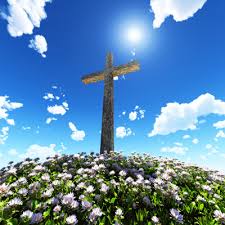
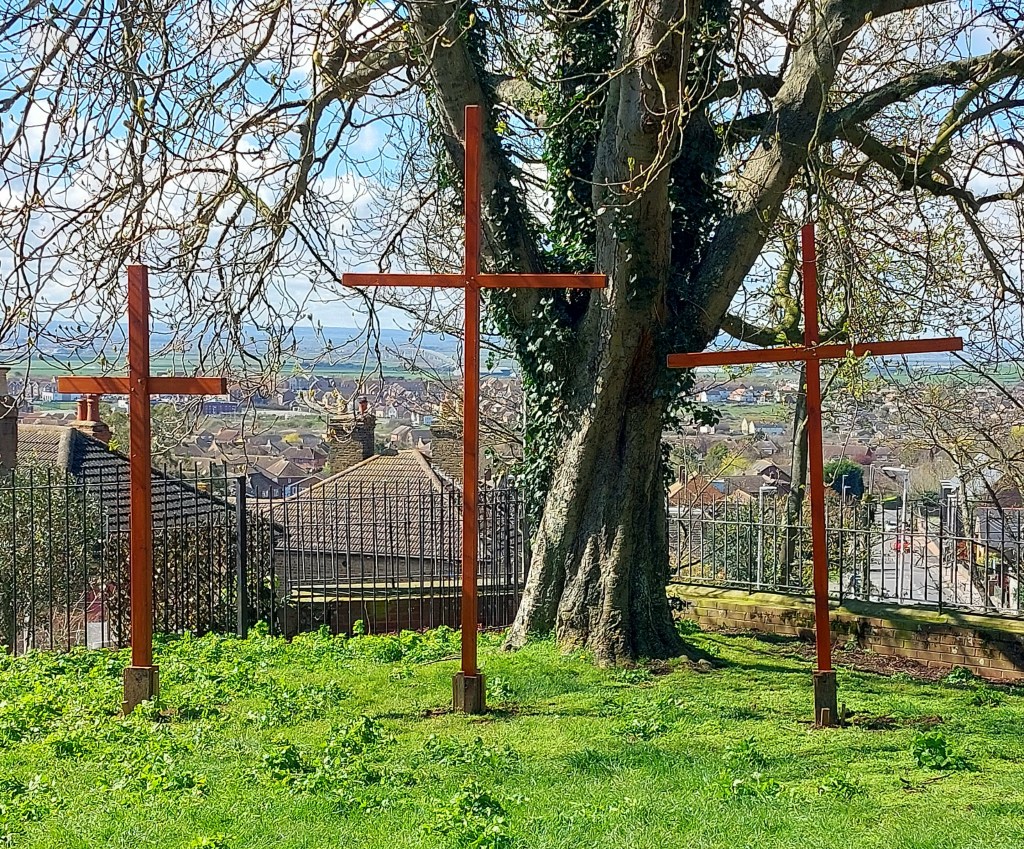
He guides us through His passion-tide, to bring us to share in His meal, to kneel at His cross, to wait by His tomb, to await His resurrection and victory over the darkness, the grave and His defeat of Satan, as we shout “Alleluia” on Easter Sunday.
The six stages of Holy Week:
Jesus as king
Jesus’s obedience to God’s will
Jesus as suffering servant
Betrayal and loyalty
Jesus’s passion/suffering
Salvation through Jesus
What a difference a day makes.
What a difference a week makes.
Palm Sunday, crowds are cheering Jesus and celebrating. Yet, just a few short days later, the same crowds jeer and call for the brutal murder of Jesus upon the cross.
Jesus knew what was coming but He still taught and proclaimed the Kingdom of God to His final breath.
Jesus made one last appeal to be accepted as their king. Before the hatred of men engulfed Him.
Once again, He confronted them with love’s invitation.
The other day I read that the public (according to the newspapers) claim the church do not promote Easter as much as Christmas. Easter and Christmas… two very important events for us – Christmas the celebration of the birth of Christ, the incarnation, God becoming man to save us…and Easter where Jesus is sacrificed in our place to defeat death, rise again, and enable us to be forgiven for our sins and reconciled with God.
So I thought about this and here’s a couple of comparisons:
The Church
At Christmas:
Advent – 4 Sundays
Hope, Prophecy, Patriarchs
Peace, Bethlehem, Prophets
Joy, Shepherds, John the Baptist
Love, Angels, Mary
Carol Service
Christingle Service
Crib Service
Midnight Mass
Christmas Morning Service
Candlemass
At Easter:
Ash Wednesday Ashing Service
Lent – 6 Sundays
Invocabit
Reminiscere
Oculi
Laetare
Judica
Palm Sunday
Maundy Thursday Service
Good Friday Pilgrimage and Gathering at the Cross
Stations of the Cross
Holy Saturday Vigil/Service of Light
Easter Sunday Service
Ascension
Pentecost
Corpus Christi
Versus
What I think is most appropriate to call commercialisation:
Where Christmas is promoted with:
Father Christmas
School Nativity Plays
Carols
Christmas number ones/Christmas songs
Grottos
TV Ads
Work Dos/Christmas parties
Decorations
Cards
Presents
Trees
High Street decorations and lights
Shop displays and more decorations
Christmas dinner menu options at pubs and restaurants for approx. 2 months
Pantomimes
Etc
And where Easter is promoted with:
Chocolate and chocolate eggs
The Easter Bunny
TV Ads but on a smaller scale
Small shop displays normally in seasonal aisles
Small amount of Easter decorations
Small amount of Easter cards
Easter dinner menu options for 1 day
In my opinion, having compared the aforementioned; the media, yet again, is showing a biased and incomplete picture. The evidence suggests that on the contrary the church does more at Easter but the sway of commercialisation makes the commercial version of Christmas more widely known.
This needs to be combated, but how? Simply, we need to follow the instruction and example of Peter in Acts and go out and witness, spreading the good news of the true meaning of both Christmas and Easter, sharing what, through love, Christ did for us and the joy of His resurrection with all it’s connotations of redemption.
Meanwhile, where does Thomas fit into all this?
Personally, I feel sorry for Thomas. I think he got a bit of a rough deal. Thomas the Doubter…in actuality he was a fervent believer yet what do we remember him for – doubting – the one who wouldn’t believe without seeing for himself and touching his beloved Master’s wounds.
Maybe, despite it being unfair, one of the reasons we remember Thomas specifically for this event is because it shows us that doubt is okay!
Doubt is something we all experience at some point and in reality, faith and doubt can and do co-exist side by side.
Thomas was not evicted from the group of disciples for his doubt. He was not condemned by Jesus for his doubt. He continued to be a valued part of the disciples as they stayed together, discussing all that had happened, sharing meals, continuing to accept each other.
Thomas had not been there when Jesus had appeared to the group of disciples initially. What was he doing? Where and why wasn’t he there are interesting questions.
BUT, it occurs to me that maybe, just maybe, he wasn’t there so that God could use him for the benefit of those too scared to admit their doubt both then and now.
Thomas only doubted for one week! He then met the risen Jesus and believed. In fact, he believed so fervently for the rest of his life that he was killed (or martyred) for his belief. Yet, still, he is referred to as “Doubting Thomas”.
One small brief moment of doubt, one incident, one mistake, one failing – and a label is applied – something that is still very much done today. And, whilst that person learns, believes, repents, changes, moves on, that label sticks.
Instead of calling Thomas “Believing Thomas” – a far more accurate name/label; because of that one brief moment of doubt he is known as “The Doubter”.
Through this and through Thomas, maybe God is teaching and reminding us that we should not label people. That we should allow people to change and accept that people do change. That we all make mistakes but when we repent God forgives us; likewise when others make mistakes we should allow them to repent and forgive them.
One more thing: asking questions.
There is a common phrase heard in classrooms and training rooms throughout the land:
“There are no stupid questions” and “if you ask a question most of the people in the room are probably thinking it and are just too scared to ask”.
Children in particular ask a lot of questions and, whilst these are often ‘when or what is for dinner?’, they often ask the really big questions:
What is God’s name?
What does God look like?
What does it mean to be reborn?
How is Jesus alive?
The questions children, and indeed some adults, ask are, in their own way, blessings. They make us think and help us gain deeper understanding and insight together.
The person that both expressed the doubts of everyone and asked the question everyone else was thinking was Thomas. For this we owe him a great deal for if the question had not been asked the answer would not have been given. Thomas the Brave who said to Jesus “Lord we do not know where you are going. How can we know the way?” To whom we owe thanks for Jesus’s answer “I am the [only] way [to God], the [real] truth and the [real] life, no one comes to the Father but through me”.
Thanks to Thomas we know it is okay to be honest about our doubts as well as our faith, we know that labels do not reflect who people truly are and we can realise how questions can lead us to deeper knowledge and growth. Thanks to Thomas, who believed because he had seen, we can see because we believe.
Who likes reading spoiler alerts to find out what will happen ahead of the next episode?
Who avoids them like the proverbial plague? Ah okay, you might want to put your hands over your ears then because in some ways this passage from John is a little bit like a trailer or spoiler for two weeks time!
Today we hear about and celebrate the resurrection of Lazarus. In two weeks we hear about and celebrate the resurrection of Jesus.
There are lots of parallels in this story pointing towards what was going to happen. John even mentions at the beginning of this passage an event (Mary anointing Jesus’s feet) which does not occur until after the resurrection of Lazarus.
Jesus was very clear right from the beginning that EVERYTHING He does is for the glory of God. His wisdom and knowledge far exceeds ours.
It was still difficult for Martha and Mary that Jesus did not immediately drop everything and come to them upon hearing that Lazarus was severely ill.
Today’s society tend to want everything immediately. Patience and waiting are hard. Whilst I know that waiting times for ambulances are much longer than ideal at the moment; how many of us have to wait over two days before one leaves to attend to us?
But Jesus knew what He was doing and so He waited. Once the time was right He told the disciples He was going back to Judea. The religious leaders there already wanted Jesus dead and this worried His disciples. Ironically, it is Thomas (later to be known as the doubter) who persuaded the disciples to accompany Jesus even if it meant death.
Jesus is the Light of the World. As He says, if we walk during the day (in the light) we will not stumble because we see (have) the light of the world (Jesus).
Those who walk at night stumble because the Light (Jesus) is not in them.
By the time Jesus arrived, Lazarus had been in the tomb for four days.
Decomposing!
Stinky!
Yuk!
Martha (the sister who in another passage we are told did all the chores whilst Mary sat listening to Jesus) heard Jesus was on His way and came to meet Him.
Martha says “Lord, if you had been here…” Martha knows and believes that Jesus has the power to heal. Is she declaring her faith? Or is she displaying anger that Jesus was not there in time to stop Lazarus dying? Jesus tests her and she proclaims her faith and her belief.
Jesus is the resurrection and the life and He was about to prove it whilst showing, again, through this miracle that Jesus is the Giver of Life and the Saviour. He was also showing His followers a preview of how He would be defeating death.
It is important that we understand the relevance of Lazarus having been in the tomb for four days. Jesus had raised people to life before after all, so we need to know what makes the resurrection of Lazarus so different.
Well, previously when Jesus had raised people from the dead the timescale between their death and resurrection was a great deal shorter.
Jesus needed this miracle to be determinate.
To help us understand let me explain that at that time people believed that a person’s spirit left their body on the third day after their death. On the fourth day there is no doubt. The person is really dead. Not sleeping. Dead Dead!
This was important as it meant there could be no dispute over the fact that Lazarus was actually dead before Jesus resurrected him.
Martha went to Mary and told her “The Teacher is here”. Jesus is the Ultimate Teacher. Mary went to Jesus and used the same words as her sister, “Lord, if you had been here …” Mary and the Jews with her wept. Jesus wept. But, Jesus was not mourning Lazarus. Jesus knew all along that He would be raising Lazarus from the dead. Jesus wept for those who did not understand. He wept for those who had lost hope. He wept at the sight of the very suffering He came to save us from. Through Jesus believers are to grieve with hope.
Jesus went to the tomb, He called for the stone to be moved away. The stench of death was all around. Jesus prayed. He did everything with prayer. He knows God always hears Him and thanks God for this. But He also needed the crowd to see that God had sent Him and that He was acting with God’s authority.
Jesus called out in a loud voice “Lazarus, come out!” Jesus has compassion for each one of us and calls us by name.
Lazarus came out still bound in the burial cloths BUT no longer a rotting corpse. Instead he was fully and completely healed. Jesus told the crowd to unbind Lazarus and they helped free him.
Lazarus, a new creation, freed from the tomb and welcomed back to life.
Jesus died to defeat sin and death, the Ultimate Sacrifice and our Saviour is raised from the grave so we can be forgiven and reconciled with God.
Not only that but Jesus came to have a relationship with EVERYONE, not just the Jews.
So how does that affect us. Basically, we cannot experience the resurrection unless we experience death. By this I mean that we cannot accept new life in Christ, if we do not allow our old, sinful lives to die.
We need to let go of whatever is holding us back, whatever is stopping us from being a new creation in Christ.
Let us hear Jesus calling us by name, let us say goodbye to what is holding us back, let us leave the tomb and walk in the light of Jesus.
And more than that, as we are told in Romans; by believing and having faith in Jesus, what He has done, is doing and will do, we are able to take part in bringing glory to God in all we do.
Let us give Him the glory, great things He hath done.
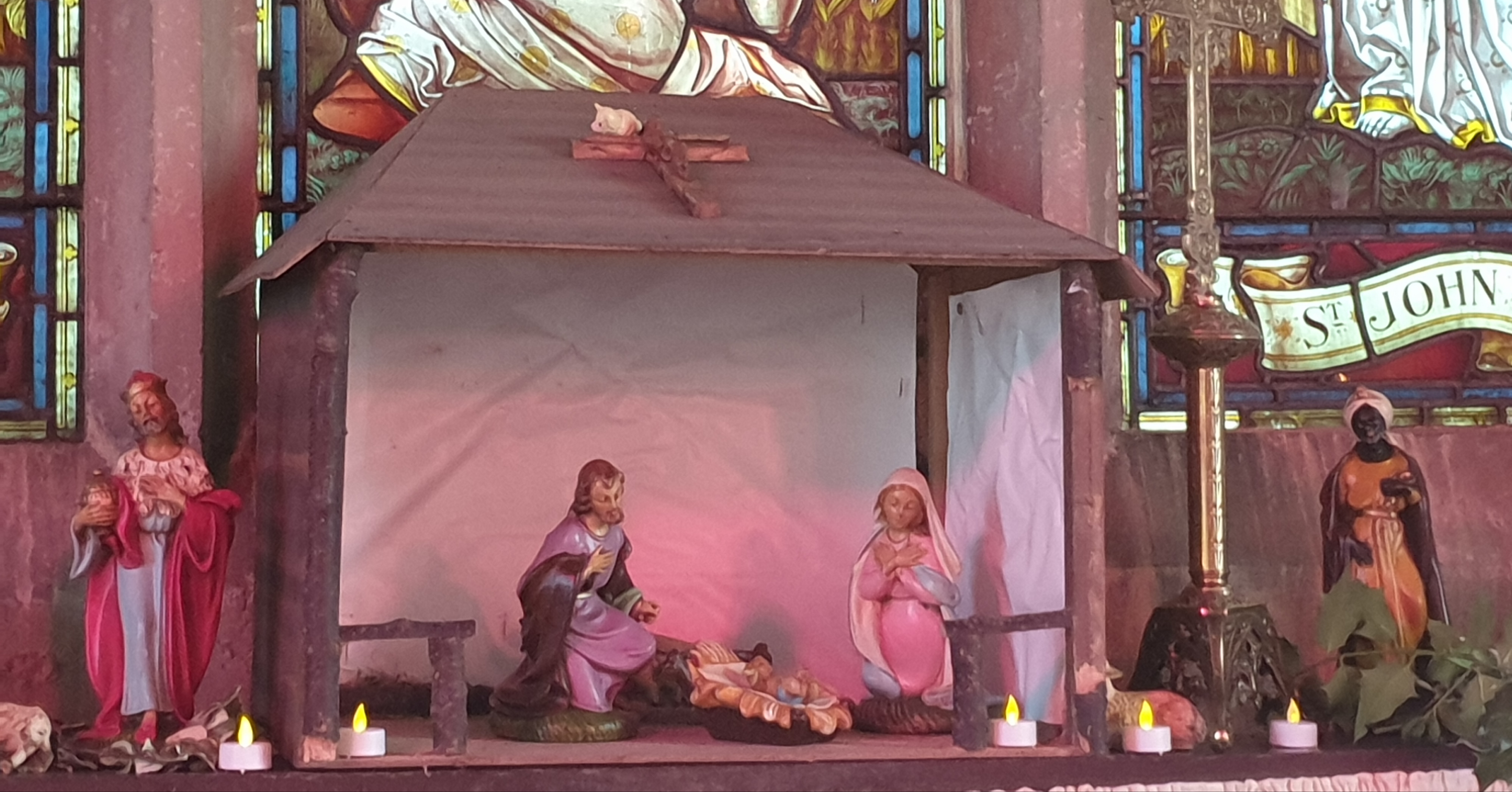
Why do I like the idea of always having a lamb (or sheep) on top of the (Nativity) stable (especially when there is also a cross depicted on it)?
Well, there is, of course, the simple icebreaker reason. Children, and indeed adults, walk into the church, see the Nativity Scene and ask “Why is there a sheep on the roof?” Bingo! There is your cue to talk to them, tell them what the scene represents, why we actually celebrate Christmas, that Jesus is ‘The Lamb of God’ or even just have a chat with them. Evangelicalism at it’s best in fact because it has been started by someone actually asking a question, which can led to a much wider discussion and spreading the word.
As just mentioned, then there is the description of Jesus being the Lamb of God. A title given to Jesus in John’s Gospel and referenced in the Book of Revelation; symbolizing Jesus as the greatest sacrifice. His blood shed to take away the sins of the world. How apt then, especially if the stable used is one with a cross depicted, that a lamb be placed on the roof symbolizing Jesus coming down from heaven, being born human at that first Christmas to His sacrifice on the cross at Easter to save us, rising from the grave and ascending to heaven.


 Just because