
What Goes In Must Come Out

In our reading from Matthew Chapter 15 (verses 10-28), the Scribes and Pharisees ask Jesus why the disciples are not following the tradition of the elders “for they do not wash their hands when they eat”. This is not saying the disciples were eating with unwashed hands – although they may have been. They are not telling Jesus “Yuk! Look at that one – he still has fish guts on his fingers and he’s eating. Can’t you make him wash his hands?” Which is reminiscent of meal times with the children: “Did you wash your hands?” “Yes.” “I’m not convinced – go wash them again!”

The Elders, who were past religious leaders not current living rulers of the people, had a tradition of ceremonial washings. These were continued by tradition and were not a commandment from God. The religious leaders asking the question here were offended that the disciples did not observe these rigid and extensive traditions. Traditions which these Scribes and Pharisees took very seriously – a lot more seriously than they took God’s commandments. Hence, Jesus’s reply “Why do you transgress the commandment of God because of your tradition?”

Jesus did what He often did. He answered a question with a question. He turns the accusations back to the accusers. “Because of your tradition” repeated Jesus. Not only was Jesus pointing out that the accusation was based purely on tradition and not on God’s actual commandments but He was pointing out that the Scribes and Pharisees are far too wrapped up in these trivialities. They were not paying attention to God’s Law and Scriptures but were condemning people based on tradition; declaring them unclean and denying them access to God based on a tradition.

Jesus went on to give examples of how their traditions were in conflict with God’s commandments and dishonoured God. Honour your father and mother, a clear command which even comes with a penalty for disobedience. When we are adults no longer living in our parent’s house or under their authority we do not have to obey them but we do have to honour them. Part of honouring them was to look after and aid them in times of necessity. This would be done by sharing resources with their parents to help them. Some Jewish people would declare their possessions or savings as a gift to God, especially dedicated to Him, and as such their resources were unavailable to help their parents despite those having made the vow still having access to the resources – money, property, possessions – for themselves.

Jesus doesn’t hold back, He goes straight into pointing out the hypocrisy of these traditions, calling the Scribes and Pharisees hypocrites. They honour Me with their lips but their heart is far from Me. We call this lip service. When we say the words but our hearts are not in it. It is a truth not limited to the Scribes and Pharisees being confronted by Jesus but is true of people of today too. Appearing to draw near to God when our heart is far away. It is easy to want and be impressed by the image of being near to God without actually really being there. God is interested in the internal and the real. He knows what is actually written on our hearts and minds. We tend to be much more interested in the merely external image. It is vital to take care to ensure that our relationship with God is not superficial.

All cultures and societies have various traditions, often which have been handed down. Like recipes: my gingerbread recipe came from my mother who got it from my grandmother who got it from my great grandmother and so on. And many families will have some sort of practice and tradition that has been taken on by each new generation.

So I want to pause here to point out that Jesus was not labelling all traditions as bad or all traditions as good. What He was doing was putting them in their place. Traditions are not the same as God’s Word, God’s commandments and how God wants us to live. Traditions have a lower priority than God.

Having told off these Scribes and Pharisees, Jesus now teaches the crowds about these ceremonial cleanliness traditions in regard to food in advance of the New Covenant where the old food laws would be void and all food allowed, as declared in Acts (chapter 10 verse 15). Jesus warns us that it is not what we eat that defiles us but what we say and that what we say reflects on the state of our hearts.

Now the disciples were only human and, similar to what might happen today, they mention to Jesus that they think He might have offended the Pharisees slightly. Well, yes, that was after all the intention. Jesus needed to get the point across that they valued man-made tradition too highly. The commandments of men will not last because they are not rooted in God or truth.

Peter, it’s always Peter, asked Jesus to explain because the disciples had not understood. ‘Do you still not understand?’ Jesus said.

I can empathise. There are times when I am explaining something which I think is quite simple to the children, or the husband, and they just look at me and … especially if it’s something which the rest of us would say was just common sense … they say what or but. They just don’t get it and it has to be explained again and sometimes again and again and then in words of half syllable. Very frustrating at times for those of us who do understand and can see how simple the concept actually is. I look at them and think ‘seriously how is it that you don’t understand, are you not listening, I’m not speaking a different language.’

Now, I’m not saying that all Jesus’s teachings are easy and should be immediately understood. I’m just saying that I empathise with His response to the disciples of “Are you also still without understanding?” Here were the disciples being accused of being spiritual unclean because they had not followed a ceremonial tradition and Jesus pointing out that following the tradition did not make a person spiritually clean or unclean as it was a tradition of man and not a commandment of God, and the disciples are saying to Him: “Hey Jesus, what do you mean?”

Jesus explains. It is not what food we eat or how we eat it that makes us spiritually clean or unclean but what is in our heart. The heart is where our true characters lie. It is not merely our emotions but the true self – the true person as they actually are instead of how they outwardly appear.

“Is this a dagger I see before me?” Possibly, but the dagger is merely the tool not the instigator of the murder; which is conceived in the heart and soul of the murderer.

Instead of worrying about what to eat and drink, what to wear and what hair style, as God’s people, we should be more concerned about what we do, and think and say.

There is a well-known saying “What goes in must come out”. This is what Jesus explains to the disciples. From food no moral defilement comes to the soul. The food is eaten, the body absorbs the nutrients it needs and the rest is ejected through the excrement process.

It is not what we eat or whether we have water poured over each hand alternately, three times each, from a two handled cup, reciting blessings as we dry our hands which determines righteousness but what is in our hearts.

Our reading from Matthew then moves on to the Canaanite woman who’s daughter was possessed by a demon and I would like to share a short reflection from August 2023 by Pope Francis.

Now let us look at the woman’s faith, which the Lord praises, saying that it is “great” (v. 28). According to the disciples, the only thing that seemed “great” was her insistence; but Jesus sees her faith. If we think about it, that foreign woman had probably little or no awareness of the laws and religious precepts of Israel. What does her faith consist of then? She does not have a wealth of concepts but of deeds — the Canaanite woman draws near, prostrates herself, insists, takes part in a close dialogue with Jesus, overcomes every obstacle just to speak with him. This is the concreteness of faith, which is not a religious label but is a personal relationship with the Lord. How many times we fall into the temptation to confuse faith with a label! This woman’s faith is not fraught with theological gallantry, but with insistence — she knocks at the door, knocks, knocks. Her faith is not made up of words, but of prayer. And God does not resist when he is prayed to. This is why he said, “Ask, and it will be given to you; seek, and you will find; knock, and it will be opened to you”. (Pope Francis, Angelus, 20 August 2023)

I leave you to ponder Ralph Waldo Emerson’s words “What lies behind us and what lies before us are tiny matters compared to what lies within us.”

Ceremonial Hand Washing (Photo by sanka sumedha on Pexels.com)

Three Promises

John 14:15-21

Our Gospel reading today is a passage of three promises. The promise of Jesus that He will not leave the disciples (or us) as orphans. The promise of the Holy Spirit that the Father will send His Spirit to dwell in us. And the promise of the Father that whoever obeys Jesus’s commands and loves Him will be loved by the Father and both God the Father and God the Son will make their home with us.

God the Father, Son and Holy Spirit want to be with us on earth because they want us to be with them in heaven.

When we obey God’s word and fulfil our mission, God comes to us and great things happen. Barriers are broken, enemies are reconciled, disease is cured, addiction is conquered, hope is established, people are blessed, communities are formed, unity is established and church happens. 

When God sends the Holy Spirit discouraged people cheer up, dishonest people clean up, sour people sweeten up, gossipers shut up, conflicted people make up, sleeping people wake up, lukewarm people fire up BUT most of all the Lord Jesus Christ, the Saviour of all the world, is lifted up.

What do we picture or imagine when we think of the Holy Spirit? When we think of Him, what do we think He looks like?

We have an image we apply to God the Father, whether consciously or subconsciously. In the Old Testament we have, amongst many others,  the imagery of the burning bush, the fiery and cloudy pillars. We have the imagery of God as the brightest light, and, thanks to the film industry there is of course the image of God as the kindly old man on a cloud with a long white beard. However, we personally imagine God when we try to box Him into a particular image, there are many solid concepts that we apply. 

We have an image we apply to God the Son. Jesus incarnated as human gives us a very definite image of God in man shape. The exact image is often influenced by works of art and our own society as we imagine Him looking more like our own rather than taking into consideration the human heritage and society He was born into. And, of course, for both God the Father and God the Son, we take the verse from Genesis that tells us that we were created in God’s own image and reverse it to mistakenly try and make God like us. However, again, regardless of how we personally imagine Jesus, we have a solid concept for Him.

But do we have the same solid concept of the Holy Spirit? Or is one of the reasons we do not refer to the Spirit as much as we should because we have less of a clear image in our minds of how to personify Him.

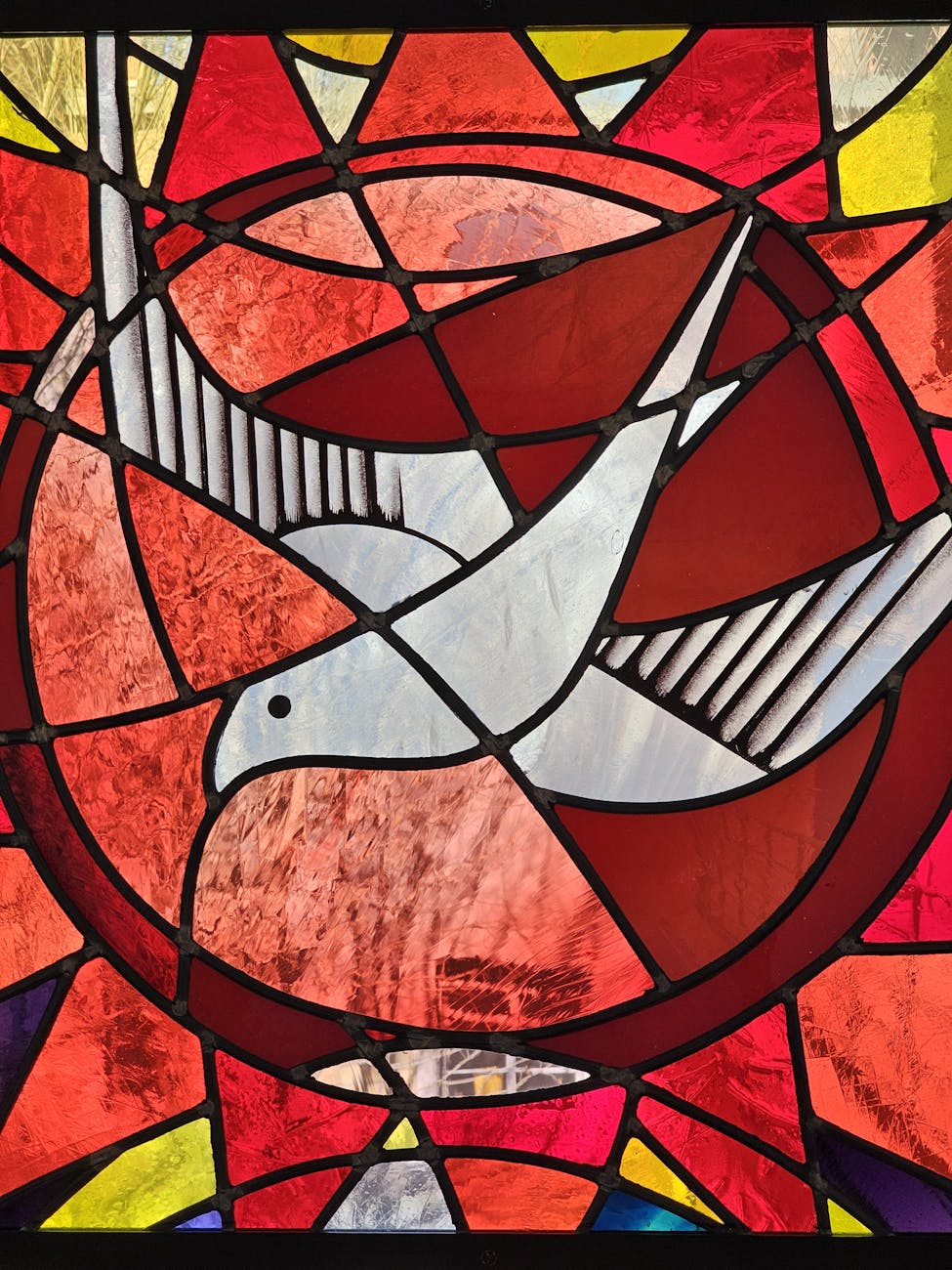
The Holy Spirit is the breath of God. He dwells in us. He has appeared as a dove and as tongues of fire. Jesus spoke of the Holy Spirit in very solid concrete terms. All mentions of the Holy Spirit in the Bible are very concrete, very solid, very real.

Jesus is, again, preparing His disciples for His departure. It’s been a bit of a rollercoaster for them.

Jesus prepares them for His death. Jesus is betrayed by one of their intimate group. Jesus is arrested, tried, tortured, crucified. He dies and is placed in the tomb, rises from the dead and is again with His disciples but now He is saying they have to say goodbye again as He is going back to the Father.

Confusion, betrayal, fear, terror, loss, sadness, grief, surprise, joy, relief and now they are looking loss in the face again.

But Jesus wasn’t leaving His disciples, or us, bereft of God. He was preparing the way for the Holy Spirit to be with and dwell in us. 

The Lord is here. His Spirit is with us. Ever present in our lives.

Jesus, God the Son, brought comfort, help, guidance and healing to the people He met. God the Holy Spirit brings comfort, help, healing and confidence in God’s continued and eternal presence. The Holy Spirit is the embodiment of God, dwelling within each one of us who have become united with Christ through our salvation; transforming us and growing us so that we can be a blessing to others and to the world.

Some one once described the Holy Spirit as “the present-tense of God”: not the God of history, not the God of the future, but the God of the here and now, active in our lives. Through the Holy Spirit we experience God on a day to day basis as He keeps us in God’s presence every moment of every day, sustaining us and our faith.

As the Holy Spirit works more and more in our lives we increasingly become obedient to God’s will for our lives. 

Jesus says “If you love me you will keep my commandments … and those who love me will be loved by the Father”.

Do you love Jesus?

We are not talking about a “pink and fluffy” kind of love.

Jesus wants our obedience, our actions, our devotion. Love for Jesus is about following His call on our lives. Authentic love for Jesus is shown by how we live to Him and how we live with each other.

Love for Jesus begins with emotion but as it deepens it moves to obedience and devotion.

And so we must rely on the power of the Holy Spirit working within us, changing us, transforming us, drawing us closer to God.

The Lord is here. His Spirit is with us. Change is coming!  

Holy Spirit (Photo by Ann H on Pexels.com)

He Is Risen!

Listening to the readings again on Easter Sunday with the women going to the tomb to prepare Jesus’s body reminds me of something I read recently about Mary – Jesus’s mother.

It is interesting, is it not, that Jesus’s mother – arguably His greatest disciple, a woman of tremendous faith, who stayed by Him to the bitter end, is not listed amongst the women going to attend to Jesus’s body.

And this poses the theory that the first person Jesus appeared to may well have been His mother and that this is why she was not among those going to the tomb at dawn. Such an appearance would be part of completing her participation in the essential parts of the paschal mystery.

Mary suffered above all others in the suffering and death of her son. Christ kept the commandments. He honoured His heavenly Father, His earthly father and His mother, so it makes sense that he’d visit her first.

If a son lived far away and his mother was told he’d died but he was actually alive and healthy and he returned to the area, it would highlight that he was not a good son if he visited his friends first and his mother last.

Jesus was the perfect son. So, why would He not visit His mother first. There’s also her faith, which, despite the apostles losing theirs at Jesus’s passion, Mary had in abundance. Scripture tells us that the Lord shows Himself to those who have faith in Him. And, of course, she loved her son so much and scripture tells us that those who love Him will be visited by Him.

How joyful she must have felt at seeing her son alive once more.

There is a special kind of joy at Easter. It’s not just the spring flowers springing up into life or the longer days. What it is is a deep, radiant joy born from our Lord’s victory over sin and death so that we might have eternal life with Him.

Jesus leaves the darkness and rises to new life. Through God’s grace, this gives us the gift that, no matter what our past was, we have permission to leave it behind and embrace the hope and joy of new lives in Christ. His sacrifice and act of intermediary reconciliation grants us forgiveness of our past sins, our present sins and our future sins.

A cross in a sunny field of flowers. Easter Joy.

Rules for Life

“Do not be afraid; for God has come only to test you and to put the fear of Him upon you so that you do not sin.”

God wanted to help His people – not destroy them. But when they heard the thunder and the trumpet, when they saw the flashing and the smoke on the mountain, they were afraid.

Because of their fear, the people wanted a mediator; yet God had already granted them one in the form of Moses.

We, also, already have a mediator – Jesus.

The word fear has more than one meaning. There is the type of fear the Israelites had – that of being scared, afraid, terrified – but that is the wrong type of fear to have of God.

Then there is the right kind of fear to have of God, and that is one of awe, respect and reverence. It is through this that we are granted the boldness to approach God through Jesus Christ.

God gave Moses the Ten Commandments. The purpose of these is how to have healthy relationships with God and each other.

God invites us to have a personal relationship with Him.

The deep significance of the gift of the Ten Commandments has been obscured by society. As a result we lose the religious awe found in this passage of Exodus and lessen our understanding.

They are not “maxims for a good life”. They ARE the living words of the living God. The God who has redeemed us. It is not the Ten Commandments which save us. Salvation is a gift of God – which He gives us freely through His grace.

There are some who try to use the Ten Commandments to conclude that we have to somehow earn God’s love and care. But actually it is the opposite. They demonstrate God’s continued love and care – giving us the law in the first place proves God’s love for us.

Our obedience is a loving, grateful response to all that God has done and continues to do.

So what is the essence of The Ten Commandments?

Jesus already gave us the answer to this when He told us that the greatest commandment is this, “To love the Lord our God with all our heart, soul, mind and strength and to love everyone else as we love ourselves”.

Baptism is the act of making a God choice. The making of the promises is choosing faith in God above any other life. Living our baptism means living by a single loyalty to God.

Remembering our baptism, who we are and who God is, in the inner recesses of our hearts and in the life we share together makes us grateful that God has given us these commandments, that we might find strength and shelter in our darkest times – helping us to remember that even in our darkest times we are not alone.

Talk from Holy Trinity Sheerness 8th October 2023 (Exodus 20)

Ten Commandments