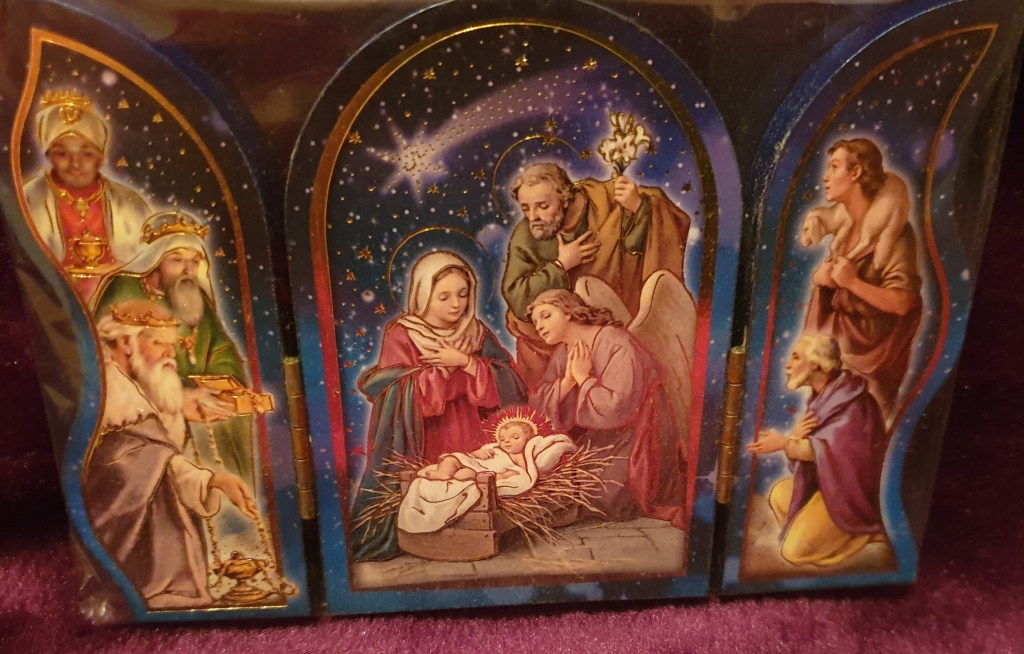
Mary …

We tend to use a mixture of readings from the Gospels of Matthew and Luke to revisit the miracle of Jesus’s birth. Here, Matthew doesn’t tell us how the Virgin Birth took place—except that it was by the Holy Spirit. Whereas, Luke gives a little more detail, the angel telling Mary that the Holy Spirit will come upon her, and the power of the Most High will overshadow her. The Virgin Birth is a divine miracle in the power of the Holy Spirit.

But Matthew does tell us two things about Jesus, one being what he does: “You shall call his name Jesus for he shall save his people from their sins”. Many Jews were looking for a Messiah who would come in conquering power. But Matthew shows us the much deeper human need. Jesus comes to save us from our sins—our spiritual needs far outweighing other needs.

The miracle of the Virgin Birth is also a sign of the far greater miracle and mystery of God becoming flesh and taking his place amongst us as one of us – the Incarnation. God didn’t just send angels, prophets and messengers—he came! In Jesus, God has come close; has taken human nature and human life to himself joining human nature to his own divine being. This is all of the Grace of God, who is a God who stoops to take us by the hand. In this respect, Matthew quotes from the Old Testament: ‘The virgin will be with child and will give birth to a son, and they will call him “Immanuel”—which means, “God with us.”’ If the name Jesus is descriptive of what Jesus does, Immanuel is descriptive of who Jesus is—God with us.

The miracle of the Virgin Birth points towards both the humanity and the deity of Jesus. He was a human person born in the normal way. He is also the eternal God who has come to us—the God-man. Jesus didn’t begin his existence at Christmas, but as eternal God, entered into time and space at Christmas. For unto us a Child is born, unto us a Son is given… (Isaiah 9:6).
So many people are ‘in the dark’ about God and don’t see him clearly. Yet, if you want to know what God is like, you only have to look at Jesus. Jesus Christ is the “Word of the Father, now in flesh appearing…” He is the revelation of the will, wisdom and person of God. His teaching is the
instruction of God. His death is the death of God-for-us. His resurrection is the victory of God! The meaning of Christmas is first and foremost a message of amazing grace, of a God who comes near.

The miracle of the Virgin Birth is a new creation, the beginning of a whole new world. What we can’t do for ourselves, God has and is doing. Into a world of brokenness and sadness God has come by means of a supernatural birth in the power of the Holy Spirit. But it doesn’t end there: the same Spirit who hovered over Mary and brought about a miracle of new life and transformation in her can also do the same in us! Regardless of who you are or what you have done you can start a whole new life as part of the new world. Jesus is the answer to our deepest needs. He is God come among us in order to save us from our sins and to rescue us from the deepest cause of our alienation and brokenness. When we start from the inside out we can have hope that the entirety of our life can experience the transformation he brings.

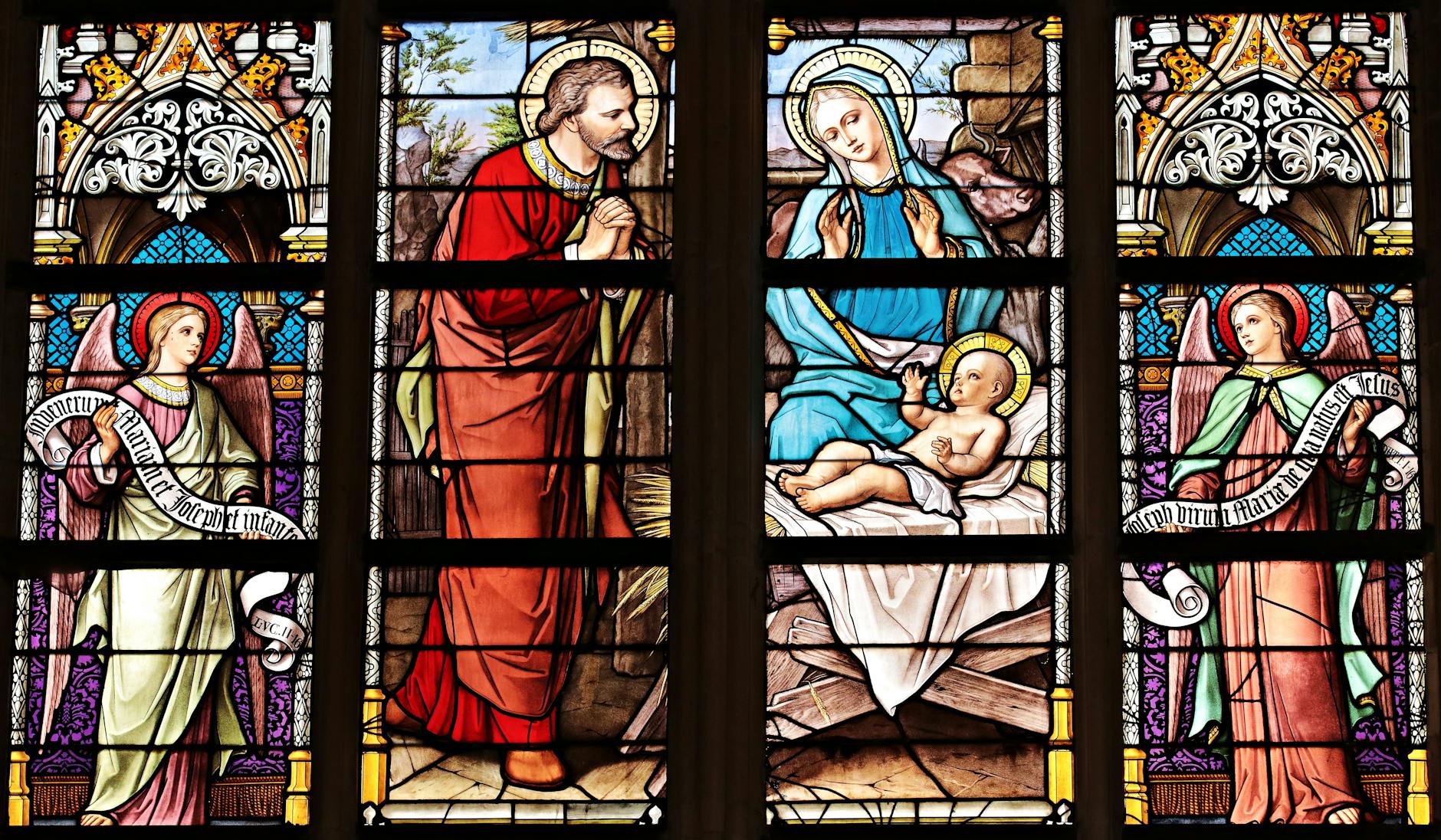
Mary, mother of Jesus (Photo by Juan Carlos Leva on Pexels.com)

Once Upon A Time …

there was a little baby born in a stable who would become the saviour of the world. He was visited by shepherds and magi, whilst the angels sang and a star shone.

And that is precisely the problem – too many people treat the reports of Jesus’s birth as if it was a nice little fairy story for children. There is too much complacency, too much commercialism and too much watering down the truth because it’s easier to fall in with non-believers, materialism and instant gratification than it is to stand firm in the faith. Humans like an easy life but the ironic thing is that taking the easier road leads, at the end, to suffering.

The road less travelled, narrow and difficult though it may seem at times, is the path to God’s house. Whilst the journey may seem hard, the end is worth it. It is better to travel the more difficult road with Christ by our side and wait for our reward at the end of the journey than it is to opt for the easy journey and the consequences that await.

Advent is a time of waiting, watching and preparing, of truly listening to God with our heart and with all our senses, of opening our hearts and minds, of making changes and being prepared to be changed, of praying and inviting Jesus into our lives and our hearts. It is a time to get ready to climb that difficult path up the mountain. 

Jesus is the gift that keeps on giving. He is real and the path to life, not just a story for Christmas. He is our Saviour, our Redeemer, the King of Kings and Lord of Lords who rules through love not war. He sacrificed himself to defeat death and the devil to save us. He shows us God’s mercy, love and grace. He grants us forgiveness and shows us how to live.

This year, why not use this time of Advent to evaluate yourself and your faith, to choose Jesus, the greatest gift of all, to choose life not death. Yes that means making difficult choices and choosing the harder path over the easier one. It means loving the Lord your God with all your heart, mind, soul and strength and loving your neighbour as yourself. It means loving, forgiving and praying for your enemies. It means listening and obeying our Lord and Master and following him.

But what a friend we have in Jesus, all our sins and griefs he bears. What Joy, Love, Light and Peace we gain as a child of our Heavenly Father. 

Hell is truly an absence of God, of not being in his loving presence. So stop treating Jesus’s birth as a fairy story and give it back the significance it requires.

I pray that you all receive God’s blessing this Christmas.

Image of a stained glass window depicting Jesus’s birth (Photo by Pixabay on Pexels.com)

Advent Is For Life Not Just For Christmas

Our reading from Luke (Luke 21:25-36) today is part of a longer apocalyptic teaching. So, why are we starting Advent with these warnings instead of with the message that a baby will be born?

Well, Advent doesn’t just precede Christmas when we remember the birth of Jesus. Advent is that time of waiting, of preparation, of making sure we are ready. It is about preparing our hearts and opening our minds.

But we are not just ensuring we are ready for baby Jesus. We also need to be ready for when Jesus comes again.

Advent is for life, not just for Christmas!

It is about being ready for Jesus, for watching and waiting and preparing for Him to come, both as a baby and when He comes again in glory. We must be alert, ready for the coming of the end. Not caught up in the commercialisation, the excess and the worries of the day but remaining ever watchful, confident and eager for the events Jesus tells us of – the signs that our deliverance is nigh. That He IS come again.

We all know what waiting is like. In smaller concepts there’s waiting for a bus, waiting for an appointment, waiting for the right vicars to be called to Sheppey. Sometimes the wait seems interminably long…

… and yet it does come to an end with fulfilment as that bus, appointment, those vicars, anything else we’re waiting for … Ashley’s Amazon parcels, the shopping, all arrive.

And they don’t always arrive when we expect them – sometimes the waiting is dragged out and they are a bit (at least in our eyes) late.

But then they arrive and that moment of waiting, that moment of expectation, changes into certainty, realisation and fulfilment of what we have received. No one waits without good reason. How long we wait is determined by the reward at the end. And Jesus is the greatest reward!

So we wait, patiently, trusting in God as we wait.

Waiting faithfully and being prepared, for our Lord will come again – but only God knows the exact day and time. We wait patiently through suffering for the wait is worth it.

Often people fill the waiting with distractions and keep busy to avoid the waiting. How easy it is to miss the very thing we are waiting for if we do that; because we are paying attention to the distractions instead of watching and waiting.

Advent is taking time, slowing down, opening our minds, being prepared to change.

It is the chance to wait and change our lives. Don’t miss that by running around. Instead get our hearts ready for Jesus to be in our lives more fully that ever before.

We must trust and be prepared to trust.

We must trust God in both the good and the bad times.

Take a step back, let God into every situation, listen to His guidance, pray on it, trust and wait.

We know God’s promise will be fulfilled. We must trust in His promise with faith and prayer.

We must be ready as we wait.

If Jesus returned tomorrow, or even this afternoon, are we prepared? Do we put enough planning and preparation into being ready for Him?

Make time for God. Live how Jesus wants us to live. Ask yourself what would Jesus do? Are our hearts and minds focussed on Him? Are we ready?

Tradition is actually the passing on of belief – despite the vernacular it isn’t staying the same or doing things this way because that’s how they were done 20 or 30 years ago. No! It’s actual meaning is the passing on of belief. If we are not ready we could miss out. Pass on the belief so all God’s children can be ready. Keep an open mind. Think and be prepared.

Faith is about going deeper in our personal journey with Christ. Know Jesus and be open to Jesus.

Ensure we have what we need to be prepared so that, no matter what day or hour He returns, we are ready. Don’t be complacent.

Keep relationship with God, and work on it doing God’s will every day.

Advent is a time when we have to look at our lives. Do we accept forgiveness and follow Him?

Humans are very good at procrastination.

Procrastination is very different to waiting.

So, humans procrastinate, run out of time and think I’ll do it tomorrow. But tomorrow might not come, the chance might never come again.

We must respond to God immediately when He calls us.

We must NOT be resistant to change or let rituals become idols.

Don’t procrastinate. Prepare now and keep the preparation ongoing.

Be ready and continue to be ready.

For God’s time is not our time but His promises are always kept. Jesus came, Jesus IS coming again!

So again I say, Advent is for life not just for Christmas!

Advent

… for life not just for Christmas …

I wonder how many already have put all the decorations away? I wonder how many will rush to put them away on twelfth night? I wonder how many will keep them up until Candlemas when Jesus is presented at the temple? I wonder how many still have turkey and excess food to eat?

I further wonder how many of those who’ve already put their decorations away, excitedly got them out in November, and on putting them away said something along the lines of “thank goodness they’re away for another year”? I also wonder how many of those who have not yet put the decorations away will be saying something similar when they do?

And all this wondering is because I wonder how many put Jesus away with the decorations? How many try to box Him up and leave Him in the loft with a “thank goodness that’s done for another year”?!

We see the slogan, “A dog is for life not just for Christmas”. Something which is very true – they are a life long commitment!

Jesus is a life long commitment. Not only that, He is for life in more ways than one.

Jesus was born as that tiny baby at Christmas for our salvation. He came to save our lives. His sacrifice for the forgiveness of sins for us to have life. Jesus is for life.

When we commit ourselves to Jesus and let Him into our lives; this is a life long commitment. We spend each day trying to follow Jesus’s example.

So this year I pray that, instead of putting Jesus away with the decorations for another year, we open the door to Him – letting Him in for life!

Jesus is for life not just for Christmas!

Witnessing and Doubting

(Talk given at Minster Abbey 16th April 2023)

So…witnessing and Doubting Thomas!

The other day I read that the public (according to the newspapers) claim the church do not promote Easter as much as Christmas. Easter and Christmas… two very important events for us – Christmas the celebration of the birth of Christ, the incarnation, God becoming man to save us…and Easter where Jesus is sacrificed in our place to defeat death, rise again, and enable us to be forgiven for our sins and reconciled with God.

So I thought about this and here’s a couple of comparisons:

The Church

At Christmas:

  • Advent – 4 Sundays
    • Hope, Prophecy, Patriarchs
    • Peace, Bethlehem, Prophets
    • Joy, Shepherds, John the Baptist
    • Love, Angels, Mary
  • Carol Service
  • Christingle Service
  • Crib Service
  • Midnight Mass
  • Christmas Morning Service
  • Candlemass

At Easter:

  • Ash Wednesday Ashing Service
  • Lent – 6 Sundays
    • Invocabit
    • Reminiscere
    • Oculi
    • Laetare
    • Judica
    • Palm Sunday
  • Maundy Thursday Service
  • Good Friday Pilgrimage and Gathering at the Cross
  • Stations of the Cross
  • Holy Saturday Vigil/Service of Light
  • Easter Sunday Service
  • Ascension
  • Pentecost
  • Corpus Christi

Versus

What I think is most appropriate to call commercialisation:

Where Christmas is promoted with:

  • Father Christmas
  • School Nativity Plays
  • Carols
  • Christmas number ones/Christmas songs
  • Grottos
  • TV Ads
  • Work Dos/Christmas parties
  • Decorations
  • Cards
  • Presents
  • Trees
  • High Street decorations and lights
  • Shop displays and more decorations
  • Christmas dinner menu options at pubs and restaurants for approx. 2 months
  • Pantomimes
  • Etc

And where Easter is promoted with:

  • Chocolate and chocolate eggs
  • The Easter Bunny
  • TV Ads but on a smaller scale
  • Small shop displays normally in seasonal aisles
  • Small amount of Easter decorations
  • Small amount of Easter cards
  • Easter dinner menu options for 1 day

In my opinion, having compared the aforementioned; the media, yet again, is showing a biased and incomplete picture. The evidence suggests that on the contrary the church does more at Easter but the sway of commercialisation makes the commercial version of Christmas more widely known.

This needs to be combated, but how? Simply, we need to follow the instruction and example of Peter in Acts and go out and witness, spreading the good news of the true meaning of both Christmas and Easter, sharing what, through love, Christ did for us and the joy of His resurrection with all it’s connotations of redemption.

Meanwhile, where does Thomas fit into all this?

Personally, I feel sorry for Thomas. I think he got a bit of a rough deal. Thomas the Doubter…in actuality he was a fervent believer yet what do we remember him for – doubting – the one who wouldn’t believe without seeing for himself and touching his beloved Master’s wounds.

Maybe, despite it being unfair, one of the reasons we remember Thomas specifically for this event is because it shows us that doubt is okay!

Doubt is something we all experience at some point and in reality, faith and doubt can and do co-exist side by side.

Thomas was not evicted from the group of disciples for his doubt. He was not condemned by Jesus for his doubt. He continued to be a valued part of the disciples as they stayed together, discussing all that had happened, sharing meals, continuing to accept each other.

Thomas had not been there when Jesus had appeared to the group of disciples initially. What was he doing? Where and why wasn’t he there are interesting questions.

BUT, it occurs to me that maybe, just maybe, he wasn’t there so that God could use him for the benefit of those too scared to admit their doubt both then and now.

Thomas only doubted for one week! He then met the risen Jesus and believed. In fact, he believed so fervently for the rest of his life that he was killed (or martyred) for his belief. Yet, still, he is referred to as “Doubting Thomas”.

One small brief moment of doubt, one incident, one mistake, one failing – and a label is applied – something that is still very much done today. And, whilst that person learns, believes, repents, changes, moves on, that label sticks.

Instead of calling Thomas “Believing Thomas” – a far more accurate name/label; because of that one brief moment of doubt he is known as “The Doubter”.

Through this and through Thomas, maybe God is teaching and reminding us that we should not label people. That we should allow people to change and accept that people do change. That we all make mistakes but when we repent God forgives us; likewise when others make mistakes we should allow them to repent and forgive them.

One more thing: asking questions.

There is a common phrase heard in classrooms and training rooms throughout the land:

“There are no stupid questions” and “if you ask a question most of the people in the room are probably thinking it and are just too scared to ask”.

Children in particular ask a lot of questions and, whilst these are often ‘when or what is for dinner?’, they often ask the really big questions:

  • What is God’s name?
  • What does God look like?
  • What does it mean to be reborn?
  • How is Jesus alive?

The questions children, and indeed some adults, ask are, in their own way, blessings. They make us think and help us gain deeper understanding and insight together.

The person that both expressed the doubts of everyone and asked the question everyone else was thinking was Thomas. For this we owe him a great deal for if the question had not been asked the answer would not have been given. Thomas the Brave who said to Jesus “Lord we do not know where you are going. How can we know the way?” To whom we owe thanks for Jesus’s answer “I am the [only] way [to God], the [real] truth and the [real] life, no one comes to the Father but through me”.

Thanks to Thomas we know it is okay to be honest about our doubts as well as our faith, we know that labels do not reflect who people truly are and we can realise how questions can lead us to deeper knowledge and growth. Thanks to Thomas, who believed because he had seen, we can see because we believe.

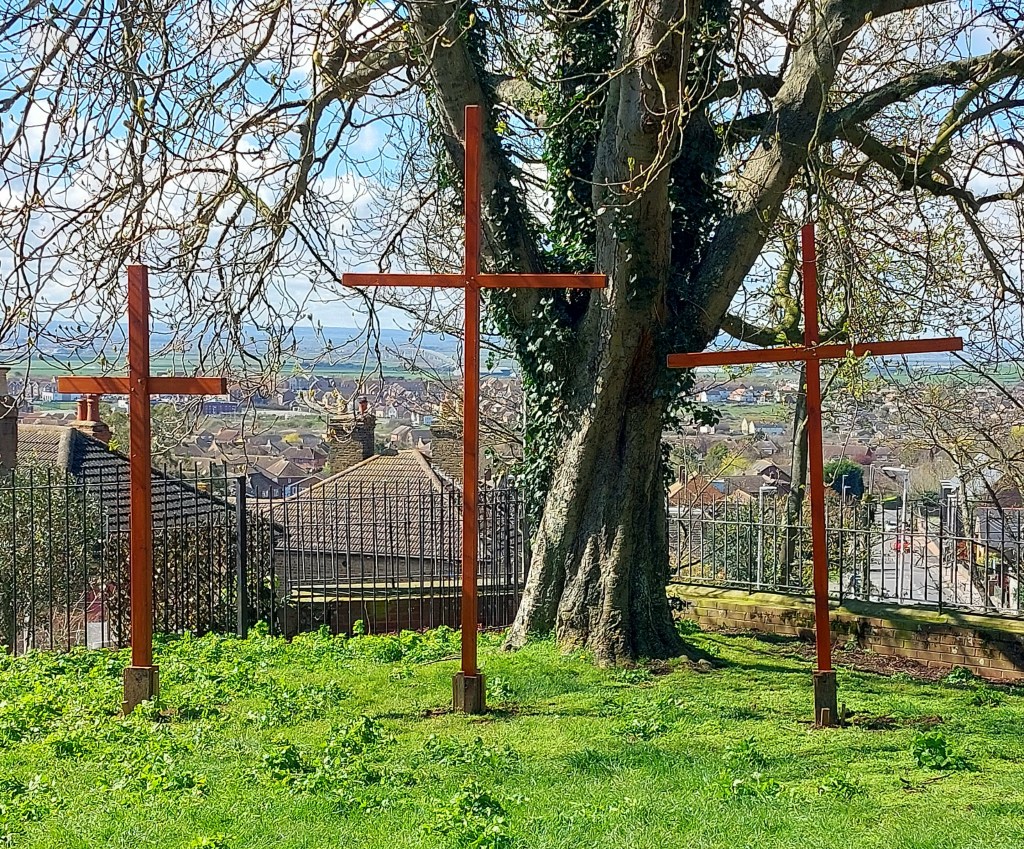
Three crosses

First Sunday in Advent 27th November 2022

Happy New Church Year! Today, we are celebrating both the first Sunday in the church year AND the first Sunday in Advent; and so, yes, the Christmas jumpers have been got out.

And in Matthew, Jesus tells us to “Stay Awake…”. I don’t know about you but I am most definitely going to need more coffee!!!

We are told that, if the house owner knew in advance exactly what time the thief was going to break into his house, then he would have stayed awake and not let his house be broken into. He would be prepared! He would have made plans to protect his home and for the thief to be caught.

Likewise, if we were to receive a warning that something would happen at a certain time then we would prepare and make sure we were ready. If an electricity company says at this time on this day we are turning the electric off then we would make sure that batteries were charged, the torches were working and so on.

We would be ready and alert!

“Keep awake for you do not know on what day or at what hour your Lord is coming.”

We know Christ will return – this is promised and God keeps His promises. What we do not know is the timing – and God’s time is not the same as ours.

So we must be ready and watchful.

Be prepared.

Advent is a time of waiting and preparation.

Are we prepared?

When I ask you “are you ready for Christmas” what do you think of?

Is it whether you’ve got all the presents?

Is it whether they are all wrapped or how much wrapping you need to do?

Is it whether the Christmas cards are all written or who you’ve still got to send one to or whether they’ll be posted in time with the planned postal strikes?

Is it when the decorations will go up or whether they are up already or when they’ll be got out of storage?

Is it whether the Christmas pudding and Christmas cake are made or when they’ll be made?

Be honest – when asked if you are ready for Christmas – who actually interprets this question as:

Are you ready for Jesus?

Are you ready for His birth?

Are you ready for Him to come again?

!!!

“Keep awake for we do not know the hour He will return.”

Thankfully, this does not mean that we all must become insomniacs. It means we need to be Spiritually awake. To be on our guard against spiritual distraction. To pay attention. To spend time with God in prayer and growing our faith. To be more fully alive in Christ.

I was writing Christmas cards this week. I’ve been writing quite a lot to give hope to people who would otherwise be forgotten. And I got quite cross because I found a range of cards that have the greeting “Happy Holidays”.

Now this really annoys me. It’s the same with a lot of television adverts on at this time of year.

Let me share why…

It misses the point!

It doesn’t just miss the point – it totally avoids it with an enormous detour.

And what is it that these Christmas cards and adverts are all missing out?

Well, the clue’s in the name. The reason for the season – Christ. The greatest gift of all.

So we must stay spiritually awake so that we do not commit the crime of leaving Christ out of Christmas. We must be alert and watchful to make sure that we do not demote Jesus to the bottom of the list. We must be on our guard to ensure that we are not just giving Him a cursory nod/brief acknowledgement or lip service just so that we can “tick that box”.

We must be prepared and ensure that we are putting Jesus at the forefront of our lives. Before everything else. First.

So this year let us use this time of Advent to wait patiently for Christ.

Waiting can seem boring. It can be hard to be patient. Especially when there are so many other distractions.

But waiting does not actually mean doing nothing!

It is an opportunity to prepare our hearts, our minds, our souls.

It is an opportunity to put our trust in the Lord. To truly repent, to forgive and to accept forgiveness. It is an opportunity to seek God more deeply in prayer and to surrender to His ways – becoming more alive in Christ.

I’m going to deviate slightly to quote from a Christmas film, which due to this quote is, in my opinion, one of the best Christmas films:

Tonight I want to tell you the story of an empty stocking. Once upon a midnight clear, there was a child’s cry. A blazing star hung over a stable and wise men came with birthday gifts.

We haven’t forgotten that night down the centuries; we celebrate it with stars on Christmas trees, the sound of bells and with gifts. But especially with gifts. You give me a book; I give you a tie. Aunt Martha has always wanted an orange squeezer and Uncle Henry could do with a new pipe.

We forget nobody, adult or child. All the stockings are filled…all that is, except one. And we have even forgotten to hang it up. The stocking for the child born in a manger. It’s his birthday we are celebrating. Don’t ever let us forget that.
Let us ask ourselves what he would wish for most…and then let each put in his share. Loving kindness, warm hearts and the stretched out hand of tolerance. All the shining gifts that make peace on earth.

The Bishop’s Wife (1947)

So let us use this advent to be ready for and to remember Christ this Christmas as we pray:

Lord, grant that we may stay awake, remain watchful and stand firm in the faith out of our love for you. Amen.

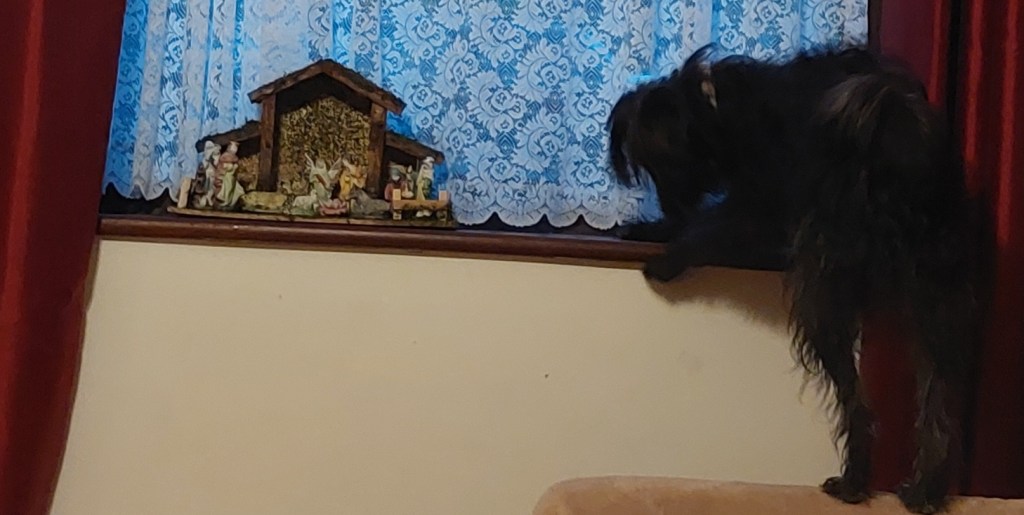
Poppet bowing to the Posada nativity

The Lamb On Top Of The Stable

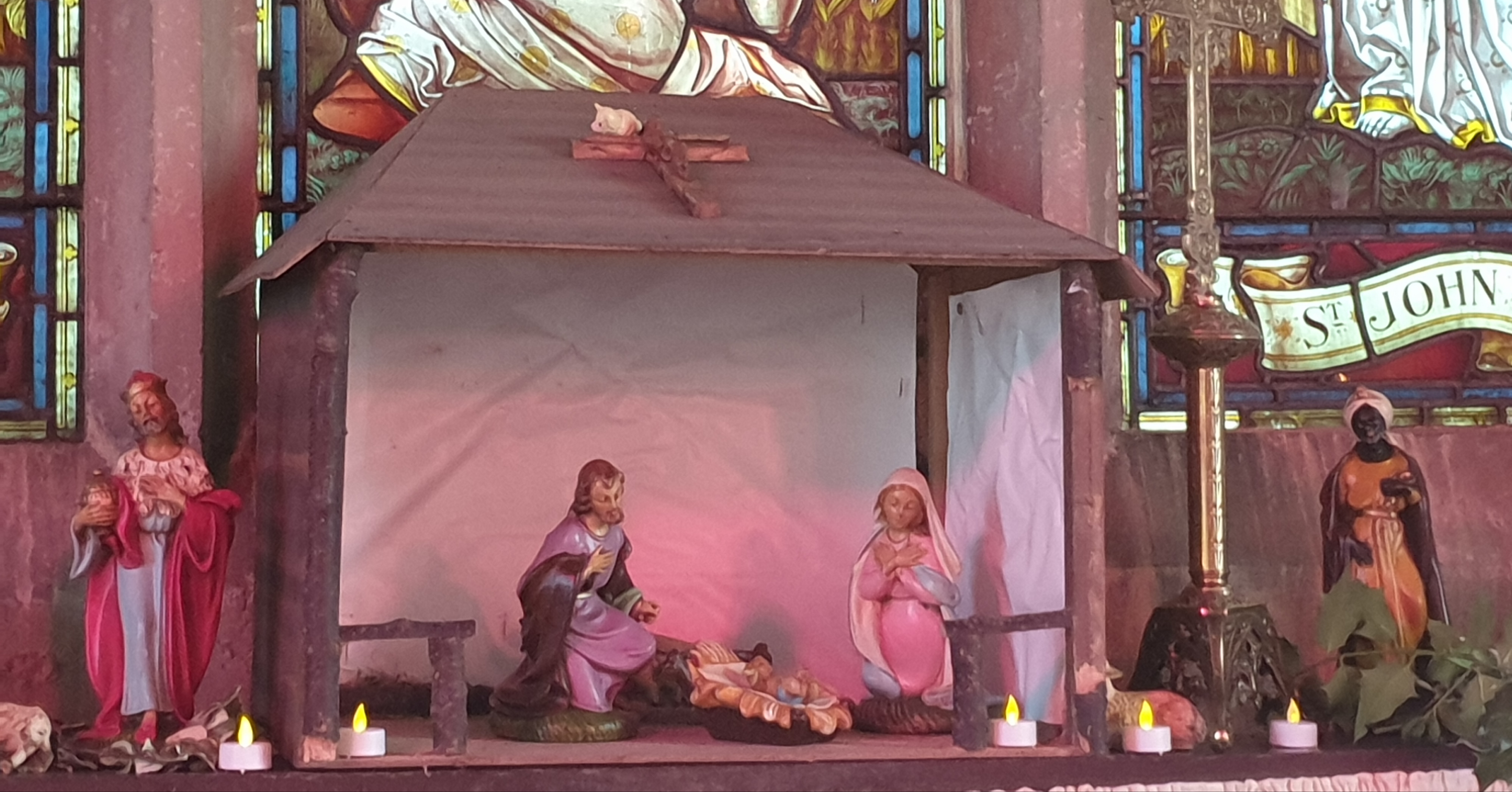
Why do I like the idea of always having a lamb (or sheep) on top of the (Nativity) stable (especially when there is also a cross depicted on it)?

Well, there is, of course, the simple icebreaker reason. Children, and indeed adults, walk into the church, see the Nativity Scene and ask “Why is there a sheep on the roof?” Bingo! There is your cue to talk to them, tell them what the scene represents, why we actually celebrate Christmas, that Jesus is ‘The Lamb of God’ or even just have a chat with them. Evangelicalism at it’s best in fact because it has been started by someone actually asking a question, which can led to a much wider discussion and spreading the word.

As just mentioned, then there is the description of Jesus being the Lamb of God. A title given to Jesus in John’s Gospel and referenced in the Book of Revelation; symbolizing Jesus as the greatest sacrifice. His blood shed to take away the sins of the world. How apt then, especially if the stable used is one with a cross depicted, that a lamb be placed on the roof symbolizing Jesus coming down from heaven, being born human at that first Christmas to His sacrifice on the cross at Easter to save us, rising from the grave and ascending to heaven.

Sheep on stable
Nativity with a sheep on the stable roof

Light the Dark

Christmas is coming
The turkey’s getting fat
Children cry for presents
Thinking that is that.

But what is forgotten
The greatest present of all time
That Lord Jesus died for us
And saved your life and mine,

It’s not about the goodies
Or about the Christmas tree
Although they’re very nice to have
And certainly not free!

It’s not about the stockings
Or the mince pies and reindeer
It’s not dear old Father Christmas
Or the so called festive cheer.

It’s not a time for greed greed greed
Or want want want want want
It’s not a time to break the bank
Or waste what we haven’t got.

It’s the time when darkness turned to light
The birthday of our Lord
A little babe who did no wrong
And who should be adored.

So whilst you’re busy having fun
And fielding demands
Remind them why we celebrate
And what our God has done.

A lowly stable’s all He had
His bed a bit of straw
Sent to us to save our souls
Our debt of sin He bore.

The stars shine bright to light His way
As angels His praises sing
So don’t forget on Christmas Day
Who gave us everything
Life everlasting
Love, hope and peace,
A light in the darkness
Be thankful at least.

Nativity pic
Nativity