Holy Innocents

The Feast of the Holy Innocents takes place on 28th December.

Doctor Who tells us that time is “wibbly wobbly timey wimey”. That is what we experience throughout the forty days of Christmastide.

Just a few days before the Remembrance of the Holy Innocents we celebrated Jesus’s birth as a teeny tiny human baby. Then at this feast day we jump forward a couple of years to after the magi’s visit and Herod is ordering the slaughter of many children in an attempt to kill Jesus. Then the following week we go back to that visit of the magi before we leap forward to Jesus being a man at His baptism and then a couple of weeks later Jesus is a teeny tiny baby again as He is presented at the Temple.

But for now, let us return to the day when we remember the Holy Innocents whose deaths Herod was responsible for.

Each year we remember that Joseph heeded the warnings and instructions he received, that he took his family to Egypt and that as a result of this the prophecy was fulfilled and Jesus was kept safe to grow into a man, fulfil His mission and be our salvation.

But we skim over the bit where many innocent children were killed by a scared but cruel man who wanted Jesus dead because he thought he would lose his power.

A voice was heard in Ramah, sobbing and loud lamentation; Rachel weeping for her children, and she would not be consoled, since they were no more.”

In the Holocaust, approximately 1.5 million Jewish children, and tens of thousands of non-Jewish children were murdered.

The Nazi’s targeted children as part of their ideological goal to create a “radically pure” society and eliminate future generations of “unwanted groups” including Romani, Polish and disabled children.

In the hope of killing one child, Herod had many killed.

Looking back at Moses, who came into the world to bring a kind of deliverance, a new king had risen to power in Egypt. This new king knew nothing of Joseph1 (the Israelite who saved Egypt from the famine). He just saw how numerous the Israelite people were and, wanting to stop the numbers increasing, ordered the death of every Israelite boy born.

There is a constant battle between good and evil in the world and in our own lives.

Evil will always lash out violently towards good. Evil will use any means necessary in an attempt to retain power. There will be resistance when we do good in the world. There will be temptations as we turn away from sin. The strength of these temptations show how committed to change and how committed to doing good we are.

There is wickedness in the world. There are, very sadly, people in this world who will slaughter or arrange the slaughter of thousands and thousands of beautiful, innocent, babies and children, for their own ends, to get what they want and to keep their power.

Evil does not hold back it’s hate for the young and God does not hold back His grace from the young.

God gives us His grace freely and in abundance out of love for us. He is a generous God and there is more than enough grace to encompass everyone no matter their age. He protects us with His grace.

Our world today is, again very sadly, not that different from the world throughout history. We can still see the callousness of Herod and those like him. We still live in a world where innocents are murdered.

We can lament and cry for them. We can pray for their families and friends. But the massacres still continue. Change begins in the human heart and is expressed in what we do and think and say.

It is hard to change a world ingrained with death. But we can contribute to this change. We can demonstrate charity and patience and sanctity of life.

Christ came for our lives, to give us life abundant, sacred and unending.

Herod represents all the powers that stand against Christ; all the people that reject Christ and all the elements of ourselves that want nothing to do with Christ and prefer their independence to His will.

What are we willing to destroy because of our refusal of Christ? What aspects of our own lives and the lives of others are we ready to destroy because of our refusal of Christ?

Herod’s massacre of the innocents is a warning to us. After his death, Herod’s kingdom was divided between the sons he hated. In less than 100 years, everything Herod had built, including the monuments he had intended as structures for his glory, had been reduced to ruins.

Herod is remembered as a petty tyrant. He is not mourned.

We mourn the innocents, the children of Bethlehem, yet they are so often forgotten.

But, in heaven, “where like stars, His children crowned, all in white shall wait“.
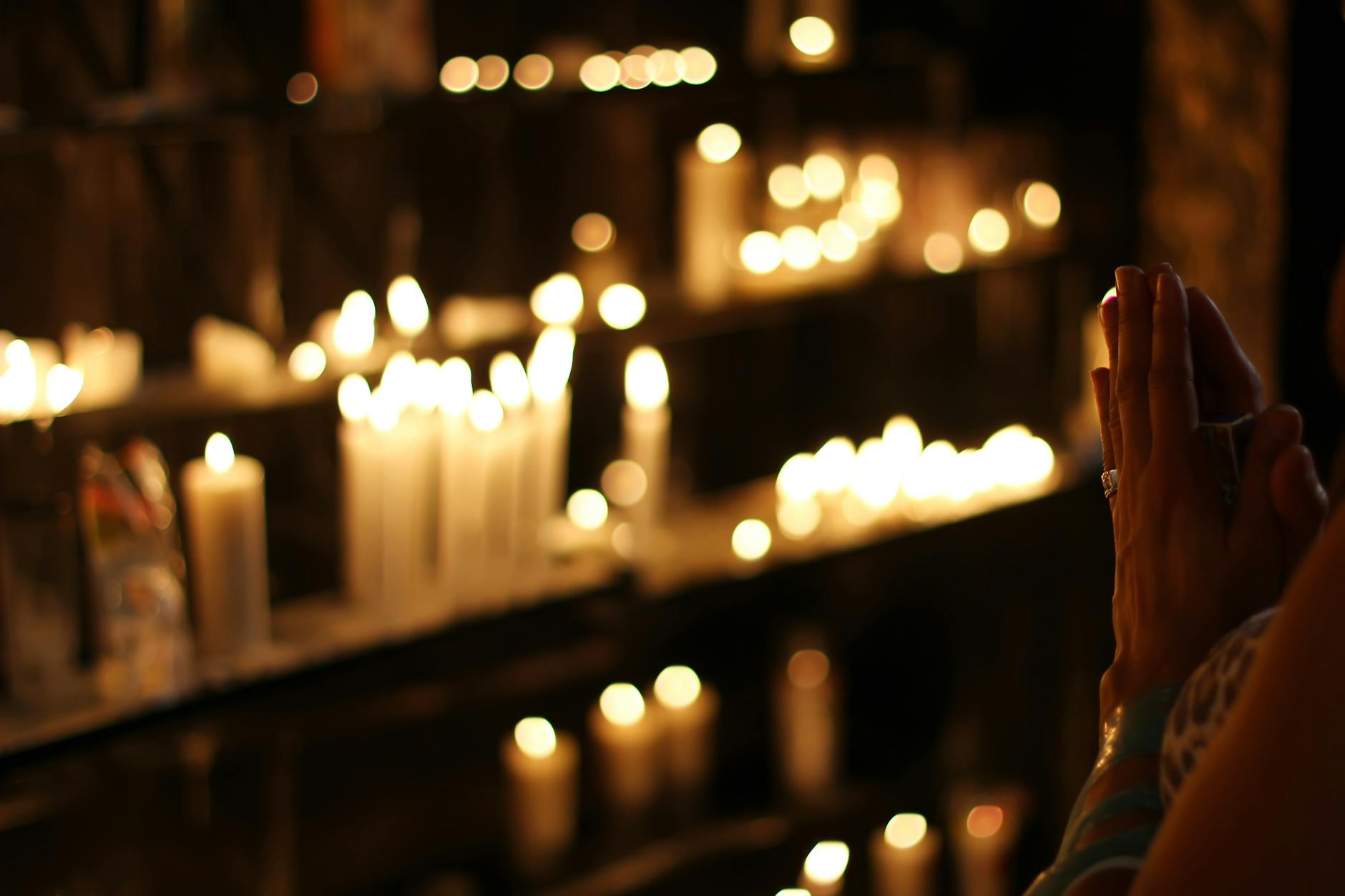
Lit candles for prayer and remembrance. (Photo by Rodolfo Clix on Pexels.com)
  1. Genesis ↩︎

Don’t be a Pharisee …

The Legend of the Stones

Two women approached a wise man and asked for instruction. One of them regarded herself as a terrible sinner. In her youth, she had deceived her husband, and she tortured herself constantly with the memory of her infidelity.

The second, on the other hand, had lived her entire life within the law and by the rules. She wasn’t conscious of any serious sin, had nothing much to reproach herself with and felt quite pleased with herself.

The wise man asked both women about their life. The first went as she confessed her great sin. She felt her sin had been so great that she had no right to expect forgiveness. The second said that she had not committed any particular sins.

The wise man said to the first woman, ‘Go, daughter of God, and look for the heaviest boulder you can find – one that you can barely manage to carry – and bring it to me.’

‘And you,’ he said to the second woman, who could not recall any serious sin, ‘go and bring me as many stones as you can carry, but they must all be small ones.’

The women went off to do as the wise man had told them. The first brought a huge boulder; the second brought a whole sackful of small pebbles.

The wise man examined the stones and said, ‘Now do as follows. Take the stones back and replace each one of them exactly where you picked it up, and when you have put them all back where you found them, come back to me.’

The women went off again to carry out the wise man’s instructions. The first very easily found the place from where she had taken the huge boulder, and she replaced it where it had been. But the second had no idea where she had picked up all her little pebbles, and had to return to the wise man without having carried out his instruction.

‘You see,’ said the wise man, ‘that’s how it is with our sins. It was easy to take the big, heavy boulder back to its place because you knew exactly where you first found it. But it was impossible to remember where all those little pebbles came from.’

And to the first woman, he said, ‘You are very conscious of your sin. You carry in your heart the reproach of your husband and of your conscience; you have learned humility, and in this way you have been freed of your wrongdoing. You, however,’ he said to the second woman, who had come back still carrying her sack of little pebbles, ‘you, who have sinned in many small ways, do not know any more when and how you did wrong; you are not able to repent. You have grown accustomed to a life of little sins, to passing judgement on the sins of others while becoming more deeply entangled in your own. It has become impossible to free yourself of them.’

A story by Leo Tolstoy retold by Margaret Silf

To paraphrase from part of the Gospel of Luke, chapter 18: The Pharisee thanks God that he is not like other people. He details his religious practices and self perceived righteousness and considers himself more virtuous and superior to others.

The tax collector feels unworthy and simply asks God to have mercy on him, a sinner.

Jesus states it is the tax collector and not the Pharisee who went home justified by God. God values the tax collector’s humility, not the Pharisee’s self-righteousness.

Jesus told this parable to warn those who trusted in themselves but who treated others with contempt. He warns them against spiritual pride and calls for us to have humility in prayer and in life. Our justification comes solely from God’s grace and mercy and not from our own achievements.

Humility is essential for a right relationship with God whilst spiritual pride leads to self-righteousness and being rejected by God.

It is easy to fall into the trap of behaving like the Pharisee. I know someone who, on a regular basis, beats their chest and says “I thank God I am not like other men”.

Modern day Pharisees are not all as obvious as this but are characterised by their self-righteousness, a tendency to burden others with strict rules whilst not following them themselves and a focus on power and control of over serving.

They may appear religious whilst lacking genuine faith whilst adhering to certain rules or attending church yet without a corresponding difference in their daily life. They may focus on strict adherence to rules and traditions, creating heavy burdens for others yet ignoring the spirit of the law. They judge and condemn others, even misrepresenting their motives whilst projecting their own shortcomings onto them.

They believe they are more righteous than others but are unwilling to admit to their own sins or weaknesses.

They are more concerned about other’s opinion of them and how they are seen than they are about having a genuine relationship with God.

But, even for Pharisees, there is hope.

To not be a Pharisee, hear the words of Jesus. Jesus is the Light of the world, whoever follows Him will not walk in darkness but have the light of life.

Don’t ignore the content of what Jesus says, or you’ll miss out. Hear Jesus’s word and His message. Actively listen to Him by reading and paying attention to Scripture. If you ignore Scripture, if you ignore the Bible, if it just sits on a shelf gathering dust, then you are ignoring the word of Jesus.

Regardless of how busy we are, we make time for what matters most. Nobody is too busy to hear Jesus’s word.

Hearing Jesus’s word – reading the Bible is non-negotiable for both first-time faith and for growing faith. You can’t believe in and become like Jesus without His word. Hear His word.

See Jesus’s light. Light is a big metaphor. Jesus is an exposing light, an illuminating light, and a welcoming light.

He exposes what is hidden, calls out sin, and banishes darkness. He illuminates, revealing or making known the way, shining out in the darkness and showing us what we need to see. He is a welcoming light guiding us and inviting us home.

See the light, put your faith in Jesus, and be welcomed home. Follow Jesus’s path. Jesus’s promises of light and life are only for those who follow Him. Truly believe and truly follow Jesus.

This doesn’t mean just recognising that Jesus was a real person – and there is historical evidence of this – it means seeing and listening to Jesus, going wherever He leads and doing what He says. Literally following Him. Not just being a Christian but being a Christ-Follower. True believing where your highest allegiance is to Jesus; whatever He wants, that’s what you want.

Don’t be a Pharisee.
Hear Jesus’s word.
See Jesus’s light.
Follow Jesus’s path.
Be humble.

Lord Jesus Christ, Son of God, have mercy on us, all sinners.

Stones and Pebbles

Time of Change …

… time for change. As we enter October change is all around us. Changing leaves falling off trees, darkness approaches earlier each day, changing times, people come and people go. It will be tough but God will see us through.

Be strong and courageous. Do not fear or be in dread of them, for it is the Lord your God who goes with you. He will not leave you or forsake you. (Deuteronomy 31:6)

When change comes, whether it is planned and expected or whether it has been thrust upon us, whether it is wanted or unwanted, it is an opportunity to take a good look at ourselves. What do we need to change about ourselves and how we react and respond to the changes that must take place. What we need to change to be the best we can be – to have open hearts and minds and ears for God. To actually listen to His voice and His plan for us. To take the next steps on our journey.

To open ourselves to changes that will have to be made to enable us to make it through difficult situations. To be open to and make the changes that are required for us to flourish in the future.

To everything there is a season, a time for every purpose under heaven. (Ecclesiastes 3:1)

Change can be challenging and many are resistant to it but change is a normal and necessary part of life. And, of course, change can be exciting, stimulating or rejuvenating but it can also be disorientating, uncomfortable and stressful. However, change will happen whether we want it to or not, so we need to accept and embrace it, as much as possible.

But the Lord, our God, is our strength and shield. We do not need to fear what tomorrow may hold. God is with us and will never leave us. He protects us and His plans for us are good.

The Lord is my strength and my shield; my heart trusts in Him and He helps me. My heart leaps for joy, and with my song I praise Him. (Psalm 28:7)

Embracing Change