Calling Levi

In chapter 9 of Matthew’s Gospel,  Matthew recounts his own call from Jesus to become a disciple. Matthew was the name Jesus gave him. Until he became one of Jesus’s disciples, he was called Levi. And he was at his place of work in the tax office. The Jewish people did not like those among their number who became tax collectors. They viewed these people as sinners and collaborators with the Romans against their own people. Tax collectors had the force of the Roman soldiers behind them to force the people to pay the taxes, but not only that, they were considered to be extortioners because they were allowed to keep any money they over-collected. Consequently, most if not all tax collectors over-charged on purpose to line their own pockets.

The call from Jesus gave Levi Matthew the opportunity to literally turn his life around. When he was a tax collector he was busy taking but Jesus was calling him to a work that was essentially giving.

Jesus said to him “Follow Me” and he did. He left his desk, taking nothing but his pen. Jesus called him and the only thing he took from his trade was the pen this trade had taught him to use; a skill he then used to compose his Gospel of Jesus’s teachings.

There is archaeological evidence that fish taken from the Sea of Galilee were taxed. So Jesus took as His disciple the taxman that may have taken money from Peter, James, and John and the other fishermen among the disciples. Certainly, initially, it would have been difficult for them to accept each other. Yet, in one way, Levi made more of a sacrifice than some of the other disciples. Peter, James, and John could easily go back to their fishing business, but it would be practically impossible for Levi to go back to tax collecting.

Jesus sat at the table in the house, and many tax collectors and sinners came and sat down with Him. This context suggests that this was a gathering of Matthew’s friends and former business associates. Possibly, Jesus took advantage of Matthew’s decision to also reach those whom he knew.

And so the disciples were asked, “Why does your Teacher eat with tax collectors and sinners?”  The answer to this question was simple, because Jesus is the friend of sinners. As Paul wrote in Romans 5:8 “But God demonstrates His own love toward us, in that while we were still sinners, Christ died for us”.

We are fortunate that God calls sinners and not just saintly people. Jesus came to benefit those who understood their inherent need for Him. Yet the proud who see no need for Jesus do not benefit.

Jesus quoted Hosea 6:6, “I desire mercy and not sacrifice”. In Hosea’s day, God’s people were still good at bringing sacrifice, but they had abandoned mercy because they gave up the knowledge of God and truth. God would rather have right hearts, full of truth and mercy than sacrifice.

These words are more striking when we remember that they were addressed to the teachers of men. This rebuke showed that they did not know God, and Jesus bade them go and learn the meaning of their own Scriptures. These “teachers of men” thought they knew everything already, and the rebuke made them angry.

This event illustrates Jesus’s mission to seek and save the lost, calling them to repentance and a new life.

Collecting taxes

The Spirit Of God

The union between the Father and the Son is such a live concrete thing that this union itself is also a Person. I know this is almost inconceivable, but look at it thus. You know that among human beings, when they get together in a family, or a club, or trade union, people talk about the ‘spirit’ of that family, or club, or trade union. They talk about its ‘spirit’ because the individual members, when they are together, do really develop particular ways of talking and behaving which they would not have if they were apart. It is as if a sort of communal personality came into existence. Of course, it is not a real person: it is only rather like a person. But that is just one of the differences between God and us. What grows out of the joint life of the Father and the Son is a real Person, is in fact the Third of the three Persons who are God.

This third Person is called, in technical language, the Holy Ghost or the ‘Spirit’ of God. Do not be worried or surprised if you find it (or Him) rather vaguer or more shadowy in your mind than the other two. I think there is a reason why that must be so. In the Christian life you are not usually looking at Him. He is always acting through you. If you think of the Father as something ‘out there’, in front of you, and of the Son as someone standing by your side, helping you to pray, trying to turn you into another son, then you have to think of the third Person as something inside you, or behind you. Perhaps some people might find it easier to begin with the third Person and work backwards. God is love, and that love is, from all eternity, a love going on between the Father and the Son.

C.S. Lewis Mere Christianity

Today1 we are celebrating the feast of Pentecost. A regular feature of Pentecost tends to be a talk based on the Acts reading, Joel’s prophecy and tongues of fire.

And so, I am going to talk about our Gospel reading from John; where Jesus us reassuring the disciples that this is not the end of their relationship with Him. They would not be abandoned or left helpless as Jesus was going to the Father to send the Holy Spirit to be with them … and us.

Jesus said, “Believe in God, believe also in me”. This is a fundamental relationship of trust.

Jesus graciously left the gift of His peace. He said, “Peace I leave with you, my peace I give you”.

True peace is not derived from circumstances, people or things; true peace is derived from Jesus. His peace is peculiarly His to give as He purchased it with His precious blood. Jesus was the substitution for a perishing world. Jesus was commissioned to bring peace to mankind.

Jesus is The Way!

To know Jesus is to know both the way and the destination, which is communion with the Father. In order to complete His atonement for our sin Jesus had to leave and return to the Father. But Jesus leaving is linked to the role of the Holy Spirit – the Helper Jesus had referred to previously.

Jesus was returning to the Father to prepare a place for us.

Jesus is The Way, The Truth and The Life!

Jesus in His life, ministry, actions, everything that He did showed us GOd. Now it is time for Him to return to the Father, He promises the companionship of the Holy Spirit so that the disciples, and us, will be able to continue in Jesus’s way of doing things.

We can only understand and know the Holy Spirit if we know and understand the unity of the other two Persons of the Trinity – the Father and the Son. The Holy Spirit is often thought of as this bond of love between Father and Son.

Jesus describes the Holy Spirit a “another Advocate to be with you forever”. The love of the Father and His desire to be reconciled with His creation is what led to Jesus’s incarnation in the first place and is the reason for God sending the Spirit to us; God is our Advocate – the one who is by our side, no matter what, no matter which persona of the Trinity (Father, Son and Holy Spirit) it is.

The Holy Spirit is the Spirit of Truth and will be in us – not just by our side.

This Spirit is in us, united with us, the way the Father and the Son are united in each other. This bond with the Spirit enables the Spirit to be our guide in life just as Jesus did the will of God His Father.

The Holy Spirit is our guiding light – our tongue of fire – if the Spirit dwells in us.

But because it is the guiding light for those in whom it dwells, the world cannot receive the Spirit. The world refuses to see the Spirit of Truth alongside them, tapping them on the shoulder with a call to repentance. They do not want to return to being God’s original and beautiful masterpiece. They only see their own gain and not the loveliness of God.

If we can see it in Jesus, if we can see that the Holy Spirit is by our side and in our lives. If we can recognise the real truth and call upon our God to help us do the things He would have us do, then we will know the presence of God within us and His guiding light before us – our tongue of Spirit fire.

Tongues of Fire
  1. 8th June 2025 ↩︎

Boring and Mundane

Advance warning – my story of faith is not dramatic! I know I am not the only one here who has sat in a church meeting where the minister has asked for people to give testimony or to talk about finding the light and thought “but I’ve always believed”. The reality is my story is ordinary and mundane.

I had a Christian family and learnt about Jesus from an extremely young age. I’ve belonged to and been part of church my whole life.

And, having explained that I have no dramatic Hollywood style event to entertain you with, I could stop here …

…or I could, which is what I’m going to do, continue anyway and tell you more – including why it is that ordinary mundane testimonies can be a blessing to us.

Being a Christian and following a Christian life is difficult – and it’s supposed to be. Remember that old adage that implies that something’s worth is measured by how hard you had to work for it. God, through His grace and His Son Jesus Christ, has given us the most valuable gift of all; but to follow in our Lord’s footsteps takes hard work and perseverance.

We are called to faithfulness. We are persecuted, we suffer, we face trials tribulations. temptation and false teachers trying to send us off track.

When times are difficult we are tempted to give up and many do fall away. The epistles remind us to persevere, to put on God’s armour. to stand firm and to ensure in following Jesus Christ.

Remaining steadfast, staying on the narrow path and being faithful teach the need to focus on persevering, to continue to put our trust in God and to not falter.

The well known poem about the footsteps in the sand really is true. God never leaves us. Whilst people fall away and leave Him; He does not abandon us.

When I give my burdens to Him I feel a physical lightness and literally feel the weight removed from my shoulders as He takes the load for me.

When times are easy, I feel His presence walking beside me and we enjoy the journey together.

If things are more difficult I feel His hand in mine.

In times of great trial He is supporting me or carrying me if you like.

And in times of great sorrow I feel His arms around me as He embraces me with His great love and comfort.

This is certainly a great blessing and in return I pray that God will continue to fill me with His love so that it can overflow through me to others.

We are called to carry each other’s burdens, encourage and bring back the wanderers. We are called to follow Christ’s example to aspire to God’s standard and to repent of all – however mundane – that makes us guilty of not reaching that standard.

God told us to pass His teachings to our children. Having parents, teachers, ministers and peers who did this points to God’s continued faithfulness as does having been preserved in the faith. God catches me when I stumble.

He has blessed me and kept me. He has blessed you and kept you.

So let us sing of His great love for evermore and make His faithfulness known through all generations and let us give thanks to God.

Holding Hands

Awe and Wonder*

*(John 6: 1-21), talk given at HTS 28th July 2024

Again, we have a reading that is often preached on. The feeding of the 5000 and walking on water – as recounted by John.

Consequently, I have heard so many different theories about how the feeding of the 5000 was accomplished.

These theories are spoken by supposed men of faith, and yet, what they all have in common is that they detract from the awesomeness of the miracle performed by Jesus.

I have said before (and will probably do so again) that we, mere mortals, try to explain away acts of God. We are so eager to know how something has been done that we make up theories to translate the unknowable, the un-understandable, the sheer magic if you like of God’s awesome power into something mundane as we falsely claim we know how it was achieved. Like explaining away all illusionist’s tricks as mere slight of hand. We can’t just accept the wonder – the miracle – for what it is.

A miracle!

The work of God!

An amazing gift from Him to us!

We don’t need to know how it was achieved – not if we have faith and believe. It should be enough for us just to know that God did it – God provided!

God did not ignore the pleas made on behalf of His people. Instead He provided what was needed and a lot more besides.

No one went hungry. Everyone ate their fill. And yet 12 baskets of bread remained at the end of the feast.

  • 12 baskets of bread
  • 12 tribes of Israel
  • 12 Apostles

Whilst you think about that for a moment; let me mention some more parallels that are at work here.

The Passover, a major festival in the Jewish calendar remembering when the Angel of Death passed over the houses of the Israelites the night before they, in a mass exodus, followed Moses out of Egypt into the Wilderness, where God provided for them with another miracle – manna – bread from heaven.

Moses, the foreteller of the plagues of Egypt, leading a crowd through a Wilderness where God provides them with the food they need each day. Moses, who went up a mountain to speak to God in peace and solitude away from the crowd.

Jesus, instead of foretelling plagues upon Egypt, provided healing in abundance. The crowd followed Him, drawn to Him by the signs they witnessed. Jesus was leading a crowd. John just tells us that they were the other side of the Sea of Galilee. The lack of a specific place name for where this significant event takes place puts it in parallel with Moses leading the Israelites through the Wilderness.

Jesus leads a crowd through the Wilderness. With the power given to Him by God His Father, Jesus provides bread in abundance. This acts as confirmation to the crowd that Jesus is from God. He sees what is in their minds and, knowing God’s plan knows that becoming the warrior king the crowd wanted was not how God wanted Him to save the world. Jesus goes up a mountain to speak with God in solitude away from the crowd.

As is a common thread through John’s Gospel; this passage is about who Jesus us and about proclaiming Jesus’s greatness. John does this by recounting this event in such a way that we see these parallels.

Both Moses and Jesus enabled their multitudes to have food in the Wilderness. However, it is the difference that is important here.

Moses asked God where to get food for the people. He didn’t know and asked God genuinely. Moses needed to rely on God. God provided, in abundance, food for His people. When Jesus asked Philip ‘where will we get bread for the people’ it was actually a rhetorical question. Jesus already knew what He was going to do. Jesus, the Son of God with the power of God, already knew that He Himself would perform a miracle providing food in abundance for the people.

John claims Jesus is testing Philip – and this is possible. The Jews knew the Scriptures in great depth. It is possible, therefore, that Jesus wanted to see whether the disciples knew enough about who He was, and is, and to see if they remembered the manna from heaven and would realise that in a similar way Jesus would be providing for His people.

We cannot second guess God, but what we do know is that if that was the case Philip failed. And not only Philip.

Like many today, Philip could only focus on how much it would cost to find a ‘shop’ and buy bread and Andrew could only focus on how little the supplies were.

And likewise, if Jesus tests us in a similar way, do we truly acknowledge that He will provide, or, do we fail the test by focussing on cost and resources?

Jesus fed His people. He took the loaves, gave thanks and distributed it to the people. And here we have the next important difference highlighting Jesus’s greatness.

If the Israelites collected more manna than they needed and tried to store it then the manna perished. When the disciples gathered the leftovers so that none would be wasted there were 12 baskets of good food leftover. Proof of the abundance Jesus provides for those who truly put their faith in and rely on Him.

The crowd see Jesus as a prophet sent from God. It is possible they may have seen Him as a second Moses.

But regardless of how the crowd saw Him, Jesus is more than just a prophet. He is the Son of God.

And in case we had any more doubts, like many passages in the Bible, like the Trinity, we have a third significant difference highlighting who Jesus is, His greatness and His power.

When the Israelites reached the Red Sea, Moses had to rely on God to part the waters so that he could lead the Israelites across on dry land.

When the disciples were crossing the sea in a boat, Jesus needed no such help. Jesus, God’s Son, with power over creation, walked on the water to the boat and immediately they all reach shore.

Jesus walked across the surface of the water as Lord and Master, revealing Himself to His disciples using His name – the name God revealed to Moses – I Am.

Moses is considered to be God’s greatest prophet and lawgiver. But Jesus is God. Jesus is mightier. Jesus is more.

Whoever you see as that Moses equivalent – be it as prophet or leader …

  • Jesus is greater
  • Jesus is the one who provides
  • Jesus is more

Let us see Jesus for who He really is. Let us fully put our faith and trust in Him. Let us fully rely on Him and allow Him to provide for us. Let us not continue to fail the test as Philip and Andrew did. Let us be ever thankful to God for HIs great grace, abundance and mercy. Amen.

The Sea

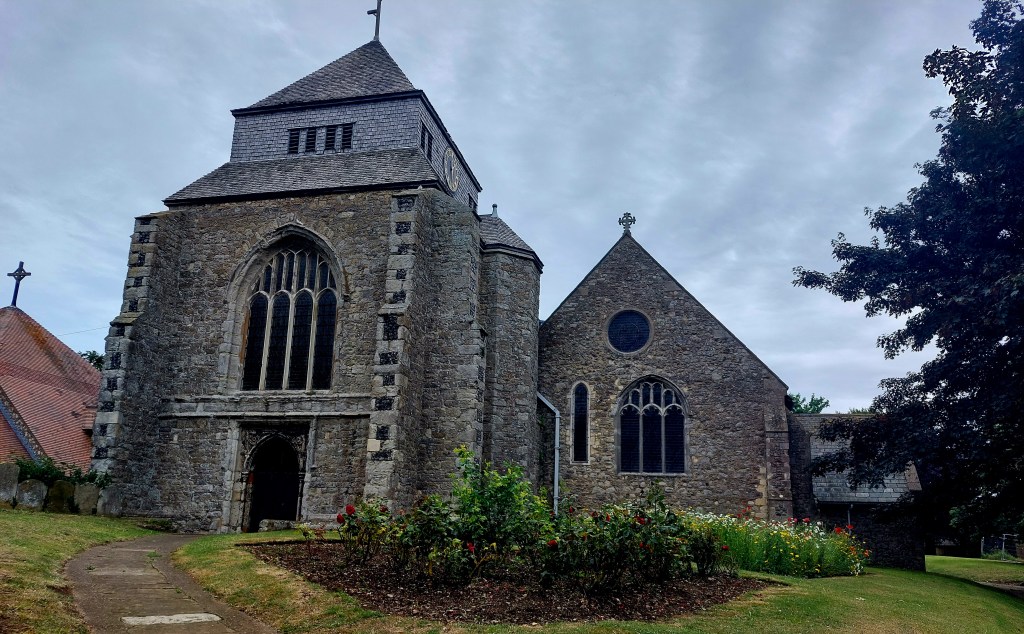
Minster Abbey Talk on John 17:1-11

“The time has come,” the Walrus said, “to talk of many things:…”

Lewis Carroll

And if we were having a conversation over some coffee and cake (hint hint) that is precisely what would happen. We would have a conversation; maybe about the weather, the coronation, a television drama, … all sorts.

Some of us find it easy to converse, some of us find it more difficult and communicate in other ways. Some of us are good at listening and for some of us it “goes in one ear and out the other”.

But, how do we pray?

There are many different ways we can pray, but ultimately, if we think about it, prayer is just the same as that conversation over coffee … isn’t it?

If not why not?

We have the opportunity to talk to God about anything and everything; and not just when we’re worried or in need or when things aren’t going as we’d like but also when we’re thankful, joyful and when things are going well.

We can do a lot of talking to God but we need to remember to listen as well. If we are honest none of us listen as much as we should.

Prayer is vitally important in our lives. An oft repeated quote “seven days without prayer makes one week (weak!)”.

Today’s Gospel reading is part of one of Jesus’s longest prayers.

In short it summarises Jesus’s relationship with the Father and the relationship He wanted His disciples to have with Himself and the Father.

Like the Holy Trinity (Father, Son and Holy Spirit) this prayer is in three sections.

  1. Jesus prays for Himself
  2. Jesus prays for His disciples
  3. Jesus prays for all believers past, present and future

Despite us having celebrated Jesus’s Ascension on Thursday, this prayer passage takes place before His arrest. But it is significant because it becomes Jesus’s evaluation of the purpose of His life, death, resurrection and ascension.

God’s glory and Jesus’s glory are one and the same. Through the death of Jesus God is glorified and all believers receive eternal life.

Eternal life is knowing the one true God; being in a living fellowship with God. And this life we receive when we accept Jesus into our hearts and lives. Jesus’s purpose, His mission, is salvation.

Jesus prays with great concern for His disciples. He was not concerned about Himself – He knew God’s plan, He knew He had to suffer and die to be victorious. Jesus’s victory was unquestionable. The disciples were just like us. They were not infallible. Jesus had predicted the disciples would desert Him. And so He prayed for them, that they would be kept safe and protected by the Father’s power and that they would fulfil their future ministry. The disciples were about to be tested and Jesus prayed that this would not separate them from Himself or from each other.

Again, like the Three-in-one, Jesus mentions three things about His disciples:

  1. They had accepted His teaching
  2. They had accepted the knowledge that Jesus is the Son of God
  3. They believed

Jesus prayed that the world would stop being opposed to God.

“All I have is Yours and all You have is Mine.” Jesus has equality with the Father.

He prays that, as He and God are one, the disciples and believers will remain as one.

In unity.

Not divided.

Division is the result of the failures of Christians.

God is awe-inspiring and loving. Jesus’s prayer is an outpouring of love and concern.

Jesus was shortly returning to the Father and to the glory He has before the world began. He had completed His mission. The Holy Spirit had been promised. With the help of the Holy Spirit it is now our turn.

Our mission, if we choose to accept it, is to bring glory to God through all we do in His name.

Are we ready?

Do we accept this mission?

Minster Abbey, Sheppey

A Journey of Truth and Faith

(Talk on Luke 24:13-35 23rd April 2023)

This passage from Luke teaches us a lot about truth and faith. It is, in both a literal and a spiritual sense, about journeys. Literally, it is about two disciples (followers of Jesus) walking from Jerusalem to Emmaus. Spiritually, it is about their and our journey from not knowing Jesus to truly knowing Jesus and sharing our experiences of Jesus. It is about rediscovering Christ’s presence in our lives, gaining a fresher understanding of God’s transforming grace, allowing our hearts to be ignited with the Holy Spirit as we too walk with Christ.

The Bible makes very clear and specific statements about Jesus. As the disciples walked along they were discussing the scriptures and the recent events that had happened. When Jesus appeared to them they were walking the wrong way – away from Jerusalem. They were preoccupied with their own difficulties, overwhelmed with sadness, grief and hopelessness. They were unable to identify God’s purpose in what had happened.

Humans like to know reasons for…well everything. We ask (both aloud and to ourselves) why? We analyse, we interpret, we assume, we conclude. And we use the answers as a Sat Nav! What we decide the answers are determine/direct what and where we do/go next.

The disciples did not fully understand the Scriptures or the meaning of what had happened to Jesus. They had knowledge but it was incomplete and not understood. It was not true knowledge of the right information.

Jesus appeared and started to walk with them. They did not see Jesus. They were kept from recognising him. The Risen Christ walking with them on their journey, but unrecognised, igniting the fire of God’s love in their hearts. Like the Footsteps poem when there is only one set of footprints (because Jesus is carrying us).

But, this enabled Jesus to impart true knowledge. He explains and interprets for them. This teaches us that the key to interpreting the Old Testament is Jesus.

Jesus explained everything from Moses to the prophets, how the Messiah would save God’s people through His death and resurrection, rescuing a sinful, unholy people by reconciling them with The Holy God.

Jesus is the Messiah whose life, death and resurrection grants us salvation. Jesus Himself told us “I am the way, the truth and the life, no man comes to the Father except through me”.

God cannot be near sin. The only way for us sinners to be reconciled to Him was for Jesus to become sin, be punished for our sin, to die and defeat death; so that through His resurrection we could, with faith and repentance, be forgiven and have a relationship with God.

But it is not sufficient to just know the facts. We must also believe in that knowledge, we must truly believe in Jesus and in what He taught. Like the disciples recognising Jesus (when He broke the bread) and rushing back to tell the others, we have to open our eyes in faith. If we believe in Him then we strive to be in His image and this is shown in how we live. We need to believe in God’s word and be motivated by faith. We know God fulfils His promises but we also need to believe this. We know He is always with us, all the time, especially those times when we only see one set of footprints. But, we also need to believe this.

There is a story that gets quoted a lot so apologies if you, like me, have heard it used before:

There was a young boy caught in a house fire and forced to flee to the roof. The father stood on the ground below with outstretched arms, calling to his son, “Jump! I’ll catch you”. He knew the boy had to jump to save his life. All the boy could see was flame, smoke and darkness. The boy was too afraid to leave the roof. His father kept yelling “Jump! I WILL catch you”. The boy protested “Daddy, I can’t see you” The father replied, “But I CAN see you and that’s all that matters”.

Reece Sherman’s Faith Lessons

Do we understand truly? Or do we rely on our assumptions? Do we truly believe and trust in God? I pray that we do.

God is always there for us and will catch us. He can see us even if we cannot see Him. Do we have enough faith to jump into those life saving arms? I pray that we do.

Thank you.

Poppet on a journey, running through grass

Witnessing and Doubting

(Talk given at Minster Abbey 16th April 2023)

So…witnessing and Doubting Thomas!

The other day I read that the public (according to the newspapers) claim the church do not promote Easter as much as Christmas. Easter and Christmas… two very important events for us – Christmas the celebration of the birth of Christ, the incarnation, God becoming man to save us…and Easter where Jesus is sacrificed in our place to defeat death, rise again, and enable us to be forgiven for our sins and reconciled with God.

So I thought about this and here’s a couple of comparisons:

The Church

At Christmas:

  • Advent – 4 Sundays
    • Hope, Prophecy, Patriarchs
    • Peace, Bethlehem, Prophets
    • Joy, Shepherds, John the Baptist
    • Love, Angels, Mary
  • Carol Service
  • Christingle Service
  • Crib Service
  • Midnight Mass
  • Christmas Morning Service
  • Candlemass

At Easter:

  • Ash Wednesday Ashing Service
  • Lent – 6 Sundays
    • Invocabit
    • Reminiscere
    • Oculi
    • Laetare
    • Judica
    • Palm Sunday
  • Maundy Thursday Service
  • Good Friday Pilgrimage and Gathering at the Cross
  • Stations of the Cross
  • Holy Saturday Vigil/Service of Light
  • Easter Sunday Service
  • Ascension
  • Pentecost
  • Corpus Christi

Versus

What I think is most appropriate to call commercialisation:

Where Christmas is promoted with:

  • Father Christmas
  • School Nativity Plays
  • Carols
  • Christmas number ones/Christmas songs
  • Grottos
  • TV Ads
  • Work Dos/Christmas parties
  • Decorations
  • Cards
  • Presents
  • Trees
  • High Street decorations and lights
  • Shop displays and more decorations
  • Christmas dinner menu options at pubs and restaurants for approx. 2 months
  • Pantomimes
  • Etc

And where Easter is promoted with:

  • Chocolate and chocolate eggs
  • The Easter Bunny
  • TV Ads but on a smaller scale
  • Small shop displays normally in seasonal aisles
  • Small amount of Easter decorations
  • Small amount of Easter cards
  • Easter dinner menu options for 1 day

In my opinion, having compared the aforementioned; the media, yet again, is showing a biased and incomplete picture. The evidence suggests that on the contrary the church does more at Easter but the sway of commercialisation makes the commercial version of Christmas more widely known.

This needs to be combated, but how? Simply, we need to follow the instruction and example of Peter in Acts and go out and witness, spreading the good news of the true meaning of both Christmas and Easter, sharing what, through love, Christ did for us and the joy of His resurrection with all it’s connotations of redemption.

Meanwhile, where does Thomas fit into all this?

Personally, I feel sorry for Thomas. I think he got a bit of a rough deal. Thomas the Doubter…in actuality he was a fervent believer yet what do we remember him for – doubting – the one who wouldn’t believe without seeing for himself and touching his beloved Master’s wounds.

Maybe, despite it being unfair, one of the reasons we remember Thomas specifically for this event is because it shows us that doubt is okay!

Doubt is something we all experience at some point and in reality, faith and doubt can and do co-exist side by side.

Thomas was not evicted from the group of disciples for his doubt. He was not condemned by Jesus for his doubt. He continued to be a valued part of the disciples as they stayed together, discussing all that had happened, sharing meals, continuing to accept each other.

Thomas had not been there when Jesus had appeared to the group of disciples initially. What was he doing? Where and why wasn’t he there are interesting questions.

BUT, it occurs to me that maybe, just maybe, he wasn’t there so that God could use him for the benefit of those too scared to admit their doubt both then and now.

Thomas only doubted for one week! He then met the risen Jesus and believed. In fact, he believed so fervently for the rest of his life that he was killed (or martyred) for his belief. Yet, still, he is referred to as “Doubting Thomas”.

One small brief moment of doubt, one incident, one mistake, one failing – and a label is applied – something that is still very much done today. And, whilst that person learns, believes, repents, changes, moves on, that label sticks.

Instead of calling Thomas “Believing Thomas” – a far more accurate name/label; because of that one brief moment of doubt he is known as “The Doubter”.

Through this and through Thomas, maybe God is teaching and reminding us that we should not label people. That we should allow people to change and accept that people do change. That we all make mistakes but when we repent God forgives us; likewise when others make mistakes we should allow them to repent and forgive them.

One more thing: asking questions.

There is a common phrase heard in classrooms and training rooms throughout the land:

“There are no stupid questions” and “if you ask a question most of the people in the room are probably thinking it and are just too scared to ask”.

Children in particular ask a lot of questions and, whilst these are often ‘when or what is for dinner?’, they often ask the really big questions:

  • What is God’s name?
  • What does God look like?
  • What does it mean to be reborn?
  • How is Jesus alive?

The questions children, and indeed some adults, ask are, in their own way, blessings. They make us think and help us gain deeper understanding and insight together.

The person that both expressed the doubts of everyone and asked the question everyone else was thinking was Thomas. For this we owe him a great deal for if the question had not been asked the answer would not have been given. Thomas the Brave who said to Jesus “Lord we do not know where you are going. How can we know the way?” To whom we owe thanks for Jesus’s answer “I am the [only] way [to God], the [real] truth and the [real] life, no one comes to the Father but through me”.

Thanks to Thomas we know it is okay to be honest about our doubts as well as our faith, we know that labels do not reflect who people truly are and we can realise how questions can lead us to deeper knowledge and growth. Thanks to Thomas, who believed because he had seen, we can see because we believe.

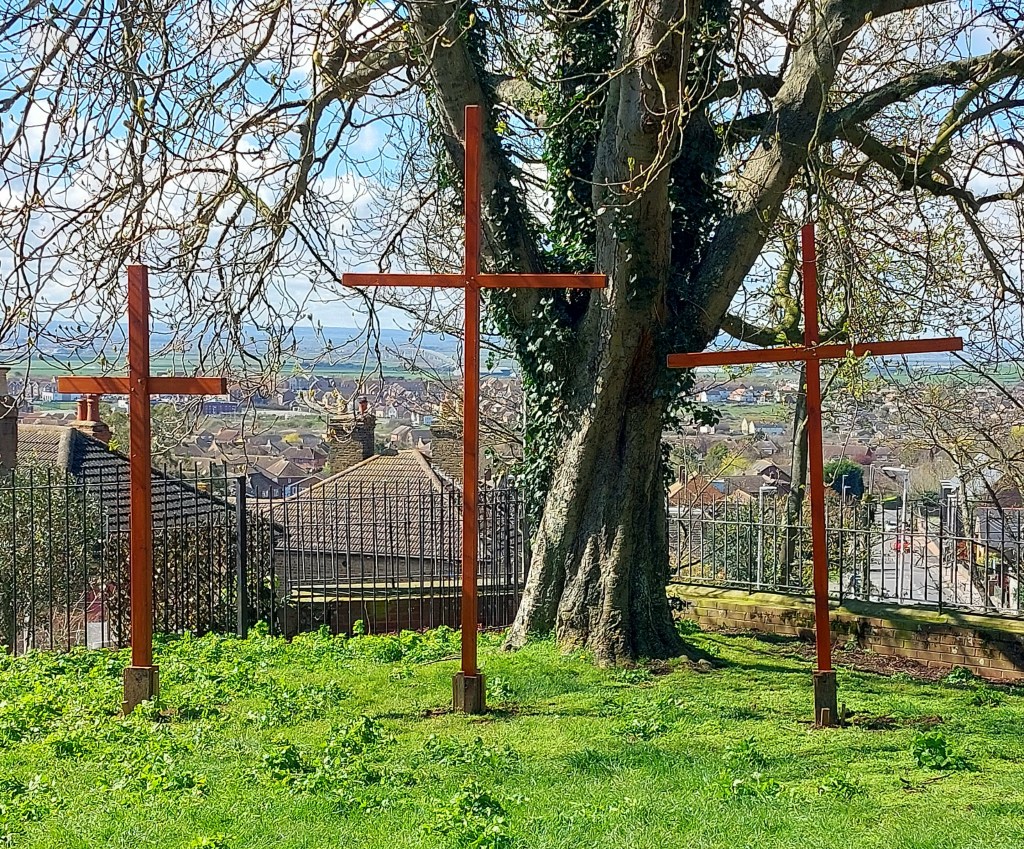
Three crosses

Easter Spoilers

Talk from 26th March (John 11:1-45)

Who likes reading spoiler alerts to find out what will happen ahead of the next episode?

Who avoids them like the proverbial plague? Ah okay, you might want to put your hands over your ears then because in some ways this passage from John is a little bit like a trailer or spoiler for two weeks time!

Today we hear about and celebrate the resurrection of Lazarus. In two weeks we hear about and celebrate the resurrection of Jesus.

There are lots of parallels in this story pointing towards what was going to happen. John even mentions at the beginning of this passage an event (Mary anointing Jesus’s feet) which does not occur until after the resurrection of Lazarus.

Jesus was very clear right from the beginning that EVERYTHING He does is for the glory of God. His wisdom and knowledge far exceeds ours.

It was still difficult for Martha and Mary that Jesus did not immediately drop everything and come to them upon hearing that Lazarus was severely ill.

Today’s society tend to want everything immediately. Patience and waiting are hard. Whilst I know that waiting times for ambulances are much longer than ideal at the moment; how many of us have to wait over two days before one leaves to attend to us?

But Jesus knew what He was doing and so He waited. Once the time was right He told the disciples He was going back to Judea. The religious leaders there already wanted Jesus dead and this worried His disciples. Ironically, it is Thomas (later to be known as the doubter) who persuaded the disciples to accompany Jesus even if it meant death.

Jesus is the Light of the World. As He says, if we walk during the day (in the light) we will not stumble because we see (have) the light of the world (Jesus).

Those who walk at night stumble because the Light (Jesus) is not in them.

By the time Jesus arrived, Lazarus had been in the tomb for four days.

Decomposing!

Stinky!

Yuk!

Martha (the sister who in another passage we are told did all the chores whilst Mary sat listening to Jesus) heard Jesus was on His way and came to meet Him.

Martha says “Lord, if you had been here…” Martha knows and believes that Jesus has the power to heal. Is she declaring her faith? Or is she displaying anger that Jesus was not there in time to stop Lazarus dying? Jesus tests her and she proclaims her faith and her belief.

Jesus is the resurrection and the life and He was about to prove it whilst showing, again, through this miracle that Jesus is the Giver of Life and the Saviour. He was also showing His followers a preview of how He would be defeating death.

It is important that we understand the relevance of Lazarus having been in the tomb for four days. Jesus had raised people to life before after all, so we need to know what makes the resurrection of Lazarus so different.

Well, previously when Jesus had raised people from the dead the timescale between their death and resurrection was a great deal shorter.

Jesus needed this miracle to be determinate.

To help us understand let me explain that at that time people believed that a person’s spirit left their body on the third day after their death. On the fourth day there is no doubt. The person is really dead. Not sleeping. Dead Dead!

This was important as it meant there could be no dispute over the fact that Lazarus was actually dead before Jesus resurrected him.

Martha went to Mary and told her “The Teacher is here”. Jesus is the Ultimate Teacher. Mary went to Jesus and used the same words as her sister, “Lord, if you had been here …” Mary and the Jews with her wept. Jesus wept. But, Jesus was not mourning Lazarus. Jesus knew all along that He would be raising Lazarus from the dead. Jesus wept for those who did not understand. He wept for those who had lost hope. He wept at the sight of the very suffering He came to save us from. Through Jesus believers are to grieve with hope.

Jesus went to the tomb, He called for the stone to be moved away. The stench of death was all around. Jesus prayed. He did everything with prayer. He knows God always hears Him and thanks God for this. But He also needed the crowd to see that God had sent Him and that He was acting with God’s authority.

Jesus called out in a loud voice “Lazarus, come out!” Jesus has compassion for each one of us and calls us by name.

Lazarus came out still bound in the burial cloths BUT no longer a rotting corpse. Instead he was fully and completely healed. Jesus told the crowd to unbind Lazarus and they helped free him.

Lazarus, a new creation, freed from the tomb and welcomed back to life.

Jesus died to defeat sin and death, the Ultimate Sacrifice and our Saviour is raised from the grave so we can be forgiven and reconciled with God.

Not only that but Jesus came to have a relationship with EVERYONE, not just the Jews.

So how does that affect us. Basically, we cannot experience the resurrection unless we experience death. By this I mean that we cannot accept new life in Christ, if we do not allow our old, sinful lives to die.

We need to let go of whatever is holding us back, whatever is stopping us from being a new creation in Christ.

Let us hear Jesus calling us by name, let us say goodbye to what is holding us back, let us leave the tomb and walk in the light of Jesus.

And more than that, as we are told in Romans; by believing and having faith in Jesus, what He has done, is doing and will do, we are able to take part in bringing glory to God in all we do.

Let us give Him the glory, great things He hath done.

Stone Cave

Amen

Recently I was watching some of the programmes showing compilations of Paul McCartney performing and the following quote was put up on screen:

“I’m not particularly religious, but I do believe in the idea that there is some sort of higher power that can help us,” says McCartney. “So, this song becomes a prayer, or mini – prayer. And the word ‘Amen’ itself means ‘so be it’ – or ‘let it be'”

Paul McCartney speaking about his song “Let It Be”

This got me thinking about the word ‘Amen’ and all the different ways we use it. For me, the main use of ‘Amen’ is to conclude a prayer or as a response to a prayer but having started to think about the word and its other uses I looked at this word in more depth.

So, next came the English definitions of the word (just because that is the language I speak – no other reason) and these were listed as:

  • let it be
  • verily
  • truly
  • it is true
  • let it be so

The word is thought to be of Biblical Hebrew origin and appears many times in the Hebrew Bible as a confirmatory response and especially following blessings.

However, its root word is now common to a number of languages with the meaning:

  • to be firm
  • confirmed
  • reliable
  • dependable
  • to have faith
  • to believe

Having been imported into Greek from the Judaism of the Early Church, the word ‘Amen’ continued to spread becoming part of many other European languages, thence to Latin and then English. It can also be found in Arabic translations of the Bible and also other texts, for example after recitation of the Quran.

Sometimes ‘Amen’ is translated from the Hebrew word as ‘so be it’.

The phrase “Amen to that” can seem quite familiar but what do we actually mean when we say that. We use this to express strong agreement with something, as a declaration of affirmation, to say “that’s sorted then”. We also use it in the same way we might say “fine” or “just leave it there”.

I mentioned earlier about it being a concluding word in, or a response word to, prayer. Jesus’s response when asked to teach us how to pray was “The Lord’s Prayer” in which is included the line “Your will be done”. He teaches us to recognise and acknowledge God’s will. He teaches us (as He prayed at Gethsemane) “yet not my will but Yours”. How apt then that Amen also means “your will be done”. So when we pray we are confirming that whilst we ask God, we acknowledge that He can see the big picture that we cannot and He knows what is best even if we cannot see it at the time and therefore we are praying “if it is your will let it be done”.

As such, “Amen” is a prayer all by itself. If you are ever stuck and thinking that you don’t know what to pray, don’t worry, God knows what is in your heart. A sincere Amen is sufficient.

Poppet helping me work.

Be Born Again

(John 3:1-17)

Nicodemus was a pharisee well educated and well versed in the scriptures. He recognised and acknowledged that Jesus was from God and that God was with him. Yet he came to see Jesus at night, being at the beginning of his belief in Jesus, not wanting his fellow pharisees to know that he had sought out Jesus.

Later, once Nicodemus’s faith and believe had grown he defended Jesus in front of the council and annointed Jesus’s body after the crucifixion.

Jesus responded to Nicodemus’s greeting  by starting to teach him how the Kingdom of Heaven can be reached. As is a common factor in conversations today, we are given the impression that Nicodemus has taken Jesus’s answer literally. Nicodemus is an intelligent man and some question whether he was merely stalling for time. However, whether he took Jesus’s answer literally or whether he was questioning it to allow him time to think, it is beneficial to us because this questioning opened up a further response from Jesus and the conversation that followed.

What does lend credence to the idea that Nicodemus was stalling for thinking time is that the Jews were not unfamiliar with the idea of rebirth and considered those converted to Judaism to have been reborn – just as we take those who have turned to Christ to have been reborn in Christ. As usual, like with the parables, Jesus was using metaphors and terminology the Jews were very familiar with.

So, being born again does not, thankfully, mean that Mothers are giving birth to the same person twice. In fact the actual rebirth is not even done by us but by God. What we must do is believe, believe and be baptised in water and in the Holy Spirit. We must receive the gift of the Holy Spirit and, with Jesus as our root, let it be fruitful so that we live with love, joy, patience, kindness, goodness, faithfulness, gentleness and self control.

Aptly, this reading this year fell on Trinity Sunday when we celebrate that God is Three in One – the Father (Presence of God), the Son (Voice of God) and the Holy Spirit (Breath of God). As we who believe are born of man, water and the Spirit. Three in One and One in Three.